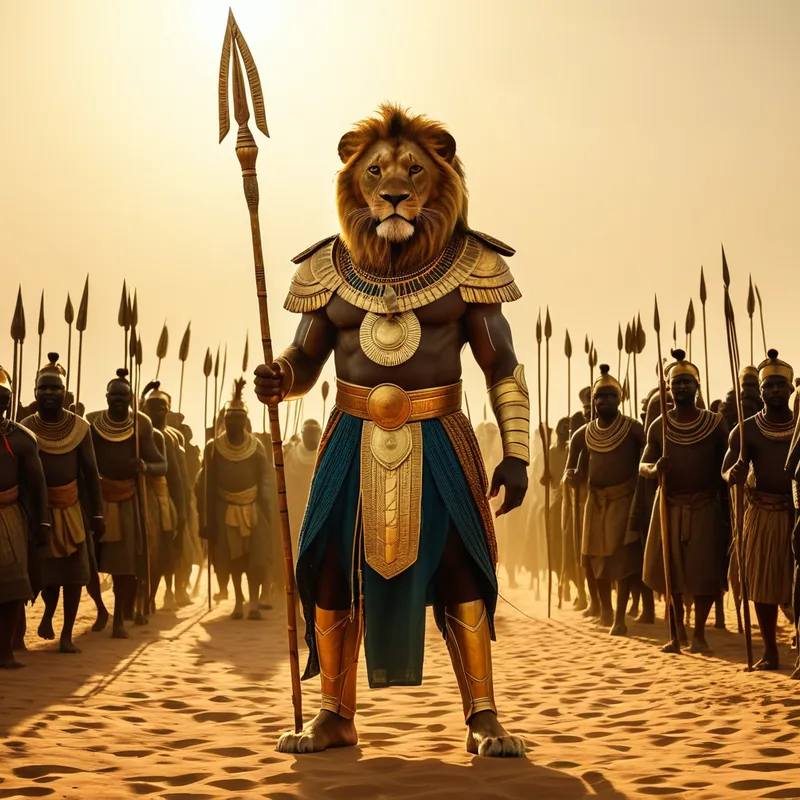
Sundiata the Lion King Myth Meaning & Symbolism
The epic of a prophesied, disabled prince who overcomes exile to reclaim his kingdom, embodying the union of cosmic order and earthly power.
The Tale of Sundiata the Lion King
Listen, and let the breath of the savannah carry you back. Before the empires of song and gold, there was a prophecy, whispered by the soothsayers to the king of Niani. A great lion would be born, they said. A king to unite all the lands of the Mande. And so it was that Maghan Kon Fatta married the woman of the prophecy, the beautiful and mysterious Sogolon Kedjou. From their union came a son, Sundiata.
But the child was not a roaring cub. He was born frail, unable to walk, crawling in the dust of the royal compound while his half-brothers mocked him. The air in Niani grew thick with doubt and scorn. The king died, and the throne was usurped by the cruel sorcerer-king Soumaoro Kanté, who wore a cloak of human skin and whose fortress at Sosso seemed unassailable. Sundiata, with his grieving mother Sogolon, was cast out into exile. They wandered from kingdom to kingdom, shadows where once they were royalty, tasting the bitter herbs of humility and survival.
Yet, in the crucible of exile, the iron within the boy began to stir. One day, driven by a final, desperate insult to his mother, a mighty surge of will moved through his limbs. Grasping a massive iron bar, Sundiata heaved himself upright. The earth trembled. The baobab tree, whose branches he pulled upon, bent to his strength. He stood—a man, tall and imposing. The lion had found his legs.
His journey became a gathering. To him came the outcast prince, the skilled hunter, the loyal bard. They were drawn by the gravity of his unfolding destiny. To defeat Soumaoro, whose magic made him invulnerable to weapons, Sundiata needed a secret. It was revealed that only the spur of a white rooster could pierce the sorcerer’s power. In a final, cataclysmic battle at Kirina, the armies of light and tyranny clashed. Sundiata, guided by fate, loosed the sacred spur. It found its mark. Soumaoro’s power shattered, and he vanished from the world of men.
Sundiata returned to Niani not as a crawling prince, but as a walking Mansa. He established the Mali Empire, forging a kingdom of justice, law, and prosperity from the chaos. The hunter became the shepherd, the exiled lion the rightful king, and his words became the Kurukan Fuga, the charter of a new and harmonious world.
Cultural Origins & Context
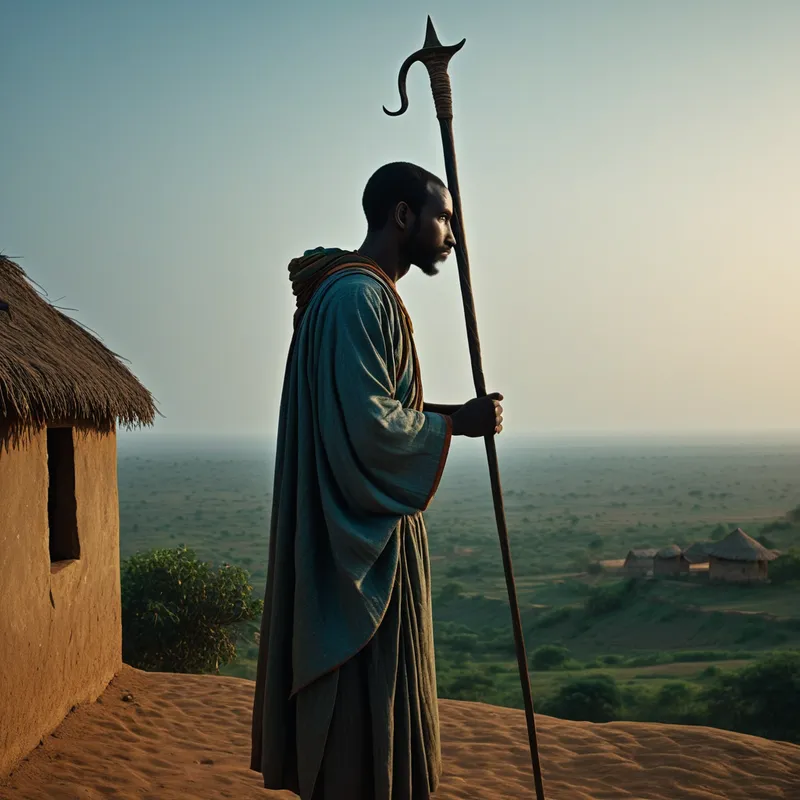
This epic is the foundational national narrative of the Mandinka people and the Mali Empire, which flourished from the 13th to the 16th century. It is not a text, but a living river of sound and memory, carried for centuries by a specialized caste of oral historians and poets known as jeliw (or griots). Their recitation, accompanied by the kora, was not mere entertainment; it was the preservation of law, genealogy, ethics, and collective identity.
The epic of Sundiata served a vital societal function: it legitimized the ruling dynasty, encoded social values like hospitality, patience, and loyalty, and provided a cosmological blueprint for the relationship between the ruler, the people, and the natural world. It is a historical myth, blending the memory of a real figure, Sundiata Keita, with archetypal patterns of the hero’s journey, making history itself a sacred, instructive story.
Symbolic Architecture
At its heart, the myth is an elaborate map of individuation—the process of becoming who one is destined to be. Sundiata’s physical lameness is not a mere disability; it is the visible sign of a destiny too great for a conventional path. His condition represents the latent, unintegrated Self, constrained by circumstance and the projections of others (his jealous stepmother, the mocking court).
The true king is not born on the throne, but in the long, humbling road away from it. Exile is the forge where the soul’s iron is tempered.
His mother, Sogolon, is the crucial animating principle. She is the vessel of the prophecy and his protector in exile, representing the necessary, sustaining connection to the deep, instinctual world that must accompany the heroic ego. Soumaoro Kanté is not just a villain, but the embodiment of the uninitiated, tyrannical shadow—raw, chaotic power without wisdom or justice, a necessary force to be confronted and integrated for order to be established. Sundiata’s victory is not the destruction of power, but its redemption under the guiding principle of rightful order and law.
The Dreamer’s Resonance
When this myth stirs in the modern psyche, it often manifests in dreams of profound limitation or hidden strength. You may dream of being paralyzed in a crucial moment, or of possessing a secret, majestic identity unknown to those around you. The somatic sensation is often one of a “sinking stomach” of powerlessness, coupled with a strange, undeniable pull toward a distant, almost forgotten “homeland”—a calling to one’s authentic life.
This is the psyche working through its own “exile phase.” The dreamer is being made aware of the gap between their current, constrained condition and their latent potential. The figure of the limping lion or the ignored, yet central, child in a dream may signal that a core aspect of the Self is disabled, awaiting the catalytic moment of will (the iron rod) to stand upright and begin the journey back to wholeness.

Alchemical Translation
The alchemy of Sundiata’s story is a masterclass in psychic transmutation. It begins with the nigredo: the humiliation, the exile, the crawling in the dust. This is the necessary dissolution of the old, false identity—the prince who never was. The long journey is the albedo, a purification through hardship and the gathering of one’s inner “company” (skills, virtues, allies).
The moment of standing is the citrinitas, the first golden dawn of the integrated will. Finally, the confrontation with Soumaoro and the establishment of the empire is the rubedo. Here, the hero does not merely defeat the shadow but uses its own secret (the rooster’s spur) to transform it, establishing a new, conscious order—the Philosopher’s Stone of the mature personality.
Individuation is not about becoming perfect, but about becoming whole. It is the crippled child accepting the prophecy, the exiled wanderer claiming the throne, and the lion learning to walk the path of a man.
For the modern individual, this myth instructs us that our deepest wounds and humiliations are often the precise coordinates of our destiny. The path to power is not over the mountain of achievement, but through the valley of acceptance—of our flaws, our exile, and the slow, deliberate work of gathering our scattered strengths to stand, at last, in our true form.
Associated Symbols
Explore related symbols from the CaleaDream lexicon:
- Lion — The core symbol of Sundiata’s destined kingship and latent, majestic power, representing the awakened Self that integrates strength with rightful authority.
- Journey — The essential structure of the myth, representing the exile and return that is necessary for transformation, moving from a state of lack to a state of wholeness.
- Destiny — The prophetic force that guides Sundiata from birth, suggesting that our truest life follows a pattern deeper than personal ambition or accident.
- Mother — Embodied by Sogolon, representing the nurturing, protective, and instinctual force that sustains the hero through the vulnerable period of incubation and exile.
- Shadow — Manifest as the sorcerer-king Soumaoro, representing the tyrannical, unintegrated aspects of power and the psyche that must be confronted and transformed.
- Order — The ultimate goal of Sundiata’s quest, represented by the Kurukan Fuga charter, symbolizing the harmonious inner constitution established after chaos is integrated.
- Hero — The archetypal pattern Sundiata fulfills, one who leaves the known world, faces ultimate trials, and returns with a boon to restore balance to their community.
- Mountain — Symbolic of the great obstacle (Soumaoro’s fortress) and the lofty, achieved state of kingship and enlightened rule that Sundiata attains.
- Tree — Often the baobab, representing stability, memory, and the support Sundiata draws from his lineage and the natural world during his pivotal act of standing.
- Key — The secret of the white rooster’s spur, representing the precise, often humble or overlooked insight required to unlock an impossible problem and defeat a tyrant.
- Crown — The rightful authority claimed not by birthright alone, but earned through the transformative trials of exile, struggle, and the integration of shadow.
- Fate — The inescapable thread woven by the soothsayers’ prophecy, guiding events toward a pre-ordained conclusion of restoration and cosmic balance.