Sulfur Principle Myth Meaning & Symbolism
The volatile divine fire, fractured in creation, must descend into darkness to be purified and reunited, forging the philosopher's gold of the integrated self.
The Tale of Sulfur Principle
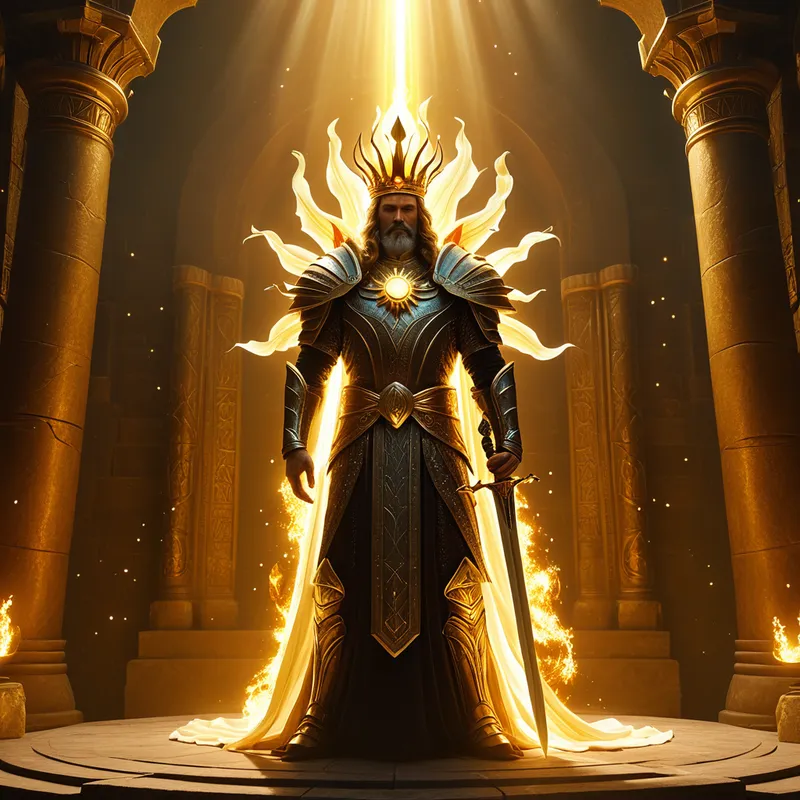
In the beginning, before the alembic of the world was sealed, there was a fire that was not of any hearth. It was the Sulfur, the Solar King, a being of pure, radiant, and volatile will. He dwelt in the highest realm, a palace of unending noon, where thought was instant act and desire was immediate fulfillment. His light was consciousness itself, brilliant and untamed.
But the great work demanded a world. The Chaos, a dark, moist, and boundless womb, lay dreaming below. To bring forth form, the King, in an act of supreme creative passion, drew his sword of intent and struck not at an enemy, but at his own glorious heart. A shard of his essential fire, a spark of his sovereign self, was sheared away and fell.
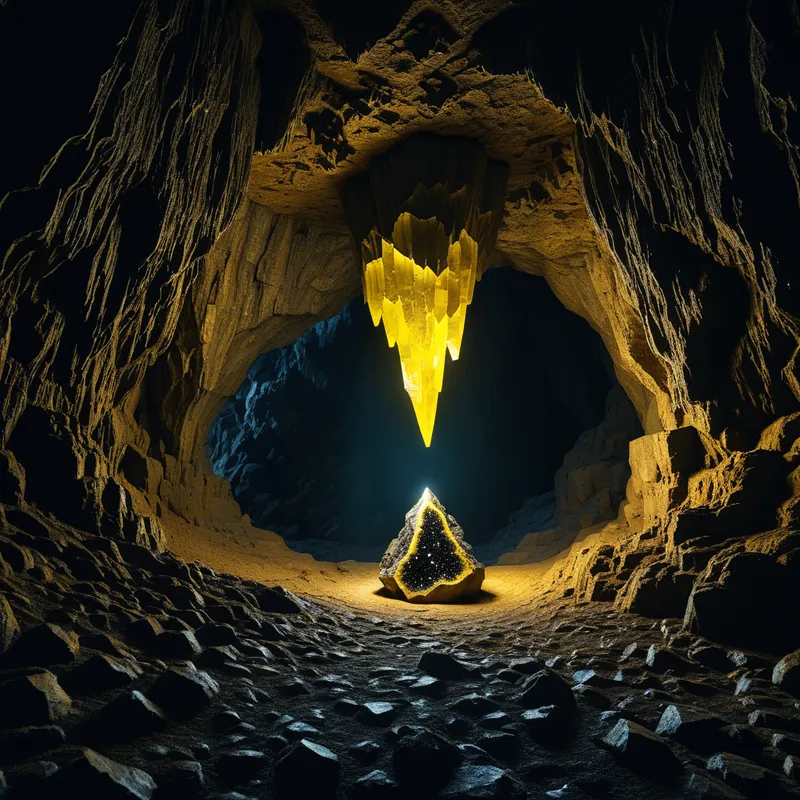
It fell not as a meteor, but as a seed of light, plummeting through the realms of fixed stars and wandering planets, through the sphere of silver reflection, down into the utter blackness of the Earthly Prison. There, in the deepest mine, the coldest clay, and the most stagnant water, the fiery shard was captured. It was encased in the Salt of the earth, bound in leaden chains of matter. The King above was wounded, his light dimmed, reigning over a perfect but sterile kingdom. The spark below was imprisoned, a frantic, golden pulse in the pitch, burning with all the memory of the sun and the agony of separation.
This is the divine fracture. The One became Two: the King in his castle of air and fire, and the Captive Sun in the dungeon of earth and water. The world between them—the realm of life, of growth, of decay—was born from this schism, a longing made manifest.
For ages uncounted, the myth whispers, the Captive Sun raged. Its heat sought escape, creating volcanoes and geysers. Its light, desperate, tried to gleam through crystals and metals. It was the soul trapped in the body, the spirit buried in habit, the divine will shackled by circumstance. It was potent, masculine, and utterly bound.
Then, a whisper moved through the elements. It was the Mercury, the androgynous messenger, the quicksilver spirit. It descended from the between-places, a shimmering veil of possibility. It did not go to the lofty King, nor directly to the raging Captive. Instead, it began to stir the very prison. With subtle, coaxing touch, it loosened the bonds of Salt. It invited the Captive’s fire to not just rage, but to cook, to refine, to soften its own prison.
This was the beginning of the solve—the dissolution. The proud, isolated fire had to learn the nature of its cage. It had to burn not against the earth, but within it, to learn patience from the stone and fluidity from the hidden waters. Its brilliant, singular yellowness dimmed, tarnished, becoming a dirty, chaotic green—the sign of the Nigredo. The Captive Sun was not dying; it was being humbled, forced into a marriage with all it had despised.
And from this dark union, guided by the sly Mercury, a new light was kindled. Not the arrogant blaze of the fallen shard, but a gentle, pervasive, white glow—the Albedo. This was the distilled essence, the spirit now informed by matter. This white light began to rise. It ascended, a silent, luminous vapor, drawn upward by a memory it could not name.
Back in the high palace, the Solar King felt a warmth on his throne of gold. He looked down, not with the gaze of a ruler, but with the longing of a bereaved half. He saw the column of white light rising toward him. In that moment, his own brilliant, static light softened. He descended from his dais, step by step, lowering his crown.
They met in the middle realm, where spirit becomes form and form aspires to spirit. The white, ascending vapor and the golden, descending King flowed into one another. There was no conquest, only recognition. In a flash of silent, all-consuming rubedo—the crimson dawn of completion—they were One. The fracture was healed. What remained was not the old King, nor the freed prisoner, but the Philosopher’s Stone, a being of radiant, stable, and compassionate gold, containing both the heights and the depths, forever whole.
Cultural Origins & Context
The myth of the Sulfur Principle is not a single story from a single tome, but the underlying narrative skeleton of the entire Western alchemical tradition, spanning from Hellenistic Egypt through the Islamic Golden Age to the Renaissance laboratories of Europe. It was never a “public” myth for the masses, but an esoteric, operative allegory passed down in encrypted manuscripts, cryptic emblems, and oral instruction within initiatory circles.
Its tellers were the Adepts and Philosophi, who wrote under pseudonyms like Basil Valentine or Hermes Trismegistus. The myth was encoded in their practical laboratory instructions for a reason: to protect it from literalism and to ensure that only those who were themselves undergoing the inner struggle—the opus—could decipher its true meaning. Its societal function was subversive and introverted. In a world dominated by external religious dogma and rigid social hierarchies, alchemy provided a clandestine framework for a direct, personal experience of the divine through the transformation of the self and the substance of the soul. The furnace was the heart, and the myth of Sulfur was its sacred scripture.
Symbolic Architecture
At its core, the myth maps the psyche’s journey from a state of primal unity, through necessary fragmentation, to a hard-won, superior integration. The Sulfur is the archetypal symbol of the active principle: our will, our ego-consciousness, our driving passion, and our sense of individual identity. It is the “I am” force.
The fall of the Sulfur is not a punishment, but the price of incarnation. To become something specific, the infinite must accept limitation.
The initial state of the Solar King represents an immature, inflated consciousness—a spirit that believes itself to be whole and sovereign, yet is disconnected from the dark, moist, unconscious depths (the Chaos and Salt). The “creative act” of striking his own heart is the necessary hubris of the ego entering the world, a act that simultaneously creates life and wounds the spirit. The Captive Sun is that same ego and will, now buried in the complexities, traumas, and instincts of embodied existence—the Shadow. The entire middle passage of the myth, the descent into the Nigredo, symbolizes the ego’s painful but essential confrontation with all it has rejected, repressed, or deemed inferior within itself.

The Dreamer’s Resonance
When this myth stirs in the modern unconscious, it manifests in dreams of fiery imprisonment and luminous ascension. You may dream of a brilliant, precious gem or a child of light trapped in a basement, a safe, or a block of ice—something of immense value is bound and inaccessible. Conversely, you may dream of a slow, deliberate climb up a mountain toward a radiant summit, or of a small, stubborn flame that refuses to be extinguished in a downpour.
Somatically, this process feels like a buildup of intense, frustrated energy—a “fire in the belly” with no outlet—that gradually transforms into a deep, cellular warmth. Psychologically, it is the process of recognizing that your most volatile passions, your anger, your ambition, your pride (the Sulfur), are not enemies to be extinguished, but lost kings that have fallen into the dungeons of your neuroses, addictions, or unresolved pain. The dream is the psyche’s depiction of the heroic, yet humbling, labor of descending into that darkness not to fight the fire, but to free it and learn its true name.

Alchemical Translation
The myth of Sulfur provides the master blueprint for psychic transmutation, or what Jung termed individuation. It models the move from a one-sided, conscious attitude (the isolated King) toward wholeness by integrating the rejected, unconscious counterpart (the Captive Sun).
The first step is Recognizing the Fracture: feeling the innate discontent of a life lived only in the “high palace” of intellect, persona, or spiritual bypassing, while a vital part of you screams in a dungeon of unmet emotion or instinct.
The crucial, active phase is the Descent and Coagula: voluntarily engaging with your own “base matter”—your shadow, your body, your trauma, your earthy human needs. This is where the proud Sulfur of your will must submit to being cooked in the vessel of your own life. It is not about brute force, but the sustained, heated attention of introspection and feeling.
The Stone is not found; it is grown from the marriage of the kingly light above and the imprisoned light below, mediated by the breath of awareness.
Finally, the Conjunctio: the sacred marriage. This is the moment when the refined essence of your life experience (the white light rising) meets and transforms your original conscious attitude (the descending King). The result is the Philosopher’s Stone—not a perfect being, but an integrated Self. Your will (Sulfur) is no longer volatile and tyrannical, but fixed and compassionate, informed by the wisdom of the depths. You become a vessel that can hold the tension of opposites, transforming base leaden moments into the gold of meaning. The myth concludes not with an ending, but with the beginning of a new mode of being: radiant, stable, and whole.
Associated Symbols
Explore related symbols from the CaleaDream lexicon: