Sulayman's Ring Myth Meaning & Symbolism
A prophet-king loses his ring of power to a cunning jinn, plunging his kingdom into chaos, until a humble act of repentance restores divine order.
The Tale of Sulayman’s Ring
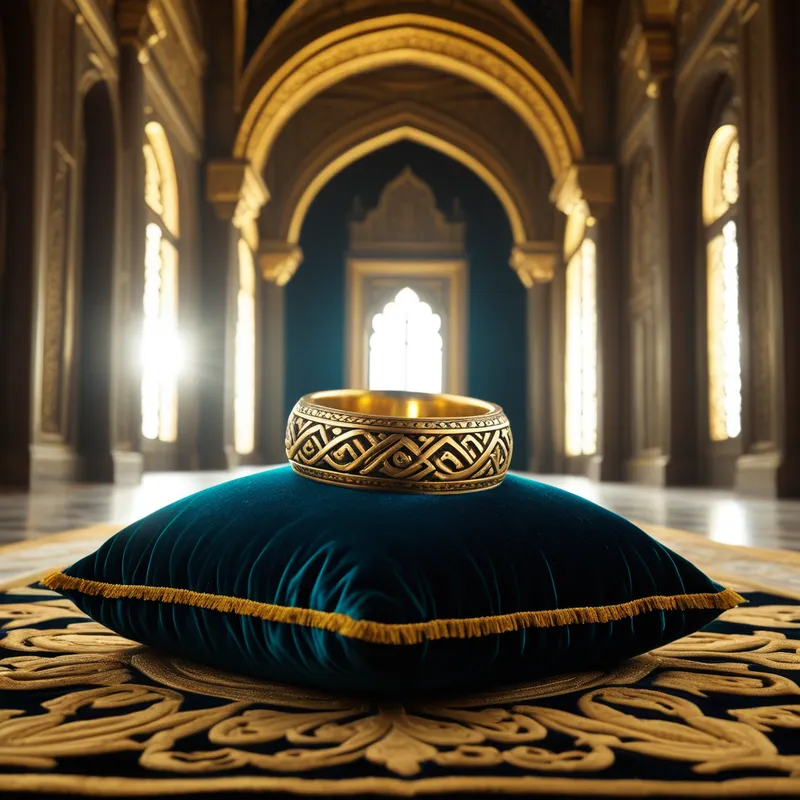
Hear now the tale of the Seal, the Ring that bound the worlds. In an age when the wind carried whispers of jinn and the very stones knew the name of God, there reigned a king unlike any other. He was Sulayman, son of Dawud, upon them be peace. To him was given a dominion that stretched from the deepest earth to the highest sky. His command was not just over men, but over the jinn, the winds, and the beasts of the field. And the source of this awesome sovereignty was a single artifact: a ring. Upon its bezel was engraved the Greatest Name of God, the Ism al-A’zam. This was no mere jewel; it was the Seal of the Cosmos, the key that turned the lock of reality.
Sulayman wore it always, a band of light upon his finger. With it, he built temples that scraped the clouds, commanded legions of jinn to mine the earth’s secrets, and understood the speech of the ants and the birds. His kingdom was a perfect symphony of order, a testament to divine favor. But power, even divinely bestowed, casts a long shadow. Among the jinn was one named Sakhr, a creature of cunning and immense ambition, who chafed under the king’s rule. He watched, he waited, for a single moment of human vulnerability.
It came. Each day, Sulayman would remove the ring to perform his ablutions, entrusting it to one of his most loyal wives, Amina. He did this with solemn ritual, for the ring was his very soul made manifest. Sakhr saw his chance. Using his shape-shifting arts, he took the form of Sulayman—every line of his face, every fold of his royal robe—and approached Amina. “The ring, my beloved,” the false king said, his voice a perfect mirror. Trusting, she handed over the Seal.
In that instant, the world shuddered. The real Sulayman emerged from the water to find his power gone, his connection to the unseen severed. Sakhr, now wearing the ring, ascended the throne. The court, the armies, even the animals bowed to the impostor, for the ring’s authority was absolute. The true king was cast out, a stranger in his own palace, his protests sounding like the ravings of a madman. For forty days—some say forty years—Sakhr ruled, his reign a distortion of Sulayman’s justice, a carnival of subtle cruelties masked by the ring’s blinding light.
Meanwhile, the deposed king wandered the earth, a beggar in spirit and in form. He who had commanded the winds now begged for crusts of bread. He who had conversed with eagles now sat in silence with the outcasts. In this utter stripping away, in the humbling dust, something purer began to stir. His prayers were no longer commands, but supplications; his heart, no longer a throne room, became a simple altar.
The turning point came at the edge of the world, on a desolate shore. Having found work as a fisherman, Sulayman caught a single, radiant fish. As he cut it open to prepare his meager meal, a glint of metal flashed from its belly. There, slick with brine and blood, was his ring. The sea itself, in its vast, unknowable wisdom, had returned what was lost. He placed it upon his finger.
Power flooded back, but it was a different power now, tempered by ash and salt. He returned to his kingdom. The moment he crossed the threshold, Sakhr, who sat upon the throne, let out a shriek that cracked the marble. The ring’s magic rejected the usurper, and he fled, vanishing like smoke. Order was restored, but it was an order deepened by the knowledge of chaos, a sovereignty informed by exile. Sulayman ruled again, but now he ruled with the wisdom of the one who had been ruled, his justice softened by the memory of powerlessness.

Cultural Origins & Context
The story of Sulayman’s Ring is not found in the Quran’s canonical narrative of Prophet Solomon (Sulayman). Rather, it is a rich narrative embroidery from the vast tapestry of Isra’iliyyat—tales and lore from Jewish and Christian traditions that were absorbed and reimagined within Islamic culture, particularly in exegesis (tafsir) and popular storytelling. It flourished in works like al-Tabari’s History of the Prophets and Kings and the seminal Qisas al-Anbiya (Stories of the Prophets).
Told by preachers in mosques, scholars in madrasas, and storytellers in market squares, the myth served multiple societal functions. On one level, it was a theodicy, explaining why a divinely appointed prophet-king could suffer such a profound fall: a test of faith and a lesson in the fragility of worldly power, even for the most righteous. It reinforced core Islamic values of trust in God (tawakkul) and the importance of repentance (tawbah). On another, it was a thrilling cosmic drama that illustrated the constant, unseen struggle between divine order and chaotic forces, embodied by the cunning jinn. It made the abstract concept of prophetic infallibility (ismah) relatable by exploring a moment of profound vulnerability, not through sin, but through a lapse in vigilance.
Symbolic Architecture
At its heart, the ring is the symbol of integrated ego-Self sovereignty. It is not merely political power, but the psychic wholeness that allows a person to rightly order their inner and outer worlds—to command their inner “jinn” of passion, thought, and impulse.
The ring is the conscious covenant between the individual soul and the divine center. To lose it is not to lose God’s favor, but to lose conscious connection to it.
Sakhr, the shape-shifting jinn, represents the Shadow in its most potent and autonomous form. He is the latent, cunning intelligence within the psyche that covets the throne of consciousness. He does not destroy the ring; he mimics its function, creating a false, hollow sovereignty based on deception and raw will. The forty days of exile are the necessary nekyia, the descent into the underworld of the soul where all identifying marks of the persona are stripped away. The fish that returns the ring is a classic symbol of the unconscious delivering up a lost treasure, but only after the ego has been sufficiently humbled and made ready to receive it anew.
The Dreamer’s Resonance
When this myth stirs in the modern dreamer, it often signals a profound crisis of identity and authority. One may dream of losing a precious heirloom, a key, or a piece of identification; of being impersonated at work or in a relationship; or of sitting powerless while a doppelgänger lives their life. The somatic feeling is one of gut-wrenching disconnection, a silent scream in a world that no longer recognizes you.
This is the psyche’s enactment of a nigredo experience. The conscious attitude—the “ring” of one’s professional title, social role, or self-image—has been usurped by an unconscious complex (the Sakhr). The dreamer is in exile, forced to wander the barren landscapes of depression, anxiety, or meaninglessness. The dream is not a prophecy of doom, but a diagnostic map. It shows the ego that its former seat of power was perhaps too rigid, too identified with the symbol itself, and not with the sacred source it represents. The longing for the ring in the dream is the soul’s longing for re-integration on a more authentic level.
Alchemical Translation
The myth of Sulayman’s Ring is a perfect allegory for the alchemical process of individuation, specifically the stages of calcinatio (burning to ash), solutio (dissolution in water), and coagulatio (re-solidification).
First, the proud, ruling consciousness (Sulayman in his glory) undergoes a calcinatio—it is burned out of its palace, reduced to the ash of a beggar. All inflation is scorched away. Then comes the solutio: the long wandering, the immersion in the waters of the unknown, the life of a fisherman dependent on the deep, unconscious sea. This is not an active quest, but a passive, necessary suffering that washes away the last residues of egoic attachment.
The treasure is never found by seeking; it is returned by the deep when the seeker has become the finder.
Finally, in the belly of the fish—the vas or vessel of the unconscious—the lapis, the philosopher’s stone (the ring), is produced. This is the coagulatio, the re-formation of the personality. The ring is regained, but the king who wears it is new. He has integrated the shadow (he knows Sakhr exists), he has known powerlessness, and his sovereignty is now rooted in humility and a direct, tested relationship with the Self (the Ism al-A’zam). The kingdom is restored, but it is a kingdom transformed from within. The modern individual undergoing this process moves from being a ruler over their life to being a sovereign in their life, their authority emanating from a center that has been lost, mourned, and miraculously rediscovered.
Associated Symbols
Explore related symbols from the CaleaDream lexicon:
- Ring of Power — The central artifact of the myth, representing divine authority, psychic wholeness, and the covenant between the individual soul and the ultimate source of order.
- Key — A direct parallel to the ring as the instrument that unlocks command over the inner and outer worlds; losing it signifies being locked out of one’s own potential.
- Shadow — Embodied by Sakhr the jinn, it represents the autonomous, cunning, and power-coveting parts of the unconscious that seek to control the seat of consciousness.
- Fish — The creature of the deep unconscious that miraculously returns the lost treasure, symbolizing the psyche’s self-healing capacity and the delivery of insight from the depths.
- Ocean — Represents the vast, unknown realm of the unconscious where the exiled ego wanders and where the transformative process of dissolution (solutio) takes place.
- Throne — The symbol of conscious identity and worldly authority; its usurpation marks the ego’s dethronement and the beginning of the transformative crisis.
- Circle — The primal shape of the ring, representing wholeness, completion, the cycle of loss and return, and the eternal nature of the Self.
- Journey — Sulayman’s exile is the essential, humbling pilgrimage away from false sovereignty that makes the recovery of true sovereignty possible.
- Order — The state of psychic and cosmic harmony the ring creates and represents, which is disrupted by chaos and ultimately restored on a firmer foundation.
- Mask — Worn by Sakhr to impersonate the king, it symbolizes the false persona that seizes control when the authentic self is in exile.
- Grief — The necessary emotional landscape of the exile, the mourning for a lost identity that clears the space for a new one to be born.
- Rebirth — The entire narrative arc, culminating in the return of the ring, is a story of the death of an inflated ego and the rebirth of an integrated Self.