Sukkot Myth Meaning & Symbolism
A seven-day pilgrimage of dwelling in fragile booths, remembering the wilderness journey and celebrating the harvest under the shelter of faith.
The Tale of Sukkot
Listen, and remember. The story does not begin in a palace or a temple, but in the vast, whispering throat of the wilderness. The people are not yet a people, but a river of souls flowing through a land of scorpion and stone, of thirst and revelation. They have been freed, but freedom is a formless, terrifying wind. They walk, a nation of refugees, following a pillar of cloud by day and a pillar of fire by night—the visible breath of the Divine Name.
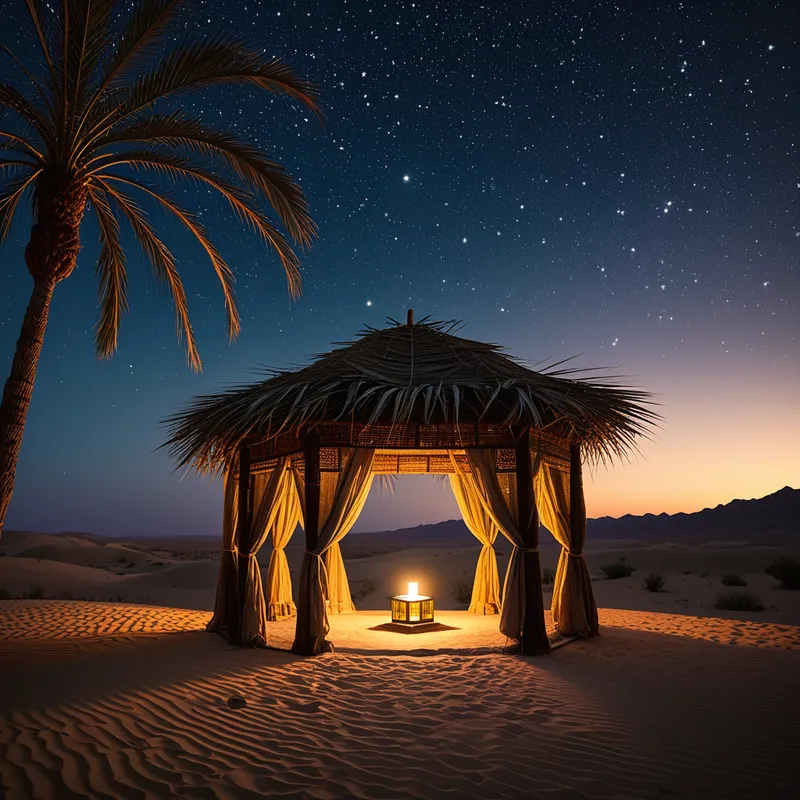
They build no cities. They lay no foundations of granite. Each evening, as the immense desert sky bruises into violet and indigo, they gather what the barren land offers: the fronds of the date palm, the boughs of the myrtle, the branches of the willow. With these, they weave temporary shelters—sukkot—fragile dwellings with roofs open enough to see the stars. The walls shudder in the wind; the roof offers scant protection from the sun’s fury or the night’s chill. Inside, they huddle, not as prisoners, but as pilgrims. They eat the manna, the mysterious bread from heaven that tastes of every longing, and they drink from the rock that followed them.
For forty years, this is their home: a kingdom of booths. It is a life of radical dependency. The shelter is not in the strength of the walls, but in the promise that preceded them. The story whispers that in that wilderness, the Shekhinah, the indwelling, comforting presence of the Divine, spread a canopy of glory over them, a cloud of protection more real than any stone. The sukkah is the memory of that cloud, made physical. It is the house that is not a house, the home that is found only in motion, under the open eye of heaven.
And then, the journey ends. They cross the river into a land flowing with milk and honey. They build houses of cedar and stone. They plant vineyards and fig trees. The harvest comes, a torrent of grapes, olives, and grain. It would be easy to forget. To point to the sturdy walls and the full barns and say, “My power and the strength of my hands have produced this wealth for me.”
Therefore, the command echoes down the generations: You shall live in booths for seven days. When you gather the final harvest, leave your strong house. Go into the garden, the courtyard, the rooftop. Build again the fragile dwelling. Let the roof be sparse. Let the wind enter. Sit in it. Eat in it. Rejoice in it. Remember the wilderness. Remember the cloud. Know that every solid wall is temporary, and every lasting shelter is a gift.
Cultural Origins & Context
Sukkot, also known as the Feast of Tabernacles or Booths, is one of the three major pilgrimage festivals (Shalosh Regalim) mandated in the Torah. Its origins are explicitly agricultural and historical. As an agricultural festival, it marks the final, ingathering harvest of the year, a time of profound thanksgiving for the earth’s bounty. As a historical commemoration, it is a tangible re-enactment of the Israelites’ forty-year sojourn in the desert following the Exodus from Egypt.
The myth was not merely told; it was, and is, performed. The primary storytellers were not bards but every family, every community. The act of constructing the sukkah itself is the narrative. The ritual waving of the lulav and etrog in all six directions symbolizes the omnipresence of the divine in nature and life. Societally, its function was dual: it prevented the amnesia of prosperity by ritually reinstating a state of vulnerability, and it fostered a powerful, collective identity rooted in a shared story of divine guidance and protection through precarious transition.
Symbolic Architecture
At its core, the myth of Sukkot is a masterclass in the symbolism of sacred impermanence. The sukkah is the central symbol—a structure that is deliberately incomplete, its roof (sechach) must be porous to the elements and to the sky.
The most profound shelter is not one that keeps the world out, but one that lets the cosmos in.
Psychologically, the sukkah represents the ego. We spend our lives building strong, permanent-seeming identities—houses of career, reputation, and personality. These are necessary, but the myth insists we periodically deconstruct them, returning to the fragile, authentic self that exists beneath the acquisitions. The wilderness journey represents the liminal space of transformation, the "in-between" where old structures have collapsed and new ones are not yet formed. Dwelling in the sukkah is an act of embracing that liminality willingly, finding security not in rigidity, but in trust and presence.
The four species (arba'ah minim) waved together are a profound symbol of unity-in-diversity, representing different types of people or qualities within the individual (knowledge, action, beauty, and heart) that must be bound together to be complete.
The Dreamer's Resonance
When the pattern of Sukkot appears in modern dreams, it often manifests as dreams of houses with missing walls or roofs, of being exposed yet strangely safe. One might dream of building a shelter from flimsy materials in a storm, or of living comfortably in a glass house. These are somatic signals of a psychological process of vulnerability.
The dreamer is likely navigating a transition where their usual defenses or "strong houses" (a relationship, a job title, a self-concept) are no longer viable or authentic. The psyche is forcing an encounter with impermanence. The anxiety in the dream is the ego’s protest against this exposure. Yet, if the dream carries a tone of awe or quiet joy amidst the fragility, it indicates the nascent emergence of a deeper trust—a connection to an inner Shekhinah or Self that does not rely on external fortifications. It is the soul practicing how to dwell in the temporary booth of a changing life.

Alchemical Translation
The alchemical process modeled by Sukkot is the solve et coagula—dissolve and coagulate—applied to the psyche. The festival’s ritual demands we dissolve our attachment to the permanent, solid "I" (the stone house) and return to the raw, unformed state (the wilderness booth). This is the solve, the breaking down of the persona’s rigid structures.
Individuation is not about building a taller, stronger tower of self, but about learning to dwell peacefully in the beautiful, fragile tent of one's own becoming.
The seven-day dwelling is the liminal, transformative stage. Here, in conscious vulnerability, one is exposed to the elements of the unconscious—the stars (aspirations), the wind (change), the rain (emotion). The ego is not destroyed but humbled, learning to see itself as a guest within the larger mystery of the Self.
The final stage, coagula, is not about returning to the old, solid house. It is about re-entering "normal" life with a transformed consciousness. The harvest celebrated is now internal: the ingathering of insights, the gratitude for the journey itself. The individual has transmuted the lead of existential anxiety into the gold of existential trust. They understand that their true home is not a location or an identity, but a faithful relationship with the moving, guiding presence that travels with them through all wildernesses. They carry the sukkah within.
Associated Symbols
Explore related symbols from the CaleaDream lexicon: