Sukhavati Myth Meaning & Symbolism
The story of Amitabha Buddha's vow to create a realm of bliss, accessible to all who call his name with sincere intent.
The Tale of Sukhavati
Listen. Before time was counted in kalpas, when [the world](/myths/the-world “Myth from Tarot culture.”/) was a sea of suffering under a sky of ash, there lived a king. His name was Dharmakara. He sat upon a throne of power, yet felt only the weight of his crown, a circle of cold metal echoing the endless, turning wheel of birth, aging, sickness, and death that gripped every being in his realm. The cries of his people were not just pleas for bread or [justice](/myths/justice “Myth from Tarot culture.”/), but the deeper, silent wail of existential dread.
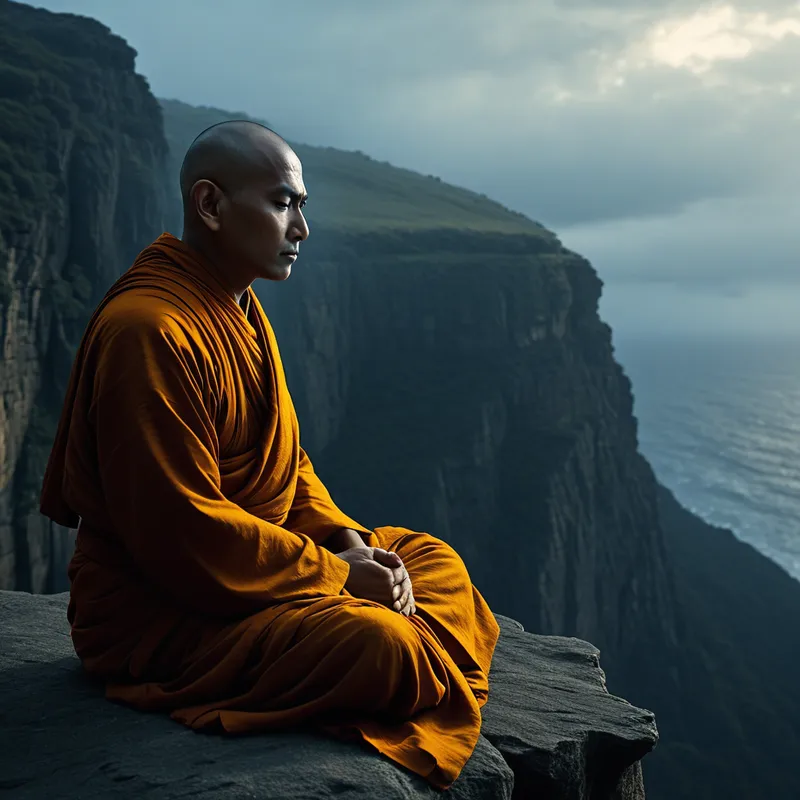
One day, he cast [the crown](/myths/the-crown “Myth from Various culture.”/) aside. The clatter of jewels on stone was the first sound of his true reign. He sought out [the Buddha](/myths/the-buddha “Myth from Buddhist culture.”/) Lokesvararaja, who shone with a light that did not cast shadows but revealed the intricate, luminous connections between all things. Under this gaze, Dharmakara’s royal heart shattered—not into pieces of despair, but into a million shards of fierce, compassionate resolve.
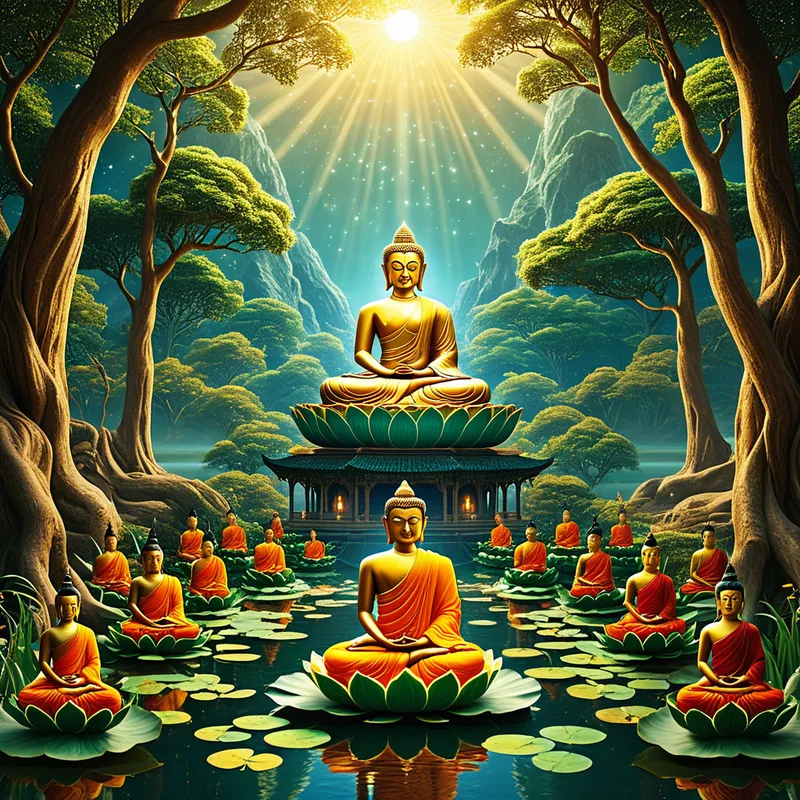
For five long kalpas, he stood before that Buddha and the assembled cosmos. He did not ask for a teaching to hoard for himself. Instead, he began to speak vows. Not one, or ten, but forty-eight profound promises that rolled like thunder from his lips, each one sculpting the architecture of a future world. “May I not attain awakening,” he vowed, his voice steady as mountain root, “if any being, upon hearing my name and wishing to be born in my land, with even a single thought of sincere faith, should fail to achieve it.” He described this land in exquisite, sensory detail: a ground of soft, yielding gold; ponds with waters of eight perfect qualities, their surfaces clear as mind itself; trees of jewels whose leaves rustle with the sounds of the Dharma; no realms of hell, [hungry ghosts](/myths/hungry-ghosts “Myth from Buddhist culture.”/), or animals; no word for “suffering” even known.
The cosmos held its breath. The very air shimmered with the weight of this aspiration. Then, the vows were complete. Dharmakara declared that all these conditions must be fulfilled for his own Buddhahood. He entered into deep meditation, and for countless ages, he cultivated the immeasurable stores of merit and wisdom needed to make his word reality.
And the moment came. The moment of perfect, complete awakening. The monk Dharmakara was no more. In his place sat Amitabha, his body radiating boundless, welcoming light that reaches to the ten directions. And with his awakening, his vows instantly manifested as a real, existent realm: Sukhavati. A pure land born not from cosmic accident, but from a single, sustained, compassionate intention. A paradise where the very environment teaches the Dharma, where beings are born from [lotus](/myths/lotus “Myth from Hindu culture.”/) flowers in a state of bliss, free from all affliction, until they themselves attain perfect enlightenment. The gate, as promised, stands open, invoked by the sincere call of his name.
Cultural Origins & Context
The myth of Sukhavati is central to the Pure Land traditions of Mahayana Buddhism, flourishing most prominently in China, Japan, Korea, and Vietnam. Its primary scriptural sources are the Longer Sukhavativyuha [Sutra](/myths/sutra “Myth from Hindu culture.”/), the Shorter Sukhavativyuha [Sutra](/myths/sutra “Myth from Hindu culture.”/), and the Amitayurdhyana [Sutra](/myths/sutra “Myth from Hindu culture.”/). These texts were likely composed in Northwest India between the 1st century BCE and the 2nd century CE, a period of intense devotional and philosophical development within Buddhism.
The myth was not merely a story for entertainment; it was a functional, societal dharma technology. In times of social upheaval, war, and perceived spiritual decline (conceptualized as the mappo in Japan), the narrative of Sukhavati offered a tangible hope. It democratized the path to liberation. While other Buddhist paths emphasized rigorous self-power (jiriki) through meditation and monastic discipline, the Sukhavati myth presented the complementary path of other-power (tariki)—relying on the grace and accomplished vow of Amitabha. It was told by monks to laypeople, inscribed in art and liturgy, and became a cornerstone of popular piety, offering a vision of salvation that was accessible to all, regardless of social status or scholarly learning.
Symbolic Architecture
Sukhavati is not a geographical [location](/symbols/location “Symbol: The symbol of ‘Location’ signifies a sense of place, context, and the environment in which experiences unfold.”/) to be found on a map, but a profound symbolic [architecture](/symbols/architecture “Symbol: Architecture in dreams often signifies structure, stability, and the framing of personal identity or life’s journey.”/) of the awakened mind and the process of spiritual transformation.
The Pure Land is not a place you go to, but a dimension of consciousness you awaken into—the natural state of reality when the defilements of greed, hatred, and delusion are purified.
Amitabha, the [Buddha](/symbols/buddha “Symbol: The image of Buddha embodies spiritual enlightenment, peace, and a quest for inner truth.”/) of Infinite Light and [Life](/symbols/life “Symbol: The symbol of ‘Life’ represents a journey of growth, interconnectedness, and existential meaning, encompassing both the joys and challenges that define human experience.”/), symbolizes the unconditioned, boundless [nature](/symbols/nature “Symbol: Nature symbolizes growth, connectivity, and the primal forces of existence.”/) of [reality](/symbols/reality “Symbol: Reality signifies the state of existence and perception, often reflecting one’s understanding of truth and life experiences.”/) itself—the luminous, deathless ground of being that is our true [nature](/symbols/nature “Symbol: Nature symbolizes growth, connectivity, and the primal forces of existence.”/). His forty-eight vows represent the complete, structured [expression](/symbols/expression “Symbol: Expression represents the act of conveying thoughts, emotions, and individuality, emphasizing personal communication and creativity.”/) of compassionate [activity](/symbols/activity “Symbol: Activity in dreams often represents the dynamic aspects of life and can indicate movement, progress, and engagement with personal or societal responsibilities.”/) emerging from that ground. Dharmakara’s renunciation is the critical turning point where the personal ego (the [king](/symbols/king “Symbol: A symbol of ultimate authority, leadership, and societal order, often representing the dreamer’s inner power or external control figures.”/)) surrenders its limited project to serve a transpersonal, cosmic [purpose](/symbols/purpose “Symbol: Purpose signifies direction, meaning, and intention in life, often reflecting personal ambitions and core values.”/).
Sukhavati’s [landscape](/symbols/landscape “Symbol: Landscapes in dreams are powerful symbols representing the dreamer’s emotional state, personal journey, and the broader context of life situations.”/) is a [mandala](/symbols/mandala “Symbol: A sacred geometric circle representing wholeness, the cosmos, and the journey toward spiritual integration.”/) of psychic [integration](/symbols/integration “Symbol: The process of unifying disparate parts of the self or experience into a cohesive whole, often representing psychological wholeness or resolution of internal conflict.”/). The jeweled trees and nets represent the interconnectedness and intrinsic value of all phenomena. The ponds of eight perfect waters symbolize the mind purified of the eight worldly concerns (gain/[loss](/symbols/loss “Symbol: Loss often symbolizes change, grief, and transformation in dreams, representing the emotional or psychological detachment from something or someone significant.”/), fame/disgrace, praise/blame, pleasure/pain). Beings born from lotus flowers signify spiritual [rebirth](/symbols/rebirth “Symbol: A profound transformation where old aspects of self or life die, making way for new beginnings, growth, and renewal.”/) emerging from the [muddy waters](/symbols/muddy-waters “Symbol: Muddy waters symbolize confusion, moral ambiguity, and the challenges of navigating through life’s complexities and vices.”/) of samsaric suffering, unstained by it. The constant, ambient teaching of the Dharma by the environment itself points to a state where reality in its every [aspect](/symbols/aspect “Symbol: A distinct feature, quality, or perspective of something, often representing a partial view of a larger whole.”/) is recognized as a [teacher](/symbols/teacher “Symbol: The symbol of the teacher in dreams often represents guidance, wisdom, and the process of learning or self-discovery.”/).
The Dreamer’s Resonance
When the motif of Sukhavati arises in a modern dream, it rarely appears as a literal Buddhist paradise. Instead, it manifests as the [psyche](/myths/psyche “Myth from Greek culture.”/)’s deep yearning for respite, integration, and unconditional acceptance.
One might dream of finding a hidden, perfectly serene room in a chaotic, dilapidated house (the psyche under stress). Or of hearing a clear, resonant sound or name that instantly stills a storm of anxiety. Another common pattern is the vision of a guide or benevolent figure who simply extends a hand, offering passage without demanding immediate understanding or worthiness. Somatic sensations often accompany these dreams: a profound, unexpected feeling of weightlessness, a deep, calming warmth in the chest, or the cessation of a chronic, background psychic “noise.”
These dreams signal a process where [the ego](/myths/the-ego “Myth from Jungian culture.”/), overwhelmed by the burdens of life, trauma, or its own shadow material, is reaching a limit. It is a psychic crisis that opens the door to the experience of “other-power”—the allowing in of grace, the surrender to a healing process larger than the conscious self’s strategies. It is the dream equivalent of the nembutsu (the recitation of Amitabha’s name), a call for help from a deeper layer of the psyche to [the Self](/myths/the-self “Myth from Jungian culture.”/).

Alchemical Translation
The alchemical journey modeled by the Sukhavati myth is one of transmutation through aspiration and receptivity. The modern individual’s “kingdom” is their constructed identity—the ego-complex with its achievements, defenses, and burdens. The “suffering of the people” is the inner turmoil of repressed emotions, complexes, and unmet potentials.
The Renunciation ([Nigredo](/myths/nigredo “Myth from Alchemical culture.”/)): Dharmakara’s casting aside of the crown is the necessary mortificatio—the dark night where one’s old, ruling identity is seen as inadequate for the soul’s deeper purpose. This is often precipitated by crisis: burnout, loss, or the haunting sense of meaninglessness.
The Formulation of the Vow (Albedo): This is the clarifying moment. It is not about listing ego-goals, but formulating a sincere, soul-directed intention. “May my life serve the healing of this wound within me and, by reflection, in others.” This intention becomes the guiding star, the [lapis philosophorum](/myths/lapis-philosophorum “Myth from Alchemical culture.”/) in its raw form.
The Cultivation & Awakening (Citrinitas & [Rubedo](/myths/rubedo “Myth from Alchemical culture.”/)): The long meditation represents the often-tedious, daily work of inner cultivation—therapy, mindfulness, shadow work, creative expression—all fueled by that initial vow. One slowly builds the “merit” (psychological integration) and “wisdom” (insight) needed. The awakening of Amitabha is the rubedo, the culmination: the moment when the center of gravity shifts from the ego to the Self. The individual realizes that the “Pure Land”—a state of integrated, compassionate, and luminous being—was not a distant reward, but the very ground revealed when the obscurations are cleared. The call to Amitabha’s name becomes the practice of constant return to this ground, especially in moments of fragmentation.
The final alchemy is the realization that you are both Dharmakara, making the vow from the midst of suffering, and Amitabha, the boundless awareness that receives and fulfills it. The seeker and the sanctuary are one.
Associated Symbols
Explore related symbols from the CaleaDream lexicon: