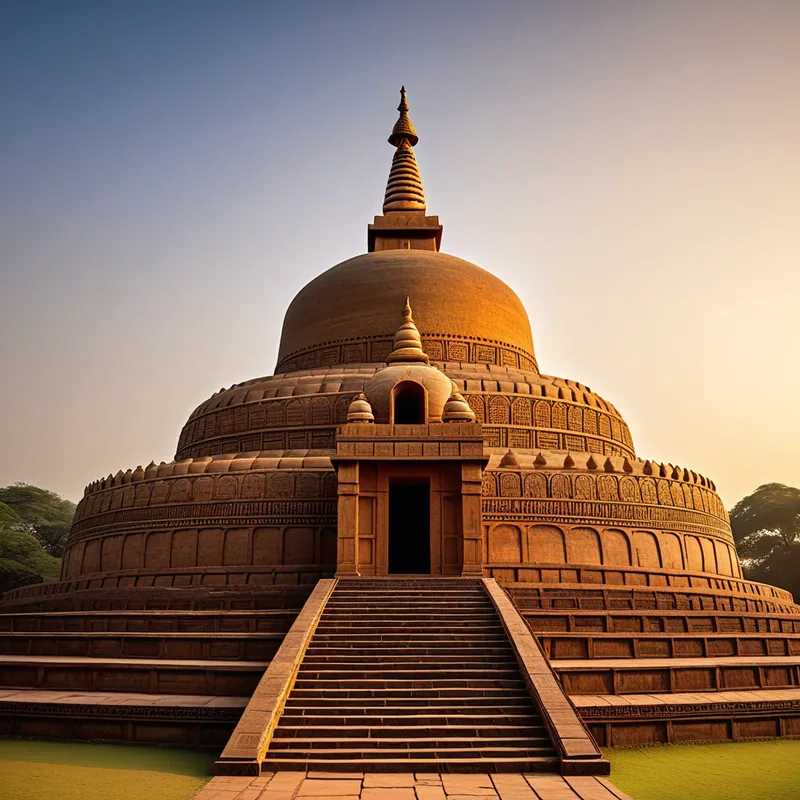
Stupa of Sanchi Myth Meaning & Symbolism
A silent monument built to hold nothing, the Stupa of Sanchi is a cosmic diagram in stone, mapping the path from earthly form to boundless liberation.
The Tale of Stupa of Sanchi
Listen. The story does not begin with a roar, but with a silence so profound it becomes a sound. It begins with an absence. A great teacher, the Tathagata, had walked the earth, turned the wheel of Dharma, and passed into the final peace of Parinirvana. His physical form was gone, consumed by the funeral pyre. All that remained were relics—fragments of bone, ashes—and a vast, echoing emptiness in the hearts of his followers.
King Ashoka, whose early reign was a storm of conquest, felt this emptiness as a searing wound. He wandered the lands, a ruler without a compass, until the Dharma found him and turned his remorse into a fierce, quiet devotion. He sought to build. Not palaces of pleasure, but monuments of memory. He desired to enshrine the relics, not as objects of worship, but as focal points for a truth that is beyond form.
The site chosen was a hill of serene stone at Sanchi. The air there was clear, the earth firm. The king commanded the finest artisans, but his command was a plea: "Build not for my glory, but for the remembrance of the path. Create a form that speaks of the formless."
And so they built. They raised a great hemispherical mound, the anda, solid and earth-bound, like the dome of the sky inverted upon the world. Upon its crown, they placed a square railing, the harmika, from which rose a central mast, the yasti, piercing the heavens. Around this silent mountain of brick and plaster, they raised a stone balustrade, and then, the gates.
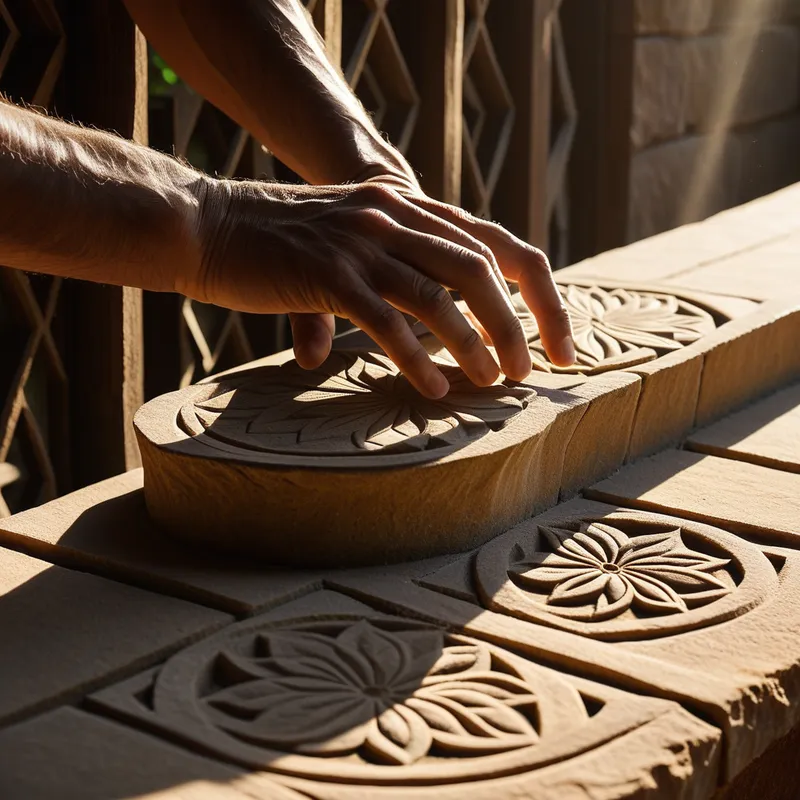
Ah, the gates—the toranas! These were not mere entrances; they were the entire cosmos in teak and sandstone. Carvers, whose hands were guided by visions, populated them. Here was the yalimukha guarding the threshold. There, the voluptuous yakshis bent the mango tree, their grace an homage to the fecundity of life. Scenes unfolded: the Buddha’s birth at Lumbini, his enlightenment at Bodh Gaya, his first sermon at Sarnath. Yet, the Buddha himself was never shown in human form. He was an empty throne under the Bodhi tree, a pair of footprints, a wheel. His presence was an eloquent absence.
The stupa was completed. It held the relics at its heart, sealed within the silent dark of the anda. Pilgrims arrived. They did not enter, for there was no interior chamber. Instead, they began to walk. In a slow, sunwise procession, they traced the path around the base, their eyes lifted to the stories on the gates, their minds turning inward with each step. The monument did not speak. It hummed. It was a compass, a map, and the territory all at once—a solid poem about emptiness, a complex diagram pointing to simplicity. It stood, and in its standing, it told the only story that mattered: the path from the periphery of suffering to the silent, central point of release.
Cultural Origins & Context
The Great Stupa at Sanchi is not the product of a single mythical event, but the crystallization of a centuries-long devotional and architectural evolution within early Buddhism, particularly the Theravada and related traditions. Its "myth" is not a narrative of gods and monsters, but the lived myth of the Sangha and the laity. Commissioned initially by Emperor Ashoka in the 3rd century BCE and greatly enlarged and embellished over subsequent centuries, its story is one of accretion, of layers of meaning built upon layers of stone.
It functioned as a chaitya, a sacred focal point for the monastic community and pilgrims. The myth was transmitted not through epic verse, but through ritual circumambulation (pradakshina) and visual pedagogy. The elaborate carvings on the toranas were the scriptures for the illiterate, a cosmic comic strip illustrating the Jataka tales (stories of the Buddha's past lives) and key events from his final life. The societal function was multifaceted: it was a center for communal veneration, a physical anchor for the Dharma in the landscape, a meritorious deed for its patrons, and a three-dimensional teaching tool. It transformed the abstract doctrine of shunyata into an experiential, architectural reality.
Symbolic Architecture
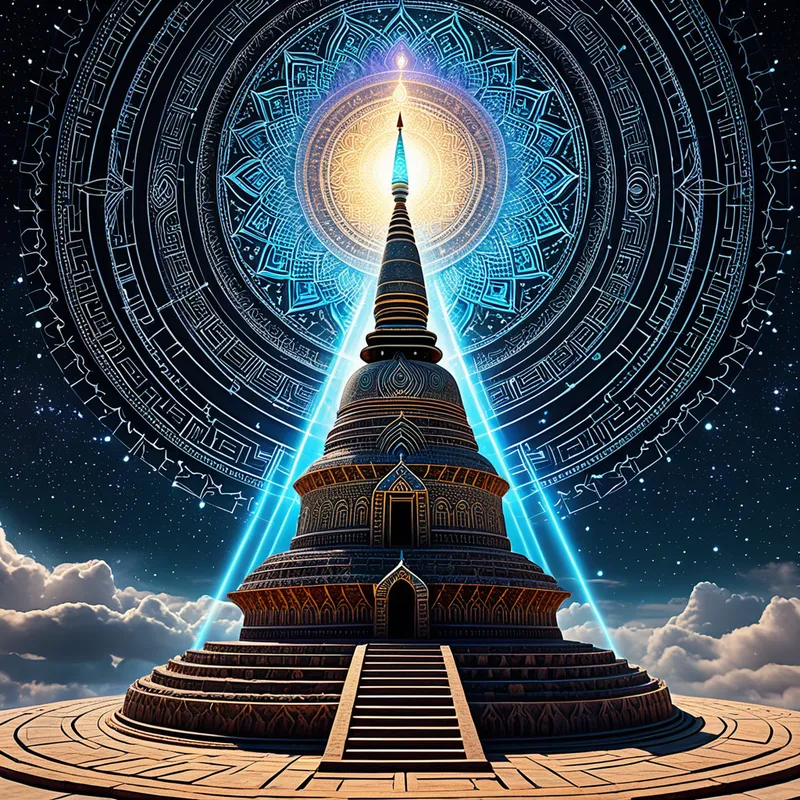
The Stupa of Sanchi is a mandala in stone, a geometric metaphor for the structure of the cosmos and the path of the mind toward enlightenment. Every element is a deliberate symbol in a grand alchemical equation.
The massive, solid anda (dome) represents the world mountain, Mount Meru, and also the inverted bowl of the sky. It is the womb of the universe, the dome of heaven, and the rounded, perfected state of the Buddha's mind in meditation. It contains the relics, symbolizing that enlightenment (Bodhi) is not elsewhere, but buried at the very core of apparent reality.
The relic is not a thing to be possessed, but a truth to be realized at the center of one's own being.
The harmika (square railing on top) signifies the abode of the gods, a transitional realm between the earthly and the transcendental. The yasti (central mast) is the axis mundi, the pivotal channel connecting all levels of existence. The three circular discs (chattras) often placed on the yasti represent the Triple Gem of the Buddha, Dharma, and Sangha.
Most profound is the ritual of pradakshina. The pilgrim moves from the outer world (the gateways teeming with life, desire, and story) inward toward the silent, relic-held center. This is the journey from samsara (the periphery of suffering and distraction) to nirvana (the still, central point). The stupa itself is static, but it compels dynamic, circular movement—a perfect symbol for the psyche, which must actively engage with its own structures to find the still point within.
The Dreamer's Resonance
When the archetype of the Sanchi Stupa arises in the modern dreamscape, it signals a profound process of psychic integration and centering. The dreamer is not merely seeing a building; they are encountering the deep structure of their own psyche.
To dream of circumambulating the stupa suggests the dreamer is in a phase of processing, of reviewing life events (the carvings on the gates) from a new, more centered perspective. There is a somatic sense of slow, deliberate movement, a winding down of chaotic mental energy into a focused pattern. To dream of the solid, impenetrable dome may reflect a felt sense of a nascent, protected self—a psychic core that is forming and solidifying, often after a period of fragmentation or loss. It is the "relic" of one's essential nature being sealed within.
Conversely, to dream of the empty throne or footprints from the carvings speaks directly to the dreamer's relationship with authority, guidance, or their own inner source of wisdom. It asks: Can you find direction from an absence? Can you lead yourself when the external figure of the "teacher" or "parent" is no longer visibly present? The dream is orchestrating a shift from external referencing to internal authority.

Alchemical Translation
For the modern individual navigating the path of individuation, the Stupa of Sanchi offers a masterful model of psychic transmutation. Its alchemy is one of containment, elevation, and symbolic navigation.
The first operation is Gathering the Relics. This is the often-painful work of collecting the fragmented pieces of oneself after a "great passing"—the end of a relationship, a career, an identity. These shards of experience, these ashes of what was, feel like worthless debris. The alchemical task is to recognize them as sacred relics, the irreducible core of lived truth, and to consciously intend to enshrine them at the center of a new psychic structure.
Next is Raising the Anda. This is the construction of a conscious container—a disciplined practice, a therapeutic framework, a daily ritual—that is solid and hemispherical. It must be broad enough to hold all of one's experience, yet rounded to deflect the sharp edges of judgment and negative self-talk. This container creates the necessary vessel for the work.
Individuation is not about adding more to the self, but about building a structure elegant and strong enough to hold the profound emptiness at the center where the true Self resides.
The final and ongoing process is The Endless Pradakshina. This is the active engagement with one's own life story. The carved scenes on our personal toranas are our memories, complexes, triumphs, and shames. Individuation requires us to walk around them, to observe them from all angles, not to become lost in any single drama, but to keep moving toward the center. Each circuit integrates another fragment, loosens another identification, until the pilgrim realizes they are not the carvings on the gate, nor even the walker, but the silent, spacious awareness at the heart of the monument itself. The Stupa does not promise escape from the world of form; it teaches how to move through it, around it, until one arrives, effortlessly, at the formless center that was home all along.
Associated Symbols
Explore related symbols from the CaleaDream lexicon: