Strigoi Myth Meaning & Symbolism
A myth of the restless dead who defy the grave, embodying the untamed psychic force that challenges the boundary between order and chaos.
The Tale of Strigoi
Listen, and let the fire grow low. [The wind](/myths/the-wind “Myth from Various culture.”/) does not howl without reason in the Carpathian night. It carries a memory older than the stones of the churches, a whisper of a time when the line between the living soil and the restless earth was thin as a grave shroud.
In a village nestled in the valley’s embrace, life moved to the rhythm of the sun and the [saints](/myths/saints “Myth from Christian culture.”/). But when the sun fled, another law took hold. It began with a death—but not a peaceful one. Perhaps it was a man who died unbaptized, or one who lived with a heart full of malice, or one taken too soon by a curse. They were buried with the proper rites, with [hawthorn](/myths/hawthorn “Myth from Celtic culture.”/) stakes and garlic cloves, yet the village dogs would not stop their wailing. The cattle’s milk would sour in the pail. A chill would settle on a single house, and within it, the living would dream of the dead, feeling a cold, insistent weight upon their chests as they slept, stealing their breath and their vitality.
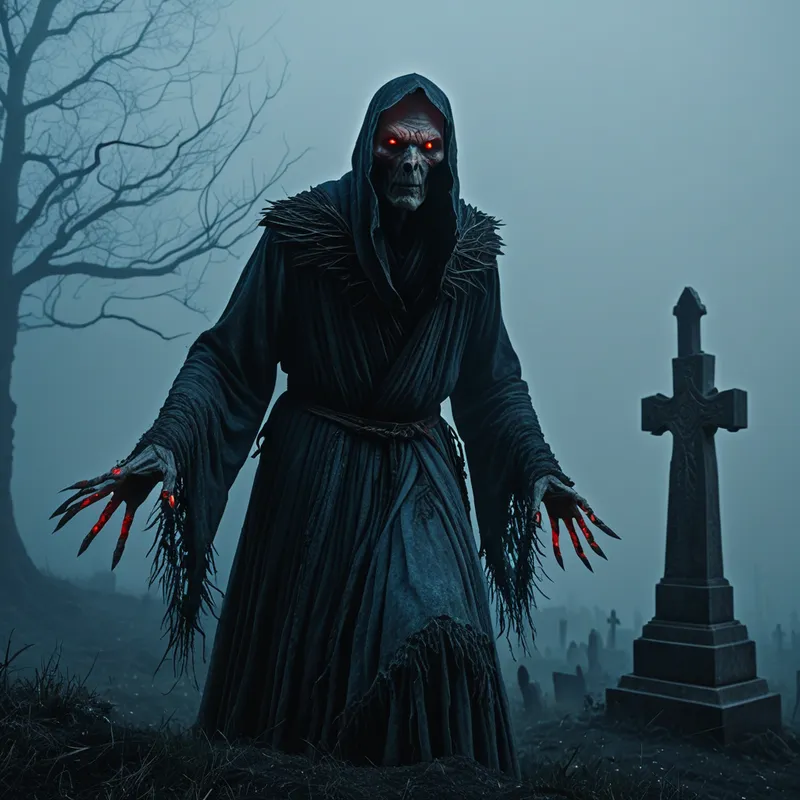
For the dead had not rested. The Strigoi had stirred in its coffin. At the stroke of midnight, it would rise, not as a memory, but as a perversion of life. Its skin was the pallor of [the moon](/myths/the-moon “Myth from Tarot culture.”/), its eyes burned with a hungry red light, and its nails grew long and sharp as scythes. It slipped from the graveyard as a mist, or as a moth, or as a shadow darker than the night itself. It returned to its former home, not in love, but in a jealous, consuming hunger. It fed on the blood of its family first, then the livestock, draining the very life-force from the village, bringing sickness and despair.
The people knew the signs. They gathered, not in panic, but in a grim, ancient resolve. The oldest among them, who remembered the old ways before the priests, would lead them to the cemetery under a waning moon. They would find the suspect grave—[the earth](/myths/the-earth “Myth from Hindu culture.”/) unsettled, as if churned from within. With prayers that were half-plea, half-defiance, they would exhume the coffin. And there it would lie, the Strigoi, not decaying but swollen with stolen life, lips stained dark.
This was the moment of reckoning. A stake of hawthorn, the tree of purification, was driven through its heart. Sometimes a scythe would sever the head, placing it between the legs. Garlic filled the mouth. Then, the body was returned to the earth, or burned, and the ashes scattered. Only then would the oppressive weight lift. The dogs fell silent. The wind carried only the scent of pine, not decay. The boundary between the worlds, violently breached, was sealed once more—at least until the next troubled soul failed to cross over.
Cultural Origins & Context
The myth of the Strigoi is not mere superstition; it is a foundational narrative of boundary maintenance. In the Romanian village, a microcosm where everyone and everything had a place, a proper death and burial were the final, crucial acts of social integration. The community’s health depended on the dead staying in their ordained realm.
The tale was passed down not by bards, but by the babe (elders) and practiced by the entire village. It functioned as a social and spiritual protocol. It explained misfortune—sickness, drought, livestock death—not as random tragedy, but as a consequence of a moral or ritual rupture. The Strigoi was often someone who died outside the accepted order: the unbaptized, the suicide, the wicked, or the seventh child of the same sex. The myth enforced social norms by presenting a terrifying post-mortem consequence for transgression. The rituals of prevention (garlic, hawthorn) and exhumation were communal acts of self-preservation, reinforcing group identity and collective power against chaos.
Symbolic Architecture
Psychologically, the Strigoi is the ultimate [symbol](/symbols/symbol “Symbol: A symbol can represent an idea, concept, or belief, serving as a powerful tool for communication and understanding.”/) of the unintegrated [shadow](/symbols/shadow “Symbol: The ‘shadow’ embodies the unconscious, repressed aspects of the self and often represents fears or hidden emotions.”/) that refuses to stay buried. It represents psychic [energy](/symbols/energy “Symbol: Energy symbolizes vitality, motivation, and the drive that fuels actions and ambitions.”/)—instinct, rage, untamed desire, or unresolved [trauma](/symbols/trauma “Symbol: A deeply distressing or disturbing experience that overwhelms the psyche, often manifesting in dreams as unresolved emotional wounds or psychological injury.”/)—that was denied proper [expression](/symbols/expression “Symbol: Expression represents the act of conveying thoughts, emotions, and individuality, emphasizing personal communication and creativity.”/) in [life](/symbols/life “Symbol: The symbol of ‘Life’ represents a journey of growth, interconnectedness, and existential meaning, encompassing both the joys and challenges that define human experience.”/). Because it was not acknowledged, it does not die. It lingers in the unconscious (the grave), festering and gaining [strength](/symbols/strength “Symbol: ‘Strength’ symbolizes resilience, courage, and the ability to overcome challenges.”/), until it erupts to feed on the vitality of the conscious [personality](/symbols/personality “Symbol: Personality in dreams often symbolizes the traits and characteristics of the dreamer, reflecting how they perceive themselves and how they believe they are perceived by others.”/) (the [village](/symbols/village “Symbol: Symbolizes community, connection, and a reflection of one’s roots or origins.”/), the [family](/symbols/family “Symbol: The symbol of ‘family’ represents foundational relationships and emotional connections that shape an individual’s identity and personal development.”/)).
The shadow that is buried without rites will always find a way to dig itself out.
The Strigoi’s [hunger](/symbols/hunger “Symbol: A primal bodily sensation symbolizing unmet needs, desires, or emotional voids. It represents craving for fulfillment beyond physical nourishment.”/) for [blood](/symbols/blood “Symbol: Blood often symbolizes life force, vitality, and deep emotional connections, but it can also evoke themes of sacrifice, trauma, and mortality.”/) is symbolic of its craving for the [anima](/symbols/anima “Symbol: The feminine archetype within the male unconscious, representing soul, creativity, and connection to the inner world.”/) or life-force it lacked. It seeks to drain the warmth, [emotion](/symbols/emotion “Symbol: Emotion symbolizes our inner feelings and responses to experiences, often guiding our actions and choices.”/), and [connection](/symbols/connection “Symbol: Connection symbolizes relationships, communication, and bonds among individuals.”/) from the living to sustain its own half-existence. The specific countermeasures are profoundly symbolic: wild [garlic](/symbols/garlic “Symbol: Garlic symbolizes protection, purification, and transformation, often representing both healing and social boundaries.”/) (purity and expulsion of evil), the hawthorn stake (the piercing [truth](/symbols/truth “Symbol: Truth represents authenticity, honesty, and the quest for knowledge beyond mere appearances.”/) that pins the [chaos](/symbols/chaos “Symbol: In Arts & Music, chaos represents raw creative potential, uncontrolled expression, and the breakdown of order to forge new artistic forms.”/) to a single point), and decapitation (severing the seat of twisted [consciousness](/symbols/consciousness “Symbol: Consciousness represents the state of awareness and perception, encompassing thoughts, feelings, and experiences.”/)). The myth dramatizes the painful but necessary process of confronting what we have tried to bury.

The Dreamer’s Resonance
When this myth pattern stirs in modern dreams, it often manifests as a sense of being drained or haunted by a presence from one’s past. The dreamer may encounter a figure that is familiar yet monstrous, or simply feel an oppressive, chilling weight in a dream space—a classic symbol of the “incubus” or “succubus” experience.
Somatically, this can mirror feelings of chronic fatigue, anxiety, or depression that have no clear external cause. Psychologically, it signals that a part of [the self](/myths/the-self “Myth from Jungian culture.”/)—an old identity, a repressed anger, a childhood trauma, an un-lived passion—has become a psychic Strigoi. It was buried alive by shame, neglect, or societal expectation, and now it rises at night to feed on your energy, leaving you listless by day. The dream is the graveyard, and the haunting is [the shadow](/myths/the-shadow “Myth from Jungian culture.”/)‘s demand for recognition.
Alchemical Translation
The individuation process modeled here is not one of gentle integration, but of necessary exhumation and transmutation. The modern individual must become both the terrified villager and the resolute elder. The first step is to identify what is “souring the milk” in your life—what recurring drain or pattern of misfortune points to a buried conflict.
To integrate the shadow, one must first have the courage to open the coffin.
The alchemical work is the exhumation: bringing the buried content (the resentments, the griefs, the “unacceptable” desires) into the light of consciousness. This is the piercing stake of honest self-reflection. The “decapitation” is the dis-identification from the old story that gave this complex its power. Finally, the “garlic in the mouth” is the act of imbuing it with a new, purifying meaning—not to destroy the energy, but to neutralize its toxic form so its power can be composted back into the [psyche](/myths/psyche “Myth from Greek culture.”/). The Strigoi’s fierce, relentless life-force, once reclaimed, is immense. It is the raw power of the rebel who defies false finality, the untamed spirit that the overly-ordered self tried to kill. The goal is not to slay it forever, but to perform the rite you failed to perform long ago: to acknowledge it, bless its passing, and allow its energy to finally, truly, transform.
Associated Symbols
Explore related symbols from the CaleaDream lexicon: