Story Blankets Myth Meaning & Symbolism
A myth of a weaver who captures the world's stories in a blanket, loses it, and must journey inward to re-weave it from memory and spirit.
The Tale of Story Blankets
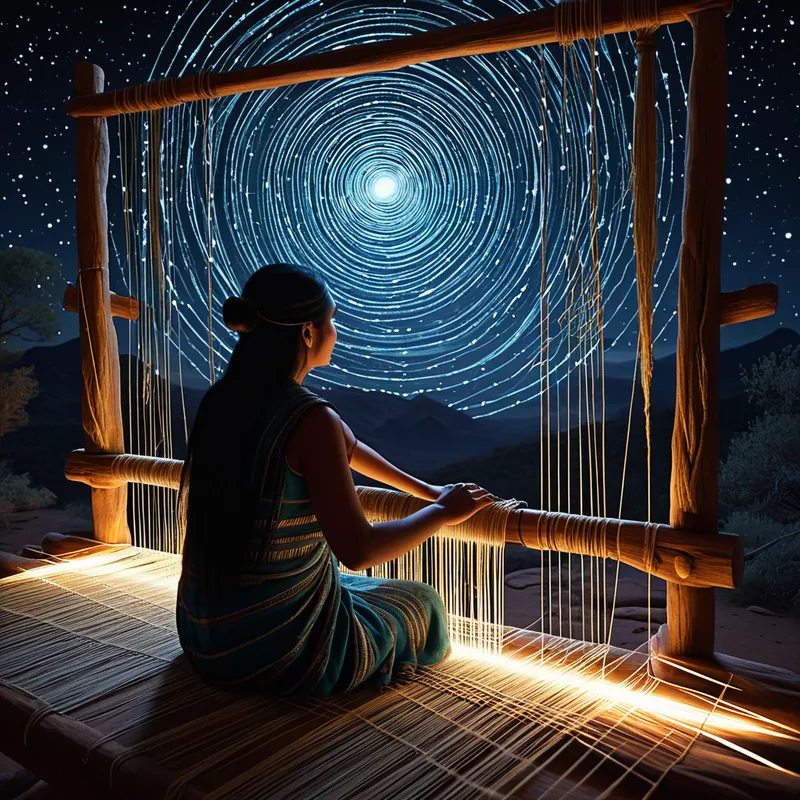
In the time before memory hardened into history, when the world was still soft with the breath of the first dawn, there lived a weaver. She was not the first woman, nor the first grandmother, but she was the first to listen. She heard the stories the wind told as it sighed through the pines. She understood the tales the river murmured over smooth stones. She felt the epic songs trembling in the roots of the great cedar.
Her fingers, stained with the juices of berries and earth, did not just twist fiber into thread. They captured echoes. From the shaman’s chant, she spun a thread that hummed. From the warrior’s silent prayer before battle, she drew a strand dark and strong as obsidian. From the laughter of children chasing fireflies, she crafted a filament of pure, shimmering light. Upon a loom made of willow and cedar, she began her life’s work: the Story Blanket.
It grew not as a mere covering, but as a living, breathing tapestry of the People. One corner held the migration saga, threads forming the shapes of caribou herds and mountain passes. Another held the love stories, intertwined with the scent of summer blooms. The centerpiece was the creation story itself, a swirling vortex of color where First Maker danced the world into being. The blanket was the soul of the tribe, its memory, its heartbeat made visible. To sit before it was to know who you were, where you came from, and the song of your place in the great pattern.
Then came the Great Wind. It was not a weather of the sky, but a wind of the spirit—a season of forgetting, of discord. In the chaos, a terrible rent was torn in the world’s fabric. The sacred blanket, caught on a gust of this despairing wind, was ripped from the loom. The weaver watched in silent agony as it unraveled, its threads scattering like shooting stars into the four directions, lost in the canyons of time, buried in the mud of rivers, snagged on the thorns of distant, forgotten lands.
The weaver fell into a stillness deeper than grief. The People were adrift, their stories scattered, their identity fading like a footprint in sand. For a long age, she sat in the empty space where the loom had been. The silence was deafening. But in that absolute quiet, she began to hear a new sound—the faint, persistent pulse of her own heart. And within that pulse, she heard an echo of the river’s story. In her breath, she felt the rhythm of the wind’s tale.
With no physical thread, she began to weave again. She wove with intention. She wove with breath. She wove with the memories that lived not in her mind, but in her bones, in the salt of her tears, in the strength of her hands that had once touched every story. Slowly, from the empty air, a new blanket began to form. It was not a replica. It was a re-membering. Some stories returned clear and bright. Others appeared as shadows, acknowledging the loss. The new blanket held the old patterns, but also the pattern of their loss, the stark beauty of the empty loom, and the courageous act of weaving from the void. When she was done, the blanket did not just cover; it illuminated. It taught the People that the truest stories are not those kept safe, but those re-born from the depths of one’s own spirit.

Cultural Origins & Context
The motif of the Story Blanket, while not belonging to a single, monolithic “Native American” tale, is a powerful synthesis of themes found across numerous Indigenous nations, particularly those with strong weaving traditions like the Navajo (Diné), Pueblo, and Salish peoples. For these cultures, weaving is far more than a craft; it is a cosmological act, a prayer made manifest. The loom is a microcosm of the world, its vertical warp threads representing the cosmic order, and the horizontal weft the actions and stories of life intersecting with it.
Such myths were not written but spoken, passed down through generations by elders and knowledge-keepers, often during the long process of creating a blanket or rug itself. The story served as both instruction and metaphor: teaching technical skill while encoding profound philosophical principles about memory, continuity, and resilience. Its societal function was integrative. In a world where history was oral, the myth of the Story Blanket provided a template for understanding how collective identity is actively woven, can be tragically fragmented (through displacement, conflict, or cultural disruption), and must be consciously re-woven from the enduring spirit of the people.
Symbolic Architecture
At its heart, the myth is a profound map of the psyche. The blanket represents the ego-complex and the cultural unconscious woven together—the tapestry of personal and collective identity. It is the answer to the question “Who am I?” formed from the threads of family, tradition, trauma, and triumph.
The loom is the structure of consciousness itself; the weft is the flow of experience, and the warp is the timeless archetypal patterns that give it meaning.
The Great Wind symbolizes a catastrophic encounter with the unconscious—a psychological trauma, a deep loss, or an existential crisis that shatters one’s sense of self and story. The unraveling is the dissolution of the ego, a dark night of the soul where previously held narratives of identity and purpose disintegrate.
The weaver’s subsequent stillness is not passive depression, but the essential, fertile void of the nigredo in alchemy. It is the courageous descent into silence where the old, external definitions are stripped away. Her re-weaving from memory and spirit is the act of individuation—constructing a new, more authentic identity not from external validation or inherited dogma, but from the raw, lived truth of one’s own experience and inner authority.
The Dreamer's Resonance
When this myth surfaces in modern dreams, it often appears during periods of profound identity shift or after a shattering loss. One might dream of a cherished quilt disintegrating in the wash, of tirelessly knitting a scarf that endlessly unravels, or of finding a room filled with magnificent tapestries that are moth-eaten and fragile.
Somnatically, this can feel like a dissolution in the body—a sense of coming apart, of losing one’s outline. Psychologically, it marks the psyche’s attempt to process disintegration. The dream is not merely reporting the crisis; it is initiating the healing. The act of seeing the unraveled blanket forces the dreamer to confront the loss directly. The subsequent search for threads, or the surprising discovery of an inner loom, points the way toward the next stage: the arduous, creative work of weaving a new sense of self from the remaining, and often deeply internalized, materials.

Alchemical Translation
The myth of the Story Blankets is a perfect allegory for the alchemical opus. The initial, beautiful blanket is the prima materia—the given identity, the personality formed by family and culture. The Great Wind and the unraveling are the essential stage of mortificatio and solutio. This is not a mistake in the process; it is the process. The old, rigid form must be broken down so the essential spirit within can be liberated.
The weaver’s silent, seated vigil is the albedo. In the pure light of awareness that follows dissolution, one sees what remains when all external stories are gone. This is the discovery of the inner Self, the eternal weaver within.
The final, re-woven blanket is the lapis philosophorum—not a return to the beginning, but a transcendence of it. It incorporates the loss, the journey, and the wisdom of the void into a new, more conscious and resilient whole.
For the modern individual, this myth models the journey from a borrowed identity to an earned one. It teaches that after any great loss—of a relationship, a career, a belief system, a loved one—the path forward is not about retrieving the past, but about doing the sacred, creative work of the weaver: sitting in the stillness, listening to the stories that now pulse in your own blood, and weaving, thread by intentional thread, the blanket of your becoming. The pattern will remember the old, but it will be uniquely, authentically, and unshakably your own.
Associated Symbols
Explore related symbols from the CaleaDream lexicon: