Stone People Myth Meaning & Symbolism
A myth of primordial beings who sacrificed their fluid forms to become the enduring bones of the Earth, gifting stability to all future life.
The Tale of Stone People
In the time before time, when the world was soft and new, the People of the First World lived. They were not as we are. Their forms were fluid, like light upon water, like thought given shape. They danced upon the winds, swam through the star-strewn sky, and knew no boundary between self and the shimmering, dreaming stuff of creation. They were the Dream People, and their existence was a song of pure potential.
But the world-song was unstable. The soft earth heaved and sighed, mountains rose and fell like breath, and the seas had no shore to contain their passion. The Dream People, in their compassion for the world yet to come, saw a great need. The newborn Earth required a skeleton, a framework of endurance upon which the tapestry of life could be woven. It needed steadfastness. It needed memory that could outlast the seasons.
A council was called beneath the World Tree, whose roots drank from the deep springs of mystery and whose branches held up the bowl of the sky. The eldest among them, whose voice was the rumble of distant thunder, spoke not with words, but with a vision shared directly into the hearts of all. The vision was of stillness. Of becoming the unmoving witness. Of trading the ecstasy of flight for the profound patience of the mountain.
A great silence fell, deeper than any that had come before. It was the silence of a choice being weighed in the soul of every being. To choose this path was to choose a form of profound sacrifice—to freeze their endless dance into a single, eternal posture. To become the anchor.
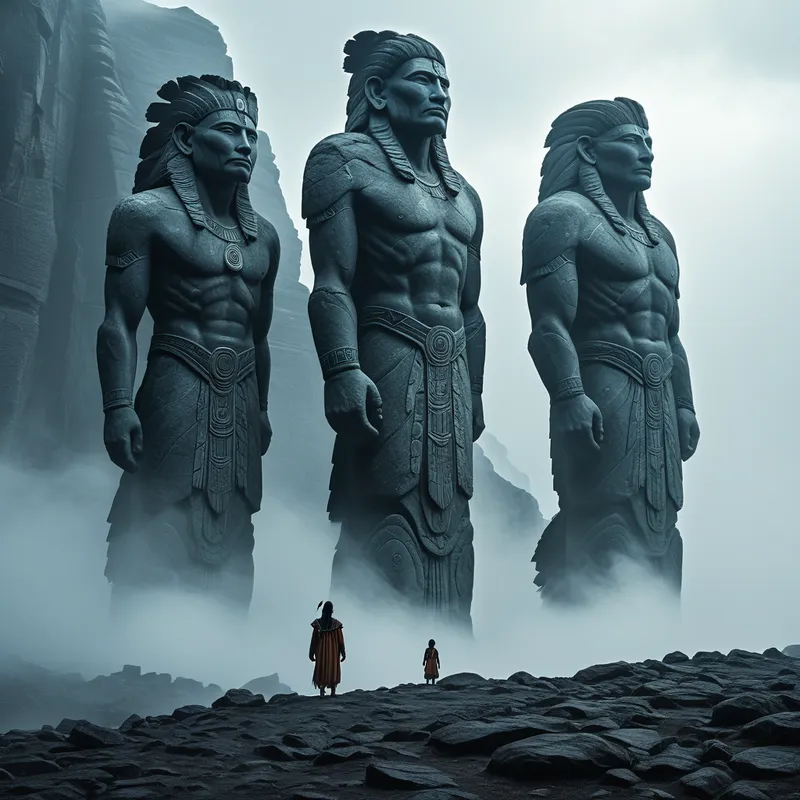
One by one, then in a great and solemn procession, the Dream People approached the soft, trembling skin of the Earth. Where their feet touched the mud, a change began. It was not a death, but a profound transmutation. Their luminous bodies began to cool and condense. The starlight in their veins crystallized into quartz and mica. Their breath became the morning mist caught in high valleys; their bones became granite and basalt. Their flowing forms solidified, locking into postures of immense dignity—some standing as sentinel peaks, some kneeling as sheltering cliffs, some lying down to form the long, strong spines of mountain ranges.
They became the Stone People. As they solidified, the world itself sighed in relief. The shaking ceased. The lands grew firm. Rivers now had courses to follow. Seeds, yet unborn, would one day find a stable home in their cracks and crevices. The First People had given their fluid, dreaming existence so that all life to come would have a firm place to stand.
Cultural Origins & Context
The myth of the Stone People is found among various Pueblo nations, including the Hopi and others. It belongs to a rich stratum of creation narratives that describe multiple worlds, or eras of existence, preceding our own. These stories are not mere folklore but are the foundational pillars of a cosmological understanding, passed down through oral tradition by elders and spiritual leaders.
The telling of such myths is a sacred act, often tied to specific ceremonies, seasons, or initiations. It serves a vital societal function: it explains the origin of the physical landscape, instilling a sense of sacred geography where every mountain, mesa, and canyon is not an inert object but a relative, an ancestor who made the ultimate sacrifice. This fosters a relationship with the land based on reverence, reciprocity, and profound responsibility. The myth teaches that stability, law, and enduring structure are not natural givens but were gifts born from conscious, compassionate sacrifice.
Symbolic Architecture
At its heart, the myth of the Stone People is a master narrative of foundation. The Stone People represent the archetypal principle of the Axis Mundi—the still, central point around which the chaos of potential organizes itself into a livable world.
To become foundational is to consent to be used, weathered, and often overlooked, for the sake of a stability you will never yourself enjoy.
Psychologically, they symbolize the necessary structures of the psyche: the core beliefs, values, and internal boundaries that provide ego stability. Before we can have the fluidity of creativity (the Dream People) or the growth of complex life, we must first establish a reliable sense of self—the “bones” of our personality. This myth speaks to the moment when potential must crystallize into commitment, when endless possibilities must be narrowed into a chosen path, a defined identity. The Stone People embody the sacrifice of omnipotence for the sake of real, grounded existence.
Their transformation is not a diminishment but an enrollment into a different order of being. They become the memory-keepers of the world, the silent witnesses who hold the history of all that passes upon them. In this, they represent the psychic function of the unconscious foundation—the deep, often unconscious structures that support our conscious life.
The Dreamer’s Resonance
When this myth stirs in the modern dreamer, it often manifests in dreams of profound grounding or, conversely, terrifying petrification. To dream of becoming stone, or of speaking with stone beings, signals a critical phase of psychological consolidation.
The somatic experience might be one of heaviness, deep pressure, or a craving for immobility—a psyche seeking to “set” its form. It can appear during life transitions that demand a new, more solid identity: committing to a relationship, a career, a moral stance, or a healing path. The dream may feel somber, even mournful, as it mirrors the Stone People’s sacrifice of fluid freedom. Alternatively, it can bring immense comfort, a feeling of being supported by ancient, unshakable strength within oneself—touching the inner ancestor who provides stability.
Conversely, dreaming of brittle stone cracking, or of being trapped in stone, may warn of an overly rigid psyche—a structure that was necessary once but now constricts growth, needing to be softened by the waters of feeling and re-imagined.
Alchemical Translation
The alchemical journey modeled here is the opus contra naturam—the work against one’s original, unbounded nature—for the purpose of serving a greater whole. In the process of individuation, we are all, at some point, called to be Stone People.
The initial state is the prima materia of the Dream People: the fluid, chaotic, and glorious potential of the unconscious. The call to transformation is the recognition that to live meaningfully in the world, one must develop a conscious attitude, an ego capable of withstanding the pressures of reality. The “solidification” is the often difficult, patient work of building character, discipline, and enduring values.
The ultimate alchemy is not turning lead to gold, but turning the gold of infinite potential into the lasting granite of conscious form.
This is the caregiver archetype in its most primordial expression. It is the self sacrificing its own boundless, narcissistic possibilities to create a stable container for other aspects of life to flourish—for relationships, creativity, and community to take root. The modern individual undergoes this transmutation whenever they choose a limiting but life-giving form: the form of a vow, the form of a routine that fosters health, the form of a principle they will not violate.
The triumph is not in movement, but in steadfastness. The Stone People do not conquer; they endure. Their gift is their presence. In our own lives, the alchemical goal is to find those inner truths so fundamental, so deeply aligned with our soul’s purpose, that they become our bedrock—the silent, patient, unmovable foundation from which the true and unique expression of our life can reliably grow. We honor the Stone People within by building a life of integrity, one where our deepest values are not fluid opinions but the very ground we stand on.
Associated Symbols
Explore related symbols from the CaleaDream lexicon: