Star Navigators Myth Meaning & Symbolism
An ancient myth of voyagers guided by stars and currents, embodying the human quest to navigate the vast unknown with ancestral wisdom.
The Tale of Star Navigators
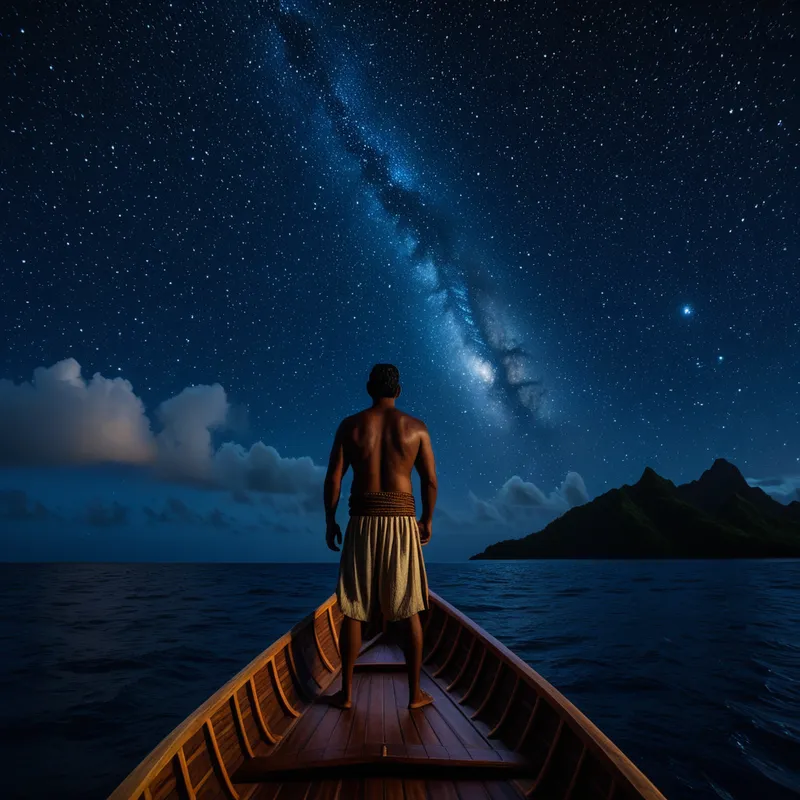
In the time before time, when the ocean was the only road and the sky was the only map, the world was a scattering of dark islands in a sea of stars. The people knew the taste of their own shore, the smell of their own soil, but the great, heaving Moana whispered of lands unseen. It was a song of terrifying beauty, a call that both lured and warned. To answer it was to court death, or discovery.
Among the people was a man named Kupe. He was not the strongest warrior, nor the loudest chief. His power was quieter, deeper. He would lie on the beach at night, his back against the earth, his eyes drinking the heavens. He did not just see points of light; he saw pathways. He saw the steady, guiding pulse of Hōkūleʻa, and the swinging dance of Maui’s Fishhook. He learned the language of the waves—the long, deep swells born in distant storms, the subtle cross-chop that spoke of unseen islands bending the sea’s muscle.
The great conflict was not with a monster, but with the immense, featureless blue. It was the terror of the blank page, the dread of leaving the last known star behind. The elders warned of Pō, the consuming darkness. But Kupe, his spirit woven from curiosity and courage, felt a different pull. He dreamed of a great land, a place of soaring birds and sweet earth, a refuge whispered by the currents.
He commanded the building of a great waʻa kaulua. Its hulls were carved from sacred trees, lashed with sennit cord stronger than iron. Its sail, woven from pandanus, awaited the breath of Mālie. On the day of departure, the village was silent. The wailing of loved ones was the only wind on shore. Kupe stood at the stern, his hand on the great steering paddle. He carried no physical map. His map was held in the bone-deep memory of star courses, the feel of the swell against the hull, the flight of the kōlea, the taste of the spray.
For weeks, they lived in a moving universe of water and sky. They followed the star road, steering by the rising and setting points of celestial bodies. They watched the color of the clouds, the gathering of certain birds at dusk. Doubt was a cold current that sometimes gripped the crew. When the sky wept and hid the stars, Kupe navigated by the feel of the ocean herself, reading the rhythm of the waves like a heartbeat. The voyage was an act of supreme faith—faith in memory, in observation, in the whispers of ancestors carried on the wind.
Then, a cloud on the horizon did not move. It grew, taking the shape of a great, green-cloaked mountain. The scent of earth and flowering trees rode the wind, a perfume more precious than any treasure. They had found Aotearoa, the Land of the Long White Cloud. Kupe had not conquered a beast, but he had conquered the unknown. He had woven a thread of knowing across the trackless sea, transforming the terrifying void of Moana into a pathway, a connection. He became the archetype, the first of the Star Navigators, proving that the world is not a prison of isolation, but a network of destinations waiting to be remembered.
Cultural Origins & Context
This is not a single myth, but a living corpus of knowledge that is Polynesian culture. The “Star Navigators” are not merely legendary figures like Hawaiʻiloa or Tupaia; they represent a collective genius honed over millennia. This knowledge system, often called Wayfinding, was the engine of the greatest human migration in history, spanning the Pacific Ocean.
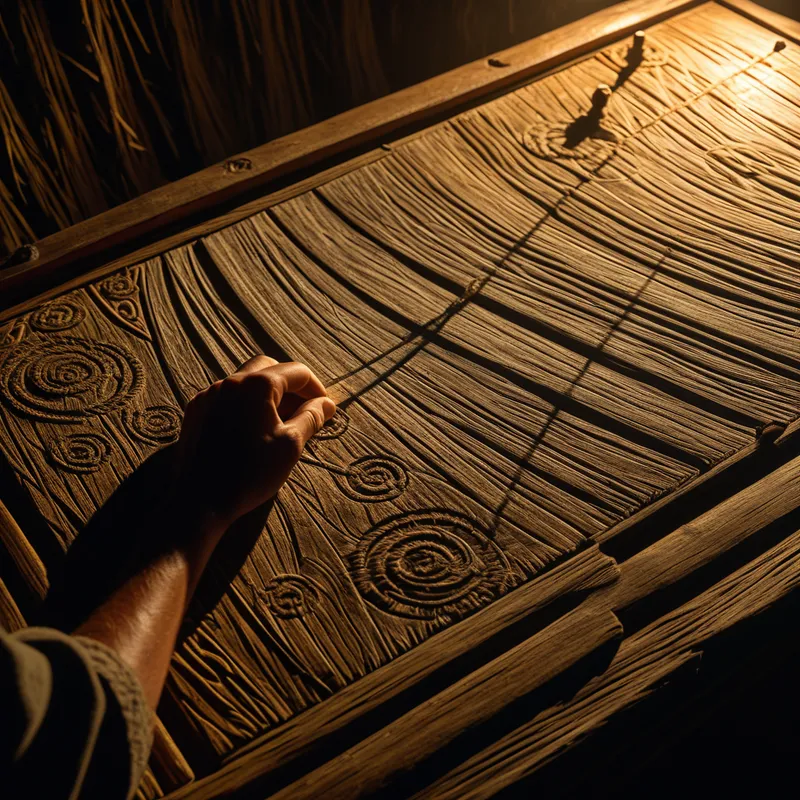
The myth was not told for entertainment alone; it was a sacred, practical curriculum. It was passed down in whare wānanga in Aotearoa, or from master navigator (pwo) to apprentice in Micronesia. Chants (oli) encoded star paths. Rhythmic dances could mimic wave patterns. Intricate mattang or rebbelith were tactile teaching tools. Its societal function was survival and expansion. It defined identity—you are a people who came from across the sea, guided by the stars. It was a testament to the intimate, animistic relationship with the natural world, where every bird, cloud, and current was a speaking member of the cosmos.
Symbolic Architecture
At its core, the myth is a master symbol for the human psyche confronting the unconscious. The vast, unknown Moana is the unconscious itself—deep, potentially perilous, and filled with both monsters and undiscovered continents of the self. The canoe (waʻa) is the vessel of consciousness, the fragile but resilient ego-complex that must undertake the journey.
The stars are not guides we follow, but fixed points within us by which we steer. The voyage is an act of remembering a knowledge we have always possessed.
The navigator represents the conscious mind (mana) trained in the art of nānā i ke kumu (looking to the source). He does not control the ocean or the wind; he listens to them, learns their language, and finds his way through cooperation. This is the essence of psychological adaptation—not brute force, but attentive dialogue with the inner and outer environments. The goal, Aotearoa, is not a prize to be won, but a wholeness (pono) to be discovered, a new state of being that was always potential, waiting to be actualized by the courageous journey.
The Dreamer’s Resonance
When this myth stirs in modern dreams, it often manifests as dreams of being lost at sea, of finding unexpected maps, or of following a specific, bright star. Somatic sensations might include the feeling of rocking, the taste of salt, or a profound vertigo under a huge sky.
Psychologically, this signals a process of orientation within the psyche’s unknown. The dreamer is in a life transition where old landmarks (jobs, relationships, identities) have fallen away, leaving them in the “open ocean” of possibility and anxiety. The dream is not a call to find a pre-charted course, but to develop the inner navigator. It asks: What are your fixed stars? Your core values, your ancestral wisdom (mana), your innate gifts? Can you read the subtle swells of your own emotions and intuitions? The anxiety in the dream is the ego’s terror of the unmarked deep, but the myth assures us that the tools for the journey are already encoded within, if we dare to learn their language.
Alchemical Translation
The alchemical process modeled here is the transmutation of chaos into cosmos—of turning a formless, frightening expanse into an ordered, traversable world with meaning and direction. For the modern individual, the “voyage” is the journey of individuation.
First, one must build the vessel: developing a strong enough ego-structure (the canoe) to withstand the storms of the unconscious. Then comes the nigredo, the blackening: the departure from the safe shore, the plunge into the unknown of a midlife crisis, a deep therapy, or a spiritual awakening. Here, one feels utterly lost. The alchemical work is to hold the tension, to resist the panic to turn back, and to begin the patient observation. This is the study of one’s own inner stars—the patterns of complexes, the archetypal figures that rise and set in one’s personal drama.
The destination is not found by chasing it, but by aligning oneself so perfectly with the laws of one’s own deepest nature that it rises inevitably on the horizon.
The guiding stars are the transcendent functions—those symbolic, reconciling images that emerge from the unconscious to point a new way. The landfall (Aotearoa) is the conscious realization of the Self, a new, more expansive psychic territory. One does not conquer the unconscious; one learns to navigate it, establishing a living connection between the conscious mind and the vast, star-filled depths from which all creativity and renewal ultimately spring. You become, in your own life, the Star Navigator.
Associated Symbols
Explore related symbols from the CaleaDream lexicon: