St. David's Daffodil Myth Meaning & Symbolism
A saint's final prayer transforms into a golden flower, a symbol of hope born from sacrifice, blooming where the soul's winter meets the promise of spring.
The Tale of St. David’s Daffodil
Listen now, and let the wind from the west carry you back. It was a time when the land of Cymru was a tapestry of green valleys and grey mountains, stitched together by the silver threads of rivers and the deep, old songs of its people. The air was sharp with salt from the sea and the promise of a final, clinging winter.
In those days, there walked a man named Dewi Sant. He was not a man of palaces, but of the wild earth. His home was the bare rock, his roof the open sky, and his congregation the sighing pines and the crying gulls. He and his brothers lived a life of profound simplicity, drinking only water, eating only leeks and bread, and tilling the hard soil with their own hands. Their faith was not a loud proclamation, but a quiet, stubborn green thing pushing through stone.
But a shadow fell upon the land. Not of armies, but of spirit. A great lethargy gripped the people, a coldness of the heart that mirrored the unending chill of the season. Crops faltered, hope dwindled, and a grey mist seemed to settle in the soul of Cymru. The people came to Dewi on the windswept hill, their faces drawn with a hunger that bread could not satisfy. “Father,” they whispered, their voices like rustling reeds, “the light is fading. The winter in us will not break.”
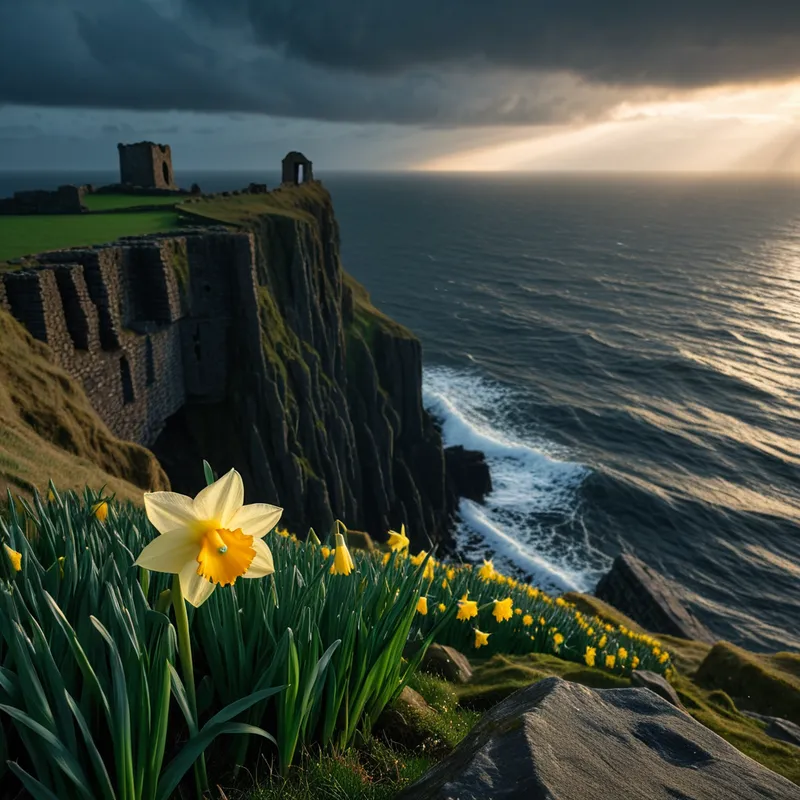
Dewi Sant felt the weight of their silent despair in his own bones. He withdrew to a lonely place where the land met the roaring sea, a cliff edge known only to the hawks. The soil there was thin, a mere scattering over ancient rock, and the wind stole the warmth from every breath. He knelt, not on soft moss, but on the cold, unyielding ground. He did not pray for miracles of grandeur. He prayed the only prayer left: a prayer of utter offering. He poured out his own vitality, his own strength, his very hope for the future, into the barren earth beneath his hands. It was not a transaction, but a gift—a final seeding.
As his prayer ended, a great exhaustion took him, and he lay upon the ground as if returning to it. The people, finding him, wept, believing the last light of their hope had gone out. But as their tears fell upon the same dark soil where the saint had poured out his soul, a wonder stirred.
Where his hands had pressed, and where their tears had fallen, the earth trembled. Not with violence, but with a gentle, persistent pushing. From the very heart of that barren, recipient ground, a spear of pure, vibrant green pierced the grey. It grew swiftly, unfurling a bud sheathed in pale light. Then, with a sound like a soft sigh, it opened.
It was a flower of such gold it seemed to have captured the sun itself. A trumpet of brilliant yellow blazed from a star of paler petals, defiant against the leaden sky. It was the first daffodil. Its fragrance was not heavy, but clean and sharp, cutting through the mist of despair. Where one bloomed, others followed, until the hillside was a cascade of golden light, rolling down towards the villages. The winter in the people’s hearts broke at the sight. The flower was not a reward; it was the saint’s final, embodied prayer, blooming eternally from the ground of sacrifice.
Cultural Origins & Context
The figure of Dewi Sant (St. David) is a historical anchor in early Welsh Christianity, a 6th-century bishop whose monastic rule emphasized austerity and hard labor. His feast day, March 1st, coincides with the traditional beginning of spring in Wales. The daffodil, whose Welsh name Cenhinen Pedr hints at an older, possibly pre-Christian connection to the more ancient national symbol of the leek, only became formally associated with him and the nation much later, around the 19th century.
This myth, therefore, is not a medieval chronicle but a folkloric crystallization—a story that grew in the collective imagination of the Welsh people, told around hearths and in chapels. It served a crucial societal function: to bind national identity, Christian piety, and the profound, cyclical rhythms of the natural world into a single, resonant narrative. It transformed a historical religious figure into a culture hero whose ultimate act was one of generative care, ensuring his people would never be without a visible, annual sign of hope. The story was passed down not by bards of the old courts, but by the common people, for whom the struggle against winter—both literal and spiritual—was a matter of survival.
Symbolic Architecture
At its core, the myth is an alchemical map of the soul’s transformation through self-expenditure. The barren cliff represents a state of psychological or spiritual aridity, a dark night of the soul. Dewi Sant embodies the archetype of the one who holds the light for the community, but here, he does not merely shine it upon them; he pours his own light into the shared ground of their despair.
The most profound hope is not found by clinging to one’s own light, but by having the courage to plant it in the darkest soil, trusting it will take a form you will never live to see.
The daffodil is the perfect symbol for this process. It is a perennial that dies back completely, its life force retreating into a hidden bulb through the long winter. Its glorious golden return is entirely dependent on this period of hidden decay and storage. Psychologically, the daffodil represents the new consciousness, the renewed attitude, or the creative life that can only emerge after a period of introversion, sacrifice, and the “composting” of the old self. The trumpet is a symbol of proclamation and announcement—not of the saint’s glory, but of life’s stubborn, beautiful return.
The Dreamer’s Resonance
When this mythic pattern stirs in the modern dreamer, it often manifests in dreams of barren landscapes, frozen ground, or a feeling of exhausting one’s last resources. One might dream of planting seeds in concrete, or of giving away a cherished, glowing object. The somatic experience is one of profound depletion paired with a strange, compelled generosity.
This dream-state signifies a critical juncture in a psychological process. The ego has striven, managed, and conserved, but has reached its limit. The dream is presenting the necessity of the saint’s gesture: to stop trying to solve the inner winter from a place of scarcity, and to instead make a radical, trusting offering of one’s remaining energy back to the unconscious itself (the fertile, dark earth). It is the psyche’s instruction to initiate a sacred surrender. The tears that water the ground in the myth are crucial here—they represent the release of grief and self-pity that must accompany the offering, making it genuine. The dreamer is being guided to trade control for potential, to trust that the psyche has its own seasons and will, in time, yield its own golden bloom from this act of faith.
Alchemical Translation
The individuation process modeled here is not one of heroic conquest, but of compassionate dissolution and regeneration. The modern individual is called to become the saint and the ground, the sacrificer and the recipient.
The first stage is Recognizing the Collective Winter: Seeing not just one’s personal depression or stagnation, but understanding it as a shared human condition, a “coldness of the heart” that affects one’s world.
The second is The Withdrawal to the Bare Cliff: This is conscious introversion—stepping back from the demands of the persona and the outer world to confront the bare, essential truth of one’s situation, without comfort or illusion.
The third and most critical is The Prayer of Expenditure: This is the alchemical nigredo. It is the conscious decision to offer up one’s current identity, ambitions, and ego-strength—to “compost” them—into the service of something greater than self-preservation. It is investing in the future self one cannot yet imagine.
The gold of the daffodil is not mined; it is grown. It is the visible form of an invisible sacrifice, proving that what is given to the depths is not lost, but transmuted.
The final stage is Blooming in Absence: The saint does not see the flower. The new consciousness, the renewed life (the daffodil), belongs to the world, to the community, to the future. The individual’s triumph is in becoming fertile ground for a beauty that transcends them. For the modern soul, this translates into engaging in creative acts, compassionate service, or foundational work whose full fruit they may never witness, trusting that their sincere offering becomes part of the eternal, golden return of spring in the human spirit. The daffodil thus becomes an emblem of hope that is earned, not wished for—a hope forged in the dark earth of genuine surrender.
Associated Symbols
Explore related symbols from the CaleaDream lexicon: