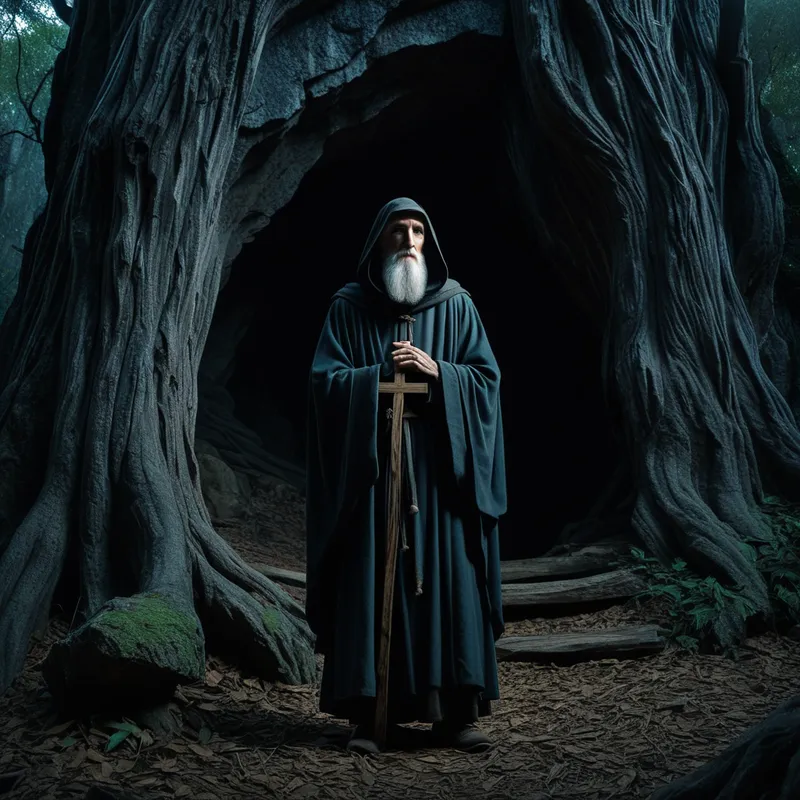
St. Benedict Myth Meaning & Symbolism
A young man flees Rome's decadence, confronts demons in a cave, and forges a sacred rule of balance, becoming a father to Western monasticism.
The Tale of St. Benedict
Listen, and hear the tale of a soul who sought the desert in a world drunk on its own ruin.
The great city, Rome, groaned under the weight of its own glory. Its marble was cold, its forums echoed with hollow debates, and young Benedictus saw in its splendor only a magnificent tomb. His heart, a bird trapped in a gilded cage, beat for a different air. So he turned his back on the studies meant to chain him to that dying world, and he fled. He took nothing but a nurse’s love and a hunger for the absolute.
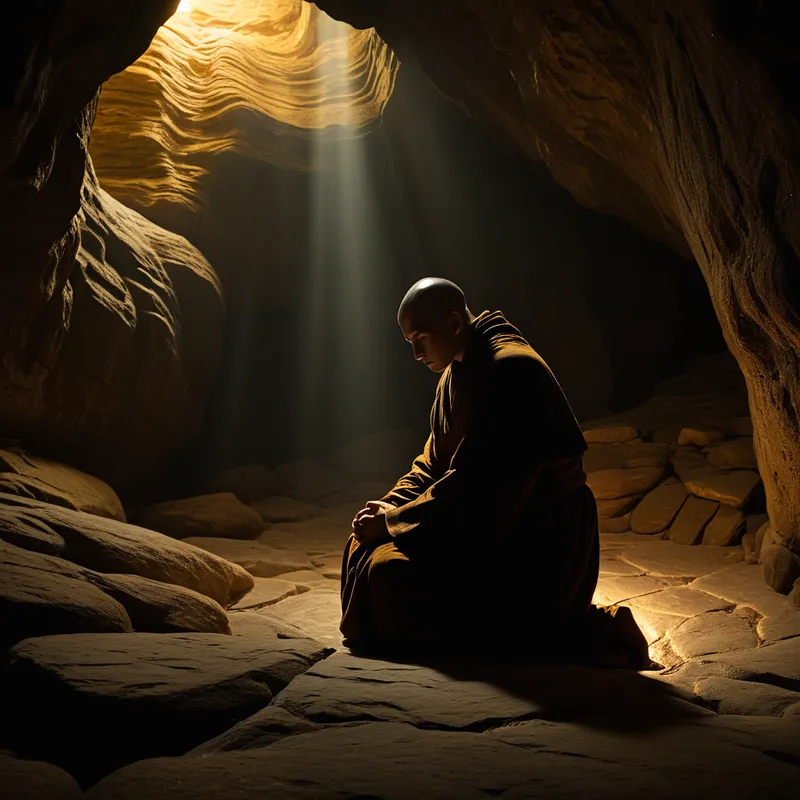
His flight led him to the wild mountains of Subiaco, to a cave so high and hidden it seemed a wound in the face of the cliff. Here, in the Sacra Speco—the Holy Cave—he met the true curriculum of the spirit. For three years, he was a man erased. Dressed in rough skins, fed only by the faithful heart of the monk Romanus who lowered bread from the cliff above, Benedict wrestled with the emptiness. But the desert without soon became the desert within. His greatest trial was not hunger or cold, but memory. The ghost of a woman he had once glimpsed in Rome—a vision of alluring, worldly beauty—rose before him in the cave’s darkness, a fiery temptation to abandon his lonely vigil. In a moment of supreme agony, he threw himself into a thicket of sharp thorns and nettles, scarring his flesh to reclaim his soul. The phantom vanished, leaving him bleeding but free.
Word of the holy hermit seeped into the valleys. A community of monks, their own rule grown slack, begged him to be their abbot. Reluctantly, he descended from his cave. He tried to impose order, a taste of the divine discipline he had learned in solitude. They, accustomed to comfort, rebelled. In the blackest betrayal, they poisoned his wine. But as Benedict made the sign of the cross over the cup, it shattered as if struck by a stone, revealing the murder in their hearts. He returned to his cave, but not alone. Disciples now came, souls starved for the substance he possessed. He built twelve small monasteries, like beacons on the hillsides.
Yet his final and greatest work awaited him further south, at Monte Cassino. Here, upon a pagan height where Apollo was once worshipped, he faced the old gods in their last stronghold. The local people still made offerings at the altar of Apollo. Benedict, with the quiet force of a river carving stone, prayed, preached, and finally toppled the idol and shattered its altar. In its place, he raised oratories to Saint Martin and Saint John the Baptist. But the Devil</ab title> did not yield easily. Once, as the brethren built the monastery, a massive stone block resisted all efforts to move it. Benedict prayed, and the invisible weight was lifted. At another time, the Evil One appeared in the kitchen as a terrifying little black boy, whose presence was revealed only when Benedict ordered a young monk to pull him out by his hair—a vision seen only by the abbot’s spiritual sight.
In this place of reclaimed ground, Benedict penned his Rule. It was not a shout of ascetic fury, but a measured, compassionate melody for communal life. Ora et Labora—Prayer and Work. The day was to be a balanced rhythm of divine office, sacred reading, and manual labor. The abbot was to be a father, the monastery a stable school for the Lord’s service. Here, in this ordered peace, Benedict’s sight grew so keen he perceived the whole world gathered in a single ray of sunlight. And when the time of his departure came, he had himself carried to the oratory, received his final communion, and died standing, supported by his brothers, his arms uplifted in prayer, as if his very death was a final, sustained note in the song he had spent his life composing.
Cultural Origins & Context
The myth of Benedict is woven from threads of history, hagiography, and profound cultural necessity. Our primary source is the Dialogues of Pope Gregory the Great, written around 593-594 AD. This was not a modern biography but a spiritual portrait, composed a generation after Benedict’s death (traditionally 547 AD) from the oral testimonies of the saint’s disciples. Gregory’s aim was edification, to show “a man of God” for a world in collapse. The Roman Empire in the West had fallen; Italy was ravaged by war, famine, and political fragmentation. In this apocalyptic landscape, Benedict’s story functioned as a cultural and spiritual survival manual. It presented a radical alternative to the decaying civitas: the ordered, self-sufficient, prayerful monasterium.
The myth was propagated by the Benedictine Order itself, which, following its Rule, became the primary engine of literacy, agriculture, and stability throughout the early Middle Ages. Monasteries became arks preserving not just faith, but classical knowledge, law, and art. The myth of Benedict—the man who replaced the chaos of a fallen world with a “school of charity”—provided the foundational charter for this civilization-saving project. He became the “Father of Western Monasticism,” a patriarch whose symbolic authority was invoked to sanctify the daily grind of communal life and the immense project of European cultural rebirth.
Symbolic Architecture
At its core, the myth of Benedict is a masterclass in the psychology of resistance and the establishment of a conscious cosmos against the entropic pull of the unconscious.
The flight from Rome symbolizes the necessary withdrawal of the ego-consciousness from identification with a dominant but decaying cultural complex. It is the first, courageous act of differentiation: “This collective value is not my truth.”
The cave in Subiaco is the nigredo of the alchemical process, the descent into the solitary crucible of the psyche. Here, Benedict confronts his own shadow—not as abstract evil, but as the alluring memory of worldly pleasure and comfort. The struggle with the phantom woman and the subsequent act of throwing himself into thorns is a brutal, concrete image of enantiodromia—using one extreme (self-mortification) to break the spell of its opposite (hedonistic possession). It is the ego actively engaging the autonomous complex to break its power.
The true battleground is not the world, but the point where the world has taken root within the soul.
The founding of Monte Cassino upon a ruined pagan temple is the myth’s central architectural symbol. It represents the conscious integration of the psychic territory. The old, instinctual patterns (the pagan altar) are not ignored or merely fought; they are deliberately dismantled, and their energy is redirected (“consecrated”) to a new, conscious center (the oratories). The Rule itself is the crowning symbol of this achieved order. It is the Lapis Philosophorum of the myth—a tangible, workable system that balances opposites: prayer and work, silence and community, authority and compassion, solitude and fellowship. It is the psyche’s constitution.
The Dreamer's Resonance
When this myth stirs in the modern dreamer, it often signals a profound crisis of orientation and a call to establish inner authority. One may dream of:
- Fleeing a collapsing city or institution: This mirrors Benedict’s flight from Rome. The dream ego recognizes that an external structure (a job, a relationship, a belief system) that once provided identity is now spiritually toxic or disintegrating. The somatic sensation is often of suffocation or frantic escape.
- Being in a cave, cellar, or isolated room: This is the Subiaco phase. The dreamer is in a forced or chosen retreat, facing the raw contents of their own psyche—boredom, loneliness, temptation, despair. The body may feel heavy, cold, or paralyzed.
- A beautiful but threatening figure offering a return to an old life: The shadow in its seductive, anima/animus form. It promises an end to the painful isolation by regressing to a former, more comfortable but less conscious state.
- Building or repairing a structure on unstable ground: This is the Monte Cassino work. The dreamer is attempting to establish a new inner order—a new routine, a creative practice, a psychological boundary—but feels sabotaged by old habits (the “pagan altars” of addiction, resentment, or laziness) or unseen forces (the “demons in the kitchen” of irritability and petty frustrations).
The process indicated is one of containment. The dreamer is undergoing the difficult labor of building an inner monastery—a disciplined, resilient structure of consciousness capable of withstanding both the chaos of the outer world and the sabotage from within.

Alchemical Translation
The alchemical journey of the Benedict myth maps perfectly onto the individuation process. The prima materia is the gifted but disillusioned young noble in corrupt Rome—the psyche identified with a collective value that has lost its soul.
The Calcinatio (burning) is the flight and the cave: the fiery isolation that burns away worldly attachments and social persona, reducing the ego to its essential, stark core.
The Solutio (dissolving) is the confrontation with the temptress and the descent into the thorns: the ego is dissolved in the waters of its own passion and pain, confronting the shadow in a liquefying crisis.
The Coagulatio (coagulating) begins with the founding of the first communities and culminates at Monte Cassino. The insights and discipline gained in solitude now precipitate into a solid, communal form. The dispersed psychic elements start to coalesce around a new center.
The Sublimatio (sublimating) is the writing of the Rule. The raw experiences of struggle, vision, and practical management are distilled into a transcendent principle—a guiding law that is both spiritual and utterly practical. This is the spirit made flesh in daily routine.
Individuation is not a departure from the world, but the construction of a sacred precinct within it from which one can engage the world without being dissolved by it.
Finally, the Mortificatio and Exaltatio are seen in Benedict’s death. The mortal body dies (mortificatio), but the posture is one of prayerful, supported ascent (exaltatio). The achieved Self, the integrated personality shaped by the Rule, does not simply end; it is offered up, completing its work. The ultimate alchemical gold forged in this process is not perfection, but balance; not escape, but grounded sanctity; a soul capable of seeing the whole world in a ray of light because it has first learned to order the small world of its own cell.
Associated Symbols
Explore related symbols from the CaleaDream lexicon: