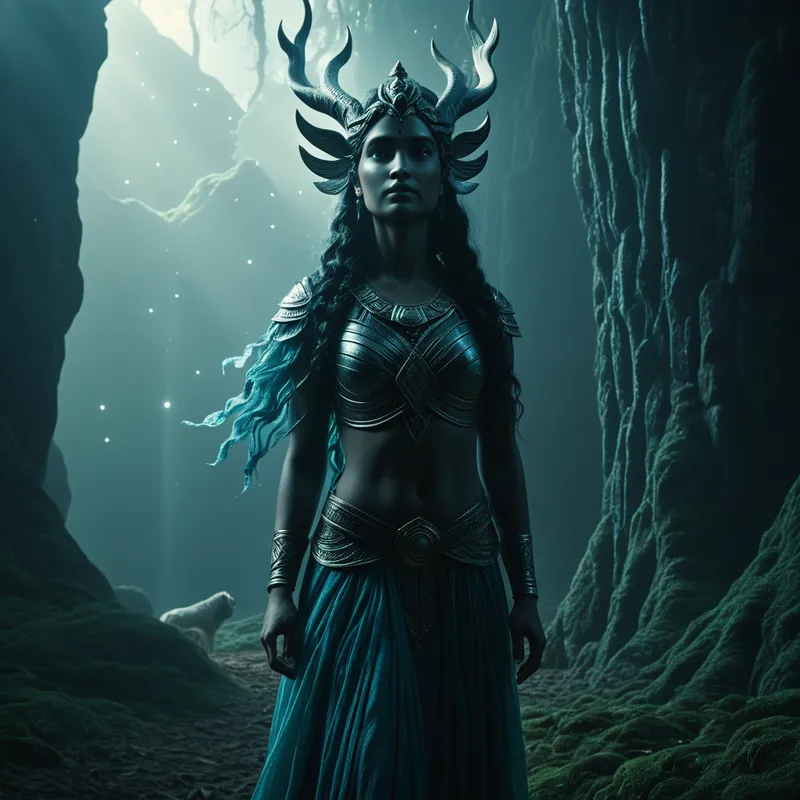
Srivijaya Maritime Kingdom
A powerful thalassocracy that controlled the strategic Strait of Malacca, blending Hindu-Buddhist influences to become a legendary center of trade and learning.
The Tale of Srivijaya Maritime Kingdom
The tale begins not on land, but in the breath between waters. In the murmuring strait where the monsoon winds conspire, a kingdom was dreamed into being not by the sword, but by the current. Srivijaya was less a place than a presence—a great, invisible net cast across the Strait of Malacca. Its capital, a city of wood and spirit perched on the Musi River, was a threshold where [the world](/myths/the-world “Myth from Tarot culture.”/) met. Here, the deep-drafted ships of Persia, the elegant junks of Cathay, and the sturdy vessels of the Chola met in a silent, floating parliament of commerce.
For centuries, the Srivijayan thalassocracy held the key to the spice routes, the passage for silks and sandalwood, [porcelain](/myths/porcelain “Myth from Chinese culture.”/) and pilgrims. Its power was not hoarded in vaults but flowed like the tides, sustained by a sacred compact: protection for tribute, safe passage for loyalty. The king was not merely a ruler but a Dharmaraja, a king of cosmic law, whose authority was mirrored in the grand stupas and monasteries that rose like spiritual mountains from the coastal plains. Palembang became a beacon of Buddhist learning, a university of the soul where scholars from across Asia gathered to translate sutras, their debates humming with the same energy as the marketplace below.
Yet, the kingdom’s essence was fluid. It built no vast, enduring stone cities; its architecture was of relationship and ritual, its monuments the intangible networks of trust and knowledge. Its might was the might of the intermediary, the keeper of the gate. But a gate can be stormed, and a net can fray. The tale turns as the currents shift. The insatiable hunger of the Chola Empire across [the sea](/myths/the-sea “Myth from Greek culture.”/) erupted in violent raids, piercing the heart of the realm. The silting of rivers choked its ports, as if the very earth withdrew its favor. Vassals, sensing the weakening of the central pulse, began to chart their own courses. The trade winds began to blow towards new harbors.
The decline was not a dramatic fall, but a slow dissolution—a forgetting. The great fleet diminished; the scholarly hum faded to a whisper. The capital, once vibrant, was gradually reclaimed by the insistent green of the Sumatran jungle. Srivijaya did not so much collapse as it receded, like a tide going out, leaving behind scattered artifacts, half-remembered chronicles in Chinese texts, and a ghostly imprint on the regional memory. It vanished so completely that for centuries it was considered a myth, a legend whispered by the strait, until modern archaeology began to piece together its shadow from the silty riverbeds.
Cultural Origins & Context
Srivijaya emerged in the 7th [century](/myths/century “Myth from Biblical culture.”/) from the rich, alluvial soup of coastal Sumatra. It was a product of the [mandala](/myths/mandala “Myth from Buddhist culture.”/) political model, where power radiated from a charismatic center in concentric circles of influence, not fixed borders. This was a world animated by the interplay of indigenous Austronesian sea-culture and the profound influx of Hindu-Buddhist cosmology from the Indian subcontinent.
The indigenous worldview was inherently amphibious. The sea was not a barrier but a connective highway; communities were fluid, their identity linked to maritime skill and clan networks. Into this, Indian concepts of divine kingship, bureaucratic statecraft, and transcendental philosophy were grafted. The Srivijayan kings mastered this alchemy. They adopted the Sanskrit language and the Mahayana Buddhist faith, not as foreign impositions, but as powerful tools to legitimize and unify their sprawling, [water](/myths/water “Myth from Chinese culture.”/)-borne realm. The kingdom became a critical synapse in the transmission of Buddhism from India to China and beyond.
This cultural context was fundamentally mercantile and pragmatic. Spirituality and commerce were not opposing forces but parallel streams feeding the same reservoir of power. The wealth generated from controlling tariffs and trade in gold, spices, and aromatics directly funded the monastic universities and grand ceremonies. The kingdom’s power was thus a hybrid creature: part Austronesian trader-chieftain, part Indian Dharmaraja, all sustained by the relentless rhythm of the monsoon and the global desire for the treasures of the East.
Symbolic Architecture
The [architecture](/symbols/architecture “Symbol: Architecture in dreams often signifies structure, stability, and the framing of personal identity or life’s journey.”/) of Srivijaya was an architecture of flow and interface. Its grandest physical structures were the Buddhist [temple](/symbols/temple “Symbol: A temple often symbolizes spirituality, sanctuary, and a deep connection to the sacred aspects of life.”/) complexes, like those potentially at Muara Jambi, which served as spiritual batteries and statements of cosmopolitan piety. But its true, invisible architecture was its network of entrepôts—coastal trading posts that functioned as psychic and economic valves regulating the flow of goods, ideas, and people.
The Strait of Malacca was Srivijaya’s primary temple—a vast, liquid nave where the rituals of exchange were daily prayer. The king’s palace was less a fixed building and more the entire maritime circuit, his throne room moving with the fleet.
The [kingdom](/symbols/kingdom “Symbol: A kingdom symbolizes authority, belonging, and a sense of identity within a larger context or community.”/) itself can be seen as a colossal, psychic [mandala](/symbols/mandala “Symbol: A sacred geometric circle representing wholeness, the cosmos, and the journey toward spiritual integration.”/). At its center sat the [king](/symbols/king “Symbol: A symbol of ultimate authority, leadership, and societal order, often representing the dreamer’s inner power or external control figures.”/) and the primary [stupa](/symbols/stupa “Symbol: A Buddhist monument representing enlightenment, the Buddha’s mind, and the path to spiritual awakening through its architectural symbolism.”/), representing [Mount Meru](/myths/mount-meru “Myth from Hindu culture.”/), the [axis](/symbols/axis “Symbol: A central line or principle around which things revolve, representing stability, orientation, and the fundamental structure of reality or consciousness.”/) of the world. The radiating circles were the successive layers of loyal ports, allied riverine chiefs, and tributary states. This was a psychological as much as a political [structure](/symbols/structure “Symbol: Structure in dreams often symbolizes stability, organization, and the framework of one’s life, reflecting how one perceives their environment and personal life.”/), a shared map of [reality](/symbols/reality “Symbol: Reality signifies the state of existence and perception, often reflecting one’s understanding of truth and life experiences.”/) where everyone knew their place in relation to the sacred, prosperous center. The constant journeying of ships was the [mandala](/symbols/mandala “Symbol: A sacred geometric circle representing wholeness, the cosmos, and the journey toward spiritual integration.”/) in [motion](/symbols/motion “Symbol: Represents change, progress, or the flow of life energy. Often signifies transition, personal growth, or the passage of time.”/), a perpetual cycle of [departure](/symbols/departure “Symbol: A transition from one state to another, often representing change, growth, or leaving behind the familiar.”/) and return that kept the cosmic and economic order in balance.
The Dreamer’s Resonance
To dream of Srivijaya is to dream of potent, fluid authority and its haunting evaporation. It resonates with the part of the [psyche](/myths/psyche “Myth from Greek culture.”/) that understands power as influence, connection, and cultural prestige rather than brute force. It is the archetype of the networker, the diplomat, the gracious host who gains strength from facilitating the journeys of others.
This dream-image also carries the profound shadow of [impermanence](/myths/impermanence “Myth from Buddhist culture.”/). It speaks to the anxiety that our influence, built on shifting alliances and temporal advantages, has no permanent foundation. The Srivijaya within may be that brilliant, syncretic phase of [the self](/myths/the-self “Myth from Jungian culture.”/)—where we successfully blend different inner “cultures” (skills, identities, roles) to create a period of great productivity and esteem. Its decline mirrors the psychological experience when external circumstances (a “Chola raid” of crisis or competition), internal changes (the “silting” of our motivation or health), or the independence of inner “vassals” (aspects of our personality breaking away) lead to a loss of that cohesive, central authority. The kingdom’s disappearance into legend reflects how periods of our own past power and integration can later feel like half-remembered myths, leaving only fragments of confidence and vague nostalgia for a time when everything was connected.

Alchemical Translation
The alchemy of Srivijaya is the transformation of water (the chaotic, potential-filled sea of opportunity) into gold (spiritual and material wealth) through the application of order (the mandala, [the law](/myths/the-law “Myth from Biblical culture.”/) of the Dharmaraja). It is the process of creating lasting meaning and structure from the flux of life. The kingdom was a grand psychological operation in which raw commercial energy was sublimated into religious art and scholarly pursuit, and spiritual authority was, in turn, used to sanctify and stabilize commercial enterprise.
Its decline is the final, necessary stage of this alchemy: the solve, the dissolution. The fixed structures (the political order, the trade monopoly) are broken down and returned to the prima materia—the jungle, the scattered communities, the forgotten scripts. This is not failure, but a return to source, making space for new compounds to form. The lost kingdom becomes the philosopher’s stone of Southeast Asian history—the elusive goal that fuels the search for understanding, reminding us that all synthesis contains within it the seed of its own diffusion.
The personal alchemy involves recognizing our own “thalassocratic” periods, where we rule through connection and synthesis. It asks: What straits do I control? What networks sustain me? And when the inevitable dissolution comes, can I witness it not as a catastrophe, but as the completion of an arc, returning my refined “gold” to the psyche’s ocean to nourish futures I will not see?
Associated Symbols
Explore related symbols from the CaleaDream lexicon:
- Ocean — The primordial source and field of action for the kingdom, representing boundless potential, connection, and the unconscious depths from which empires rise and into which they fade.
- River — The lifeblood of the capital, a flowing conduit of goods and people that links the inland resources to the maritime realm, symbolizing sustenance and the journey from source to delta.
- Bridge — The essential function of Srivijaya as a connector between cultures, continents, and spiritual worlds, a structure of passage and integration built over the waters of difference.
- Trade — The animating principle and circulatory system of the kingdom, representing dynamic exchange, negotiated value, and the flow of energy that creates and sustains complex systems.
- King — The Dharmaraja, the central axis of the worldly and cosmic mandala, embodying ordained authority, responsibility, and the fragile point where spiritual law meets material administration.
- Ring of Power — The cyclical, encompassing nature of the thalassocracy’s influence, a dominion that ruled not land but sea-lanes, a binding circle of alliance and control that had no beginning or end.
- Ruins of Power — The haunting legacy of Srivijaya, the overgrown foundations and silted ports that speak of grandeur lost to time, symbolizing the inevitable decay of temporal structures and their return to [the earth](/myths/the-earth “Myth from Hindu culture.”/).
- Power Dynamics — The essential study of Srivijaya’s existence, the subtle and shifting relationships between center and periphery, patron and client, protector and merchant that constituted its living fabric.
- Journey — The constant state of being for the kingdom and its people, embodied in the perpetual movement of ships; it represents life as passage, the quest for knowledge, and the pilgrimage for profit and merit.
- Mask — The sophisticated diplomatic and syncretic face Srivijaya presented to the world, adeptly wearing Hindu-Buddhist and indigenous guises to facilitate its role as the universal intermediary.
- Forest — The entity that patiently reclaims the abandoned capital, representing the untamed, consuming growth of nature and the unconscious that waits beyond the borders of human order and ambition.
- Dream — The kingdom’s later historical existence as a half-remembered legend, paralleling the psyche’s capacity to hold fragments of past grandeur that feel more like luminous visions than concrete reality.