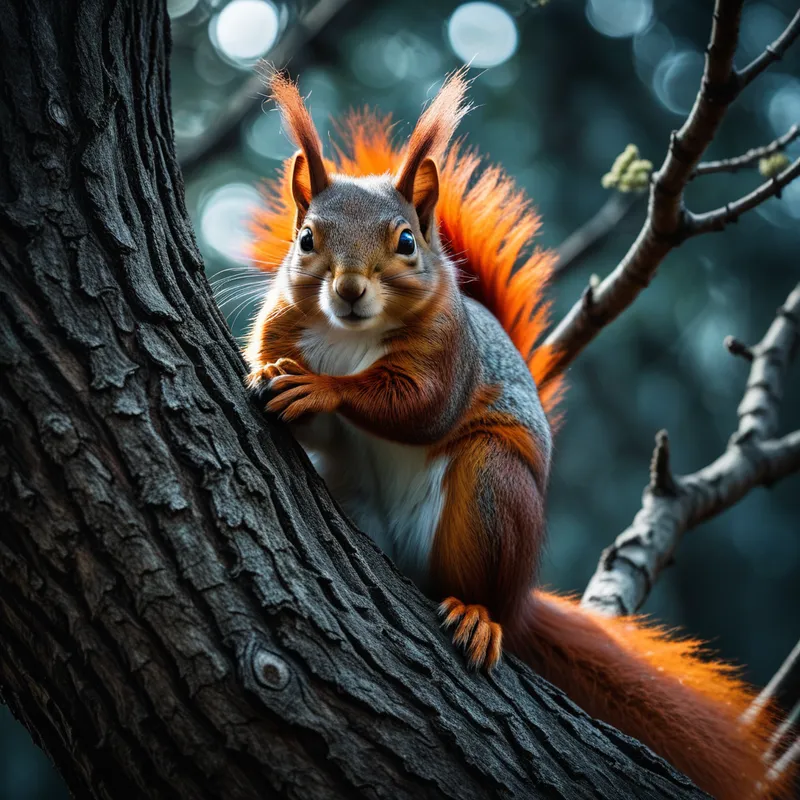
Squirrel Ratatoskr Myth Meaning & Symbolism
A squirrel scurries on the World Tree, carrying insults between the eagle of wisdom and the serpent of the deep, embodying the psyche's internal provocateur.
The Tale of Squirrel Ratatoskr
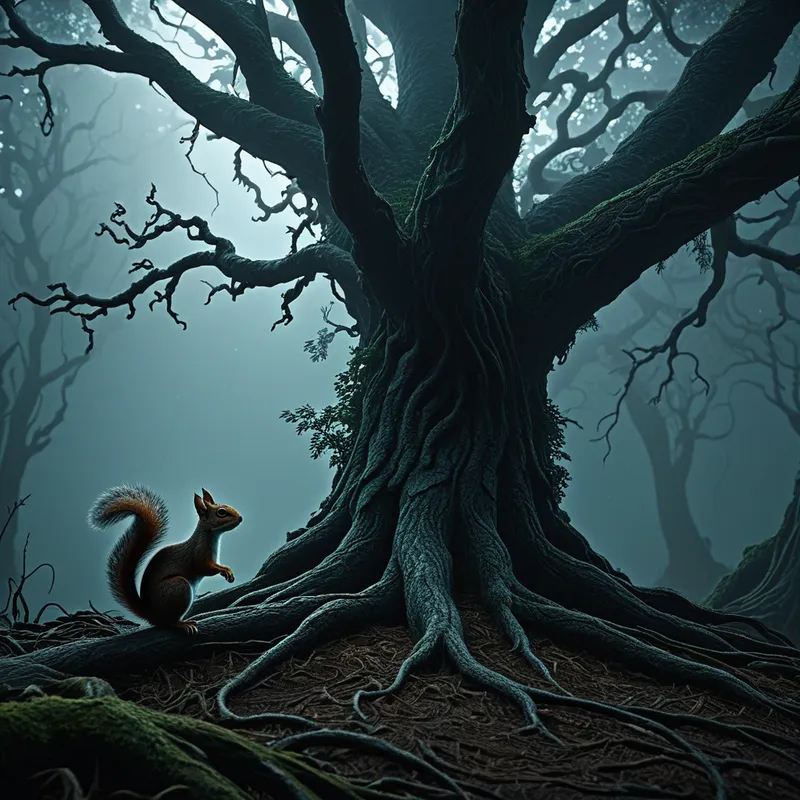
Hear now of the great Ash, [Yggdrasil](/myths/yggdrasil “Myth from Global/Universal culture.”/), whose roots drink from wells of memory and fate, whose branches hold [the nine worlds](/myths/the-nine-worlds “Myth from Norse culture.”/) in their embrace. It is a tree of groaning silence and immense, patient life. But upon its trunk, a ceaseless, chattering motion runs.
Look to the highest bough, where [the wind](/myths/the-wind “Myth from Various culture.”/) screams and [the sky](/myths/the-sky “Myth from Persian culture.”/) is thin. There perches the great eagle, its eyes seeing the turn of ages, its mind holding the cold wisdom of the heights. Its gaze sweeps the worlds below, and its thoughts are vast and slow as glaciers.
Now plunge your sight down, down through the dark, to where the three great roots clutch [the earth](/myths/the-earth “Myth from Hindu culture.”/). Here, in the dripping gloom of [Niflheim](/myths/niflheim “Myth from Norse culture.”/), the monstrous dragon [Nidhogg](/myths/nidhogg “Myth from Norse culture.”/) coils. Its scales are the black of forgotten things, and with tireless, venomous teeth, it gnaws. It gnaws at the root of the Tree, a low, constant grind of resentment, chewing on the corpses of the slanderous dead.
Between these two—the lofty, sighted head and the dark, gnawing tail of [the world](/myths/the-world “Myth from Tarot culture.”/)—a spark of mischief runs. It is [Ratatoskr](/myths/ratatoskr “Myth from Norse culture.”/), the squirrel. His fur is the red of autumn fire or a flickering tongue. His claws are needle-sharp, finding purchase in the sacred bark without a thought. He is never still.
He descends. Down the colossal trunk he scampers, through the mists of [Jotunheim](/myths/jotunheim “Myth from Norse culture.”/), past the halls of gods and men, until he reaches the wet, resonant dark of the roots. There, he chitters at the coiled darkness.
“O Nidhogg!” he calls, his voice a bright scratch in the gloom. “The eagle above calls you a witless worm. He says your gnawing is the fret of a maggot, that you know nothing but base decay. He laughs at your darkness from his seat in the sun!”
A rumble shakes the roots. Nidhogg’s eyes slit open, glowing with ancient malice. A hiss, thick with poison, fills the air. [The dragon](/myths/the-dragon “Myth from Chinese culture.”/)’s grinding grows fiercer, more intent.
Satisfied, Ratatoskr turns. Up he goes, a red streak against the grey bark, past the well of fate, through the branches that cradle the stars, until he is at the wind-lashed crown. He addresses the eagle.
“Great watcher!” he chirps, bold and impudent. “The serpent below spews venom at your name. He calls you a pompous, wind-blown fool, blind to the truths that fester in the deep. He scorns your lofty silence and vows to chew the Tree from under you!”
The eagle shifts, its feathers ruffling with a sound like distant thunder. Its piercing gaze hardens. A cold wrath gathers in its high heart.
And Ratatoskr, his message delivered, turns again. Down he runs, carrying the eagle’s fresh contempt to the depths. Up he scurries, bearing the dragon’s renewed venom to the heights. A perpetual circuit of provocation. A never-ending relay of insult. He does not create the conflict, no. He is the vein through which the animosity flows, the swift, chattering heartbeat of a quarrel that sustains the very tension of the world.
Cultural Origins & Context
This myth survives in the Poetic Edda, specifically within the poem Grímnismál, and is reiterated in Snorri Sturluson’s Prose Edda. It is not the center of a grand saga but a vivid, almost anecdotal detail within the vast descriptive tapestry of Yggdrasil’s ecology. Its tellers were skalds and poets for whom the cosmos was an interconnected, animate system, brimming with beings both grand and minute, each playing a role in the dynamic equilibrium of the whole.
The societal function of such a myth is multifaceted. On one level, it is a cosmological explanation for natural phenomena—perhaps for the rustling of leaves (Ratatoskr’s running) or for the tension between sky and earth. On a deeper, more human level, it models a profound understanding of social and psychological dynamics. In a culture built on honor, insult, and complex speech-acts (like [the flyting](/myths/the-flyting “Myth from Norse culture.”/), or verbal duel), Ratatoskr embodies the dangerous, vital power of the message-bearer, the gossip, the one who carries words. He is a reminder that communication is never neutral; it is a force that can either heal or inflame, and the messenger is an active participant in the energy they transmit.
Symbolic Architecture
Ratatoskr is the archetypal agent of stirring. He is not the [pole](/symbols/pole “Symbol: A pole in dreams often symbolizes stability, support, or a point of reference in life.”/) of wisdom ([eagle](/symbols/eagle “Symbol: The eagle is a symbol of power, freedom, and transcendence, often representing a person’s aspirations and higher self.”/)) nor the [pole](/symbols/pole “Symbol: A pole in dreams often symbolizes stability, support, or a point of reference in life.”/) of primal [resentment](/symbols/resentment “Symbol: A deep-seated emotional bitterness from perceived unfairness or injury, often festering silently and poisoning relationships.”/) (Nidhogg); he is the dynamic middle that ensures they remain in a state of creative, if destructive, [tension](/symbols/tension “Symbol: A state of mental or emotional strain, often manifesting physically as tightness, pressure, or unease, signaling unresolved conflict or anticipation.”/).
The messenger is not a passive conduit but an alchemical vessel; the very act of carrying the message transforms both the message and the carrier.
Psychologically, the eagle and [serpent](/symbols/serpent “Symbol: A powerful symbol of transformation, wisdom, and primal energy, often representing hidden knowledge, healing, or temptation.”/) represent a fundamental polarity within the [psyche](/myths/psyche “Myth from Greek culture.”/). The eagle is the soaring intellect, [consciousness](/symbols/consciousness “Symbol: Consciousness represents the state of awareness and perception, encompassing thoughts, feelings, and experiences.”/), [spirit](/symbols/spirit “Symbol: Spirit symbolizes the essence of life, vitality, and the spiritual journey of the individual.”/), and aspiration—the “high” mind that seeks overview and [clarity](/symbols/clarity “Symbol: A state of mental transparency and sharp focus, often representing resolution of confusion or attainment of insight.”/). The [serpent](/symbols/serpent “Symbol: A powerful symbol of transformation, wisdom, and primal energy, often representing hidden knowledge, healing, or temptation.”/) is the chthonic unconscious, the instinctual, the [shadow](/symbols/shadow “Symbol: The ‘shadow’ embodies the unconscious, repressed aspects of the self and often represents fears or hidden emotions.”/), the repressed and “low” energies that gnaw at the foundations of [the self](/myths/the-self “Myth from Jungian culture.”/). In a state of [dissociation](/symbols/dissociation “Symbol: A psychological separation from one’s thoughts, feelings, or identity, often experienced as a journey away from the self during trauma or stress.”/), these two forces ignore each other, leading to spiritual [inflation](/symbols/inflation “Symbol: A dream symbol representing feelings of diminishing value, loss of control, or expansion beyond sustainable limits in one’s life or psyche.”/) (the eagle detached from [reality](/symbols/reality “Symbol: Reality signifies the state of existence and perception, often reflecting one’s understanding of truth and life experiences.”/)) or morbid introversion (the [serpent](/symbols/serpent “Symbol: A powerful symbol of transformation, wisdom, and primal energy, often representing hidden knowledge, healing, or temptation.”/) consuming [the self](/myths/the-self “Myth from Jungian culture.”/)).
Ratatoskr prevents this stagnation. He is the function of provocation that forces [dialogue](/symbols/dialogue “Symbol: Conversation or exchange between characters, representing communication, relationships, and narrative flow in games and leisure activities.”/), however hostile. He is the nervous [energy](/symbols/energy “Symbol: Energy symbolizes vitality, motivation, and the drive that fuels actions and ambitions.”/) of [anxiety](/symbols/anxiety “Symbol: Anxiety in dreams reflects internal conflicts, fears of the unknown, or stress from waking life, often demonstrating the subconscious mind’s struggle for peace.”/), the inner critic, the sudden intrusive thought, or the [moment](/symbols/moment “Symbol: The symbol of a ‘moment’ embodies the significance of transient experiences that encapsulate emotional depth or pivotal transformations in life.”/) of [friction](/symbols/friction “Symbol: Friction represents resistance, conflict, or the necessary tension required for movement and transformation in dreams.”/) that forces a confrontation between what we aspire to be and what we fear we are. He ensures the psyche remains a living, dynamic [system](/symbols/system “Symbol: A system represents structure, organization, and interrelated components functioning together, often reflecting personal or social order.”/), where tension is not a flaw but a prerequisite for aliveness.
The Dreamer’s Resonance
To dream of a squirrel, particularly one that is frantic, chattering, or carrying something between two immense or opposing forces, is to encounter the Ratatoskr function in one’s own psyche. The somatic experience is often one of restless energy, a feeling of being “on edge” or caught in a loop of mental agitation.
This dream motif surfaces when the dreamer’s conscious attitude (the eagle) has become too rigid, too detached from emotional or instinctual realities. Conversely, it may appear when unconscious contents (the serpent) are festering in isolation, producing free-floating anxiety or somatic symptoms without a clear mental narrative. The dream-squirrel is the psyche’s attempt to initiate a process, however uncomfortable. It signals that a charged communication needs to happen between disparate parts of the self. The dreamer may be avoiding an inner conflict, and Ratatoskr appears to ensure the conflict cannot be ignored—he makes the insult known.

Alchemical Translation
The individuation process, the journey toward psychic wholeness, requires the confrontation and integration of opposites. The modern individual often seeks to eliminate tension—to silence the inner critic, to calm anxiety, to rise above base instincts. The myth of Ratatoskr proposes a different alchemy: the conscious engagement with the messenger of tension.
The goal is not to kill the squirrel, but to understand his route, to recognize that his scurrying path is the central axis of the self.
The first step is to identify the messenger. What is the recurrent, nagging thought, the pattern of gossip you engage in, the symptom of anxiety that seems to carry a message? This is your personal Ratatoskr. The second is to trace the route. Where is the “eagle” in your life—your lofty ideals, your spiritual aspirations, your [persona](/myths/persona “Myth from Greek culture.”/)? And where is the “Nidhogg”—your hidden resentments, your gnawing fears, your unacknowledged wounds?
The alchemical work is to intercept the squirrel. Not to stop him, but to listen to the messages he carries with a new ear. Instead of simply being inflamed by the insult (“I am worthless,” says the serpent; “You are better than this,” scorns the eagle), one must ask: What truth, however distorted, lies within this provocation? The eagle’s disdain may point to a genuine need for growth; the serpent’s resentment may guard a legitimate hurt that needs tending.
By consciously engaging with this internal circuit of communication, the individual transmutes raw insult into necessary feedback. The tension between spirit and instinct becomes a generative dialogue. The squirrel’s chaotic path up and down the world-tree becomes the sacred, spiraling path of self-knowledge, connecting the heavens of our potential with the roots of our being, making the whole tree tremble with vital, conscious life.
Associated Symbols
Explore related symbols from the CaleaDream lexicon: