
Spirits/Dancers Myth Meaning & Symbolism
In the world's beginning, primordial Spirits danced the land, sea, and sky into existence, their eternal movement sustaining the balance of all life.
The Tale of Spirits/Dancers
Listen. Before the first breath of wind, before the first cry of the [raven](/myths/raven “Myth from Haida culture.”/), there was only the Long Dark and the Great Silence. And in that Silence, there was a waiting. A potential, like a held breath in the chest of [the world](/myths/the-world “Myth from Tarot culture.”/).
Then, from the heart of the Silence, a pulse. A single, resonant beat that was not a sound, but a tremor in the fabric of what-was-not. From this pulse, the first Spirits stirred. They were not beings as we know them—they had no shape of bear or wolf, no face of man or woman. They were currents of intention, vortices of raw possibility adrift in [the void](/myths/the-void “Myth from Buddhist culture.”/).
And they were restless.
This restlessness became a swaying. The swaying became a rhythm. The rhythm became a step. One Spirit, then another, then a multitude, began to move. This was the First Dance. It was not a dance of joy or celebration, but a dance of becoming. Their movements were not random; they were the language of creation itself.
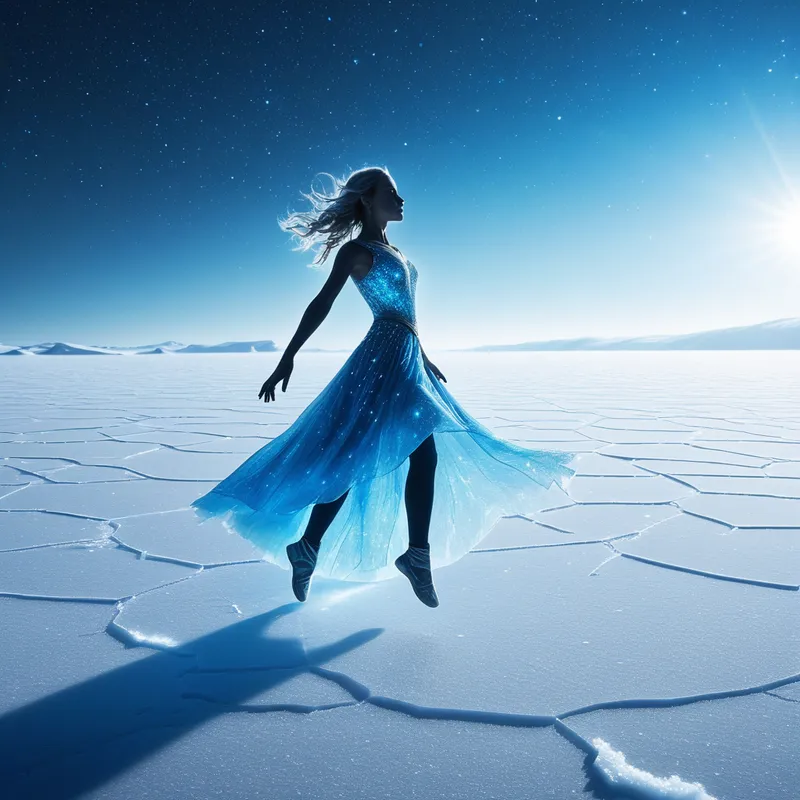
Where a Spirit swept its formless limb in a wide, arcing turn, the first winds howled into being, scouring the featureless dark. Where another stamped a complex, staccato rhythm with its essence, the first solid ground—rock and permafrost—congealed from the chaos. A Spirit whirling in a tight, furious spiral pulled the seas up from the depths and set them to churning. Others, moving in a slow, graceful procession, painted [the sky](/myths/the-sky “Myth from Persian culture.”/) with the shimmering veils of the Sky Dancers.
They danced the mountains up from the plains. They danced the rivers into their winding courses. They danced the leaping salmon, the lumbering bear, the cunning fox into existence, each creature born from a specific gesture, a unique cadence in the great choreography.
But the dance was wild, untamed. The world was raw and violent, a storm of competing creations. The Spirits, lost in their own power, began to collide. Mountains erupted where tundra should be. Oceans flooded newborn forests. The world teetered on the edge of dissolving back into the Silence.
Then, a new awareness entered the Dance. From the interplay of their movements, a pattern emerged—a great, slow heartbeat that underpinned all the frantic activity. The Spirits, one by one, felt this rhythm. They did not stop dancing—to stop was to let the world unravel—but they began to listen. To each other. To the world their dance was making.
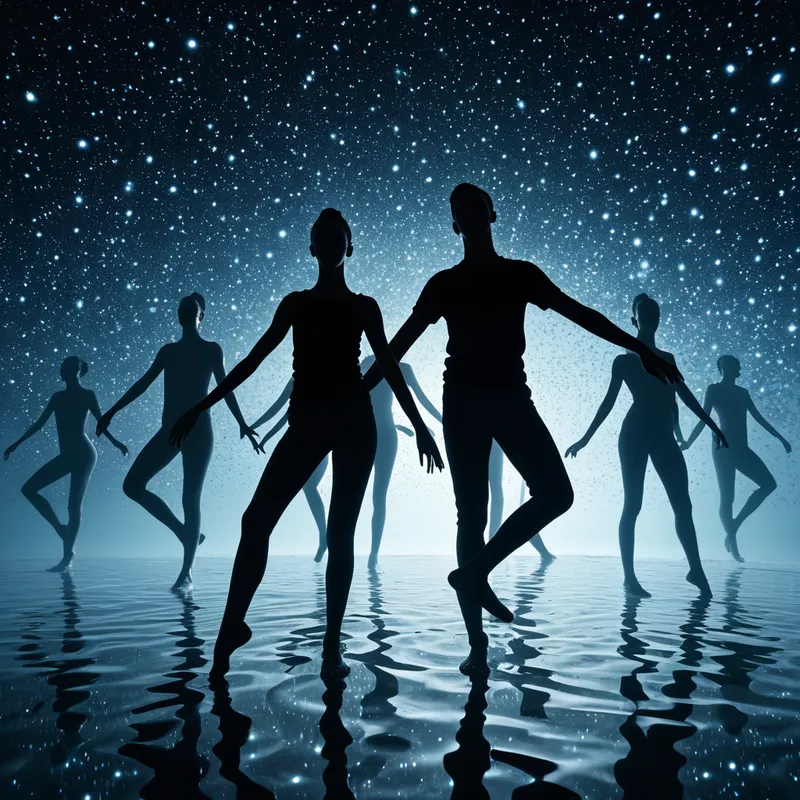
Their wild, individual movements began to weave together. The stamp that made [the earth](/myths/the-earth “Myth from Hindu culture.”/) now met the sweep that made [the wind](/myths/the-wind “Myth from Various culture.”/), and together they formed the rolling tundra. [The spiral](/myths/the-spiral “Myth from Celtic culture.”/) of [the sea](/myths/the-sea “Myth from Greek culture.”/) met the arc of the sky, and they defined [the horizon](/myths/the-horizon “Myth from Various culture.”/). The Dance transformed from a cacophony of creation into a symphony of balance. They became the Dancers of the World’s Breath, their eternal, coordinated motion the very pulse that keeps the ice frozen, the rivers flowing, and the seasons turning. They danced not to make, but to maintain. And in that shift from creation to sustenance, the world was truly born.
Cultural Origins & Context
This foundational narrative exists in myriad forms across the circumpolar world, among Inuit, Sámi, and other Arctic peoples. It is not a single, codified scripture, but a living truth embedded in the environment and oral tradition. The myth was—and is—passed down by elders and storytellers, not merely as a tale of “long ago,” but as an explanation of the present moment.
The societal function is profoundly practical and cosmological. It explains the terrifying and beautiful dynamism of the Arctic world: the grinding of sea ice, the sudden violence of a storm, the eerie beauty of the aurora. These are all visible manifestations of the ongoing Dance. The myth taught respect; if the Dancers are perturbed—by human greed, imbalance, or disrespect—their rhythm can falter, leading to poor hunts, broken ice, and starvation. Thus, rituals, songs, and even daily activities were often conceived as conscious, respectful movements within the greater Dance, a way for humans to find their step and not disrupt the harmony.
Symbolic Architecture
At its core, this myth presents [reality](/symbols/reality “Symbol: Reality signifies the state of existence and perception, often reflecting one’s understanding of truth and life experiences.”/) not as a [static](/symbols/static “Symbol: Static represents interference, disruption, and the breakdown of clear communication or signal, often evoking feelings of frustration and disconnection.”/) creation, but as a continuous, participatory [event](/symbols/event “Symbol: An event within dreams often signifies significant life changes, transitions, or emotional milestones.”/). The Spirits are archetypal forces of pure potential—the unconscious energies of the world-[soul](/symbols/soul “Symbol: The soul represents the essence of a person, encompassing their spirit, identity, and connection to the universe.”/) before they take defined form.
The world is not a noun, but a verb. It is not a thing made, but a process continually being enacted.
The initial chaotic dance represents the raw, unmediated power of the unconscious erupting into form. It is creative, but also destructive and self-consuming. The pivotal turn in the myth is not an act of domination, but of attunement—the Spirits begin to listen to the [pattern](/symbols/pattern “Symbol: A ‘Pattern’ in dreams often signifies the underlying structure of experiences and thoughts, representing both order and the repetitiveness of life’s situations.”/) emerging from their collective [action](/symbols/action “Symbol: Action in dreams represents the drive for agency, motivation, and the ability to take control of situations in waking life.”/). This symbolizes the [moment](/symbols/moment “Symbol: The symbol of a ‘moment’ embodies the significance of transient experiences that encapsulate emotional depth or pivotal transformations in life.”/) [consciousness](/symbols/consciousness “Symbol: Consciousness represents the state of awareness and perception, encompassing thoughts, feelings, and experiences.”/) arises from the unconscious, not as a separate ruler, but as a perceiving, integrating faculty. The Dance of sustenance is the [symbol](/symbols/symbol “Symbol: A symbol can represent an idea, concept, or belief, serving as a powerful tool for communication and understanding.”/) of the achieved [psyche](/myths/psyche “Myth from Greek culture.”/), where dynamic opposites (land/sea, wind/[stone](/symbols/stone “Symbol: In dreams, a stone often symbolizes strength, stability, and permanence, but it may also represent emotional burdens or obstacles that need to be acknowledged and processed.”/)) are held in a tense, ever-moving balance.
The [Human](/symbols/human “Symbol: The symbol of a human represents individuality, complexity of emotions, and social relationships.”/) Dancer in later, derived myths represents the individual ego’s [task](/symbols/task “Symbol: A task represents responsibilities, duties, or challenges one faces.”/): to learn the steps of this greater Dance, to move in [harmony](/symbols/harmony “Symbol: A state of balance, agreement, and pleasing combination of elements, often associated with musical consonance and visual or social unity.”/) with the larger patterns of [life](/symbols/life “Symbol: The symbol of ‘Life’ represents a journey of growth, interconnectedness, and existential meaning, encompassing both the joys and challenges that define human experience.”/) and instinct, rather than against them.
The Dreamer’s Resonance
When this myth stirs in the modern dreamer, it often manifests as dreams of potent, involuntary movement. One might dream of being compelled to dance in a vast, empty landscape, or of one’s body moving with a grace and power beyond waking capability. Alternatively, it may appear as dreams where the environment itself is alive and pulsing—buildings breathing, landscapes shifting rhythmically.
Somatically, this points to a process of profound psychic reorganization. The conscious mind is being asked to surrender its illusion of static control. The “dance” in the dream is the movement of deep, instinctual energies—creativity, emotion, primal life force—seeking expression and integration. The anxiety or exhilaration felt in the dream is [the ego](/myths/the-ego “Myth from Jungian culture.”/)‘s response to this upwelling. It is the psyche’s attempt to “find the rhythm” of a new phase of life, to move from a state of chaotic, internal conflict (the Spirits colliding) toward a state of fluid, embodied expression (the harmonious Dance).
Alchemical Translation
The alchemical journey mirrored here is the opus contra naturam—the work against nature—which ultimately becomes a work with nature. Initially, the raw [prima materia](/myths/prima-materia “Myth from Alchemical culture.”/) of the soul (the formless Spirits) acts with blind, natural force. [The first stage](/myths/the-first-stage “Myth from Alchemical culture.”/) of individuation is this chaotic eruption of contents from the unconscious: passions, ambitions, fears, all clamoring for form.
The crisis—the world near dissolution—is the necessary dark night of the soul, where the individual sees that unrefined, ego-driven creation leads to self-sabotage and chaos. The turning point is the development of a witnessing consciousness.
Individuation is not about stopping the dance, but about learning its true rhythm and becoming a conscious participant in its unfolding.
The modern individual’s “alchemical translation” is to take the chaotic, creative, or destructive energies within (the colliding Spirits) and not suppress them, but listen for the deeper pattern they are trying to form. This is the move from compulsive action to conscious movement. It is finding the step that harmonizes the inner wolf with the inner seal, the inner storm with the inner calm. The sustained Dance is the symbol of the individuated Self—not a fixed state of perfection, but a dynamic, lifelong process of balancing opposites, of creating and sustaining one’s world through attentive, respectful participation in the greater mystery. We do not invent the music, but we are responsible for learning how to dance to it.
Associated Symbols
Explore related symbols from the CaleaDream lexicon: