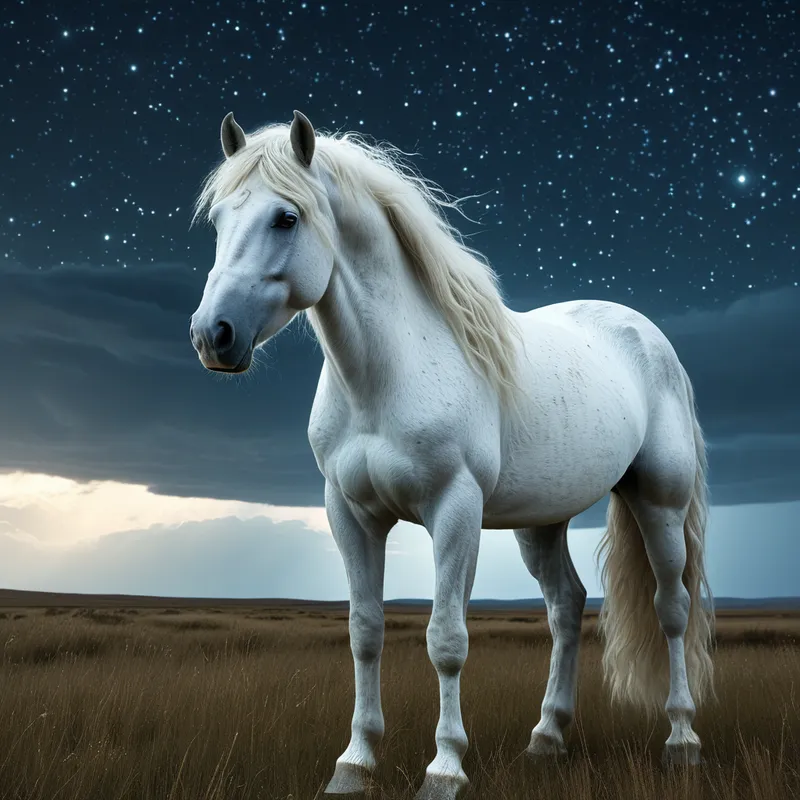
Spirit Horse Myth Meaning & Symbolism
A mythic tale of a wild, untamed horse embodying the soul's power, guiding the lost through the inner wilderness to freedom and wholeness.
The Tale of Spirit Horse
In the time before time, when the world was raw song and the wind had a name, there was a great emptiness in the heart of the people. They walked the earth, but their spirits were tethered, heavy with forgetting. The buffalo were plentiful, the rivers sang, yet a silence lived within them—a longing for a part of themselves that had galloped away into the mist of the first dawn.
From the place where the earth’s breath meets the sky’s tears, it came. Not with a thunder of hooves, but with the sudden, profound stillness that arrives before a storm. It was the Spirit Horse. Its coat was the white of new snow on the highest peak, and its mane and tail flowed like the rivers of the Milky Way. Its eyes were not the eyes of a beast of burden, but deep pools holding the memory of the first fire and the cold of the void between stars. It did not belong to the herd; it was the herd. It was the wildness that the mountains kept secret and the prairies whispered about in the long grass.
The people saw it, a shimmer on the horizon. The bravest hunters tried to approach, but their steps grew slow, their breath caught in their chests. The horse was always farther away, a mirage of power just beyond the edge of understanding. It would appear to a child lost in the woods, not as a rescuer, but as a silent companion who turned the frightening trees into a sacred grove. It would stand on a ridge as a warrior prepared for a hopeless fight, filling his heart not with rage, but with a terrible, calm clarity.
The story tells of one, a person whose name is lost, who carried the silence inside them like a stone. They walked away from the lodges, following no trail but the ache in their soul. For days they wandered, through canyon and field, until they were truly lost, empty of all but thirst and the vast sky. And there, at the moment of surrender, when the last pretense of seeking fell away, they felt a warm breath on their neck.
The Spirit Horse stood beside them. No chase, no capture. It simply stood. The person, trembling, reached out. Their hand did not touch hide and hair, but something else—the texture of the wind, the solidity of a prayer. In that touch, a vision unfolded: they saw themselves running, four-legged and free, the earth a drumbeat underfoot. They felt the terror of the hunted and the exhilaration of the wind, the weight of the herd and the solitude of the peak. They were not riding the horse; they were remembering the horse within.
When the vision cleared, the person was alone on the prairie. But the emptiness was gone. In its place was a new rhythm, a pulse in sync with the galloping heart of the world. They returned to the people, not with a trophy, but with a light in their eyes. They spoke no grand words, but when they moved, there was a grace, an unshakable freedom that had not been there before. They had not tamed the Spirit Horse. The Spirit Horse had awakened the spirit within the human.
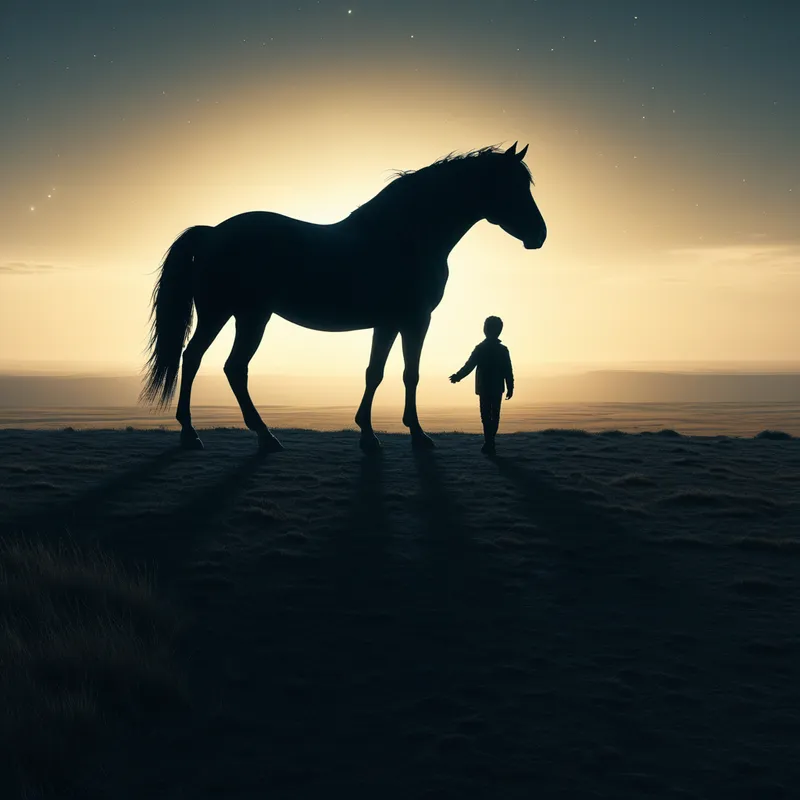
Cultural Origins & Context
The figure of the Spirit Horse is not a singular myth from one nation, but a powerful, recurring archetype woven through the oral traditions of many Plains, Plateau, and Southwest Indigenous cultures, including the Lakota, Nez Perce, and Navajo. Its story was not written but breathed into existence around council fires, in the sweat lodge, and in the personal visions sought through prayer and fasting.
These narratives served multiple vital functions. On one level, they were ecological wisdom, teaching respect for the actual horse—a transformative ally that reshaped cultures after its reintroduction to the continent. On a deeper, ceremonial level, the Spirit Horse was a spirit guide. It was a key figure in vision quest narratives, where an individual, through sacrifice and solitude, sought a personal revelation for their life’s path. To encounter the Spirit Horse in a vision was to be granted power, not over others, but over one’s own destiny—a gift of courage, endurance, and unparalleled mobility of spirit. The myth thus acted as a societal bridge, validating profound personal spiritual experience and translating it into a role of responsibility and guidance for the community.
Symbolic Architecture
The Spirit Horse is perhaps the ultimate symbol of the untamed, authentic Self before it is harnessed by the demands of the persona—the social mask we wear. It represents the raw, instinctual power of the psyche, the libido or life force in its purest, most dynamic form. It is not the domesticated horse that plows the field or carries the rider into battle according to human will. That is the ego’s use of energy. The Spirit Horse is the energy itself.
The Spirit Horse does not take you to the wilderness; it emerges from the wilderness within. It is the call of the undomesticated soul.
Its common depiction as a white or ghostly figure connects it to the spiritual realm, the numinous, and the unified field of consciousness from which individual forms arise. Its elusiveness symbolizes a core psychological truth: the Self cannot be captured or possessed by the conscious ego. It can only be encountered through surrender, through the release of the ego’s frantic seeking. The myth’s resolution—the touch that brings a vision of shared being—illustrates the moment of integration. It is not a conquest, but a sacred recognition.
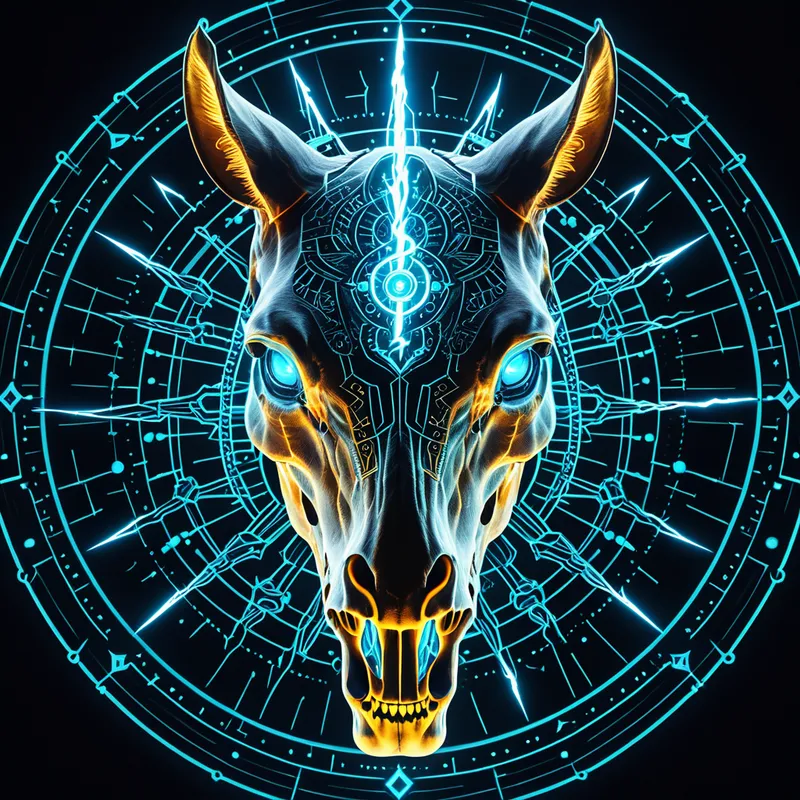
The Dreamer’s Resonance
When the Spirit Horse gallops into modern dreams, it often signals a critical juncture in the dreamer’s psychological life. It appears when the conscious personality feels trapped—in a job, a relationship, a pattern of thought, or a state of depression. The somatic feeling is one of simultaneous agitation and longing: a restless energy with no clear outlet.
To dream of chasing or trying to catch the Spirit Horse reflects the ego’s futile attempt to control and harness this erupting inner power on its own terms. The horse always escapes. More transformative is the dream where the dreamer simply observes the horse, or where the horse approaches them. This indicates a readiness to listen, a softening of the ego’s dominance. The most potent dreams involve becoming the horse—feeling the surge of muscle, the freedom of the gallop, the panoramic awareness. This is a direct experience of psychic liberation, a download from the unconscious that the path forward is not about better management, but about unleashed authenticity.
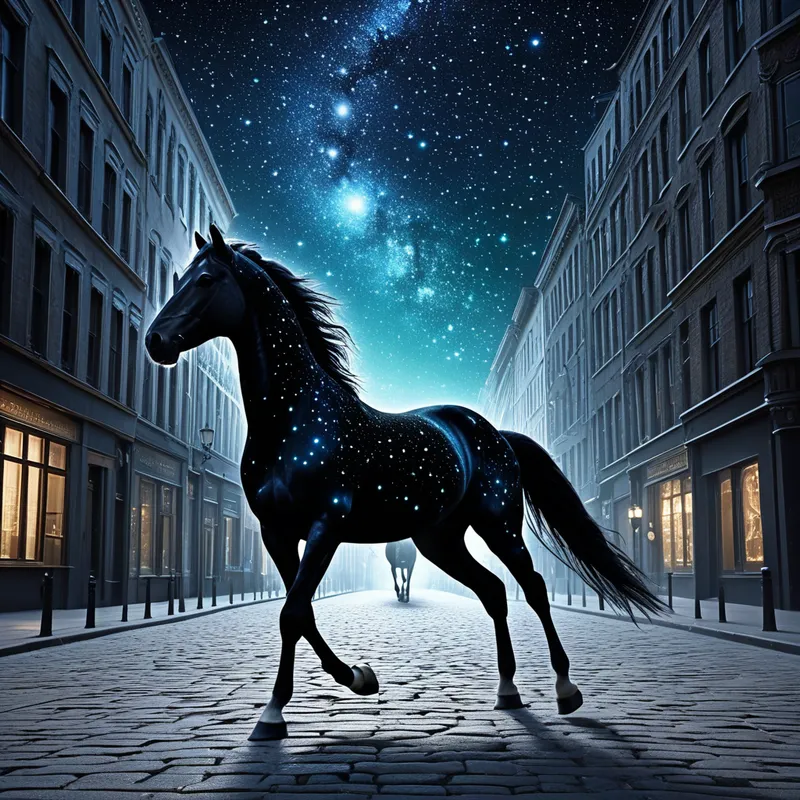
Alchemical Translation
The myth of the Spirit Horse models the alchemical stage of solutio—the dissolution—followed by coagulatio—the re-solidification in a new, nobler form. The hero’s initial state is one of coagulatio gone rigid: a psyche solidified in silence, emptiness, and disconnection (the lead). The journey into the wilderness is the solutio: the deliberate dissolution of familiar supports, ego-identities, and safe boundaries.
The encounter with the numinous is always a death of the old self. The Spirit Horse is both the psychopomp that guides you into that dissolution and the new life that emerges from it.
In the liminal space of utter loss, the transcendent function—symbolized by the Horse—manifests. The touch is the coniunctio, the sacred marriage of conscious awareness with unconscious power. The vision of shared being is the revelation of the Self. The return to the people is not a return to the old life, but the coagulatio of a new personality, now infused with and guided by that wild spirit. For the modern individual, the myth instructs us that true freedom and power are not achieved by building stronger fences for the ego, but by courageously venturing into the inner prairie to meet, honor, and integrate the untamed spirit that has been waiting there since the beginning. The goal is not to ride the horse, but to let its rhythm become your own.
Associated Symbols
Explore related symbols from the CaleaDream lexicon: