
Spirit Canyons Myth Meaning & Symbolism
A hero journeys into the underworld canyons to retrieve a lost spirit, facing shadowy echoes and the keeper of the dead to restore cosmic balance.
The Tale of Spirit Canyons
Listen. The wind does not just blow through the high desert; it remembers. It carries the whispers of the time when the world was soft, and the line between the living earth and the spirit world was as thin as a spider’s thread. This is the tale of when that thread was severed, and of the one who dared to weave it back together.
In the days when animals still spoke in the tongues of people, there was a great imbalance. A young hunter, swift and proud, pursued an elk further than any had before, to the very edge of the known lands. In his fervor, he did not see the sacred markings upon the stones, nor hear the warning hum in the air. His arrow flew true, but it struck not the elk, but the veil itself—the living membrane between the world of sun and the world of shadow. With a sound like a mountain sighing, the veil tore.
From that rent poured a chilling silence. The songs of the birds stilled. The laughter of the rivers grew muted. More terrible still, the spirits of the recently departed, who once flowed smoothly on the west wind to the starry lands, became lost. They pooled and wandered, confused, in the newly formed Spirit Canyons—a labyrinth of stone that now echoed with their plaintive cries. The people’s hearts grew heavy with unresolved grief; dreams became haunted by faces that would not leave.
None dared enter the canyons, for they were the domain of Siyah, a being of ancient stone and stillness. Siyah was not evil, but was as implacable as erosion, tasked with guarding the threshold. To face Siyah was to face the final, absolute silence.
Yet, the hunter, whose name was Kaya, was consumed by a debt heavier than any game. He had caused the rupture; he must mend it. Armed only with a drum made from the hide of the first animal he had ever thanked, and a pouch of pollen, he descended into the mouth of the deepest canyon.
The world changed. The red stone walls seemed to breathe, and the light that filtered down was the color of old bone. He did not see spirits with his eyes, but felt them: cold sorrow brushing his skin, whispers of unfinished stories tickling his ears. These were the Shadow Echoes, reflections of the grief left behind in the world above. To follow them was to be lost forever in a maze of another’s pain.
Kaya’s journey was not one of distance, but of endurance. He walked for what felt like seasons, the drum his only heartbeat. He did not fight the echoes, but when their chill despair threatened to swallow him, he would stop. He would sprinkle pollen, a dust of gold in that gray place, and sing the simple song of his grandmother—a song with no words, only a hum of belonging. The echoes would pause, listen, and for a moment, their chill would lessen.
Finally, in a chamber where no sky was visible, he found Siyah. The keeper was not a monster, but a presence—a coalescence of the canyon’s silence into a form that was all patient, watching depth. No words passed between them. Siyah simply extended a hand of smoothed stone. In it was a single, perfect Spirit Stone, cold and dark.
Kaya understood. This was the test. He could not seize it. He placed his drum on the ground and began to sing over it, pouring into his song all the gratitude, grief, and love he carried—for the elk, for his people, for the very earth he had wounded. He sang until his voice was raw, drumming with his palms until they bled. As his own life-force mingled with the song, a tear fell from his eye onto the Spirit Stone in Siyah’s hand.
Where the tear struck, the stone cracked. From within welled a light, gentle and warm. It floated upward, and as it rose, it drew the other Shadow Echoes from the labyrinth of stone. They streamed toward it, their coldness dissolving into its gentle radiance. The light ascended, a new star piercing the canyon’s gloom, showing a path upward.
Kaya emerged, not as a conqueror, but as one hollowed and refilled with silence. Behind him, the Spirit Canyons remained, but now the wind sang through them a different song—a song of remembrance, not of entrapment. The spirits had found their path, and the people’s dreams were once again their own.
Cultural Origins & Context
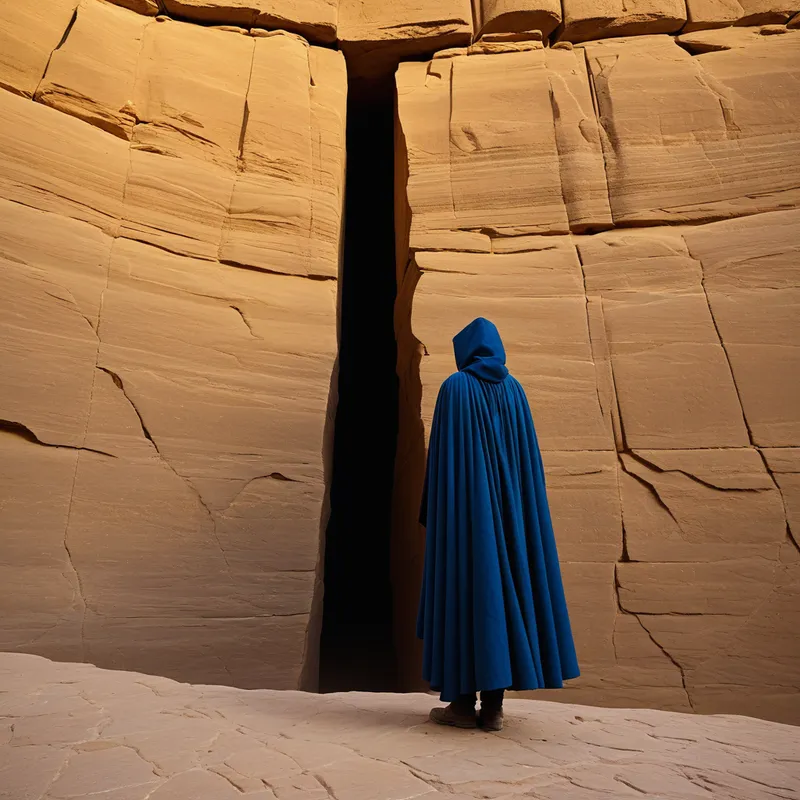
The myth of the Spirit Canyons finds its roots among several Pueblo and Southwestern nations, notably woven into the storytelling traditions of the Hopi and Navajo (Diné). It is fundamentally a landscape myth, where the immense, awe-inspiring geology of the Colorado Plateau is not merely a setting, but an active, narrative character. The canyons themselves, with their layered strata revealing epochs of time, are seen as literal archives of memory and spirit.
This story was not entertainment; it was a functional cosmology, often told by elders and medicine people during winter ceremonies or rites of passage. Its primary societal function was threefold. First, it explained the palpable, haunting presence felt in certain deep, shadowed places, providing a framework for understanding the spiritual ecology of the land. Second, it served as a profound teaching on accountability and the far-reaching consequences of one’s actions, even those taken without malice. Finally, it provided a ritual map for processing grief. The journey of Kaya models a proper “psychopomp” ritual—guiding the lost—which was a sacred duty, ensuring the dead could complete their journey and the living could be free from lingering, unresolved mourning.
Symbolic Architecture
At its core, the myth is a masterful depiction of confronting the psychic underworld that our own actions create. The torn veil represents a rupture in psychological integrity—a trauma, a profound mistake, or a repressed guilt that severs the conscious self from the deeper, soulful layers of the psyche.
The canyon is not a prison built by others, but the erosion of one’s own avoidance, carved by the persistent flow of unlived sorrow.
Kaya, the hero, represents the ego that must take responsibility for this rupture. His journey into the canyon is the necessary descent into the shadow. The Shadow Echoes are not external ghosts, but the internalized fragments of our own unresolved pain, the “unfinished business” that haunts our inner landscape. They are cold because we have withdrawn our attention and warmth from them.
Siyah, the keeper, symbolizes the ultimate reality principle—the immutable truth of what has occurred, the fact of death, loss, or failure. Siyah cannot be bargained with or defeated; it can only be acknowledged with profound humility. The Spirit Stone is the crystallized core of the wound itself, dormant and inert until met with genuine, embodied feeling.
The resolution is alchemical. Kaya does not fight; he sings. He offers his life-force (his blood, his breath, his tear)—the full vulnerability of his lived experience. This transforms the ritual (the drumming) into a genuine sacrifice, which in turn transmutes the hardened stone of the wound into liberating light. The psyche is re-integrated; what was trapped is released.
The Dreamer’s Resonance
When this myth pattern activates in modern dreams, the dreamer is almost certainly navigating a profound process of psychic integration, often triggered by loss, guilt, or a confrontation with a past action whose consequences are finally being felt. To dream of wandering in endless, labyrinthine canyons is to experience the somatic feeling of being lost in one’s own complex and layered history.
Dream encounters with shadowy, mournful figures (the Shadow Echoes) point to aspects of the self or memories that have been “ghosted”—emotionally abandoned but not laid to rest. The overwhelming emotion is not fear, but a deep, chilling sorrow and a sense of being responsible for these wandering fragments. The dream may present a task: to find a specific object (the Spirit Stone) or to reach a silent, imposing presence (Siyah). This is the psyche’s imperative to move beyond mere wandering in confusion and to directly face the core truth of the situation. The healing in the dream, if it occurs, often comes not through force, but through an unexpected expression of genuine emotion—a tear, a song, an act of tenderness toward the very thing that seems cold and dead.
Alchemical Translation
For the modern individual striving toward individuation, the Spirit Canyons myth provides a precise model for psychic transmutation. The first step is the recognition of the rupture—admitting that one’s own actions (or inactions) have created an inner schism, a canyon of separation between who one is and who one could be.
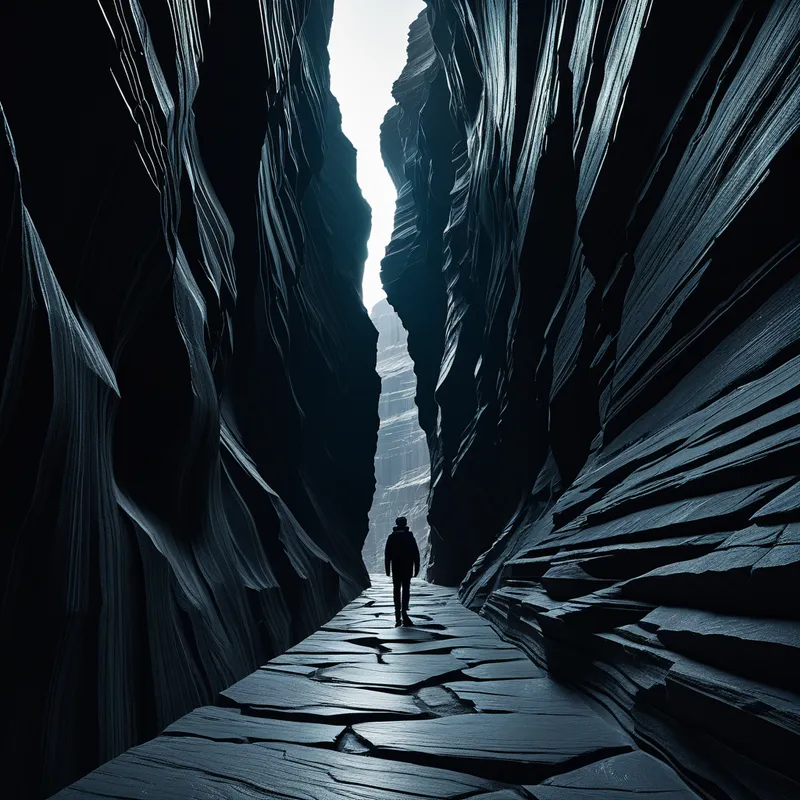
The descent is the courageous, often dreaded, entry into self-examination. It is the commitment to walk into the layered strata of one’s past, to feel the chill of disowned emotions (shame, grief, regret) without fleeing. The encounter with the Shadow Echoes is the work of shadow integration: listening to these fragmented parts, not to be consumed by their story, but to acknowledge their existence with the “pollen” of attention and the “song” of compassion.
The keeper of the dead is the truth that waits at the bottom of every canyon we carve. We do not defeat it; we offer our tears to its stone, and in that surrender, find the seal of our wound transformed into a window.
The climax is the meeting with Siyah—the confrontation with the naked, unchangeable fact. This is the point of maximum tension, where the ego’s resources are exhausted. Here, the only currency accepted is authentic, vulnerable life. The “tear” is the symbol of this: it is not a weapon, not a strategy, but the pure, involuntary expression of felt truth. This is the catalyst that performs the alchemy. The hardened complex (the Spirit Stone), when touched by conscious suffering (suffering with awareness), cracks open to release its trapped energy. What was a dead weight of guilt or grief becomes a guiding light—a new insight, a released creative force, a deeper capacity for compassion. The individual emerges not “fixed,” but fundamentally rearranged, with the inner canyons now serving as sacred architecture of a more spacious and integrated self, where the winds of spirit can move freely once more.
Associated Symbols
Explore related symbols from the CaleaDream lexicon: