
Spider Woman's Web Myth Meaning & Symbolism
A foundational myth of creation and interconnection, where Spider Woman weaves the world into being, binding all life within a sacred, shimmering web.
The Tale of Spider Woman’s Web
In the time before time, when the world was dark and formless, there was a great emptiness. From the deep, silent places, from the heart of the earth itself, she awoke. She was known as Spider Woman, Grandmother Spider, the Weaver of Worlds. She did not arrive with thunder, but with a whisper of thought and the gentle click of wisdom.
She surveyed the void, this primordial mist, and saw not emptiness, but potential. From her own being, she drew out the first thread—a filament of creative thought, strong and singing. She anchored it to the breath of the East, the place of dawn. With infinite patience, she began to weave. Her legs, her thoughts, moved in a sacred pattern, a dance older than the stars. She spun a line to the South, the land of growth and warmth. She cast a strand to the West, the realm of water and sunset. She completed the foundation with a thread to the North, the place of wisdom and cold.
And so, the first web was cast—a perfect, four-cornered loom upon the face of the deep. This was not a trap, but a matrix, a blueprint for existence. Upon this web, she sang. Her song was the vibration that stirred the silt at the bottom of the seas. Her song coaxed the mountains to rise, their bones of stone pushing towards the yet-unformed sky. She wove the rivers into silver threads, and the forests into a tapestry of green.
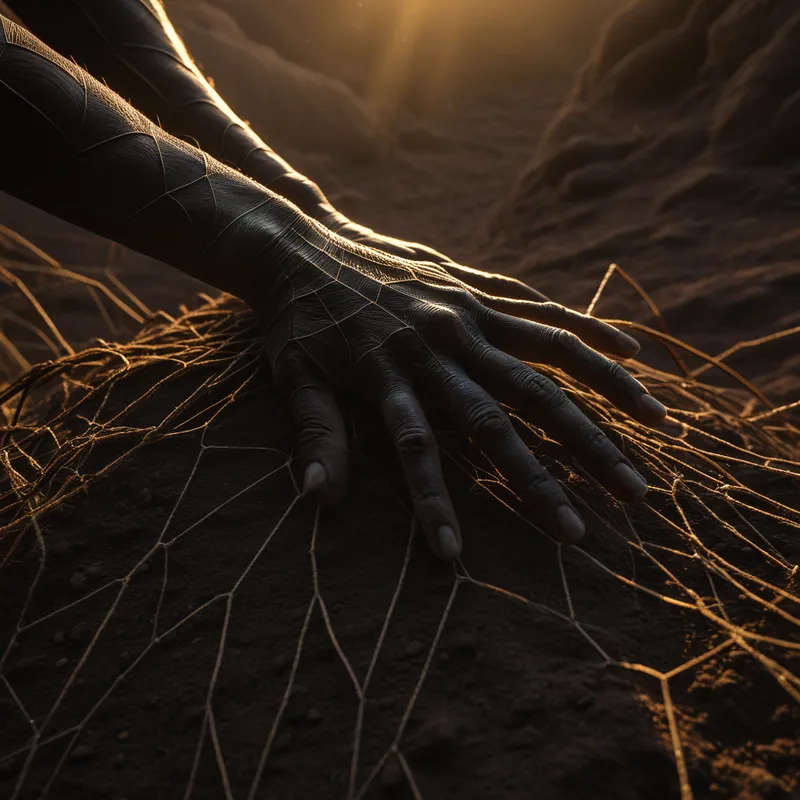
But the world was still silent, a beautiful but empty tapestry. So, Spider Woman journeyed to the Sipapu, the navel of the world. There, in the warm, dark clay, the first people slept. She leaned close and breathed into the earth, her breath a soft, guiding wind. She taught them how to climb, to emerge into the light of this new world she had woven. She did not command them, but showed them. With her web as a guide, she taught them the patterns of life: how to plant corn, how to build homes from the earth, how to weave their own baskets and blankets, imprinting the sacred geometry of connection into their very crafts. She gave them the most precious gift: the understanding that they were not on the web, but of it. Each life, each action, was a thread. Every kindness, a strengthening of the weave. Every harm, a fraying. And when her work was done, she did not vanish. She retreated to the corners of the hearth, to the spaces between canyon walls, forever weaving, forever mending, the silent guardian of the interconnected whole.
Cultural Origins & Context
The myth of Spider Woman is not a single, monolithic story, but a living tapestry of narratives found primarily among the Pueblo peoples of the American Southwest (such as the Hopi and Zuni) and the Diné (Navajo). She is a foundational Creator Goddess and cultural heroine. Unlike myths preserved in static texts, hers is an oral tradition, passed down through generations by elders and storytellers, often during winter ceremonies or at pivotal moments of teaching.
Her story was not merely entertainment; it was a societal operating system. It functioned as a cosmological map, explaining the origin and structure of the world. It was a moral and practical guide, encoding the technologies of agriculture, weaving, and pottery within a sacred context. Most importantly, it served as the core philosophical doctrine for these cultures: the principle of profound reciprocity and interconnection. The myth taught that human survival and harmony depended on recognizing one’s place within a delicate, pre-woven web of relationships—with the land, the animals, the plants, and the cosmos. To live well was to weave well, to maintain the integrity of the whole.
Symbolic Architecture
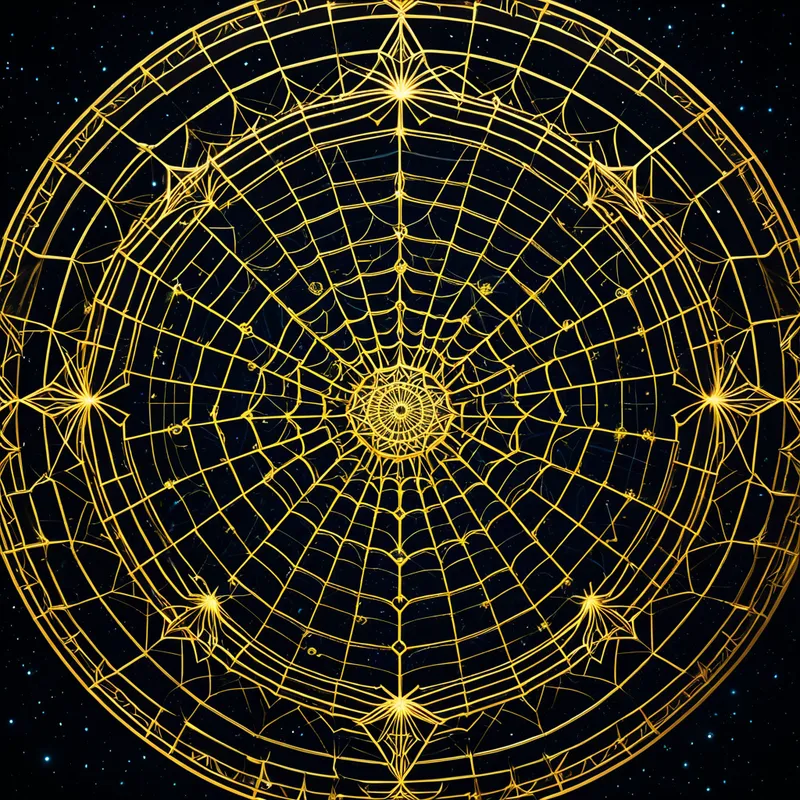
At its heart, the web is the ultimate symbol of the Indra’s Net of Native American cosmology. Each intersection is a life, a moment, a choice, reflecting all others.
The Web is not a snare for the fly, but a hymn of relation. To be caught in it is to be held by the universe.
Spider Woman herself embodies the Archetypal Feminine as Creator, but not from a distance. She is the hands-on grandmother, the patient teacher, the weaver who gets her fingers in the clay. She represents wisdom that is practical, creative, and deeply connective. The act of weaving is the symbolic act of consciousness itself—taking disparate threads (thoughts, experiences, perceptions) and forming them into a coherent, meaningful pattern. The four cardinal directions of her initial web establish sacred order out of chaos, creating a stable, oriented world within which life can unfold.
The Sipapu symbolizes the womb of the Earth, the unconscious from which conscious life (the people) emerges. Spider Woman’s role is that of the midwife of consciousness, guiding the nascent psyche from the dark, undifferentiated unity of the unconscious into the differentiated, light-filled world of ego and relationship, all while ensuring it remains tethered to its source.
The Dreamer’s Resonance
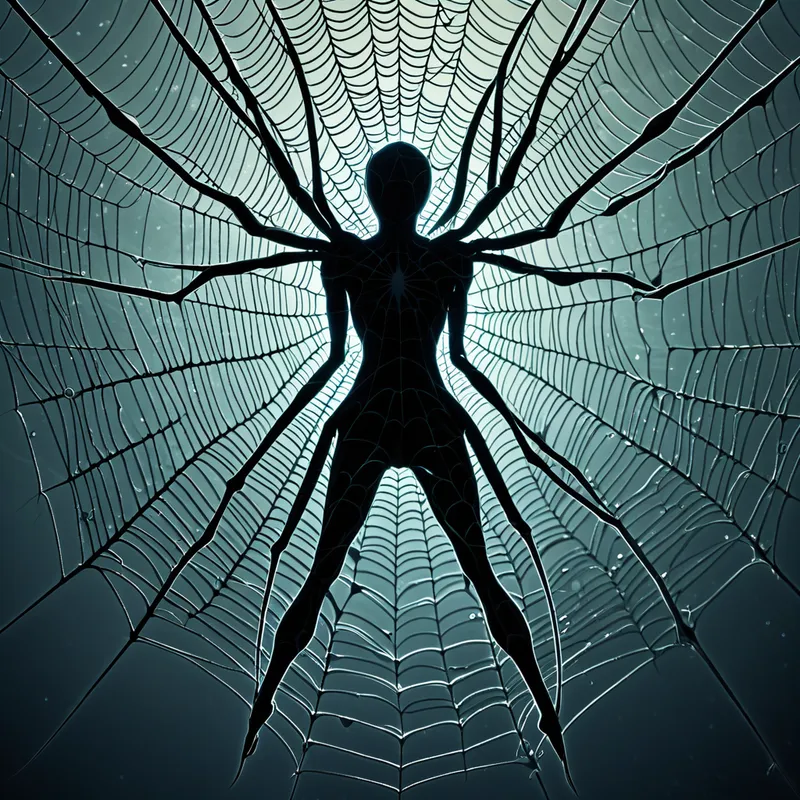
When the motif of Spider Woman’s Web appears in modern dreams, it often signals a profound process of re-weaving within the psyche. The dreamer may see intricate webs, feel themselves navigating a labyrinthine network, or encounter a benevolent but formidable spider figure.
Somatically, this can correlate with a feeling of being “pulled in many directions” or, conversely, a deep, vibrational humming—a sense of everything falling into a resonant pattern. Psychologically, it indicates the ego’s confrontation with the larger Self. The dreamer is being asked to perceive the hidden connections between seemingly disparate parts of their life: a childhood memory linked to a current relationship pattern; a career choice connected to an unexpressed talent. It is the psyche’s innate drive toward wholeness, attempting to repair fragmentation.
A dream of a broken or tangled web often speaks to a life felt as disconnected, chaotic, or devoid of meaning. The appearance of the weaver—Spider Woman—suggests the awakening of an inner, guiding intelligence capable of restoring order, not through force, but through patient, creative re-integration.
Alchemical Translation
The myth models the entire alchemical process of individuation. The initial void (nigredo) is the unexamined life, the chaos of the unconscious. Spider Woman’s first act—spinning the thread and anchoring the directions—is the emergence of the conscious attitude, the ego establishing its initial orientation in the world.
The work of the soul is not to escape the web, but to learn the sacred craft of weaving; to become, in our own small way, a conscious participant in Spider Woman’s eternal art.
The weaving of the landscape represents the opus, the long and patient work of building a life, forming relationships, and crafting a personality. This is the stage of albedo and citrinitas, where contents are brought into the light and given color and form. The guidance of the people from the Sipapu is the critical integration of the unconscious (the earthy, instinctual self) with the conscious world. One does not abandon the dark earth, but brings its wisdom up into the light.
The ultimate stage (rubedo, the reddening) is the realization of interconnection. The individuated Self understands it is not a solitary node, but a vital intersection within a vast, living network. The modern individual’s “triumph” is not one of heroic conquest, but of humble, skillful weaving. It is the shift from seeing oneself as the center of the web to understanding oneself as of the web, responsible for the strength and beauty of one’s own connections, and thus, contributing to the integrity of the whole. In this, we take up Spider Woman’s legacy, becoming stewards of our own small corner of the infinite pattern.
Associated Symbols
Explore related symbols from the CaleaDream lexicon: