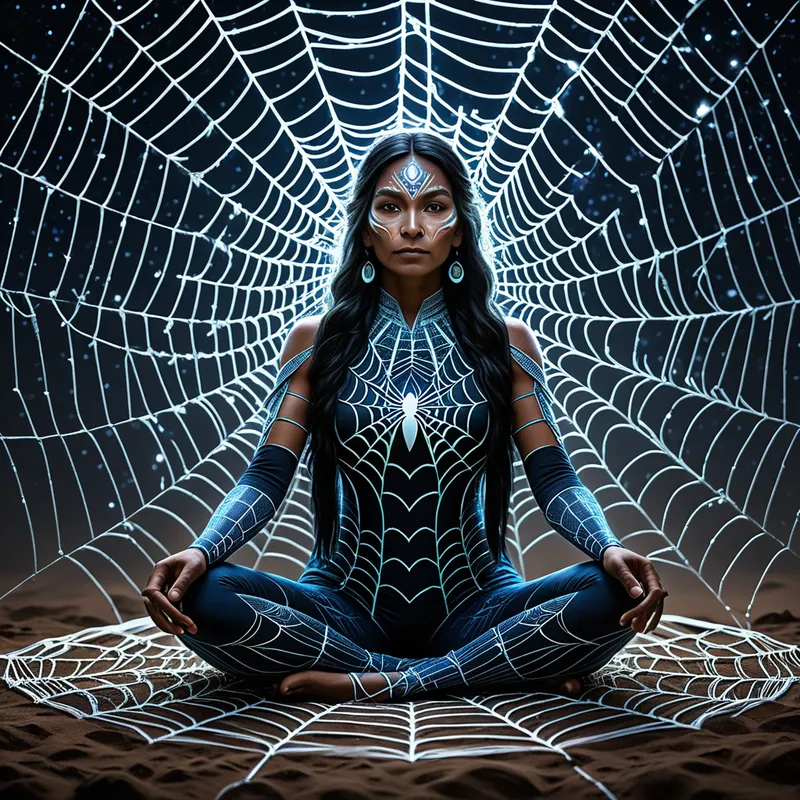
Spider Woman Myth Meaning & Symbolism
A cosmic weaver emerges from the void, spinning the world into being and teaching humanity the sacred art of connection and creation.
The Tale of Spider Woman
In the time before time, there was only the Darkness. It was a silence so deep it hummed, a void pregnant with all that could be. From this womb of potential, she stirred. Not with a crash of thunder, but with the soft, deliberate click of a spinneret. She was [Spider](/myths/spider “Myth from Native American culture.”/) Woman, Kokyangwuti.
She was alone, yet she contained the All. With a thought, she drew from herself the stuff of stars and soil. From the silken essence of her own being, she began to spin. First, she sang a song of direction, and her threads became the Four Corners. She anchored them in [the void](/myths/the-void “Myth from Buddhist culture.”/), creating the first loom of existence. Then, with infinite patience, she wove. She wove the floor of [the sky](/myths/the-sky “Myth from Persian culture.”/) and the ceiling of [the earth](/myths/the-earth “Myth from Hindu culture.”/). She wove the pathways of the sun and the secret tunnels of the roots. Her web was not a trap, but a tapestry—a living, breathing matrix of connection.
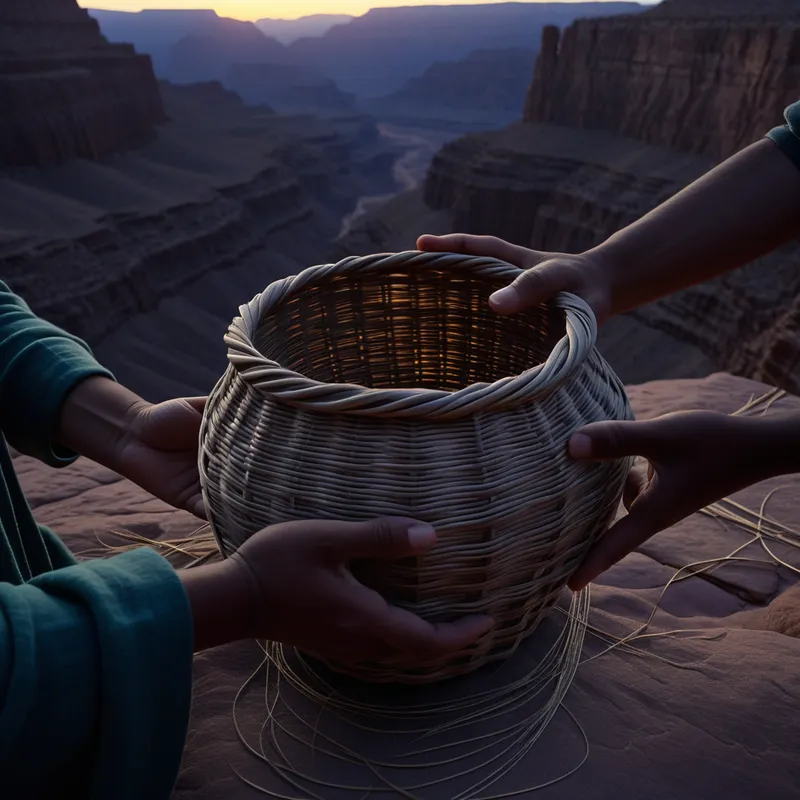
When [the world](/myths/the-world “Myth from Tarot culture.”/) was a shimmering scaffold, she took the clay of the new earth, mixed it with her saliva and the colors of the dawn, and formed the first people. She breathed into them [the wind](/myths/the-wind “Myth from Various culture.”/) of life, and they stirred. But they were confused, scattered in the dark. So, Spider Woman taught them. She showed them how to weave baskets to carry [water](/myths/water “Myth from Chinese culture.”/) and grain, how to weave blankets to hold the warmth of the fire, how to weave nets to gather sustenance from the land. But her greatest lesson was the weaving unseen: the weaving of stories, of kinship, of prayer. She taught them that to live is to be a node in the great web, to feel the tug of every other thread, to understand that a tear in one place trembles through the whole.
She led the people upward, from the dark underworlds into the sunlit world of the present. At each emergence, she was there, a constant, silent guide in the form of a small, diligent spider in the corner of the eye, reminding them: you are connected. You are made of the same sacred thread. And then, her physical form faded into the landscape—into the spiderweb glistening with morning dew on the sagebrush, into the intricate pattern on a pot, into the very structure of thought itself. She did not leave; she became the pattern that connects.
Cultural Origins & Context
The myth of Spider Woman is not a single, monolithic story, but a resonant pattern found across many Southwestern Native American cultures, most prominently among the Hopi, Navajo, and Pueblo peoples. She is known by many names: Kokyangwuti, Asdzą́ą́ Nádleehé (with whom she shares attributes), and simply [Spider Grandmother](/myths/spider-grandmother “Myth from Native American culture.”/). This is an oral tradition, passed down not in books but in the hushed tones of kiva ceremonies, in the stories told during long winter nights, and in the rhythmic motions of weaving taught from grandmother to granddaughter.
Her story was not mere entertainment; it was a functional cosmology and a social charter. It explained the origin of the world, the people, and their technologies. It encoded ethical instructions about interdependence, respect for craft, and the sacred duty of maintaining balance. To hear the story was to be reminded of your place in a vast, intelligent system. The myth was often told in conjunction with rites of passage, healing ceremonies, and the teaching of vital arts, grounding abstract principles in the tangible, tactile reality of the woven thread.
Symbolic Architecture
At its core, [Spider](/symbols/spider “Symbol: Represents creativity, feminine energy, and the weaving of destiny, as well as potential feelings of entrapment or anxiety.”/) Woman is the [archetype](/symbols/archetype “Symbol: A universal, primordial pattern or prototype in the collective unconscious that shapes human experience, behavior, and creative expression.”/) of the Cosmic Weaver. Her [symbolism](/symbols/symbolism “Symbol: The use of symbols to represent ideas or qualities, often conveying deeper meanings beyond literal interpretation. In dreams, it’s the language of the unconscious.”/) is a profound map of psychic [reality](/symbols/reality “Symbol: Reality signifies the state of existence and perception, often reflecting one’s understanding of truth and life experiences.”/).
The web is not just what she makes; it is what she is. It is the irreducible pattern of relationship, the neural network of the world-soul.
The Spider represents the [creator](/symbols/creator “Symbol: A figure representing ultimate origin, divine power, or profound authorship. Often embodies the source of existence, innovation, or personal destiny.”/) who emerges from the dark, [unconscious depths](/symbols/unconscious-depths “Symbol: The hidden, primordial layers of the psyche containing repressed memories, instincts, archetypes, and collective wisdom beyond conscious awareness.”/) ([Sipapu](/myths/sipapu “Myth from Hopi culture.”/)) to bring form to [chaos](/symbols/chaos “Symbol: In Arts & Music, chaos represents raw creative potential, uncontrolled expression, and the breakdown of order to forge new artistic forms.”/). It is a [creature](/symbols/creature “Symbol: Creatures in dreams often symbolize instincts, primal urges, and the unknown aspects of the psyche.”/) of both [terror](/symbols/terror “Symbol: An overwhelming, primal fear that paralyzes and signals extreme threat, often linked to survival instincts or deep psychological trauma.”/) and awe, a master of the liminal [space](/symbols/space “Symbol: Dreaming of ‘Space’ often symbolizes the vastness of potential, personal freedom, or feelings of isolation and exploration in one’s life.”/) between corners, embodying the [paradox](/symbols/paradox “Symbol: A contradictory yet true concept that challenges logic and perception, often representing unresolved tensions or profound truths.”/) of a [predator](/symbols/predator “Symbol: Represents primal fears, survival instincts, and internal threats. Often symbolizes aggressive impulses or external pressures.”/) whose art is also a home and a map. The Web is the ultimate [symbol](/symbols/symbol “Symbol: A symbol can represent an idea, concept, or belief, serving as a powerful tool for communication and understanding.”/) of the interconnected [universe](/symbols/universe “Symbol: The universe symbolizes vastness, interconnectedness, and the mysteries of existence beyond the individual self.”/). It is [fate](/symbols/fate “Symbol: Fate represents the belief in predetermined outcomes, suggesting that some aspects of life are beyond human control.”/), ecology, culture, and the nervous [system](/symbols/system “Symbol: A system represents structure, organization, and interrelated components functioning together, often reflecting personal or social order.”/). Each [intersection](/symbols/intersection “Symbol: An intersection symbolizes the crossroads of decision-making, presenting choices and the potential for change.”/) is a [choice](/symbols/choice “Symbol: The concept of choice often embodies decision-making, freedom, and the multitude of paths available in life.”/), an [event](/symbols/event “Symbol: An event within dreams often signifies significant life changes, transitions, or emotional milestones.”/), a [relationship](/symbols/relationship “Symbol: A representation of connections we have with others in our lives, often reflecting our emotional state.”/). The Weaving is the act of [consciousness](/symbols/consciousness “Symbol: Consciousness represents the state of awareness and perception, encompassing thoughts, feelings, and experiences.”/) itself—the patient, deliberate work of taking raw, undifferentiated experience ([clay](/symbols/clay “Symbol: Clay symbolizes malleability, creativity, and the potential for transformation, representing the foundational aspect of life and the ability to shape one’s destiny.”/), [chaos](/symbols/chaos “Symbol: In Arts & Music, chaos represents raw creative potential, uncontrolled expression, and the breakdown of order to forge new artistic forms.”/), [emotion](/symbols/emotion “Symbol: Emotion symbolizes our inner feelings and responses to experiences, often guiding our actions and choices.”/)) and crafting it into meaningful, sustainable [structure](/symbols/structure “Symbol: Structure in dreams often symbolizes stability, organization, and the framework of one’s life, reflecting how one perceives their environment and personal life.”/) (pottery, [story](/symbols/story “Symbol: The symbol of ‘Story’ represents the narrative woven through our lives, embodying experiences, lessons, and emotions that shape our identities.”/), [identity](/symbols/identity “Symbol: Identity represents the sense of self, encompassing personal beliefs, cultural background, and social roles.”/)).
Psychologically, Spider Woman represents the Eros principle in its most primordial form. She is not love as sentiment, but love as the fundamental force of [connection](/symbols/connection “Symbol: Connection symbolizes relationships, communication, and bonds among individuals.”/), the [gravity](/symbols/gravity “Symbol: The fundamental force that pulls objects toward each other, representing attraction, inevitability, and the weight of existence.”/) that binds the [psyche](/myths/psyche “Myth from Greek culture.”/) and the [cosmos](/symbols/cosmos “Symbol: The entire universe as an ordered, harmonious system, often representing the totality of existence, spiritual connection, and the unknown.”/) into a coherent whole. She symbolizes the innate [human](/symbols/human “Symbol: The symbol of a human represents individuality, complexity of emotions, and social relationships.”/) [capacity](/symbols/capacity “Symbol: A measure of one’s potential, limits, or ability to contain, process, or achieve something, often reflecting self-assessment or external demands.”/) to create meaning, to see patterns, and to understand that [the self](/myths/the-self “Myth from Jungian culture.”/) is a nexus in a field of infinite relations.
The Dreamer’s Resonance
When the pattern of Spider Woman weaves its way into modern dreams, it often signals a critical phase of psychic integration. To dream of spiders, webs, or weaving is to feel the unconscious working to mend, create, or warn.
Dreaming of being caught in a web may reflect a somatic sense of entanglement in life’s complexities—relationships, obligations, or one’s own neuroses. The body may feel stuck, paralyzed by indecision or the perception of external constraints. Conversely, dreaming of weaving a web or watching one being woven suggests the psyche is actively constructing a new synthesis. This could manifest as a somatic feeling of focused calm, of hands wanting to make, or a deep, intuitive understanding of how disparate life elements are connecting.
A dream of Spider Woman herself, as a majestic or terrifying figure, often appears when the dreamer is at a creative or spiritual crossroads. It is the psyche presenting the ultimate model of the Self. The dreamer is being shown that the power to shape their world—to spin their own story from the raw silk of their experiences—lies within. The awe or fear felt is [the ego](/myths/the-ego “Myth from Jungian culture.”/)’s reaction to this immense, transformative responsibility.
Alchemical Translation
The myth of Spider Woman is a precise alchemical manual for individuation. It models the transmutation of the leaden, chaotic [prima materia](/myths/prima-materia “Myth from Alchemical culture.”/) of the unconscious into the golden, coherent fabric of the conscious self.
The process begins in the Darkness, the [nigredo](/myths/nigredo “Myth from Alchemical culture.”/) of alchemy. This is the undifferentiated state of depression, confusion, or potential. From this, the creative instinct (the Spider) must emerge. The first act is Spinning the Directions—establishing inner order. This is the psychological work of creating values, setting intentions, and defining one’s own moral and existential coordinates (albedo).
The true alchemy is not turning lead to gold, but turning isolation into relationship, chaos into pattern, and self-concern into world-care.
The core work is the Weaving. This is the citrinitas, the slow, patient, often repetitive labor of integration. It is the therapy session where childhood threads are tied to adult understandings. It is the artistic practice where emotion finds form. It is the daily choice to mend broken connections with forgiveness or to spin new threads of compassion. Each act of understanding, each moment of synthesis, adds a strand to the personal web of meaning.
Finally, the Emergence and Dissolution represent the [rubedo](/myths/rubedo “Myth from Alchemical culture.”/). Spider Woman leads the people to the sunlit world—the achievement of a more enlightened, connected consciousness. But then she dissolves into the pattern. This is the ultimate goal: the ego no longer identifies solely with the small, separate self (the spider), but with the vast, interconnected web of being (the creation). The individual realizes they are both the weaver and the web, a unique point of consciousness eternally connected to the whole. The struggle triumphs not in domination, but in the graceful, responsible act of perpetual, sacred connection.
Associated Symbols
Explore related symbols from the CaleaDream lexicon: