
Spider Rock Myth Meaning & Symbolism
A sacred Navajo tale where Spider Woman, a divine weaver, teaches the people survival and wisdom from her towering home, Spider Rock.
The Tale of Spider Rock
In the time before time, when the world was still soft from the hands of the Diyin Dine’é, there stood a place of profound silence and towering stone. This was Tseyi, Canyon de Chelly, a deep wound in the earth that held the breath of the ages. And from its floor, a single spire of red sandstone clawed at the sky, so tall it seemed to pierce the belly of the clouds. This was Spider Rock, and it was not empty.
At its impossible summit, where the wind sang a constant, lonely hymn, lived Spider Woman, or Na’ashjé’ii Asdzáá. She was ancient, her form both grandmother and arachnid, her eyes holding the patience of millennia. From her high perch, she watched the Diné below, struggling in the harsh, beautiful land. They were hungry, cold, and vulnerable to the chaos that still roamed the world.
One day, she descended. Not with a crash of thunder, but on a single, glistening thread of her own making, silent as a sunbeam. She appeared before a young woman and a young man, their faces etched with the hardship of survival. They trembled, not from fear, but from the sheer presence of the sacred.
“My children,” her voice was the sound of dry leaves rustling, of a loom’s shuttle clicking, “you walk upon Nihimá but you do not know her garments. You face the Anaye of hunger and cold, but you have no shield.”
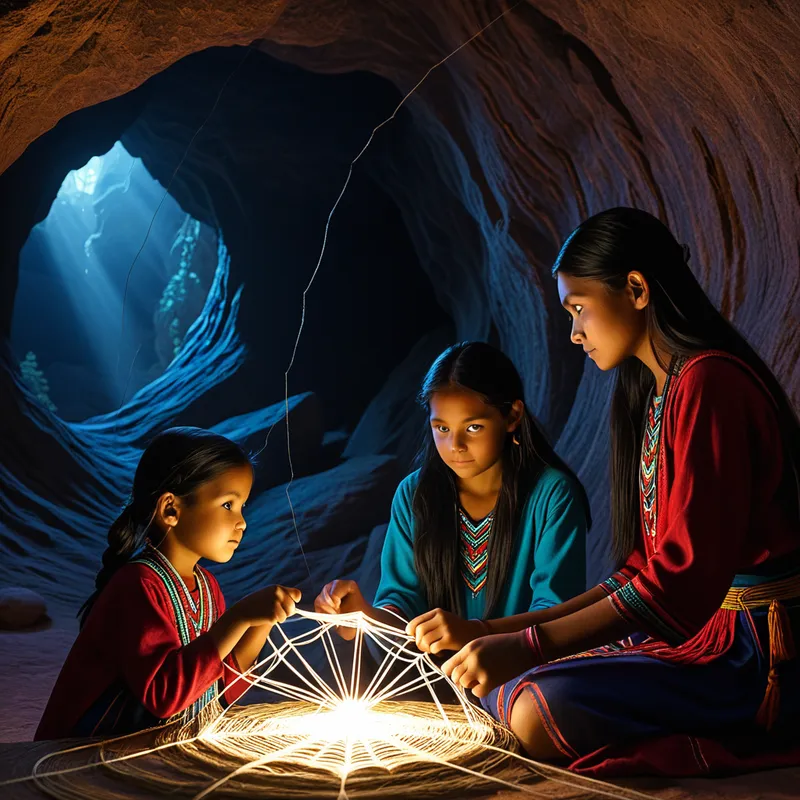
She took them then, not by force, but by the compelling gravity of her wisdom. Up the sheer face of Spider Rock they climbed, not with hands and feet, but seated on a widening web she spun beneath them—a cradle ascending into the sky. They entered her home, a cave high in the rock, warm and smelling of dried herbs and sacred pollen.
Here, she showed them the first loom. Its frame was of sunbeam and canyon oak, its cross-poles of steadfast resolve. “See,” she whispered, guiding their hands. “You take the chaos of the world—the raw wool, the scattered cotton. You comb it with discipline. You spin it with intention.” The spindle whirled in her deft fingers, transforming fluff into strong, singing thread.
“Now the weave,” she instructed. “The warp threads are the verticals of your life—your lineage, your spirit, the path from earth to sky. They are fixed, your foundation. The weft thread is your choices, your actions, your days. It moves back and forth, through the warp, crossing, locking, creating pattern.” Under her guidance, the simple fibers began to form a fabric—strong, beautiful, complex. It was a blanket. It was a net for catching game. It was the very fabric of culture.
“This,” Spider Woman said, her touch on the finished weave as gentle as a blessing, “is how you will live. You will weave your families, your homes, your stories. You will weave protection from chaos and beauty from the raw earth. Remember: the pattern holds power. A good pattern brings harmony, Hózhǫ́. A broken pattern brings disorder, Hóchxǫ́.”
When she returned them to the canyon floor, they were no longer just a woman and a man. They were weavers. They were teachers. They carried the wisdom of the loom in their hands and the pattern of Hózhǫ́ in their hearts. And high above, Spider Woman remained, a silent guardian in her stone tower, her own eternal web catching not flies, but the first and last light of the sun, a reminder that from the highest solitude comes the wisdom that binds the world together.
Cultural Origins & Context
The story of Spider Woman and Spider Rock is not merely a folktale; it is a foundational narrative deeply embedded in the Diné worldview. Originating in the sacred landscape of Tseyi in present-day Arizona, the myth is part of the vast oral tradition known as the Diné Bahane’, the Navajo creation story. It was historically passed down by medicine people, elders, and storytellers, often in conjunction with the teaching of the weaving arts themselves. The myth served a crucial societal function: it was the divine charter for one of the pillars of traditional Navajo life—textile arts. It sanctified the act of weaving, transforming it from a mundane craft into a holy discipline, a literal enactment of cosmic order. The towering presence of Spider Rock in the physical landscape served as a constant, tangible reminder of this sacred origin, linking geography, mythology, and daily practice into an unbroken whole of meaning.
Symbolic Architecture
At its core, the myth is a masterclass in symbolic instruction. Spider Woman is the archetypal Senex figure who imparts the technology of consciousness. Her home, Spider Rock, symbolizes the axis mundi—the world center, the connection between the earthly realm and the realm of the spirits (the Diyin Dine’é). To ascend the rock is to undertake a spiritual ascent to receive wisdom.
The loom is the central symbol. It represents the structured framework of reality and the psyche.
The loom is the mandala of the soul: a fixed center (the self) around which the complexities of experience (the threads) are organized into a coherent, meaningful pattern.
The warp—the vertical, fixed threads—symbolizes the eternal, unchanging aspects: destiny, natural law, the spiritual constants. The weft—the horizontal, moving thread—symbolizes human agency, time, choice, and the fleeting moments of life. Weaving, therefore, is the act of creating cosmos from chaos, of integrating the eternal with the temporal to produce something both functional and beautiful. The lesson is that a life lived without this conscious weaving—without aligning one’s actions (weft) with one’s deeper nature and values (warp)—results in a tangled, useless thread, vulnerable to the monsters of meaninglessness and despair.

The Dreamer’s Resonance
When this myth pattern activates in the modern psyche, it often manifests in dreams of vertiginous heights, intricate structures, or benevolent but demanding teachers. To dream of climbing a vast, solitary tower or cliff face reflects a somatic experience of the ego’s arduous ascent toward a higher perspective or a neglected piece of wisdom. The body may feel the tension of the climb—the fear of falling (regressing) mixed with the pull of the summit (individuation).
Dreams of webs, looms, or complex, fragile networks being woven speak to a psychological process of integration. The dreamer is in the act of consciously connecting disparate parts of their life—career, relationships, personal history—into a new, more cohesive whole. A dream of being taught a complex skill by an ancient, patient figure signals the emergence of the inner Senex or sage, the part of the psyche that knows how to create order and beauty from raw experience. The anxiety in such dreams often mirrors the Navajo concept of Hóchxǫ́—the fear that the pattern will be broken, that the weaving will fail. This is the shadow of the process: the resistance to the discipline and focus required for true creation.
Alchemical Translation
The alchemical journey modeled by the Spider Rock myth is that of coagulatio—the process of giving solid, enduring form to spirit or insight. In psychological terms, it is the stage of individuation where insights from the unconscious must be woven into the fabric of conscious life.
The modern individual often lives in a state of psychic chaos—a tangle of impulses, opinions, and identities. The myth prescribes the remedy: find your loom.
First, one must ascend to the rock—withdraw from the collective noise, enter a meditative or reflective state (the “high, lonely place”) to gain perspective. This is confronting the shadow and engaging the Self. Then, one must learn the craft from the inner Spider Woman—develop the discipline (the warp) of daily practice, whether in art, relationship, or introspection. Finally, one must perform the weaving—take the raw material of one’s experiences, emotions, and relationships (the weft) and consciously, patiently, pass them through the framework of one’s values and goals.
The triumph is not a dramatic slaying of a beast, but the quiet, ongoing creation of a life that holds together, that protects, that expresses beauty. The “monsters” of hunger and cold are transmuted into the creative tension of the loom. The modern seeker, like the first Diné, is tasked with nothing less than weaving a soul—thread by conscious thread, choice by deliberate choice—until the pattern of the true self emerges from the chaos, and one can truly begin to walk in beauty.
Associated Symbols
Explore related symbols from the CaleaDream lexicon: