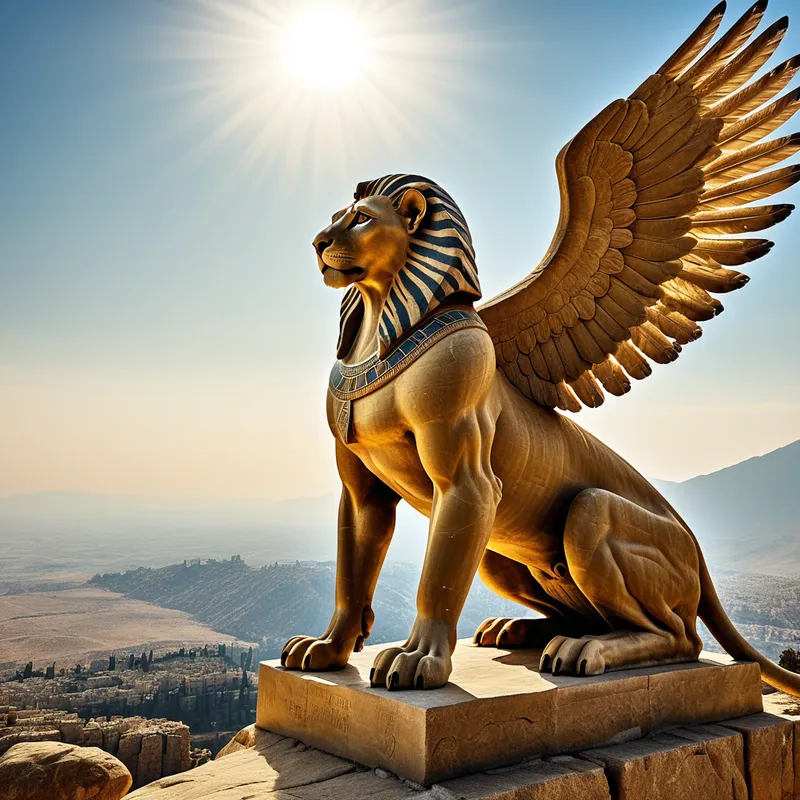
Sphinx Myth Meaning & Symbolism
A winged monster with a woman's face and a lion's body devours those who fail her riddle, until a hero's answer reveals the truth of human existence.
The Tale of Sphinx
The air over Thebes was thick with a curse, a miasma of dread that clung to the stones and choked the hope from its people. From the high crags of Mount Phikion, she watched. The Sphinx—a creature of terrible beauty, a blasphemous fusion sent by the wrathful gods. Her face was that of a maiden, pale and serene as a marble statue, but her body was the rippling, tawny mass of a lion, and from her shoulders sprang the vast, feathered wings of an eagle. Her voice, when she chose to use it, was a melody that promised death.
She had come as Hera’s vengeance, or perhaps Apollo’s plague, a punishment for the sins of a king. Her method was a cruel poetry. She would descend upon the road to the city, barring the way to all travelers, and pose her riddle. It was a simple question, deceptively so, whispered with the calm of absolute power:
“What goes on four feet in the morning, two feet at noon, and three feet in the evening?”
To the shepherds and merchants, the soldiers and princes who dared the path, the answer seemed to dance just out of reach. They would stammer guesses—animals, the sun, the seasons—and with each wrong answer, a cold light would enter the Sphinx’s human eyes. Then, with a speed that belied her size, the lion’s body would move, and the traveler would be seized, dragged to the precipice, and cast down to the rocks below. The bones of the failed littered the base of her rock, a grim monument to Thebes’ despair. The city was dying, cut off from the world, strangled by an enigma.
Then came the wanderer. He was a man marked by fate, Oedipus, though he knew himself only as an exile from Corinth. He had heard of the monster and the price of passage. Grief and a furious intellect drove him forward. He climbed the path, stepping over the remnants of those who came before.
The Sphinx regarded this new supplicant. She saw not a king, but a man, his face lined with travel and a deeper, unnameable sorrow. She posed the riddle, the same words that had spelled doom for so many, hanging in the dusty air between them.
Oedipus did not hesitate. He had walked the roads, he had seen the span of a life. The answer was not in the stars or in beasts, but in the very dust from which man was made. He looked not at the monster, but through her, into the heart of the paradox.
“The answer is Man,” he said, his voice steady. “For in the morning of his life, he crawls on all fours; at noon, he walks upright on two feet; and in the evening of his age, he takes a staff as a third foot.”
A profound silence fell. The cruel smile vanished from the Sphinx’s face, replaced by a look of utter, devastating comprehension. The riddle was her essence, her reason for being. It was a trap of thought, and this mortal had sprung it from the inside. The truth, once spoken, could not be unspoken. With a cry that was neither human nor beast—a sound of shattered purpose—the Sphinx hurled herself from the rock, dashing herself upon the stones below. The road to Thebes was open. The monster was dead. But the man who solved the riddle had just begun his tragic walk into the darkest truth of all.
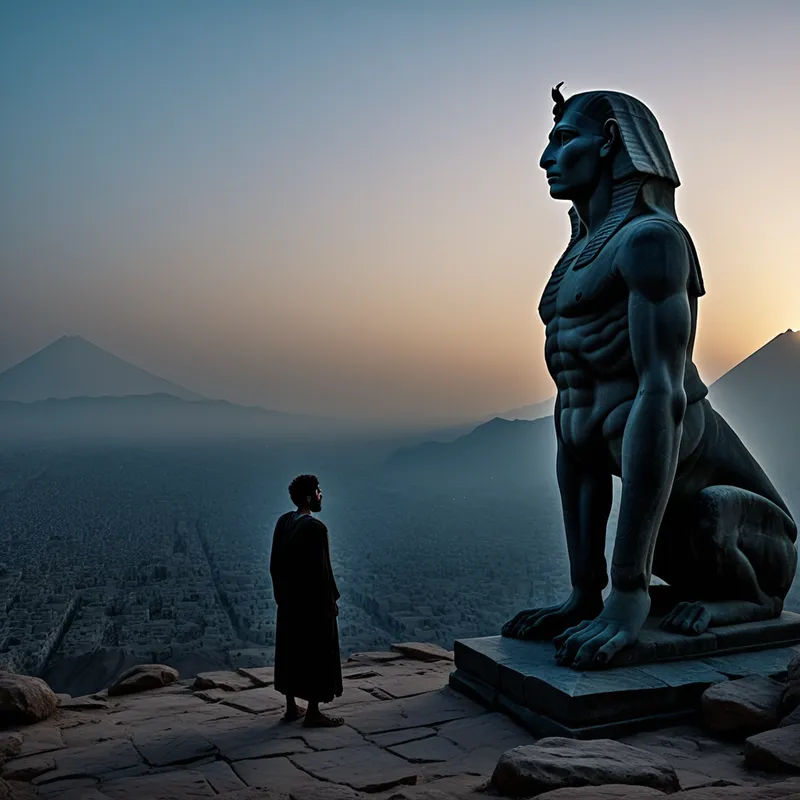
Cultural Origins & Context
The myth of the Sphinx is most famously preserved in the Theban plays of Sophocles, particularly Oedipus Rex. However, its roots are older, woven into the fabric of Greek oral tradition. The Sphinx herself is a cultural import, a mythological figure whose iconography likely traveled from Egypt and the Near East, where sphinxes were often depicted as benevolent, male guardians. The Greeks transformed her into something more psychologically potent: a female monster, a hybrid, an active destroyer.
Her placement at Thebes is significant. Thebes was a city perpetually struggling with themes of fate, pollution (miasma), and monstrous births. The Sphinx externalized this inner turmoil. She was not just a random monster; she was the embodied consequence of royal transgression, a physical manifestation of a moral and cosmic disorder that needed to be solved. The myth was told at symposia, in epic recitations, and later in the great theaters of Athens. It served as a foundational narrative about intelligence triumphing over brute force, but with a characteristically Greek twist: the triumph is poisoned. Oedipus’s brilliant answer saves the city but sets him on the path to his own horrific self-discovery, modeling the Greek belief that great knowledge and great suffering are inextricably linked.
Symbolic Architecture
The Sphinx is not merely a monster; she is a living symbol of the Unanswered Question that blocks the path of life. She represents the threshold guardian of a new stage of consciousness, one that cannot be passed by force, only by insight.
Her hybrid form is the first clue. The human head signifies intellect and language—the domain of the riddle. The lion’s body represents raw instinct, predatory power, and the untamed forces of nature. The eagle’s wings connect her to the divine, to lofty realms of prophecy and fate. She is, therefore, a complete system: a fusion of mind, body, and spirit, but in a chaotic, threatening alignment. She is the unintegrated self, where cognitive power serves a destructive, animalistic end.
Her riddle is the core of her symbolic power.
The ultimate riddle is always about the nature of the one who confronts it. The answer is not found in the external world, but in a moment of radical self-reflection.
The Sphinx does not ask about gods or monsters. She asks about the human condition itself: time, mortality, and the progression of a single life. To fail the riddle is to fail to understand one’s own nature. It is a failure of self-knowledge, for which the price is death—not just physical, but psychic death, a perpetual stasis before the threshold. Oedipus succeeds because he objectifies “Man,” seeing the pattern of a life from the outside. Tragically, he cannot yet apply that insight to himself. He knows what Man is, but not yet who he is.
The Dreamer’s Resonance
When the Sphinx appears in a modern dream, she rarely manifests as a literal winged lion-woman. She is the feeling of an insurmountable, intelligent obstacle. She is the crucial job interview that feels like a trap, the complex emotional equation in a relationship that seems to have only wrong answers, the creative block that mocks your efforts. She is the problem that defines a phase of life.
Somnologically, dreaming of the Sphinx pattern indicates a psyche engaged in a critical confrontation with its own complexity. The dreamer is at a crossroads where old ways of thinking (“four feet”) are no longer sufficient, but the new perspective (“two feet”) is not yet fully integrated. The Sphinx-dream creates a somatic pressure, a tightening in the chest or a dryness in the throat—the body’s memory of being questioned, of having its worth tested.
The monster in the dream does not want to destroy the dreamer; it wants to be understood. Its violence is the violence of a neglected truth demanding attention. To dream of fleeing the Sphinx is to dream of avoiding a necessary, if painful, insight. To dream of answering her correctly is to feel a profound release, a sense of a logjam breaking in the psyche, even if the consequences of that new knowledge are not yet known.

Alchemical Translation
In the alchemical vessel of the soul, the myth of the Sphinx models the stage of Nigredo, the blackening, where the individual confronts the chaotic, hybrid matter of the unconscious. The road to Thebes is the path of individuation. The city represents a state of potential wholeness, but the path is blocked by a chimeric guardian—the shadow, not as a simple dark double, but as a sophisticated, enigmatic complex that wields our own intellect against us.
The heroic task is not to slay this guardian with sword, but to dissolve it with logos, with the correct word. This is psychic alchemy. The base material (the chaotic hybrid, the unsolved problem) is transmuted through the application of conscious insight.
The Sphinx’s suicide upon hearing the answer is the key. The complex does not integrate by being beaten; it dissolves when truly comprehended. Its energy is released back into the psyche, no longer as a blocking monster, but as available power.
Oedipus’s answer, “Man,” is the prima materia of self-knowledge. For the modern individual, the alchemical question becomes personalized: “What is the pattern of my life? What walks on four, then two, then three feet in my journey?” Answering it requires the same courage: to look at one’s own life with objective clarity, to name one’s dependencies (the staff), one’s strengths (the upright walk), and one’s origins (the crawl). The triumph is the dissolution of the internal Sphinx—the anxiety, the obsessive thought-pattern, the intellectualized defense—that prevents forward motion. The tragedy, as Oedipus shows us, is that this victory often illuminates shadowed corners of our history we were not prepared to see. The alchemical journey does not end with the solved riddle; it begins in earnest, as we walk, newly unblocked, into the complex city of our own becoming.
Associated Symbols
Explore related symbols from the CaleaDream lexicon: