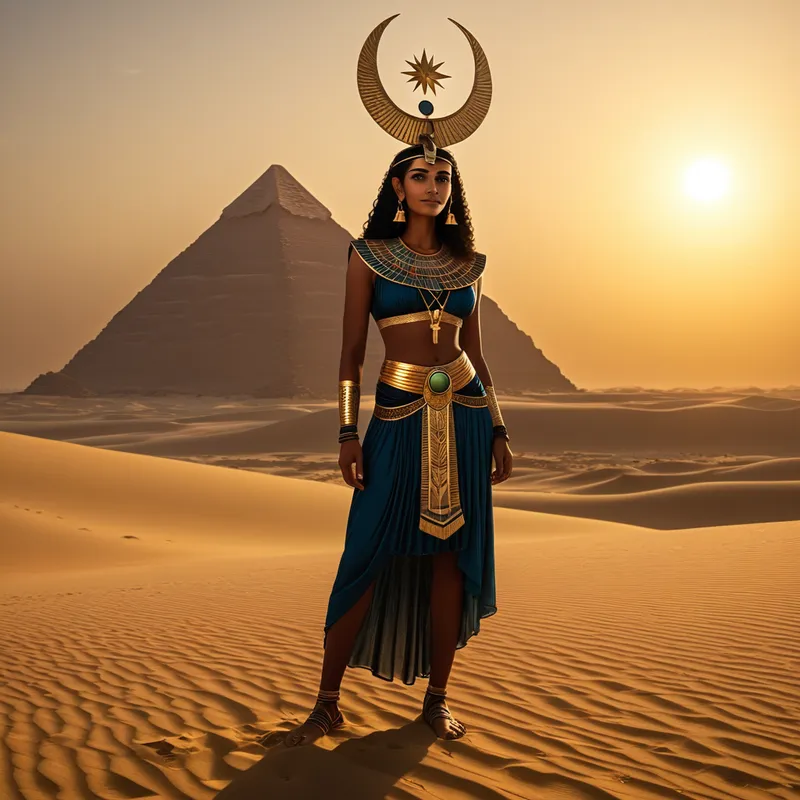
Sopdet Myth Meaning & Symbolism
The celestial goddess whose predawn rising heralds the Nile's life-giving flood, weaving together time, fertility, and the promise of cyclical rebirth.
The Tale of Sopdet
Listen. The world holds its breath.
The great river, Nile, has grown thin and tired. Its banks, once lush and humming with life, are now cracked and silent. The granaries whisper with the ghosts of last season’s harvest. The land of Kemet lies parched beneath the unrelenting gaze of Ra, waiting for a sign it fears may never come.
In this time of dust and longing, all eyes turn not to the sun, but to the eastern horizon in the deepest hour of night. They seek a flicker, a promise written in the oldest script—the stars. For seventy days, the brightest jewel of the night, Sirius, has been absent, swallowed by the sun’s own fire. It is a time of mourning, a celestial death.
But in the heart of this darkness, she stirs.
She is Sopdet, the Scorcher, the Sharp One. She is not a goddess of gentle comfort, but of precise, terrible necessity. She sleeps in the underworld, her light banked, her power coiled. Then, on a night thin as a papyrus sheet, a change whispers through the cosmos. Just before Ra’s first light cracks the world’s shell, a new light appears.
A single, piercing, silver-white star breaches the horizon.
It is Sopdet, returning. Her heliacal rising is not a gentle dawn, but a cosmic announcement—a fanfare of one. Her light is a needle, stitching the sky back to the earth. The priests on the temple roofs see it first. A cry goes up, a shiver of pure recognition that races from the precinct of Amun to the smallest mud-brick home.
Her arrival is the signal. It is the trigger in the heart of the world. The news flies down the river: “She has returned! The Inundation comes!”
And the river listens. Far to the south, in the mystical lands beyond the cataracts, the waters hear their mistress’s call. A tremor, then a rumble. The lifeblood of Egypt, held back for so long, begins to move. It is not a gentle swell, but a rising, churning, red-brown torrent—carrying not destruction, but the rich, black silt of creation. It spills over the banks, swallowing the cracked earth, a benevolent flood that drowns the old dryness to birth the new fertility.
Sopdet does not cause the flood; she announces it. She is the punctual heartbeat of the universe, the guarantor that the cycle holds. With her star shining beside the rising sun, the New Year begins. Time itself is reborn. The fields will soon be green, the granaries will groan with abundance, and Ma’at—the cosmic order—is confirmed once more. The world exhales. The promise is kept.

Cultural Origins & Context
The myth of Sopdet is not a narrative of epic battles or familial drama, but one of celestial mechanics made divine. It emerged from the most fundamental observation of the ancient Egyptian world: the symbiotic relationship between the star Sirius and the Nile’s annual flood. This was not mere folklore; it was a pillar of statecraft, religion, and survival.
The myth was lived annually. It was passed down not only by temple priests who were master astronomers, meticulously recording the star’s 70-day absence and its precise return, but by every farmer who watched the horizon. Its societal function was absolute. Sopdet’s rising marked the Egyptian New Year (Wep Renpet) and was the linchpin of the civil calendar. It dictated the agricultural schedule, tax collection, and religious festivals. She was the timekeeper of the gods, and her reliability was the foundation of Ma’at itself. To venerate Sopdet was to participate in the maintenance of cosmic and social order, to align human activity with the immutable rhythm of the heavens.
Symbolic Architecture
Sopdet represents the archetype of the Harbinger—the precise, punctual signal that initiates a transformative process. She is not the transformation itself (the flood, the growth), but the essential catalyst without which the cycle fails.
The promise is not in the abundance, but in the moment of its sure announcement.
Psychologically, she symbolizes the awakening of innate timing. She is the internal signal that a long period of dormancy (“the 70 days of absence”) is over and a time of release and fertility is at hand. Her star is a point of orientation in the personal darkness, a fixed certainty that change is not only possible but imminent according to a deeper, natural law. She is often linked with Isis, framing her as the faithful wife whose return heralds the rebirth of life (Osiris/Horus). This ties her symbolism to fidelity to a cycle, to a promise that must be kept for life to continue.
Her five-pointed star is a symbol of piercing clarity and direction—a single point of light that cuts through confusion and announces a new phase. She embodies the marriage of the celestial and the earthly: the star (spirit, idea, potential) directly causing the flood (emotion, unconscious content, creative energy) to irrigate the land (the conscious life, the ego).
The Dreamer's Resonance
When the pattern of Sopdet rises in the modern dreamer’s psyche, it often manifests as dreams of waiting for a sign. One might dream of watching an empty horizon, consulting a stopped clock, or feeling a profound, somatic anticipation—a tightness in the chest that is neither anxiety nor fear, but a focused readiness.
The dreamer may see a single, brilliant light in an otherwise dark sky, or hear a specific, clear sound (a bell, a horn) that signals a sudden, internal shift. This is the psyche’s “heliacal rising.” It indicates the end of a personal “70 days”—a period of stagnation, grief, or creative drought. The somatic process is one of release; the dream often precedes a sudden, intuitive knowing or an upwelling of emotion that feels like a necessary flood, washing away a psychic drought. It is the dream of correct timing, announcing that the unconscious is primed to deliver its nourishing silt to the conscious mind.

Alchemical Translation
The alchemical journey modeled by Sopdet is the Opus of Right Timing—the work of aligning the ego with the innate, cyclical rhythms of the Self. The modern individual often lives in a state of forced or artificial seasons, ignoring internal cues for dormancy and pushing prematurely for growth.
The first stage is the Absence: acknowledging and respecting the necessary fallow periods in life, the “70 days” when our inner Sirius is unseen, and our creative or emotional waters are low. This is not failure, but a cosmic winter.
The Heliacal Rising is the moment of synchronicity: the internal recognition that the wait is over. This requires attunement—the “priest on the temple roof”—a practiced, observant consciousness that can spot the first glimmer of the new phase before it is fully manifest.
The flood follows the star, not the will. The work is in seeing the star, not in forcing the river.
The final stage is the Inundation: allowing the released contents of the unconscious—the rich, chaotic, fertile “silt” of new feelings, images, and insights—to flood the ordered banks of the conscious self. This is not a controlled irrigation, but a surrender to a life-giving deluge that will eventually recede, leaving behind the fertile ground for a new year of the soul. To individuate is to learn to live in this sacred cycle, trusting the celestial signal of the deeper Self to guide the rhythms of one’s life. Sopdet teaches that rebirth is not random; it is a promise kept by the cosmos, witnessed by those who know where, and when, to look.
Associated Symbols
Explore related symbols from the CaleaDream lexicon: