Solomon's Throne Myth Meaning & Symbolism
The legendary throne of King Solomon, a masterpiece of divine wisdom and cosmic order, representing the ultimate integration of power, justice, and spirit.
The Tale of Solomon’s Throne
Hear now, and let your spirit be stilled, for I speak of a seat that was not merely a seat, but the axis of [the world](/myths/the-world “Myth from Tarot culture.”/). In the days when the scent of cedar from Lebanon still hung fresh in the air, and the kingdom of Israel stretched from [the river](/myths/the-river “Myth from Buddhist culture.”/) to [the sea](/myths/the-sea “Myth from Greek culture.”/), there lived a king whose name was whispered by [the wind](/myths/the-wind “Myth from Various culture.”/): [Solomon](/myths/solomon “Myth from Biblical culture.”/).
His father, the warrior David, had secured the kingdom with blood and psalm. But Solomon was given a different task—to secure it with wisdom. And so he dreamed not of more conquest, but of a throne. Not a simple chair of state, but a living emblem of the cosmos itself, a vessel for the divine judgment granted to him.
He summoned the master craftsman Hiram, and they spoke in the hushed tones of the inner court. “Build me a throne,” Solomon said, his voice like deep [water](/myths/water “Myth from Chinese culture.”/), “that will tell a story without words. Let every step toward it be a lesson. Let every creature upon it be a witness.”
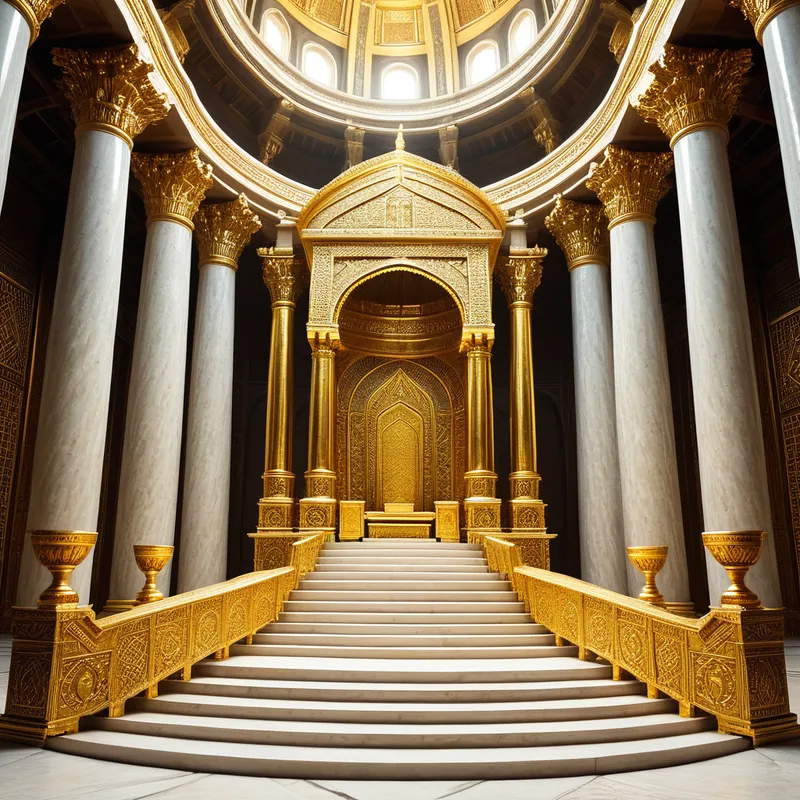
And so they wrought a wonder. From the finest ivory, carved until it gleamed like captured moonlight, they formed the great chair. Over it, they poured pure gold, so that it seemed not to be overlaid, but to have grown that way, a tree of sun-metal. But the true mystery lay in the approach. Six steps led up to the seat, and on each step, two lions stood guard—one to the left, one to the right. Twelve lions in total, their mouths forever open in silent roars of vigilance, their eyes of precious stones seeing all who dared ascend.
Upon the armrests, more lions stood sentinel. And behind the throne, the rounded back was crowned with the head of a calf, a symbol of patient service. But the greatest marvel was unseen until the king sat. For it was said that when Solomon, heavy with the burden of judgment, would place his foot upon the first step, a mechanism of divine design would stir. The lions would extend their paws, as if in salute. And when he reached [the summit](/myths/the-summit “Myth from Taoist culture.”/) and sat, a golden shamir would descend from the heavens, its wings outspread to shade the king’s head, and in its beak, it would place the Ark of the Covenant’s very essence—the spirit of [the Law](/myths/the-law “Myth from Biblical culture.”/) itself.
Then the king would speak, and his words would not be his own, but the clear, flowing [justice](/myths/justice “Myth from Tarot culture.”/) of the cosmos, sorting truth from falsehood as wheat from chaff. The throne was not his power; it was [the crucible](/myths/the-crucible “Myth from Alchemical culture.”/) for the power lent to him. It was the place where a man became the conduit for a wisdom that ordered the world.
Cultural Origins & Context
The detailed descriptions of Solomon’s Throne are found not in the canonical books of Kings and Chronicles, which mention its grandeur only briefly, but primarily in the later Midrash and the extra-biblical <abbr title=“The “Book of the Bee,” a 13th-century Syriac compilation of biblical and theological narratives”>Kebra Nagast of Ethiopia. This tells us a crucial truth: the myth grew in the telling. It flourished in the soil of exilic and post-exilic Judaism, a time when the physical throne was long lost to history, but the idea of it became more potent than ever.
Rabbis and storytellers, grappling with the loss of [the Temple](/myths/the-temple “Myth from Jewish culture.”/) and the Davidic monarchy, used the throne as a narrative anchor. It became a symbol of a lost [golden age](/myths/golden-age “Myth from Universal culture.”/), a time when heaven and earth collaborated seamlessly through a righteous king. The elaborate descriptions—the mechanical lions, the miraculous shamir—served a profound societal function. They were not mere fantasy, but theological assertions. They proclaimed that true sovereignty, the kind that brings peace and order (Shalom, from which Solomon’s name derives), is not based on military might but on divinely-sanctioned wisdom and the meticulous execution of cosmic law. The throne was a story told to remember what kingship ought to be, a template against which all earthly power should be measured.
Symbolic Architecture
The [throne](/symbols/throne “Symbol: A seat of authority, power, and sovereignty, representing leadership, divine right, or social hierarchy.”/) is a masterpiece of symbolic [psychology](/symbols/psychology “Symbol: Psychology in dreams often represents the exploration of the self, the subconscious mind, and emotional conflicts.”/), a map of the integrated Self. Each element is a facet of [consciousness](/symbols/consciousness “Symbol: Consciousness represents the state of awareness and perception, encompassing thoughts, feelings, and experiences.”/) brought into harmonious alignment under a central, ruling principle.
The six steps represent a graduated [ascent](/symbols/ascent “Symbol: Symbolizes upward movement, progress, spiritual elevation, or striving toward higher goals, often representing personal growth or transcendence.”/), the stages of moral and spiritual development required to approach true judgment. The twelve lions—echoing the twelve tribes of Israel—symbolize the raw, instinctual power of the [psyche](/myths/psyche “Myth from Greek culture.”/). They are the passions, the drives, the fierce protective energies. In their ordered pairs on the steps, they depict these potent forces not as enemies to be slain, but as loyal guardians when properly integrated and positioned. They are sublimated instinct, power in service to order.
The throne is not where the king rests, but where the kingdom within him is brought to heel and crowned.
The [ivory](/symbols/ivory “Symbol: A precious material from elephant tusks, symbolizing purity, luxury, and mortality due to its source and value.”/) and gold speak of a [synthesis](/symbols/synthesis “Symbol: The process of combining separate elements into a unified whole, representing integration, resolution, and the completion of a personal journey.”/): [ivory](/symbols/ivory “Symbol: A precious material from elephant tusks, symbolizing purity, luxury, and mortality due to its source and value.”/) from the [earth](/symbols/earth “Symbol: The symbol of Earth often represents grounding, stability, and the physical realm, embodying a connection to nature and the innate support it provides.”/) (the animal, the mortal, the foundational) overlaid with gold (the divine, the eternal, the transcendent). This is the [alchemy](/symbols/alchemy “Symbol: A transformative process of purification and creation, often symbolizing personal or spiritual evolution through difficult stages.”/) of the [human](/symbols/human “Symbol: The symbol of a human represents individuality, complexity of emotions, and social relationships.”/) [condition](/symbols/condition “Symbol: Condition reflects the state of being, often focusing on physical, emotional, or situational aspects of life.”/). The calf’s head signifies patient, enduring service and sacrifice, the necessary humility that underpins wisdom. Finally, the miraculous shamir and the implied [presence](/symbols/presence “Symbol: Presence in dreams often signifies awareness or acknowledgment of something significant in one’s life.”/) of [the Law](/symbols/the-law “Symbol: Represents external rules, societal order, moral boundaries, and the tension between personal freedom and collective structure.”/) signify that ultimate wisdom is not generated by [the ego](/myths/the-ego “Myth from Jungian culture.”/), but received. It descends when the [vessel](/symbols/vessel “Symbol: A container or structure that holds, transports, or protects something essential, representing the self, emotions, or life journey.”/)—the [human](/symbols/human “Symbol: The symbol of a human represents individuality, complexity of emotions, and social relationships.”/) psyche, properly prepared and aligned—is ready to receive it. The throne, therefore, is the [archetype](/symbols/archetype “Symbol: A universal, primordial pattern or prototype in the collective unconscious that shapes human experience, behavior, and creative expression.”/) of the Self as a ruling, ordering principle.
The Dreamer’s Resonance
When the image of Solomon’s Throne arises in a modern dream, it rarely appears as a historical relic. It manifests as the dreamer’s own “seat of power”—perhaps a CEO’s chair that feels terrifyingly large, a judge’s bench one is unprepared to mount, or a simple chair at the head of a family table that radiates daunting authority. The dream often centers on the ascent: the dreamer climbing the steps, feeling the gaze of the lion-statues (which may be family portraits, colleagues, or internal critics), and the profound anxiety or awe about taking the final seat.
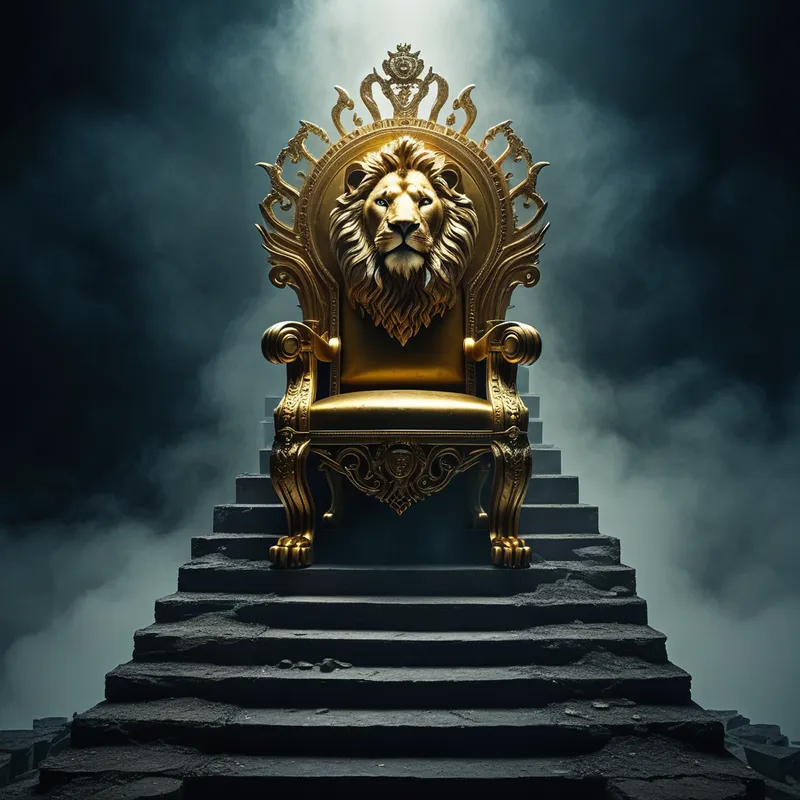
This dream signals a critical moment of psychological process: the ego is being called to a higher level of responsibility and integration. The somatic feeling is often a tightening in the chest—the weight of [the crown](/myths/the-crown “Myth from Various culture.”/)—or a weakness in the knees on the steps. The lions represent the “unruly” aspects of one’s own nature—anger, desire, pride—that must be acknowledged and organized, not denied. To dream of sitting successfully on the throne is to experience a moment of profound self-authorization, where one’s disparate parts are aligned behind a central, conscious decision. To dream of being unable to reach it, or of the throne being empty or crumbling, speaks to a deep avoidance of one’s own inner authority and the difficult, step-by-step work of integration it requires.
Alchemical Translation
The myth of Solomon’s Throne is a precise allegory for the Jungian process of individuation, where the base elements of the personality are transmuted into the gold of the integrated Self. The “base matter” is the chaotic, instinct-driven psyche—the unnumbered lions roaming wild. The alchemical vessel is the structured, deliberate design of the throne itself—the conscious framework of discipline, ethics, and self-reflection.
The six steps are the stages of [the opus](/myths/the-opus “Myth from Alchemical culture.”/): confronting [the shadow](/myths/the-shadow “Myth from Jungian culture.”/) (meeting the first lions), engaging with the anima/animus, and successive integrations. Each step requires that we place our foot firmly, accepting the responsibility of that level, and see our instincts not as threats but as necessary guardians for that new height. The gold overlaid on ivory is the ultimate goal: the mortal ego, fully realized and complex (ivory), becomes the vehicle for a transpersonal, guiding principle (gold).
To sit upon the inner throne is not to dominate the psyche, but to become the space where its conflicts are resolved and its voices are heard in just measure.
For the modern individual, the “construction of the throne” is the lifelong work of building a conscious personality capable of bearing the weight of its own truth. It is creating an inner council where every passion (lion) has its appointed place, where ascent is gradual and earned, and where final judgment comes from a place that feels, mysteriously, both deeply personal and beyond oneself. The throne is not a destination of domination, but of serene, authoritative balance—the point where one finally becomes a fit ruler of one’s own inner kingdom.
Associated Symbols
Explore related symbols from the CaleaDream lexicon: