Solomon and the Jinn
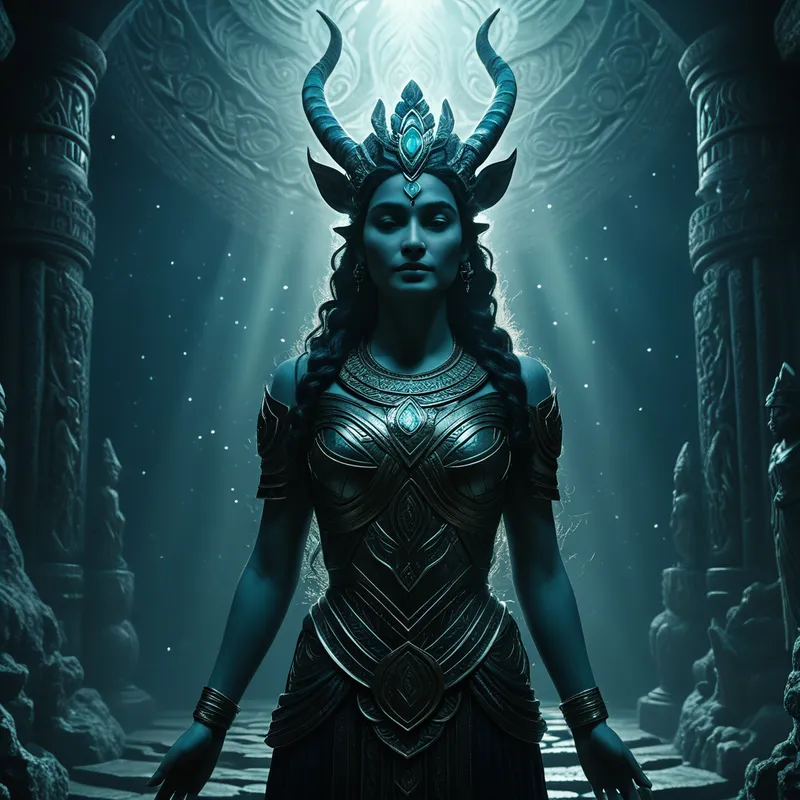
The legendary King Solomon uses divine wisdom to command supernatural jinn, building his temple through mystical power and unparalleled authority.
The Tale of Solomon and the Jinn
The tale begins not with a command, but with a prayer. [Solomon](/myths/solomon “Myth from Biblical culture.”/), son of [David](/myths/david “Myth from Biblical culture.”/), stood upon the windswept heights, his heart a vessel of gratitude. “My Lord,” he implored, “grant me a kingdom such as shall not belong to anyone after me. Indeed, You are the Bestower.” And the prayer was answered, not with mere gold or armies, but with a sovereignty that bridged the seen and unseen. The winds were made subservient, blowing at his behest to carry his mobile throne across vast distances in the blink of an eye. But the most profound grant was authority over the jinn—those capricious, powerful entities of smokeless fire who dwell in the spaces between things.
With this authority, Solomon did not become a tyrant, but a master architect of divine will. His great project was the completion of [the Temple](/myths/the-temple “Myth from Jewish culture.”/) in [Jerusalem](/myths/jerusalem “Myth from Biblical culture.”/), a task of impossible scale and perfection. He summoned the hosts of [the jinn](/myths/the-jinn “Myth from Pre-Islamic Arabian / Islamic culture.”/), and they came—a tumultuous, fiery multitude, their forms shifting like heat haze. Among them were the mighty builders, who could hew mountains into blocks and set column upon column with preternatural speed. Others were divers, plunging to the ocean’s abyss to retrieve pearls and rare treasures to embed within the sacred walls. The air hummed with their labors, a symphony of otherworldly industry directed by a human mind and a prophetic heart.
Yet, Solomon’s command was absolute because it was rooted in a higher law. He possessed the Ring of Power, inscribed with the Greatest Name of God. This was no mere tool of domination; it was a [covenant](/myths/covenant “Myth from Christian culture.”/), a focal point that aligned his will with Divine Order. The jinn could not disobey its bearer, for to do so was to rebel against the cosmic decree itself. The myth tells of one jinn, a being of great knowledge, who could fetch the throne of [the Queen of Sheba](/myths/the-queen-of-sheba “Myth from Biblical culture.”/) “before your glance returns to you.” This illustrates not brute force, but the instantaneous execution of a command within a reality made pliable by divine permission.
The narrative deepens with [the shadow](/myths/the-shadow “Myth from Jungian culture.”/) of mortality. Solomon’s [death](/myths/death “Myth from Tarot culture.”/) came not in battle or bed, but in prayer, leaning upon his staff. The jinn, unaware, continued their relentless toil, believing his watchful gaze still upon them. It was only when a creature of [the earth](/myths/the-earth “Myth from Hindu culture.”/)—a termite—gnawed through the staff, causing his body to fall, that the illusion broke. The jinn stopped, their compelled labor ceasing in a moment of profound revelation: “If we had known the unseen, we would not have remained in humiliating torment.” Their freedom was restored by the very mortality they had been forced to serve, a final, poignant lesson on the limits of all power beneath the Divine.
Cultural Origins & Context
The story of Solomon (Sulayman in Arabic) is woven throughout the Islamic tradition, primarily in the Qur’an and the expansive corpus of Hadith and Qisas al-Anbiya. He is revered not as a magician, but as a prophet-king, a model of just rule and divinely-bestowed wisdom (hikmah). His command over jinn, animals, and [the wind](/myths/the-wind “Myth from Various culture.”/) is consistently framed as a clear sign (ayah) from God, a miraculous proof of his prophethood and a demonstration that all creation, seen and unseen, is ultimately subject to the Creator.
This context is crucial. In the pre-Islamic Arabian worldview, jinn were feared, unpredictable powers, often blamed for misfortune and madness. Islam integrated them into a monotheistic cosmos as another creation of God, possessed of free will, subject to judgment, and capable of both belief and disbelief. Solomon’s narrative thus performs a profound cultural alchemy: it subsumes these potent, chaotic forces of the old world into a new, divinely-ordered hierarchy. The jinn are not abolished; they are harnessed in service to a sacred, civilization-building project under a righteous ruler. This mirrors the Islamic project itself: bringing the chaotic forces of human society and the natural world into harmony under [the law](/myths/the-law “Myth from Biblical culture.”/) of God (Sharia).
Symbolic Architecture
The [Temple](/symbols/temple “Symbol: A temple often symbolizes spirituality, sanctuary, and a deep connection to the sacred aspects of life.”/) built by the jinn is more than a physical [structure](/symbols/structure “Symbol: Structure in dreams often symbolizes stability, organization, and the framework of one’s life, reflecting how one perceives their environment and personal life.”/); it is the [psyche](/myths/psyche “Myth from Greek culture.”/) of the integrated ruler. Its foundations are the unshakable law of God, its walls are the discipline of wisdom, and its adornments are the diverse, often chaotic, energies of the inner and outer worlds, brought into beautiful, purposeful order.
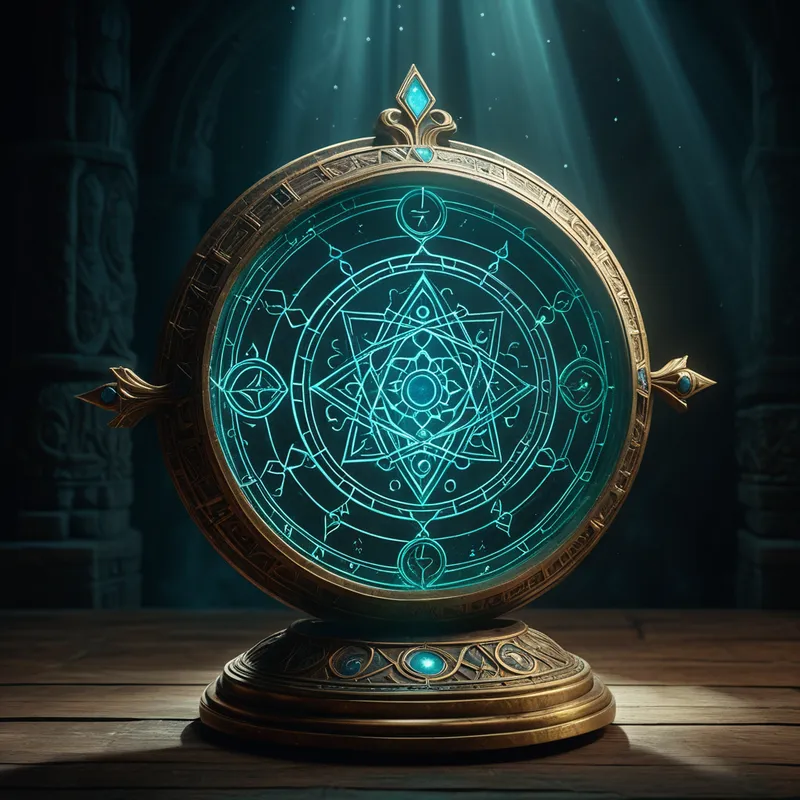
The Ring of Power is not an external object, but the conscious, centered self aligned with a transcendent principle. It is the point where individual will surrenders to, and thus becomes an instrument of, a greater Will. To wear the ring is to hold the tension between authority and submission.
The jinn represent the formidable, often unconscious, forces within the [human](/symbols/human “Symbol: The symbol of a human represents individuality, complexity of emotions, and social relationships.”/) [soul](/symbols/soul “Symbol: The soul represents the essence of a person, encompassing their spirit, identity, and connection to the universe.”/): raw creativity, ambition, [passion](/symbols/passion “Symbol: Intense emotional or physical desire, often linked to love, creativity, or purpose. Represents life force and deep engagement.”/), and the shadowy drives that can either destroy or build. Solomon does not exterminate these jinn; he knows their names, compels them to labor, and directs their fiery [energy](/symbols/energy “Symbol: Energy symbolizes vitality, motivation, and the drive that fuels actions and ambitions.”/) into a sublime creation. This is the essence of psychological [integration](/symbols/integration “Symbol: The process of unifying disparate parts of the self or experience into a cohesive whole, often representing psychological wholeness or resolution of internal conflict.”/)—[the ego](/myths/the-ego “Myth from Jungian culture.”/), fortified by wisdom and divine [connection](/symbols/connection “Symbol: Connection symbolizes relationships, communication, and bonds among individuals.”/), no longer being terrorized by inner demons, but putting them to work.
His death, hidden from the jinn, reveals the ultimate fragility of the ego’s control. The sustaining illusion of permanent, personal power is upheld only by a staff—a prop of identity. When it crumbles, the compelled energies stop. True, lasting order must be built on something more eternal than the individual will.
The Dreamer’s Resonance
To dream of Solomon and the jinn is to dream of a critical phase of self-mastery. It speaks to the dreamer’s confrontation with their own unruly, potent, and often hidden capacities. The jinn in the dream may be fearsome or fascinating, representing repressed talents, overwhelming emotions, or addictive impulses. Solomon’s presence suggests the emergence, or the need for, a ruling principle—a wise, discerning consciousness that can face these forces without being overwhelmed.
The dream may present a task: a temple to be built, a chaotic landscape to be ordered. This is the dream-ego’s call to undertake [the great work](/myths/the-great-work “Myth from Alchemical culture.”/) of integration. The inability to command the jinn reflects a feeling of being at the mercy of one’s own compulsions or external pressures. Conversely, successfully directing them signifies a moment of profound inner alignment and empowered creativity, where one’s deepest energies are finally harnessed to a life-affirming purpose.
Alchemical Translation
The myth is a precise allegory for the alchemical [Magnum Opus](/myths/magnum-opus “Myth from Alchemical culture.”/). The base matter is the chaotic, fiery nature of the jinn (the [prima materia](/myths/prima-materia “Myth from Alchemical culture.”/), the unconscious psyche). Solomon, [the adept](/myths/the-adept “Myth from Alchemical culture.”/)-king, possesses the transforming agent: the Ring, symbolizing the [Lapis Philosophorum](/myths/lapis-philosophorum “Myth from Alchemical culture.”/) or the fixed, transcendent truth. The process is one of forced, dedicated labor—the [solve et coagula](/myths/solve-et-coagula “Myth from Alchemical culture.”/).
The Temple is the lapis in its final, perfected state: the Self. Every block laid by a jinn is a complex integrated, a shadow reclaimed, an instinctual energy sublimated into the service of the whole. The divers retrieving pearls from the dark sea are the forays into the personal and collective unconscious to bring up treasures of insight and value.
The alchemy is not of lead to gold, but of [chaos](/myths/chaos “Myth from Greek culture.”/) to cosmos, of disparate psychic forces into a coherent, sacred whole. The death of the king is the necessary stage of mortificatio—the death of the old, identifying ego so that the enduring structure of the true Self (the Temple) remains. The jinn’s cessation of work is the liberation of these energies from their compulsive bindings, now free to operate in a new, self-regulated harmony.
Associated Symbols
Explore related symbols from the CaleaDream lexicon:
- Ring of Power — The symbol of divinely-sanctioned authority and the focused will that channels higher law into manifest action; it represents the covenant between the human and the transcendent.
- Temple — The perfected Self, the sacred space built through disciplined effort where the divine and the human, the conscious and unconscious, are brought into harmonious order.
- Jinn — The raw, potent, and often chaotic forces of the unconscious psyche, creativity, and instinctual energy, which can be either destructive demons or productive servants.
- Wind — The subservient winds represent the mastery over the intellect, spirit, and the swift, invisible currents of thought and inspiration that carry [the self](/myths/the-self “Myth from Jungian culture.”/) toward its destiny.
- Roots of Wisdom — The deep, nourishing connection to tradition, divine law, and ancestral knowledge that grounds and sustains true authority, preventing it from becoming mere tyranny.
- Power Dynamics — The essential tension in the myth between command and submission, freedom and compulsion, exploring how true power is exercised within a framework of higher responsibility.
- Stone — The foundational element of the Temple, representing law, permanence, and the building blocks of consciousness and civilization, hewn from the mountain of raw experience.
- Shadow — The collective term for the jinn as representations of the personal and cultural unconscious—all that is hidden, potent, and requiring integration for wholeness.
- Order — The divine fitrah or natural state to which Solomon aligns his kingdom; the harmonious structure imposed upon chaos through wisdom and just rule.
- Wisdom’s Key — The discernment (hikmah) that unlocks the proper use of power, allowing Solomon to command not through fear, but through understanding the nature of what he commands.
- [Djinn](/myths/djinn “Myth from Islamic culture.”/)‘s Whisper — The ever-present temptation of the unruly forces, the seductive or corrosive thoughts from the shadow that test the integrity of the ruling consciousness.