Solomon Myth Meaning & Symbolism
A king receives divine wisdom, builds a sacred temple, but his heart turns to foreign gods, fracturing his kingdom and legacy.
The Tale of Solomon
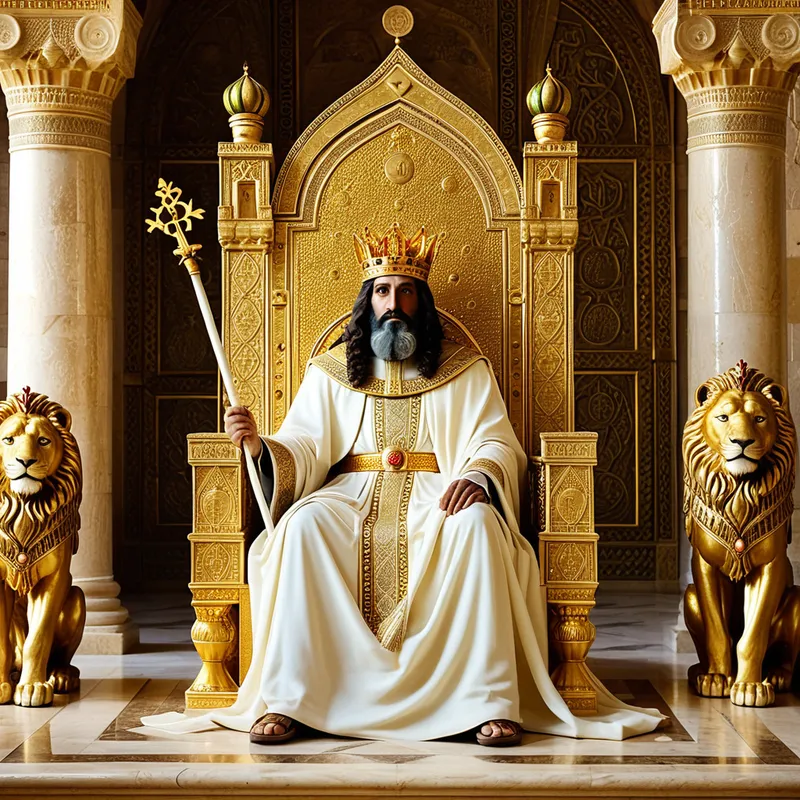
Hear now the tale of the golden king, the son of the warrior and the queen. In the twilight of David’s reign, when blood and promise stained the palace stones, a whisper moved through the court: Who will hold the scepter? From the intrigue of brothers, one emerged, Solomon, beloved of YHWH. And to him, in the deep of night at the high place of Gibeon, the Divine appeared not in thunder, but in a silent question hanging in the incense-thick air.
“Ask. What shall I give you?”
The young king, feeling the weight of the unformed kingdom upon his shoulders like a mantle of lead, did not ask for long life, nor for the death of his enemies, nor for boundless wealth. He drew a breath that tasted of myrrh and desert wind, and asked for a listening heart—lev shomea—to discern between good and evil, to govern the vast, tribal soul of the people. This plea, a rarity in the annals of kings, pleased the Unseen. So wisdom was granted, a wisdom that settled in his bones like a second heartbeat, profound and terrifying. And with it came riches and honor he had not sought, until silver in [Jerusalem](/myths/jerusalem “Myth from Biblical culture.”/) was as common as stone, and cedar as plentiful as sycamore.
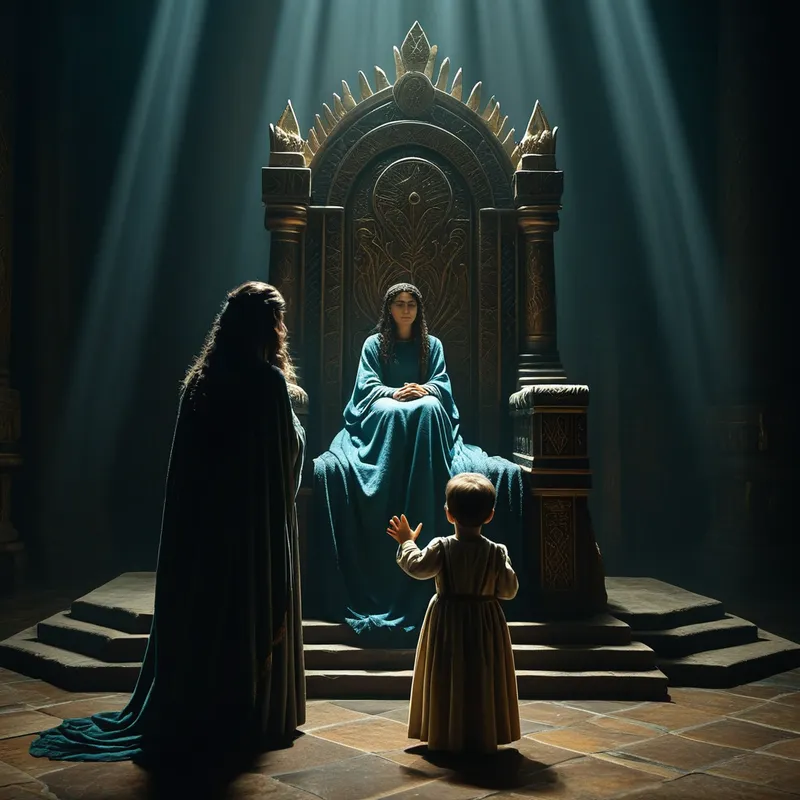
His wisdom became a living legend. It flowed in proverbs that dissected the human heart, in songs that ached with love and mortality. It was proven in the most harrowing of courts: two women, one child living, one dead, each claiming the breath of life. His decree—Cut the living child in two—was not cruelty, but a surgical strike into the maternal soul, revealing truth in a scream of protest. The kingdom listened, and awe held them still.
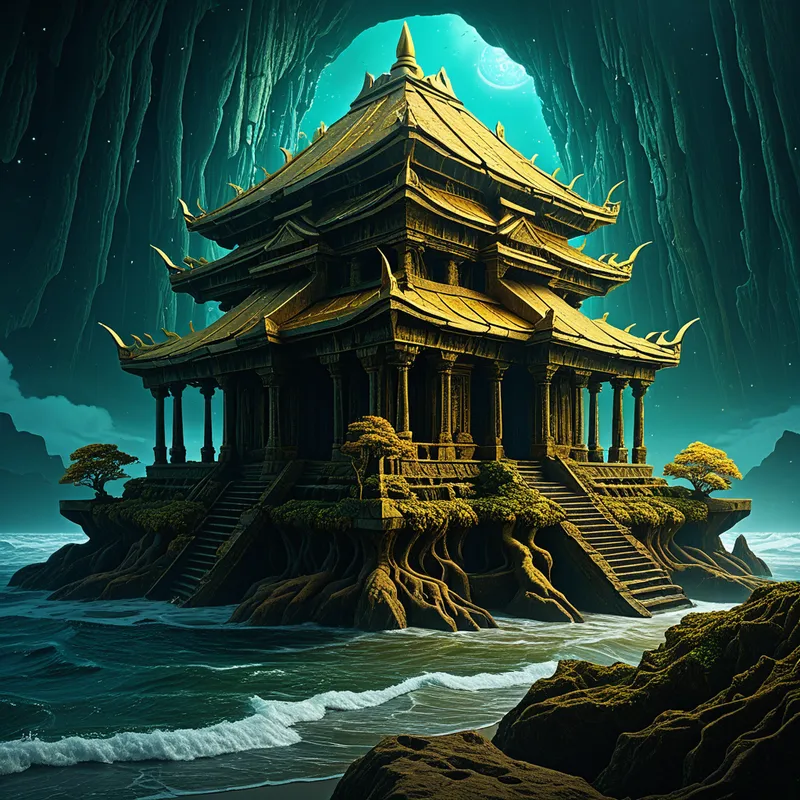
And he built. Oh, how he built. For seven years, the sound of hammer on stone, of saw on fragrant cedar from Lebanon, was the heartbeat of Jerusalem. He raised the Temple, a house for the Name, where the glory cloud would dwell. Gold overlay the walls, cherubim with outstretched wings guarded the inner sanctum, and the air itself seemed to crystallize into holiness. Then, for thirteen more years, he built his own house, a palace of [justice](/myths/justice “Myth from Tarot culture.”/) and splendor. He was the apex, the wise ruler, the matchless king to whom the Queen of Sheba journeyed, her camels heavy with spices and gold, to test his fame with hard questions. She left breathless, declaring the half had not been told.
But the heart that could discern a false mother could not guard itself. For love, they say—a slow, sweet poison—he clung to his many foreign wives, seven hundred princesses and three hundred concubines. And as he grew old, their whispered yearnings turned his heart. To please them, he built high places on the mountain facing Jerusalem, for Ashtoreth of the Sidonians, for Chemosh the abomination of Moab, for Molech before whom fire consumed the innocent. Incense rose from alien altars, a fragrant betrayal that clouded the once-clear channel of his listening heart.
And the Voice, which had given, now spoke in judgment. Because he had broken the covenant, the kingdom would be torn from his son’s hand, rent in two like [the child](/myths/the-child “Myth from Alchemy culture.”/) he never cut. The legacy of unity, forged by his father and gilded by his own wisdom, would shatter. The king died, heavy with years and glory, leaving behind a temple of gold and a nation poised on the brink of fracture. The wisest of all men became a warning etched in stone and memory.
Cultural Origins & Context
The Solomon narrative is a foundational national epic within the Deuteronomistic history—the sweeping theological account spanning Joshua to Kings. Compiled during the Babylonian Exile or shortly after, these stories served to answer a catastrophic question: Why did we fall? Solomon’s story is a central pillar in that answer. It is not a neutral biography but a profound morality tale told by priestly and scribal custodians of the Yahwistic tradition.
His reign is presented as Israel’s [golden age](/myths/golden-age “Myth from Universal culture.”/), the fulfillment of the promises to Abraham and David. The descriptions of boundless wealth and peace serve as a potent symbol of divine blessing contingent on covenant fidelity. The story functions as a theodicy of empire and its perils. It was told to remind a people stripped of kingdom and temple that wisdom and blessing are not possessions but relationships, easily forfeited when the sacred center (Zion) is compromised by the seductive peripheries of other loyalties.
Symbolic Architecture
Solomon is the [archetype](/symbols/archetype “Symbol: A universal, primordial pattern or prototype in the collective unconscious that shapes human experience, behavior, and creative expression.”/) of the ego-[consciousness](/symbols/consciousness “Symbol: Consciousness represents the state of awareness and perception, encompassing thoughts, feelings, and experiences.”/) at its most potent and perilous [zenith](/symbols/zenith “Symbol: The highest point in the sky or life’s peak moment, representing spiritual culmination, achievement, and divine connection.”/). He represents the [pinnacle](/symbols/pinnacle “Symbol: The highest point or peak, representing achievement, culmination, or spiritual transcendence.”/) of conscious [achievement](/symbols/achievement “Symbol: Symbolizes success, mastery, or reaching a goal, often reflecting personal validation, social recognition, or overcoming challenges.”/)—order, intellect, discernment, and cultural creation.
The Temple is not merely a building; it is the symbol of the integrated Self, a sacred inner space constructed through conscious effort (wisdom) to house the transcendent, numinous element (the Divine Presence).
His legendary wisdom symbolizes the [capacity](/symbols/capacity “Symbol: A measure of one’s potential, limits, or ability to contain, process, or achieve something, often reflecting self-assessment or external demands.”/) of consciousness to mediate, to discern, and to create meaningful [structure](/symbols/structure “Symbol: Structure in dreams often symbolizes stability, organization, and the framework of one’s life, reflecting how one perceives their environment and personal life.”/) from the [chaos](/symbols/chaos “Symbol: In Arts & Music, chaos represents raw creative potential, uncontrolled expression, and the breakdown of order to forge new artistic forms.”/) of instinct and tribal conflict. The judgment of the two harlots is the ultimate act of conscious discrimination, using a shock to the unconscious (the [threat](/symbols/threat “Symbol: A threat in dreams often reflects feelings of vulnerability, anxiety, or fear regarding one’s safety or well-being. It can indicate unresolved conflicts or the presence of external pressures.”/) of destruction) to reveal primal, instinctual [truth](/symbols/truth “Symbol: Truth represents authenticity, honesty, and the quest for knowledge beyond mere appearances.”/) (the real [mother](/symbols/mother “Symbol: The symbol of ‘Mother’ represents nurturing, protection, and the foundational aspect of one’s emotional being, often associated with comfort and unconditional love.”/)’s love).
Yet, his downfall reveals the fatal flaw of consciousness that believes itself complete. His many foreign wives symbolize the multitude of unconscious complexes, desires, and cultural “others” that the strong ego attracts and seeks to assimilate. Building altars for them signifies [the ego](/myths/the-ego “Myth from Jungian culture.”/)’s capitulation—its enantiodromia—where conscious values are secretly governed by the very unconscious forces they sought to rule. The fractured [kingdom](/symbols/kingdom “Symbol: A kingdom symbolizes authority, belonging, and a sense of identity within a larger context or community.”/) is the inevitable psychic state: a civil war between the conscious [identity](/symbols/identity “Symbol: Identity represents the sense of self, encompassing personal beliefs, cultural background, and social roles.”/) (Judah) and the repressed, instinctual forces (Israel) when the ruling principle loses its [connection](/symbols/connection “Symbol: Connection symbolizes relationships, communication, and bonds among individuals.”/) to its divine [source](/symbols/source “Symbol: The origin point of something, often representing beginnings, nourishment, or the fundamental cause behind phenomena.”/).
The Dreamer’s Resonance
To dream of Solomon is to dream of one’s own inner rulership at a critical juncture. Dreaming of receiving wisdom may indicate a nascent capacity for deeper discernment in a waking-life dilemma. [The temple](/myths/the-temple “Myth from Jewish culture.”/) in dreams can appear as a magnificent but inaccessible building, a ruined sanctuary, or a room being meticulously constructed—each reflecting the state of the dreamer’s psychic integration.
Dreaming of the judgment scene often surfaces when one is caught between two compelling but opposing choices or identities, and feels a part of [the self](/myths/the-self “Myth from Jungian culture.”/) must be “cut” or sacrificed. The emotional terror and relief in the dream point to the process of a difficult but necessary discrimination. Conversely, dreaming of building altars to strange gods, or of a wise figure turning away in sorrow, signals a profound warning from the unconscious: the dreamer’s core values and integrity are being compromised by an unrecognized addiction, a relationship, or a pursuit that is eroding the foundation of the self.
Alchemical Translation
The alchemical journey of Solomon is [the opus](/myths/the-opus “Myth from Alchemical culture.”/) of the Ruler archetype. It begins with the [nigredo](/myths/nigredo “Myth from Alchemical culture.”/) of potential and confusion (the succession crisis), moves into the brilliant albedo of received wisdom and conscious ordering (the judgment, the proverbs, the Temple construction), and peaks in the glorious, deceptive citrinitas of worldly achievement and fame (the visit of Sheba, the unparalleled wealth).
The fatal turn is the failure to proceed to the rubedo—the integration of the shadow. The foreign wives are the rejected, alluring contents of the personal and collective shadow, which the conscious ruler-mind initially contains in his harem (a controlled, compartmentalized space).
The true alchemical work would have been to consciously wed these elements, not to secretly worship them. To integrate the sensual (Ashtoreth), the aggressive (Chemosh), and the sacrificially demanding (Molech) into the temple of the Self, transforming their raw power rather than hiding their altars on the hillside. Solomon’s failure is the Ruler’s warning: consciousness that builds a perfect temple but neglects the foundation of its own humanity will see its kingdom divided.
For the modern individual, the myth calls for an audit of one’s inner kingdom. Where have you built magnificent structures of career, intellect, or [persona](/myths/persona “Myth from Greek culture.”/) (your Temple and palace)? And on which hidden hill, to placate which unloved part of yourself, are you secretly burning incense? The path of individuation demands we bring those altars into the temple, not to worship them, but to understand their fire, thereby transforming the fractured kingdom into a truly united, conscious Self. The wisdom is given, but the harder work—the guarding of the heart—remains our lifelong sovereign duty.
Associated Symbols
Explore related symbols from the CaleaDream lexicon: