Sol Invictus Myth Meaning & Symbolism
The myth of the Unconquered Sun, a Roman deity of invincible light, embodying the promise of rebirth after the darkest night.
The Tale of Sol Invictus
Listen. Feel the deep, marrow-chilling cold that grips [the world](/myths/the-world “Myth from Tarot culture.”/). It is the time of the Brumalia, when the sun, that life-giving god, seems to weaken and falter. The days shrink, the nights stretch long and hungry. In the heart of the empire, in [the shadow](/myths/the-shadow “Myth from Jungian culture.”/) of the great temples, a dread whispers through the people: what if the light does not return? What if the darkness wins?
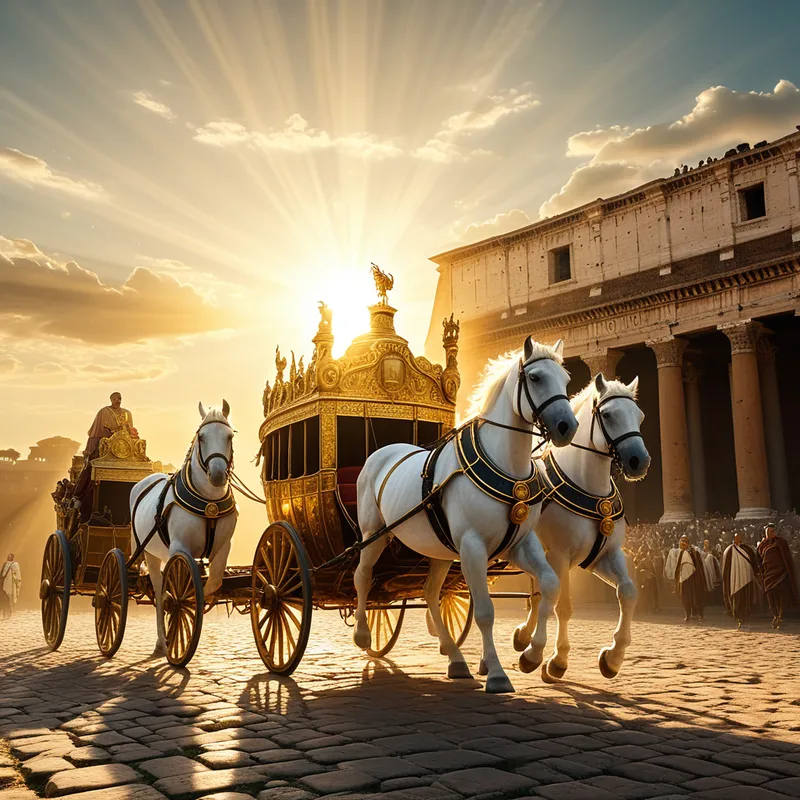
But in the silent, star-flecked vault of the heavens, a promise is kept. There is a power that does not falter. He is Sol Invictus. He is not the gentle, pastoral sun of high summer, but the indomitable, unconquerable core of solar fire. While the world sleeps in frost, he is engaged in his eternal, silent struggle. His chariot, forged from the essence of dawn, is drawn by steeds whose breath is solar wind. They do not gallop on a road of clouds, but on the very fabric of the celestial sphere.
The conflict is not with a monster or a titan, but with the primordial principle of entropy itself—the slide into eternal night. Each shortening day is a battle lost; each lengthening night, a siege against the walls of creation. The nadir approaches. On the longest night, the world holds its breath. The priests of the Cultus Deorum keep vigil. Fires are banked low. Hope is a fragile ember.
Then, in the deepest black before the dawn, a line of fire etches the eastern horizon. It is not a sudden explosion, but a relentless, inevitable advance. [The chariot](/myths/the-chariot “Myth from Tarot culture.”/) of Sol Invictus has turned the corner of darkness. He has not been defeated. He was never able to be defeated. His retreat was a strategic depth, his weakening a feint against [the void](/myths/the-void “Myth from Buddhist culture.”/). And now, he returns. The light that crests the hills is not just light; it is victory made visible. It is the tangible proof of an invincible covenant: the sun is unconquered. The world will be warmed again. The crops will grow. The empire, a mirror of this cosmic order, will endure. The people, emerging from their homes, feel the thin, new warmth on their faces and know—not just believe, but know—that life has triumphed over death once more. The festival of the Dies Natalis Solis Invicti begins, not with relief, but with the roaring, defiant joy of a truth reaffirmed: the light always returns.
Cultural Origins & Context
The figure of Sol Invictus did not spring fully formed from Roman soil. He was a syncretic deity, a powerful fusion of older Roman sun gods like Sol Indiges and the potent, mystery-steeped sun gods of the Eastern provinces, particularly the Syrian Elagabal and the Persian Mithras. His official, state-sponsored cult was elevated by the Emperor Aurelian in 274 CE, following a period of profound military and political crisis—the so-called Third-Century Crisis. This was no accident.
Aurelian, seeking to unify a fractured empire under a single, transcendent symbol, consecrated a magnificent temple on the Campus Martius and established a college of pontiffs for Sol. The myth of the Unconquered Sun functioned as a powerful societal and political metaphor. Just as Sol Invictus guaranteed cosmic order and the cyclical return of life, the Emperor, as his chosen representative on earth, guaranteed the political and social order of Rome. The sun’s invincibility mirrored the desired invincibility of the empire. The annual celebration of his birth on December 25th was a public, state-managed reaffirmation of stability, renewal, and imperial power, cutting across various social classes and ethnic groups within the vast, diverse empire. It was a myth told not just in stories, but in coins, in temple architecture, and in the very rhythm of the state calendar, designed to instill a collective confidence in the enduring cycle of Roman life.
Symbolic Architecture
At its core, the myth of Sol Invictus is a master [symbol](/symbols/symbol “Symbol: A symbol can represent an idea, concept, or belief, serving as a powerful tool for communication and understanding.”/) of invincibility through cyclical return. It is not a symbol of [static](/symbols/static “Symbol: Static represents interference, disruption, and the breakdown of clear communication or signal, often evoking feelings of frustration and disconnection.”/), unchanging power, but of power that proves itself by surviving its own apparent [dissolution](/symbols/dissolution “Symbol: The process of breaking down, dispersing, or losing form, often representing transformation, release, or the end of a state of being.”/).
The deepest strength is not that which never wanes, but that which is proven unconquerable precisely by its return from the waning.
The “conquest” is not over an external [enemy](/symbols/enemy “Symbol: An enemy in dreams often symbolizes an internal conflict, self-doubt, or an aspect of oneself that one struggles to accept.”/), but over the internal, existential [threat](/symbols/threat “Symbol: A threat in dreams often reflects feelings of vulnerability, anxiety, or fear regarding one’s safety or well-being. It can indicate unresolved conflicts or the presence of external pressures.”/) of non-being. The sun’s [journey](/symbols/journey “Symbol: A journey in dreams typically signifies adventure, growth, or a significant life transition.”/) into the [winter solstice](/symbols/winter-solstice “Symbol: Symbolizes a time of reflection, introspection, and the return of light after darkness.”/) represents the necessary descent—the depression, the [loss](/symbols/loss “Symbol: Loss often symbolizes change, grief, and transformation in dreams, representing the emotional or psychological detachment from something or someone significant.”/), the dark [night](/symbols/night “Symbol: Night often symbolizes the unconscious, mystery, and the unknown, representing the realm of dreams and intuition.”/) of the [soul](/symbols/soul “Symbol: The soul represents the essence of a person, encompassing their spirit, identity, and connection to the universe.”/) that every [life](/symbols/life “Symbol: The symbol of ‘Life’ represents a journey of growth, interconnectedness, and existential meaning, encompassing both the joys and challenges that define human experience.”/) and every [psyche](/myths/psyche “Myth from Greek culture.”/) must periodically endure. Sol Invictus embodies the archetypal promise that this descent is not a final defeat, but a phase in a sacred circuit. His symbol is the cycle itself, the circumpunct, representing the eternal, central self that persists through all transformations.
Psychologically, Sol Invictus represents the indestructible [nucleus](/symbols/nucleus “Symbol: The core or central part of something, often representing the essence of self, foundational identity, or the source of emotional energy.”/) of the psyche—what Carl Jung might call the Self. It is the organizing principle that, even when [consciousness](/symbols/consciousness “Symbol: Consciousness represents the state of awareness and perception, encompassing thoughts, feelings, and experiences.”/) is clouded by [despair](/symbols/despair “Symbol: A profound emotional state of hopelessness and loss, often signaling a need for transformation or surrender to deeper truths.”/) (the long night), continues its unseen work, ensuring that a new [attitude](/symbols/attitude “Symbol: Attitude symbolizes one’s mental state, perception, and posture towards life, influencing emotions and actions significantly.”/), a new [dawn](/symbols/dawn “Symbol: The first light of day, symbolizing new beginnings, hope, and the transition from darkness to illumination.”/) of understanding, will eventually emerge. He is the antithesis of [fragmentation](/symbols/fragmentation “Symbol: The experience of breaking apart, losing cohesion, or being separated into pieces. Often represents disintegration of self, relationships, or reality.”/); he is the guarantor of [psychic wholeness](/symbols/psychic-wholeness “Symbol: A state of complete integration between conscious and unconscious aspects of the psyche, representing spiritual unity and self-realization.”/) and renewal.
The Dreamer’s Resonance
When this myth stirs in the modern unconscious, it often manifests in dreams of profound, transformative darkness just before a breakthrough. One might dream of being lost in an endless, frozen landscape, or trapped in a deepening tunnel with no visible end. The somatic feeling is one of crushing weight, cold isolation, and the dread of permanence—this is the “longest night” of the psyche.
The pivotal dream image is the first, undeniable sign of the unconquered light. It is not a floodlight, but a pinprick: a single, unwavering star in a black sky, a faint glow under a closed door, a match struck in a vast cavern. This image carries a somatic shift—a slight easing of the chest, a subtle warmth. The dreamer isn’t saved yet, but they know the tide has turned. The psychological process here is the unconscious affirmation of [the Self](/myths/the-self “Myth from Jungian culture.”/)’s endurance. [The ego](/myths/the-ego “Myth from Jungian culture.”/), in its state of despair, is being shown by the deeper psyche that the core identity is not being destroyed, but is, in fact, orchestrating its own renewal. The dream is a nocturnal ritual of the Dies Natalis, celebrating the rebirth of hope and direction from within the depths of the dreamer’s own darkness.
Alchemical Translation
The alchemical journey, the Opus, is perfectly modeled by the solar myth. The process begins with the [Nigredo](/myths/nigredo “Myth from Alchemical culture.”/)—the longest night, the feeling of psychic death, the dissolution of old, rigid conscious attitudes. This is the sun’s retreat. The ego feels conquered, but the Self is merely descending to gather its strength.
The alchemical gold is not found by avoiding the blackness, but by proving one’s essence unconquerable within it.
The turning point, the Albedo, is the solstice dawn—the moment of Self-recognition. It is the insight that “I have survived this. My core was not annihilated.” This leads to the Citrinitas, the spreading light of a new, more resilient consciousness, integrating the lessons of the darkness. Finally, the [Rubedo](/myths/rubedo “Myth from Alchemical culture.”/) is the full, triumphant return of Sol Invictus—the birth of the “solar” personality, where the individual no longer identifies solely with the fragile ego (which waxes and wanes) but with the enduring, cyclical, and unconquered center of their being.
For the modern individual, the myth instructs us not to fear our periods of depression, loss, or creative barrenness. These are not signs of failure, but the necessary winter solstice of the soul. The work is to cultivate faith—not a religious faith, but a psychological trust—in the invisible, inner process. The [triumph](/myths/triumph “Myth from Roman culture.”/) of Sol Invictus is the triumph of individuation: becoming, like the sun, a self-sustaining source of light and order, unconquered by the temporary darknesses of life, eternally capable of dawn.
Associated Symbols
Explore related symbols from the CaleaDream lexicon: