Sogbo Thunder God Myth Meaning & Symbolism
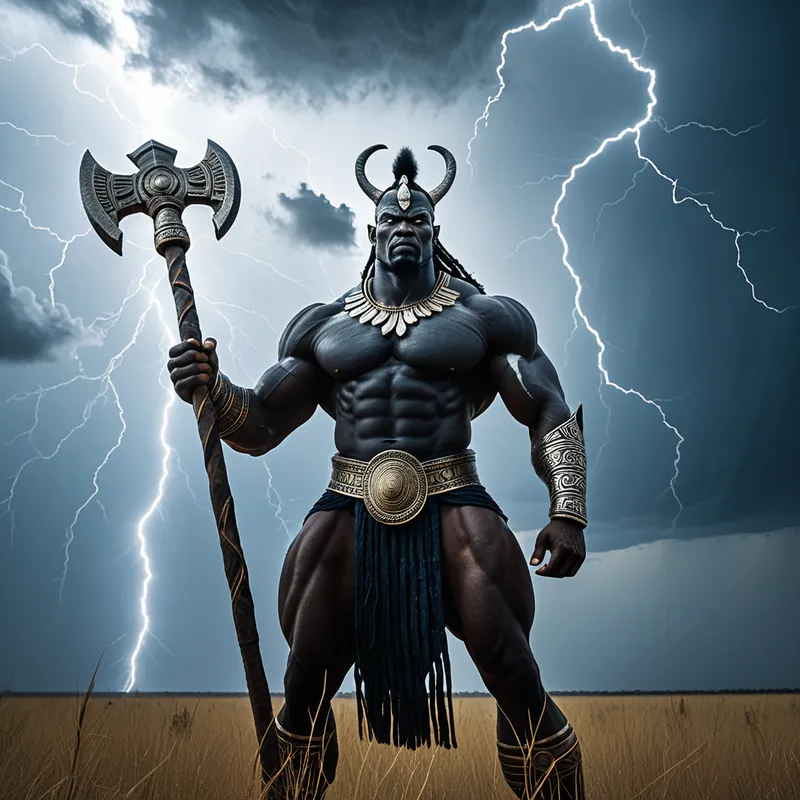
The myth of Sogbo, the Fon Thunder God, is a story of celestial power, the establishment of cosmic order, and the sacred, terrifying voice of the sky.
The Tale of Sogbo Thunder God
Listen. Before the world knew its name, the sky was a silent, empty vault. The earth lay parched and waiting. Then came the first sound—a low, gathering rumble that was not a sound at all, but a feeling in the bone, a vibration in the deep rock. It was the breath of Mawu-Lisa, stirring the void. And from that divine breath, from the first tension between stillness and motion, Sogbo was born.
He did not emerge gently. He cracked into being, a being of pure, unbridled force. His body was the dark, gathering cloud; his voice, the shattering peal that splits the heavens. He was given dominion over the sky, and with him came his legion—the So. They were the wind that howls, the lightning that sears, the rain that drowns. For a time, there was only chaos. Sogbo’s power was absolute, but it was wild, untempered, raining fire and flood upon the earth without pattern or purpose. The people below cowered, not in reverence, but in terror.
But Mawu-Lisa, who is both wisdom and order, saw the imbalance. Power without purpose is destruction. So they sent a command, not to suppress Sogbo, but to channel him. They gave him a counterpart, a balance upon the earth: Sakpata, the god of the earth and its poxes. And to Sogbo himself, they gave a sacred charge and a sacred symbol.
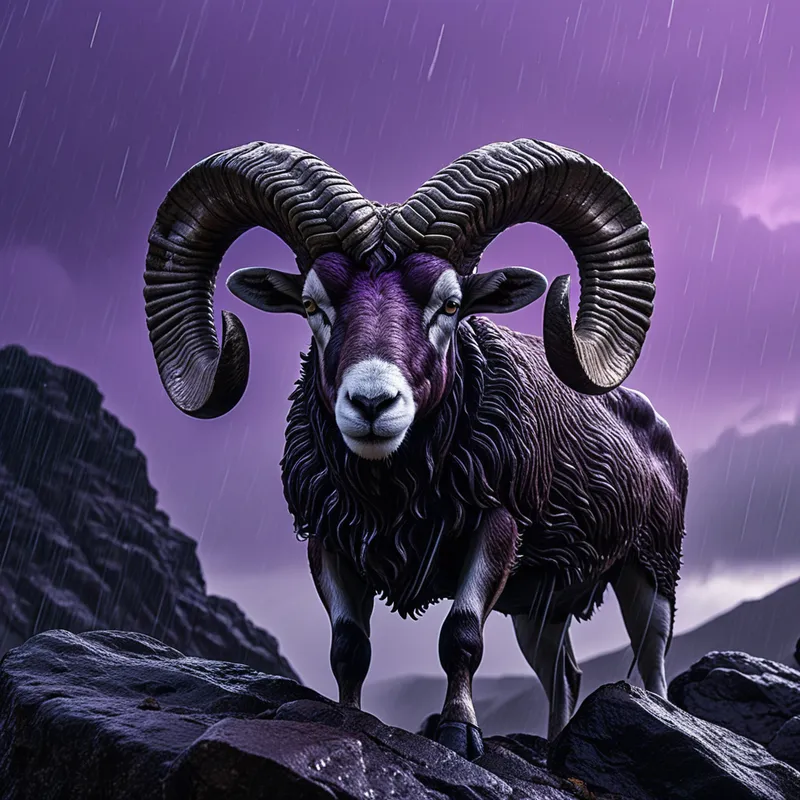
They sent the ram. Not a meek creature, but a beast of formidable strength, its horns curled like the paths of destiny. This ram was to be Sogbo’s vessel on earth, his connection to the realm below the storm. The iron—the metal forged in the heart of the earth by fire—was bound to its horns. When the priests of Sogbo performed the rites, when the drums beat in the rhythm of the coming storm, they called upon this ram. They invoked the pact.
Now, Sogbo’s thunder was no longer mere noise. It became a language. The lightning was no longer blind fire, but a divine scribe etching law across the sky. The rain was no longer an indiscriminate deluge, but a measured, fertilizing gift. Sogbo became the celestial king, the enforcer of Mawu-Lisa’s order. His wrath fell upon oath-breakers and those who defied the natural law. His storms cleansed. His voice commanded respect. He ruled the sky not as a tyrant of chaos, but as a sovereign of sacred, terrifying power—power that had been given a purpose, a responsibility, and a bridge to the world below.
Cultural Origins & Context
This myth originates from the Fon people of the Kingdom of Dahomey, in what is now Benin and parts of Togo and Nigeria. It is a core narrative within the Vodun cosmology. Unlike static texts, this myth lived and breathed through oral tradition, performed by priests (Houngan or Mambo) and storytellers during rituals, festivals, and initiations. Its telling was not mere entertainment; it was a cosmological map and a social contract.
The story of Sogbo functioned on multiple levels. Cosmologically, it explained the terrifying yet necessary phenomenon of thunderstorms, framing them as aspects of a divine, ordered intelligence rather than random violence. Societally, it reinforced the hierarchy and structure of the kingdom, mirroring the divine kingship of Sogbo in the earthly authority of the Ahosu. The myth justified the power of the priestly class who mediated with Sogbo and provided a moral framework: just as Sogbo punished cosmic disorder, so would earthly authority punish social transgression. It was a story that tied the people to the sky, their king to the gods, and chaos to a higher, purposeful order.
Symbolic Architecture
At its [heart](/symbols/heart “Symbol: The heart symbolizes love, emotion, and the core of one’s existence, representing deep connections with others and self.”/), the myth of Sogbo is about the transformation of raw, archetypal power into structured, sovereign [authority](/symbols/authority “Symbol: A symbol representing power structures, rules, and control, often reflecting one’s relationship with societal or personal governance.”/). Sogbo begins as pure [Chaos](/symbols/chaos “Symbol: In Arts & Music, chaos represents raw creative potential, uncontrolled expression, and the breakdown of order to forge new artistic forms.”/)—the unstoppable force, the id of the [cosmos](/symbols/cosmos “Symbol: The entire universe as an ordered, harmonious system, often representing the totality of existence, spiritual connection, and the unknown.”/). His initial state represents the psychological [reality](/symbols/reality “Symbol: Reality signifies the state of existence and perception, often reflecting one’s understanding of truth and life experiences.”/) of unintegrated power: rage, ambition, or creative [energy](/symbols/energy “Symbol: Energy symbolizes vitality, motivation, and the drive that fuels actions and ambitions.”/) that is explosive and potentially self-destructive.
The gift of the ram is the gift of incarnation. Raw spirit must be grounded in a form to become effective in the world.
The ram is the crucial [symbol](/symbols/symbol “Symbol: A symbol can represent an idea, concept, or belief, serving as a powerful tool for communication and understanding.”/) of this grounding. It is an earthly, physical animal, yet one of great [strength](/symbols/strength “Symbol: ‘Strength’ symbolizes resilience, courage, and the ability to overcome challenges.”/) and symbolic potency (often associated with leadership and sacrifice across cultures). The iron on its horns represents technology, culture, and [human](/symbols/human “Symbol: The symbol of a human represents individuality, complexity of emotions, and social relationships.”/) craft—the means by which the divine is mediated and made tangible. Sogbo’s [acceptance](/symbols/acceptance “Symbol: The experience of being welcomed, approved, or integrated into a group or situation, often involving validation of one’s identity or actions.”/) of this charge signifies the [moment](/symbols/moment “Symbol: The symbol of a ‘moment’ embodies the significance of transient experiences that encapsulate emotional depth or pivotal transformations in life.”/) the [archetype](/symbols/archetype “Symbol: A universal, primordial pattern or prototype in the collective unconscious that shapes human experience, behavior, and creative expression.”/) of the Ruler is born from the [archetype](/symbols/archetype “Symbol: A universal, primordial pattern or prototype in the collective unconscious that shapes human experience, behavior, and creative expression.”/) of the Chaos-maker. His power is no longer for its own sake; it is in service to a larger order (Order) established by Mawu-Lisa. The [thunder](/symbols/thunder “Symbol: A powerful natural sound symbolizing divine communication, sudden change, or emotional release in arts and music contexts.”/) becomes his voice of judgment, the [lightning](/symbols/lightning “Symbol: Lightning symbolizes sudden insights or revelations, often accompanied by powerful emotions or disruptive change.”/) his swift, clarifying [action](/symbols/action “Symbol: Action in dreams represents the drive for agency, motivation, and the ability to take control of situations in waking life.”/), and the rain his nourishing decree.
The Dreamer’s Resonance
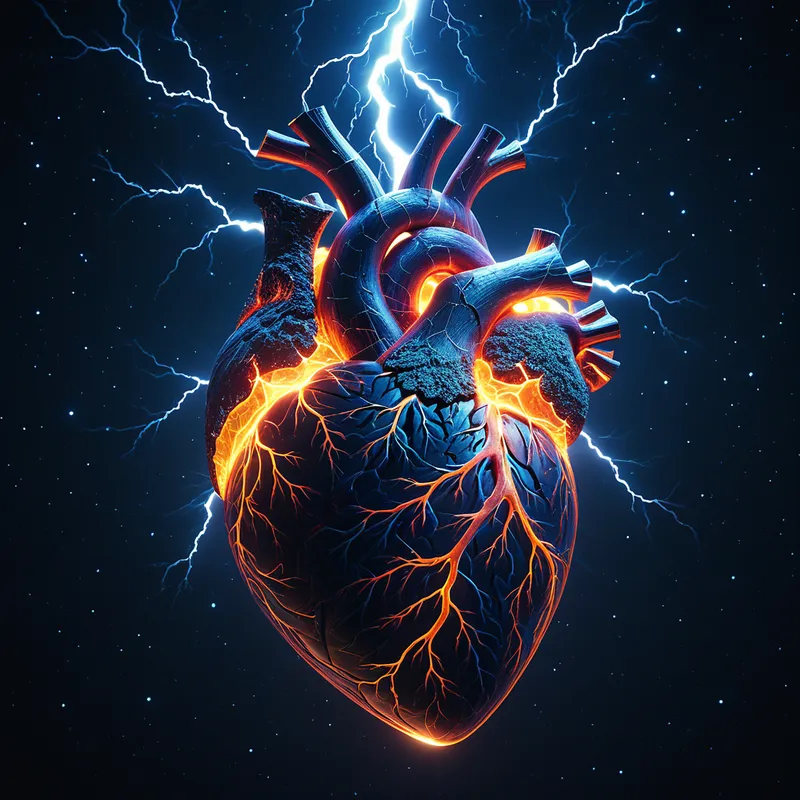
When this myth stirs in the modern Dream, it often manifests as dreams of immense, uncontrolled power or terrifying storms. You may dream of being in a house while a hurricane rages outside, of seeing lightning strike perilously close, or of feeling a tremendous, booming voice that shakes your very foundation. Somatically, this can feel like a surge of adrenaline, a clenching in the gut, or a racing heart—the body’s echo of the thunderclap.
Psychologically, this indicates a confrontation with one’s own unintegrated power. It may be a burgeoning talent that feels too big to handle, a rising anger at personal injustice, or a leadership role that both excites and terrifies. The storm in the dream is the psychic energy seeking a channel, a form, a “ram.” The dream is the psyche’s attempt to initiate the same process Sogbo underwent: moving from a state where one’s power is a problem (causing internal or external chaos) to a state where it becomes a purposeful, defining force. The anxiety in the dream is the birth pang of the inner sovereign.
Alchemical Translation
The individuation process modeled here is the transmutation of potency into authority. In our personal alchemy, we all contain a Sogbo—a center of immense, sometimes frightening potential. The first stage is acknowledging this power, feeling its chaotic rumble within, rather than denying or projecting it outward.
The iron is the discipline we apply, the ram is the vessel of our life in the world—our career, our relationships, our art—through which that power must flow.
The alchemical work is the binding of the iron to the horns. This is the conscious, often difficult act of giving our raw potential a form. It means taking our chaotic creative energy and committing to a craft (the iron of practice). It means taking our righteous anger and forging it into clear boundaries and assertive communication. It means taking our ambition and submitting it to a higher ethical principle (the Mawu-Lisa within, or the Self). The Sacrifice here is the sacrifice of the childish fantasy of omnipotence for the mature reality of focused, responsible power.
The outcome is not a taming, but a mastering. The thunder does not cease; it gains a voice. The individual does not become meek; they become authoritative. They move from being subject to their own inner storms to becoming the conscious ruler of their own psychic sky, capable of both fierce judgment and nourishing rain, in service to their own wholeness.
Associated Symbols
Explore related symbols from the CaleaDream lexicon:
- Thunder — The divine voice and commanding presence of Sogbo, representing the shocking, unavoidable announcement of truth or power that breaks through stagnation.
- Lightning — The swift, penetrating clarity and decisive action of the Thunder God, which cuts through deception and illuminates reality in a sudden, brilliant flash.
- Sky — The domain and body of Sogbo, representing the realm of consciousness, authority, and the higher principles or laws that govern existence.
- Order — The cosmic principle established by Mawu-Lisa, which Sogbo’s transformed power serves to enforce, symbolizing the necessary structure that contains and directs chaotic energy.
- Chaos — The primal, undifferentiated state of Sogbo’s power before its integration, representing the raw, unformed potential and destructive capacity within the psyche.
- Ritual — The ceremonial practices that connect the human community to Sogbo, embodying the conscious, formalized channels through which transcendent power is safely engaged.
- Ram — The sacred earthly vessel and mediator for Sogbo’s power, symbolizing the grounded, physical form that raw spirit must inhabit to become effective and responsible.
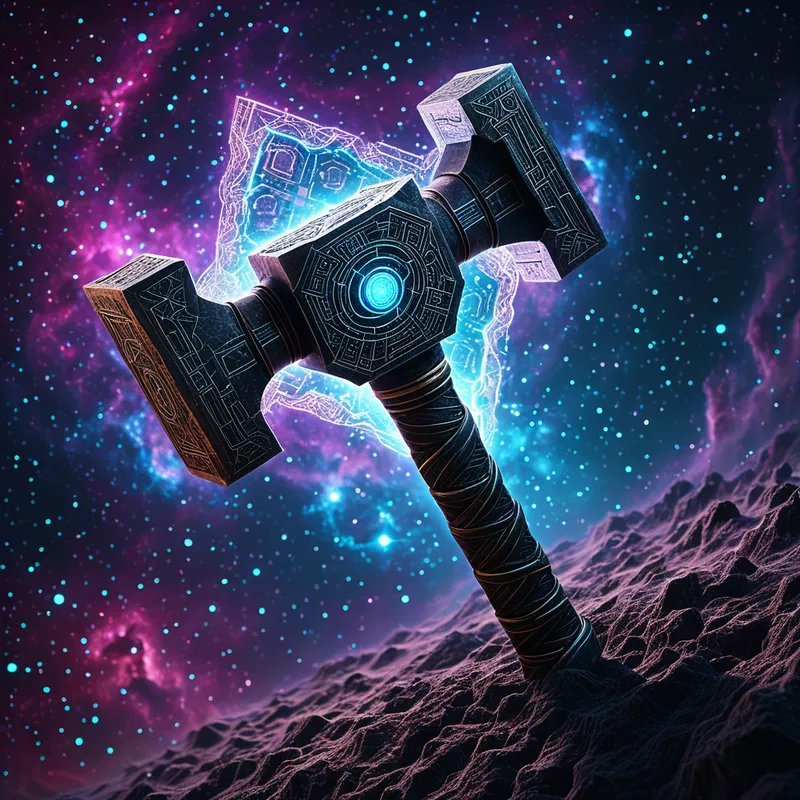
- Iron — The metal of craft and civilization bound to the ram’s horns, representing discipline, technology, and the forging of wild power into a usable, purposeful tool.
- Rain — The nourishing, fertilizing aspect of Sogbo’s storms after his transformation, symbolizing the creative and life-giving potential that follows a cathartic release of power.
- Mountain — The rocky outcrop where the sacred ram stands, representing stability, endurance, and the meeting point between the celestial power of the sky and the solidity of the earth.
- Crown — The implicit symbol of Sogbo’s sovereignty over the sky, representing achieved authority, rightful rule, and the responsibility that comes with mastered power.
- Thunderstorm — The complete phenomenological expression of Sogbo, encompassing the terrifying power, cleansing violence, and ultimate fertility of the integrated archetype.