Sodom and Gomorrah Myth Meaning & Symbolism
A tale of two cities consumed by fire and brimstone for their profound inhospitality and corruption, leaving only a pillar of salt as a warning.
The Tale of Sodom and Gomorrah
Hear now of the cities of the plain, Sodom and Gomorrah, jewels set in the cradle of the Jordan, where [the earth](/myths/the-earth “Myth from Hindu culture.”/) was rich and the [water](/myths/water “Myth from Chinese culture.”/) sweet. They were cities of gates and towers, of commerce and plenty, but a sickness had taken root in their heart, a coldness that turned the milk of human kindness to curd. Their sin, the scriptures whisper, was grievous and very heavy.
The tale turns on a visitation. Two strangers, radiant in their humble guise, came to the city gate at evening. There sat Lot, a man caught between worlds, who saw [the divine spark](/myths/the-divine-spark “Myth from Gnostic culture.”/) within the travelers. With urgent bows, he pressed them to his home, for he knew [the law](/myths/the-law “Myth from Biblical culture.”/) of [the desert](/myths/the-desert “Myth from Biblical culture.”/): a stranger at the gate is a sacred trust. But the city had forgotten this law. As the bread was broken, a sound arose—a mob, men of the city, young and old, surrounding the house. Their demand was a violation of the deepest covenant: “Bring out the men who came to you, that we may know them.” The air grew thick with menace.
Lot, in a desperate, flawed bargain, offered his own daughters to the ravenous crowd, a move that shocks the soul and reveals the moral decay that had seeped even into the righteous man’s mind. The visitors, now revealed as messengers of the Divine, struck the mob with blindness. The night filled with confused groping. Then came [the word](/myths/the-word “Myth from Biblical culture.”/), hissed in the dark: “Flee. Do not look back. Escape to the hills, lest you be consumed.”
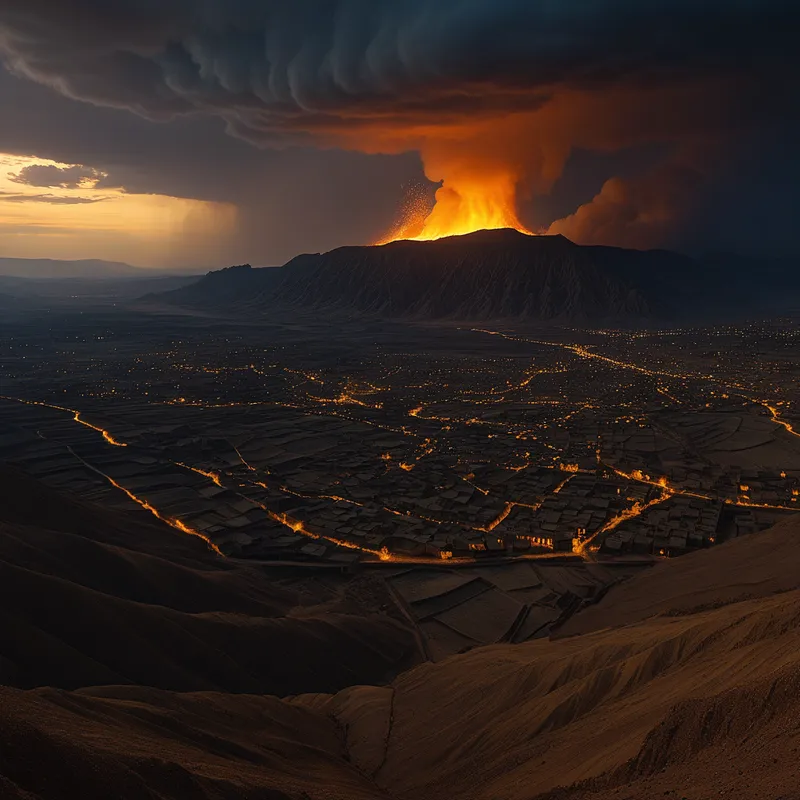
Dawn hesitated. As Lot, his wife, and his daughters fled, a terror from YHWH rained upon the cities. Not water, but fire and brimstone—a burning [sulfur](/myths/sulfur “Myth from Alchemical culture.”/) that fell like divine judgment, igniting the earth, the stone, the very soul of the place. [The sky](/myths/the-sky “Myth from Persian culture.”/) turned the color of a furnace; the air reeked of scorched stone and divine wrath. And then, the fatal glance. Lot’s wife, her heart tethered to the life she was leaving, to the memories embedded in those doomed walls, turned. In that moment of backward longing, she ceased to be. The breath in her lungs, the blood in her veins, transmuted into a crystalline monument of regret—a pillar of salt, gazing eternally upon the cataclysm. Behind her, the valley roared, and the cities of the plain were overturned, leaving only a column of smoke rising like a funeral pyre to heaven.

Cultural Origins & Context
This story is woven into the foundational tapestry of [the Torah](/myths/the-torah “Myth from Jewish culture.”/), the first five books of the Hebrew Bible. It belongs to the Genesis narrative, specifically within the Abrahamic cycle. Its origins are oral, passed down through generations of nomadic and early settled Israelites, likely crystallizing during the Babylonian Exile (6th century BCE), a period of profound national trauma and theological reflection. The story served as an etiological myth, explaining the stark, desolate geography of the Dead Sea region. But more importantly, it functioned as a powerful boundary marker for a community defining itself against the perceived moral corruption of urban Canaanite culture. It was a story told to reinforce the sacred laws of hospitality (hakhnasat orchim) and communal righteousness (tzedakah), framing them not as mere social customs, but as the very pillars that prevent cosmic collapse.
Symbolic Architecture
The myth is a stark map of the consequences of a collective [shadow](/symbols/shadow “Symbol: The ‘shadow’ embodies the unconscious, repressed aspects of the self and often represents fears or hidden emotions.”/) made manifest. Sodom and Gomorrah represent not merely sexual transgression, but the [archetype](/symbols/archetype “Symbol: A universal, primordial pattern or prototype in the collective unconscious that shapes human experience, behavior, and creative expression.”/) of profound inhospitality—a complete closure of the [heart](/symbols/heart “Symbol: The heart symbolizes love, emotion, and the core of one’s existence, representing deep connections with others and self.”/) to the Other, to the [stranger](/symbols/stranger “Symbol: A stranger in dreams can represent unfamiliar aspects of the self or new experiences.”/), to the divine spark in the unfamiliar. This is the [psyche](/myths/psyche “Myth from Greek culture.”/) turned in on itself, a [city](/symbols/city “Symbol: A city often symbolizes community, social connection, and the complexities of modern life, reflecting the dreamer’s relationships and societal integration.”/)-state of the [soul](/symbols/soul “Symbol: The soul represents the essence of a person, encompassing their spirit, identity, and connection to the universe.”/) that consumes its own resources in narcissistic gratification and violent exclusion.
The fire from heaven is not merely punishment, but the inevitable, alchemical heat generated when conscious awareness finally confronts a repressed shadow of unbearable density.
The cities’ [location](/symbols/location “Symbol: The symbol of ‘Location’ signifies a sense of place, context, and the environment in which experiences unfold.”/) in a fertile plain symbolizes potential squandered, a psyche with all the resources for growth and [connection](/symbols/connection “Symbol: Connection symbolizes relationships, communication, and bonds among individuals.”/) that instead cultivates toxicity. Lot represents the fragile ego attempting to negotiate with the collective shadow, ultimately compromised by it. His [wife](/symbols/wife “Symbol: The symbol of a ‘wife’ in a dream often represents commitment, partnership, and personal relationships, reflecting one’s desires for intimacy or connection.”/)’s transformation is the central, chilling [symbol](/symbols/symbol “Symbol: A symbol can represent an idea, concept, or belief, serving as a powerful tool for communication and understanding.”/) of the peril of identification. The pillar of [salt](/symbols/salt “Symbol: Salt represents purification, preservation, and the essence of life. It is often tied to the balance of emotions and spiritual cleansing.”/) is a [monument](/symbols/monument “Symbol: A structure built to commemorate a person, event, or idea, often representing legacy, memory, and cultural identity.”/) to a [consciousness](/symbols/consciousness “Symbol: Consciousness represents the state of awareness and perception, encompassing thoughts, feelings, and experiences.”/) that cannot release its attachment to a dying [paradigm](/symbols/paradigm “Symbol: A fundamental model or framework in arts and music that shapes creative expression, perception, and cultural understanding.”/), to a familiar [identity](/symbols/identity “Symbol: Identity represents the sense of self, encompassing personal beliefs, cultural background, and social roles.”/)—even a corrupt one—and is thus frozen in time, unable to participate in the forward [movement](/symbols/movement “Symbol: Movement symbolizes change, progress, and the dynamics of personal growth, reflecting an individual’s desire or need to transform their circumstances.”/) of [life](/symbols/life “Symbol: The symbol of ‘Life’ represents a journey of growth, interconnectedness, and existential meaning, encompassing both the joys and challenges that define human experience.”/).

The Dreamer’s Resonance
When this myth stirs in the modern dreamer, it often signals a profound confrontation with a “Sodom” within. Dreaming of a beautiful yet menacing city, of faceless hostile crowds, or of being warned to flee signals that a long-ignored aspect of the personal or collective shadow is demanding recognition. The somatic experience can be one of claustrophobia, a feeling of being trapped in a toxic environment (a job, a relationship, a pattern of thought) that is spiritually suffocating.
To dream of being Lot is to dream of complicity—of knowing something is deeply wrong but bargaining with it, trying to save fragments of a corrupt system. To dream of being Lot’s wife, however, is to experience the terror of the backward glance. This is the moment in analysis or self-work where the pain of releasing an old wound, a familiar grievance, or a cherished self-image feels like death itself. The dream-body may feel heavy, paralyzed, or turning to stone. It is the psyche’s warning: to integrate [the shadow](/myths/the-shadow “Myth from Jungian culture.”/), you must leave its geography entirely. Looking back with nostalgia is the act that seals the fate of transformation into sterile monument, rather than liberated life.
Alchemical Translation
The alchemical journey modeled here is the [nigredo](/myths/nigredo “Myth from Alchemical culture.”/)—the blackening, the utter dissolution of a psychic structure that has become irredeemably corrupt. The fertile plain is the [prima materia](/myths/prima-materia “Myth from Alchemical culture.”/), the initial potential of [the Self](/myths/the-self “Myth from Jungian culture.”/). The corruption of Sodom is the long process of putrefaction, where unconscious contents fester. The arrival of the divine messengers is the stirring of the transcendent function, the call from a center beyond [the ego](/myths/the-ego “Myth from Jungian culture.”/).
The flight from the city is the most critical, active step in individuation: the conscious, painful decision to abandon an entire way of being, to let a part of the psyche die so that the whole may live.
The fire and brimstone are the searing, purifying agony of this realization. This is not a gentle refinement but a cataclysm. The ego (Lot) must flee, but it cannot do so unscathed or without loss (his wife, his old home). The pillar of salt is the ultimate warning against the incomplete nigredo. If the ego, in its suffering, merely fixates on what was lost—identifying with the trauma, the victimhood, the “good old days” of unconsciousness—it becomes inert. True alchemical translation occurs only when the ego, having escaped, does not look back. It must journey to the sparse, unknown hills (a state of humble, stripped-bare consciousness), where the terrifying, creative work of rebuilding [the world](/myths/the-world “Myth from Tarot culture.”/)—and the self—can begin from ashes and salt. The destruction is not an end, but the violent, necessary precondition for a covenant with a new, more conscious life.
Associated Symbols
Explore related symbols from the CaleaDream lexicon: