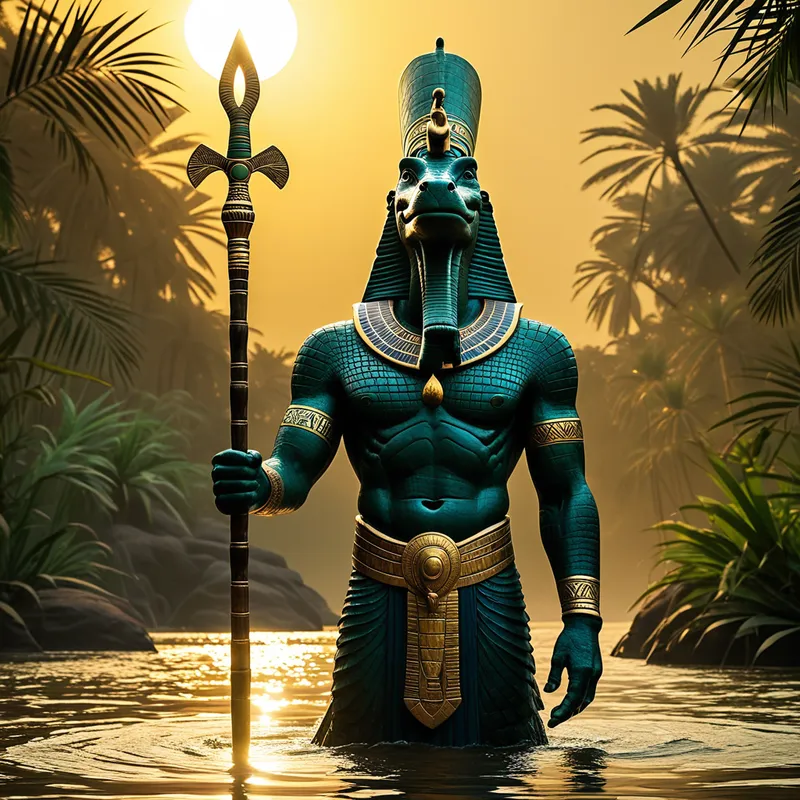
Sobek Myth Meaning & Symbolism
The myth of Sobek, the crocodile god, embodies the raw, creative, and terrifying power of the primordial waters, challenging us to integrate our primal nature.
The Tale of Sobek
Before the first sunrise, there was only the dark, boundless, and silent water. Nun—cold, deep, and pregnant with all that ever could be. From this liquid nothingness, a consciousness stirred. Not with a thought, but with a hunger. A raw, unformed will to be.
It moved. The waters, which knew no current, began to churn. A great shape heaved itself from the abyss, scales like polished black stone shedding the cosmic dew. It was the first creature, born of chaos itself: a crocodile of impossible size. Its eyes opened, twin orbs of molten amber, and in their gaze was the ferocity of existence. This was Sobek, the Rager, He Who Unites the Dispersed.
He did not speak. He acted. With a lash of his mighty tail, he carved channels in the formless deep. Where he swam, currents formed. Where he rested, mudbanks rose. His jaws, capable of shattering the bones of worlds, were also the first shapers of the silt. From the fertile ooze he churned, the first green shoots of life—the papyrus and the lotus—dared to unfurl. He was terror and fecundity woven into one scaled body.
As the sun god Ra embarked on his first journey across the sky, his light fell upon the waters. It did not tame Sobek, but it revealed him. The crocodile god basked on the newly formed bank, his hide drinking in the warmth, a king upon a throne of his own making. The other gods, emerging into the ordered world of Ma’at, looked upon him with awe and trepidation. He was necessary, this embodiment of Nun’s lingering power, but he was unpredictable—a force of nature that could protect or devour.
The people who came to the great river saw him in every ripple, heard him in every splash. They built temples at the water’s edge, like Shedet in the Faiyum, and placed within them sacred crocodiles, adorned with gold and jewels. They fed them choice meats, for to honor Sobek was to appease the river’s soul. They knew the truth in their bones: the same waters that brought the life-giving inundation, that made the black land Kemet, also hid the swift, silent death that lurked beneath. To live by the Nile was to live by Sobek’s grace. His myth was not a story told once, but a reality felt with every harvest and every fearful glance into the deep, green water.

Cultural Origins & Context
Sobek’s veneration was not born from a single, canonical text, but from the visceral, daily experience of the Nile. His cult was ancient, with roots stretching back to the Old Kingdom, and was particularly strong in regions where crocodiles were abundant, such as the Faiyum Oasis and at Kom Ombo, where he shared a unique double temple with Horus. This pairing itself was significant, linking the chaotic, aquatic power of Sobek with the celestial, orderly power of Horus.
His myth was passed down through temple rituals, royal iconography, and the oral traditions of fishermen and farmers. Pharaohs adopted him as a symbol of raw, unstoppable power and ferocity in battle—a divine model for smiting enemies. Yet, for the common people, his function was deeply ambivalent and practical. He was a god to be propitiated, a numinous presence in the river upon which all life depended. The practice of mummifying sacred crocodiles, found in their thousands at sites like Medinet Madi, was a profound act of devotion and fear-management, an attempt to ritually integrate this terrifying aspect of their world into the cosmic order of Ma’at.
Symbolic Architecture
Sobek is the archetypal symbol of the raw, unintegrated life force—the primal energy that exists before and beneath civilization, morality, and even conscious thought. He is not evil, but he is dangerous. He represents the pure instinct for survival, procreation, and dominance.
To encounter Sobek is to stand at the shore of your own unconscious, facing the churning, creative, and potentially devouring powers that reside there.
His domain is the Nun, the chaotic waters that precede creation. Psychologically, this is the undifferentiated psychic soup of the unconscious, teeming with potentials, traumas, and archaic drives. Sobek is the personification of that realm’s emergent power. His duality is key: he is both the fertile silt (creation) and the crushing jaws (destruction); the protective strength of the riverbank and the sudden pull into the depths. He symbolizes the necessary but often rejected parts of the self: aggression, voracious appetite, territoriality, and the sheer, amoral will to exist.
The Dreamer’s Resonance
When Sobek surfaces in modern dreams, he rarely appears as a literal crocodile god. He is the atmosphere of a dream—the feeling of being watched from dark water, the sudden panic of something grasping your leg beneath the surface, or the awe of witnessing a powerful, reptilian creature moving with ancient grace in an unexpected place (a city fountain, a basement pool).
This is the psyche signaling a confrontation with the “sobekian” elements within. The dreamer may be navigating a situation requiring raw assertion, feeling overwhelmed by primal emotions like rage or lust, or sensing a creative impulse that feels too wild and untamed to channel. The somatic experience is often one of visceral alertness—a tightening in the gut, a quickening of the pulse. The psychological process is one of recognition. The dream asks: What powerful, instinctual part of you have you pushed into the murky depths of your own Nun? What life force are you afraid will devour you if you acknowledge it?

Alchemical Translation
The individuation process, the alchemical journey toward psychic wholeness, requires not slaying the crocodile, but integrating it. Sobek’s myth models this transmutation. The first step is naming and facing the primal force, just as the Egyptians did by building temples on the riverbank. One must acknowledge the existence of their own chaotic, aggressive, and voracious energies without immediate judgment or repression.
The second step is ritual containment, symbolized by the mummification of the sacred crocodile or its depiction adorned with solar regalia. This is the conscious act of bringing this raw power into relationship with the ruling principles of the self (the “solar” consciousness). It involves finding forms—creative outlets, healthy boundaries, conscious assertion—to channel the force, rather than letting it rule unconsciously or be projected onto others.
The ultimate alchemy is realizing that the ferocity needed to defend your psychic boundaries and the fertile power to create your life spring from the same sacred, dangerous source.
Finally, integration is achieved when one can, like the paired deities at Kom Ombo, hold Sobek and Horus in balance. The individual learns to wield the focused, strategic power of the falcon (conscious purpose) informed by the unstoppable, instinctual drive of the crocodile (unconscious vitality). The rebel energy of Sobek, which defies easy order, becomes not an enemy of the self, but the indispensable, fierce guardian of its deepest, most authentic waters.
Associated Symbols
Explore related symbols from the CaleaDream lexicon: