Sleeping Beauty's Thorn Hedge Myth Meaning & Symbolism
A kingdom falls into an enchanted sleep behind an impenetrable wall of thorns, awaiting the destined prince who must navigate the barrier to awaken life.
The Tale of Sleeping Beauty’s Thorn Hedge
Listen, and let the old tale unwind itself from the spindle of memory. In a time when the world was still woven with magic, a king and queen, their hearts heavy with longing, were finally blessed with a daughter. They named her the Princess, and her christening was a splendor. Yet, in their joy, they forgot one. An ancient fairy, shrouded in the shadows of the forgotten hearth, arrived in a whirlwind of slighted pride. Her gift was not a blessing, but a curse: on her fifteenth year, the princess would prick her finger on a spindle and die.
The air in the hall turned to ice. But one fairy, her gift still ungiven, stepped forth. She could not undo the curse, but she could soften its edge. “She shall not die,” the fairy whispered, her voice like a sigh through willow branches. “She shall fall into a deep sleep, a sleep of one hundred years, from which only a prince’s kiss shall awaken her.”
The king, in terror, ordered every spindle in the kingdom burned. But destiny is a thread that cannot be severed. On the day she turned fifteen, wandering a forgotten tower, the princess found an old woman at a spinning wheel. Curious, she reached out—a sharp pain, a drop of crimson on the whorl. The curse took hold. She sank down upon a bed, and sleep claimed her like a gentle, swift tide.
But the enchantment did not stop at her eyelids. It breathed out from the castle, a visible sigh of slumber. The cook, hand raised to box the scullion’s ear, froze. The king, mid-sentence on his throne, nodded off. The hounds in the courtyard, the flies on the wall, the very fire in the grate—all stilled. A profound silence fell.
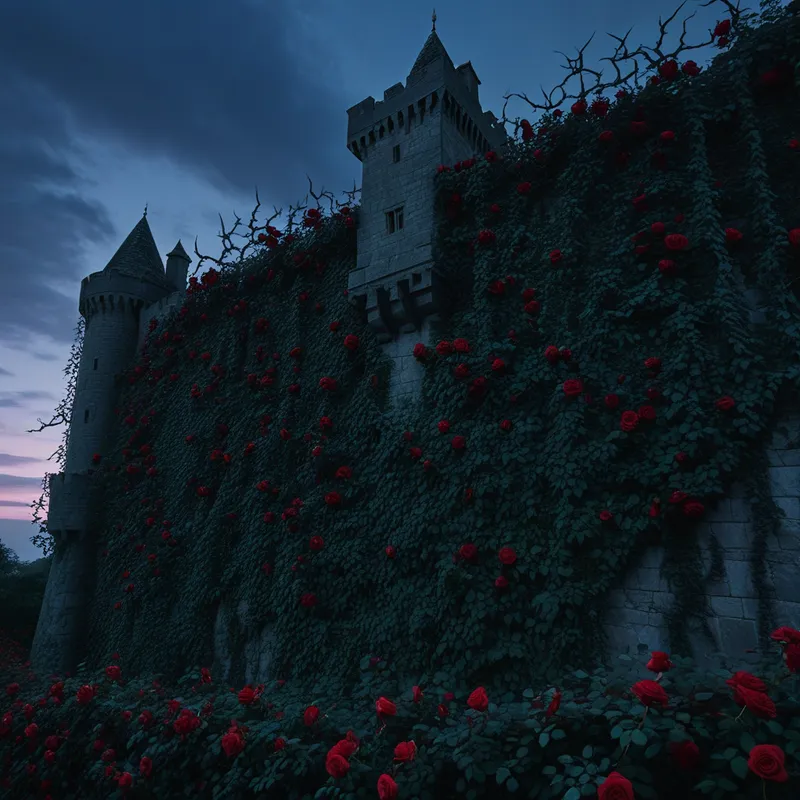
And then, from the very soil of the castle grounds, a hedge began to grow. Not a gentle hedge, but a fortress of thorns. They were black as a starless midnight, thick as a man’s arm, and woven so tight no light could pass. They rose higher than the tallest tower, a living, impassable wall. The castle and its sleeping inhabitants vanished from the world, becoming a rumor, a legend of a kingdom lost behind a wall of briars.
For a hundred years, princes and adventurers came. They saw the formidable hedge, a crown of wild roses blooming atop its cruel height. They heard the legend of the beauty within. They drew their swords and hacked at the thorns. But the briars grasped and held them fast; they were swallowed by the green, dark wall, and were seen no more.
Until, on the very day the century turned, a prince came who had heard the tale not as a challenge for conquest, but as a truth sung in his blood. He approached the legendary thicket. And as he stood before it, the impossible happened. The thorny branches, heavy with century-old roses, shuddered. They parted of their own accord, weaving themselves into a fragrant, arched passageway just for him. He walked through a corridor of living wood and bloom, and the hedge closed silently behind him.
He found the castle in its eerie, perfect stillness. He walked through halls of sleeping courtiers, past a frozen feast, up the silent stair, to the highest tower. There she lay, and she was so radiant that the very air seemed to glow. He knelt, overcome not by daring, but by a reverence that felt like recognition. He bent and kissed her.
Her eyelids fluttered. She awoke, and as she did, the entire castle drew a waking breath. The cook’s slap landed with a yelp, the king finished his sentence, the fire crackled back to life. The great thorn hedge outside withered in an instant, becoming a blooming rose garden. The long sleep was over. The destined awakening had come.
Cultural Origins & Context
The tale we know as “Sleeping Beauty” is a refined tapestry woven from much older, darker threads. Its earliest known written version is “Sun, Moon, and Talia” from the Pentamerone, a story containing themes of predation and violation absent from later sanitized versions. Charles Perrault’s 1697 “La Belle au bois dormant” added the gracious fairies, the hundred-year sleep, and the heroic prince, codifying the narrative for French salon culture. The Brothers Grimm, in their 1812 “Briar Rose” (Dornröschen), streamlined it further, focusing on the curse, sleep, and awakening.
This was not merely a children’s story. It was a cultural dream, passed down by fireside and in nurseries, functioning as a social parable. It spoke to profound anxieties about the vulnerability of young women, the danger of overlooked forces (the slighted fairy), and the absolute power of ordained destiny. The thorn hedge itself is a powerful folk motif representing a liminal barrier, protecting a sacred or cursed space from the profane world. It enforced a necessary period of stasis, a timeout from history, until the conditions for renewal were met.
Symbolic Architecture
At its heart, this is a myth of suspended animation and necessary passage. The princess is not merely a character; she is the symbol of latent potential, the undeveloped Self, or an entire system (be it a psyche, a family, or a culture) that has been traumatized and shut down.
The prick of the spindle is not an accident, but an initiation—a painful, inevitable encounter with a fateful aspect of life (often represented by the overlooked, “dark” fairy) that forces a retreat from the world.
The ensuing sleep is a death-like state of incubation. It is not useless time, but a period of profound, invisible process. The entire kingdom joining the sleep indicates that when the core Self is wounded, the entire internal system falls into stasis, repeating empty gestures (the frozen slap, the unfinished sentence).
The Thorn Hedge is the myth’s master symbol. It is the visible manifestation of the defense mechanism that grows around profound psychological injury. It is fierce, impenetrable, and beautiful in its terrible way (adorned with roses). It keeps the world out, but also traps the sleeping system within. It tests all who approach: those who come with force (the ego’s willpower) are impaled and consumed. Only the one who comes at the right time, with the right quality of being—often interpreted as the integrated Prince—finds it opening as if by grace.

The Dreamer’s Resonance
When this myth pattern arises in modern dreams, it signals a profound somatic and psychological stalemate. Dreaming of being trapped in a briar patch, or trying to reach a sleeping figure behind a wall of thorns, speaks to a feeling of being ensnared by one’s own defenses. The dreamer may be protecting a deeply vulnerable, dormant part of themselves—a creative spark, a capacity for joy, a childhood trauma—with such efficient prickliness that it has become a prison.
The somatic experience is one of constriction, numbness, or being “stuck.” There is energy, but it is all bound up in maintaining the barrier. The sleeping figure in the dream is the disowned Self, the potential that had to be put away for safety. The dream is a snapshot of the psyche’s current architecture: a fortified core, inaccessible even to the dreamer’s own conscious efforts. It indicates that the time for forceful action has passed; what is needed is a shift in timing and attitude, a readiness for a different kind of approach.

Alchemical Translation
The myth models the alchemical process of nigredo followed by a guided awakening. The curse and the sleep represent the necessary dissolution of an old, naive state of consciousness (the innocent princess before the spindle). The hundred-year sleep is the long, dark night of the soul where all conscious striving ceases.
The hedge is the vas or vessel of transformation—the sealed container in which the mysterious work of the unconscious can proceed without interference from the conscious mind’s premature solutions.
The prince who arrives at the appointed hour symbolizes the emergence of a new, unifying psychic authority—the individuating ego—that does not fight the defenses but is recognized by them. His kiss is not an act of conquest, but one of connection and acknowledgment. It represents the moment of synthesis, when the conscious mind finally makes respectful contact with the long-buried, sleeping value in the unconscious.
The instantaneous awakening and the hedge transforming into a rose garden illustrate the alchemical rubedo, the reddening or final stage of enlightenment. The defensive structure, its purpose fulfilled, transmutes into a thing of beauty. The energy once used for isolation now flowers. The myth thus maps the journey from traumatic shutdown, through a period of enforced incubation and protection, to the destined moment when the psyche is ready to integrate its lost wholeness and awaken to a new, more complete life.
Associated Symbols
Explore related symbols from the CaleaDream lexicon: