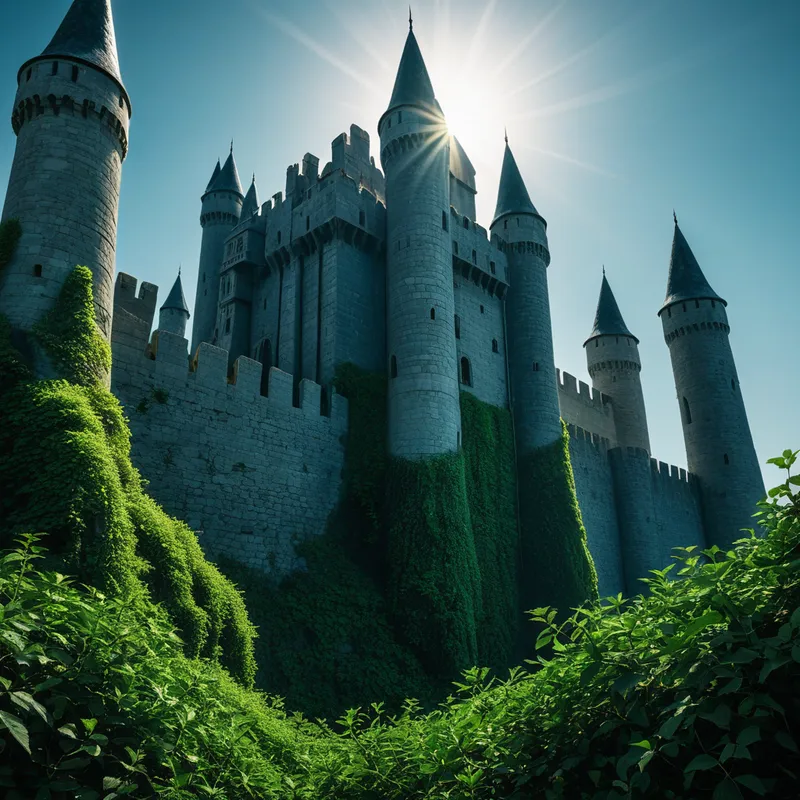
Sleeping Beauty's Castle Myth Meaning & Symbolism
A kingdom falls into a century of enchanted sleep, broken only by a prince who navigates a forest of thorns to awaken the slumbering princess and her realm.
The Tale of Sleeping Beauty’s Castle
Listen, and hear the tale of a silence that swallowed a kingdom.
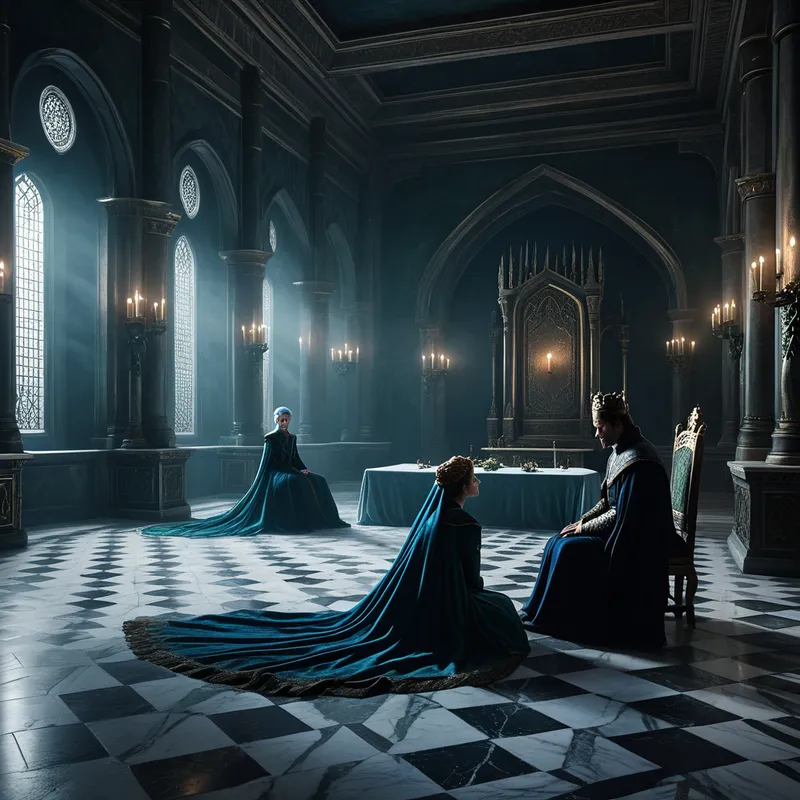
In a time when [the world](/myths/the-world “Myth from Tarot culture.”/) was younger and magic was a thread woven into the very fabric of things, there was a king and queen who longed for a child. Their wish was granted, and a daughter was born, radiant as dawn. They named her Aurora. A great feast was called, and to it were invited the wise women of the realm, beings of grace and power who would bestow gifts upon the infant. But the king, in his folly, possessed only twelve golden plates, and so the thirteenth wise woman was not invited. She arrived nonetheless, a shadow in the hall of light.
Eleven had given their blessings—beauty, wit, grace, song—when the uninvited one stepped forth. Her voice was the crackle of frost. “In her fifteenth year,” she proclaimed, “the princess shall prick her finger on a spindle and fall down dead.” The hall gasped, the very stones seeming to weep. But the twelfth, who had not yet spoken, softened the doom. “She shall not die,” she countered, her voice a balm. “She shall fall into a deep sleep, one lasting a hundred years.”
The king, in terror, ordered every spindle in the kingdom burned. Yet fate is a river that finds its course. On the day of her fifteenth birthday, exploring a forgotten tower, the princess found an old woman at a spinning wheel. Curious, she reached for the spindle, and the sharp point pierced her skin. The curse unfolded not upon her alone, but upon the entire world she knew. She fell onto a nearby bed, into a sleep as deep as the ocean. And at that same moment, a sigh passed through the castle. The king, mid-stride, slumped in his throne. The queen, lifting a cup, froze. [The cook](/myths/the-cook “Myth from Alchemical culture.”/), scolding a scullion, fell silent. The very dogs in the courtyard lay down their heads. A profound stillness descended.
Then, from the very soil of the castle grounds, a forest began to grow. Not of oak or pine, but of immense, tangled briars, thick as a man’s arm and armed with thorns like black iron. They twisted and climbed, weaving a living wall around the castle, tower, and rampart, until the entire kingdom was hidden from sight, a secret kept by the land itself. It became known as the Castle of the [Sleeping Beauty](/myths/sleeping-beauty “Myth from Greek culture.”/), a place of legend where time stood still.
A hundred years passed. Kings and knights tried to penetrate the thorn-wood, but it grasped them, held them fast, and they perished. Then came a prince from a distant land, in the year the curse was destined to break. He heard the old tale and felt not dread, but a calling. He approached the formidable wall, now blooming with flowers among the thorns. As he drew near, the briars, as if recognizing the appointed hour, did not resist. They parted for him, forming a path, and closed again behind. He walked through the silent courtyards, past sleeping guards and dozing peacocks, up [the spiral](/myths/the-spiral “Myth from Celtic culture.”/) stair to the highest tower.
There she lay, and he was breathless, for rumor had not done her [justice](/myths/justice “Myth from Tarot culture.”/). He knelt, and moved by a force deeper than courage, he kissed her. Her eyelids fluttered. She awoke, and looked upon him as if from a great distance. And as she awoke, so did the castle. The king finished his step. The queen sipped her wine. The cook’s shout echoed. The dogs barked. Laughter and light and life surged back into the stones. The thorn-forest withered away to dust in the sun. The long silence was broken, and the kingdom, having dreamed for a century, began to live again.
Cultural Origins & Context
The tale we know as “Sleeping Beauty” is a palimpsest, a story written over older stories. Its most famous literary versions come from Giambattista Basile in the 17th century and Charles Perrault, whose “La Belle au bois dormant” (The Beauty Sleeping in the Wood) codified the narrative for European salon culture. The Brothers Grimm later recorded a German variant, “Little Briar Rose.” These collectors were not inventing, but curating an oral tradition that stretched back into the fog of pre-history.
Societally, the tale functioned on multiple levels. For a peasantry familiar with hardship, it was a fantasy of suspended time—a respite from toil and mortality. For the aristocratic courts where Perrault’s version was told, it was an allegory of dynastic survival, the “sleep” representing a period of political peril before a rightful heir (the prince) restores order. At its heart, it is a rite-of-passage myth, mapping the dangerous transition from childhood innocence (the protected princess) to adult sexuality and sovereignty (the awakened queen), a journey fraught with the “curse” of biological and social change.
Symbolic Architecture
The castle is not merely a setting; it is the central [symbol](/symbols/symbol “Symbol: A symbol can represent an idea, concept, or belief, serving as a powerful tool for communication and understanding.”/)—the [psyche](/myths/psyche “Myth from Greek culture.”/) in a state of profound arrest. It represents a totality, a complete world-[system](/symbols/system “Symbol: A system represents structure, organization, and interrelated components functioning together, often reflecting personal or social order.”/) (the [kingdom](/symbols/kingdom “Symbol: A kingdom symbolizes authority, belonging, and a sense of identity within a larger context or community.”/)) that has been forced into [stasis](/symbols/stasis “Symbol: A state of inactivity, equilibrium, or suspension where no change or progress occurs, often representing psychological or existential paralysis.”/). The [curse](/symbols/curse “Symbol: A supernatural invocation of harm or misfortune, often representing deep-seated fears, guilt, or perceived external malevolence.”/) of the uninvited Wise Woman is the inevitable intrusion of [fate](/symbols/fate “Symbol: Fate represents the belief in predetermined outcomes, suggesting that some aspects of life are beyond human control.”/), pain, or the unconscious into a [life](/symbols/life “Symbol: The symbol of ‘Life’ represents a journey of growth, interconnectedness, and existential meaning, encompassing both the joys and challenges that define human experience.”/) that has tried to remain perfectly protected and unchanging.
The spindle is the puncture of reality into the illusion of perfect safety. It is the moment of trauma, of awakening to a pain that seems to terminate growth.
The hundred-[year](/symbols/year “Symbol: A unit of time measuring cycles, growth, and passage. Represents life stages, progress, and mortality.”/) sleep is a [period](/symbols/period “Symbol: Periods in dreams can symbolize cyclical patterns, renewal, and the associated emotions of loss or change throughout life.”/) of necessary [incubation](/symbols/incubation “Symbol: A period of internal development, rest, or hidden growth before emergence, often associated with healing, creativity, or transformation.”/). It is not [death](/symbols/death “Symbol: Symbolizes transformation, endings, and new beginnings; often associated with fear of the unknown.”/), but a deep withdrawal. The burgeoning [thorn](/symbols/thorn “Symbol: A symbol of pain, protection, and hidden beauty, representing obstacles that guard growth or cause suffering.”/) [forest](/symbols/forest “Symbol: The forest symbolizes a complex domain of the unconscious mind, representing both mystery and potential for personal growth.”/) is the natural psychological [defense](/symbols/defense “Symbol: A protective mechanism or barrier against perceived threats, representing boundaries, security, and resistance to external or internal challenges.”/) that grows around a wound—a protective [barrier](/symbols/barrier “Symbol: A barrier symbolizes obstacles, limitations, and boundaries that prevent progression in various aspects of life.”/) that also becomes an isolating [prison](/symbols/prison “Symbol: Prison in dreams typically represents feelings of restriction, confinement, or a lack of freedom in one’s life or mind.”/), keeping the world out and the sleeping Self in. The perished princes represent failed conscious attempts to force a [resolution](/symbols/resolution “Symbol: In arts and music, resolution refers to the movement from dissonance to consonance, creating a sense of completion, release, or finality in a composition.”/), to “hack through” a [defense](/symbols/defense “Symbol: A protective mechanism or barrier against perceived threats, representing boundaries, security, and resistance to external or internal challenges.”/) [mechanism](/symbols/mechanism “Symbol: Represents the body’s internal systems, emotional regulation, or psychological processes working together like a machine.”/) with sheer will, which only leads to greater entanglement.
The successful [prince](/symbols/prince “Symbol: A prince symbolizes nobility, leadership, and aspiration, often representing potential or personal authority.”/) is not stronger, but timely. He arrives when the inner process is complete. He represents the emergent [consciousness](/symbols/consciousness “Symbol: Consciousness represents the state of awareness and perception, encompassing thoughts, feelings, and experiences.”/), the [animus](/symbols/animus “Symbol: In Jungian psychology, the masculine inner personality in a woman’s unconscious, representing logic, action, and spiritual guidance.”/) of directed [purpose](/symbols/purpose “Symbol: Purpose signifies direction, meaning, and intention in life, often reflecting personal ambitions and core values.”/), that can approach the dormant core (the Self) with reverence, not force. His kiss is not a romantic conquest, but a symbolic act of recognition, [connection](/symbols/connection “Symbol: Connection symbolizes relationships, communication, and bonds among individuals.”/), and [acceptance](/symbols/acceptance “Symbol: The experience of being welcomed, approved, or integrated into a group or situation, often involving validation of one’s identity or actions.”/) that bridges the gap between the dormant potential and the awake, living world.

The Dreamer’s Resonance
When this myth patterns a modern dream, the dreamer is likely in a state of psychic paralysis. They may dream of being trapped in a beautiful but empty house, of trying to move through syrup, or of watching loved ones frozen in time. The somatic feeling is one of weight, of being pinned. This is the psyche’s signal of a developmental arrest.
The dream is not merely reporting a problem; it is depicting the structure of the hibernation. The “castle” could be a career that once felt vibrant but now feels like a gilded cage, a relationship that has gone dormant, or a creative talent that has been put to sleep by criticism or fear. The thorns are the accumulated resentments, anxieties, and excuses that have grown so thick the dreamer can no longer see a way out or in. To dream of the prince or of finding the sleeping figure is to sense the first stirring of the part of the psyche that can initiate the awakening—the nascent will, the new idea, the courageous feeling that is willing to approach the heart of the stagnation.
Alchemical Translation
The myth of Sleeping Beauty’s Castle is a perfect map of the alchemical [nigredo](/myths/nigredo “Myth from Alchemical culture.”/) and albedo. The prick of the spindle is the initial mortificatio—the symbolic death of the old, naive conscious attitude. The long sleep is the necessary [putrefactio](/myths/putrefactio “Myth from Alchemical culture.”/), a descent into the unconscious where, in darkness and silence, a secret transformation occurs. The kingdom is not decaying; it is being preserved, its essential forms held in perfect suspension, awaiting the catalyst.
The hundred years are not a punishment, but the psyche’s own timeless measure for the gestation of a new level of being.
The prince’s journey is the conscious ego’s role in the latter stages of individuation. It does not cause the change, but it must willingly enter the tangled forest of the personal and collective unconscious (the thorns), trusting that the process itself will provide a path. His kiss is the conjunctio, [the sacred marriage](/myths/the-sacred-marriage “Myth from Various culture.”/) of the conscious and unconscious, the masculine principle of directed consciousness and the feminine principle of dormant, holistic potential.
For the modern individual, the alchemical translation is clear: we all have castles within us—domains of our spirit that have fallen asleep due to shock, neglect, or over-protection. The work is not to rage against the thorns, but to acknowledge the sleep, to respect the incubation period, and to cultivate the princely part of ourselves that is patient, attentive, and ready to offer the kiss of conscious engagement when the inner timing is right. The awakening is never of the “princess” alone, but of the entire kingdom—the whole psyche, with all its forgotten citizens (talents, memories, energies), returning to life, integrated and whole.
Associated Symbols
Explore related symbols from the CaleaDream lexicon: