Sleeping Beauty Myth Meaning & Symbolism
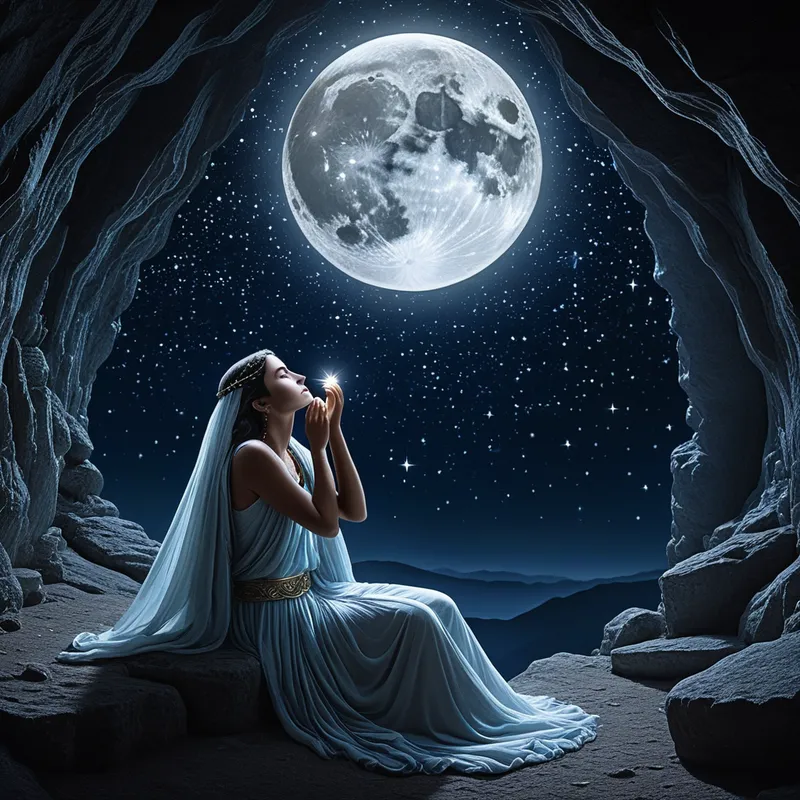
The moon goddess Selene falls in love with the mortal shepherd Endymion, who is granted eternal sleep to preserve his beauty and their nightly communion forever.
The Tale of Sleeping Beauty
Hear now the tale not of a princess in a thorn-encrusted castle, but of a shepherd upon a lonely mountain, and the love that stopped the very wheel of time.
In the ancient land of Caria, there rose a mountain known as Latmos. Its slopes were gentle, its pastures rich with thyme and asphodel, and upon it tended a shepherd named Endymion. He was not a king, nor a warrior of renown, but in his form was captured such beauty that the very earth seemed to sigh as he passed. His eyes held the deep, quiet grey of a twilight sky, and his sleep was as profound and peaceful as a mountain tarn.
Each night, as he slept in a sacred cave upon the mountain, a visitor came. She was Selene, daughter of the Titans Hyperion and Theia. Drawn across the heavens in her chariot of pearl, she would pause her celestial journey, leaving the silver horses to wait among the clouds. She would descend, a beam of concentrated moonlight, to the mouth of Endymion’s cave. There, she would kneel beside him, her cool, luminous light playing over his features, her heart—an immortal, celestial heart—seized by a mortal ache.
She loved him. Not with the fleeting passion of the gods for mortals, but with a love that feared the ravages of time. She saw in his sleeping face a perfection that waking life, with its toil, sorrow, and inevitable decay, would surely steal. Each dawn was a theft, pulling her back to her duties and him toward age and death. The conflict was not of curses or spindles, but of the fundamental order: the immortal and the mortal were not meant to meet in stasis.
Driven by this divine sorrow, Selene went to the king of gods, Zeus. She did not ask for Endymion’s immortality in the bustling halls of Olympus. She asked for something stranger, more profound. She begged for Endymion to be granted eternal sleep. Not death, but a suspension of life’s trajectory. Zeus, moved by the purity of her request—or perhaps understanding a paradox only a goddess could conceive—granted it.
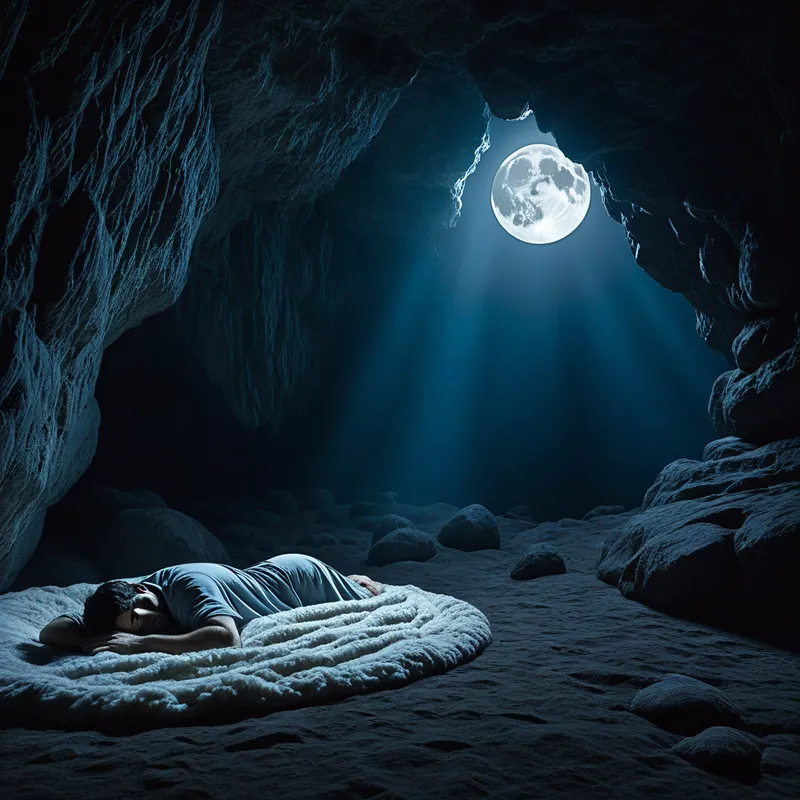
And so, the resolution was not a kiss, but a decree. Endymion was placed in an ageless slumber within his cave on Mount Latmos. Time’s flow ceased for him. He would never wake to wrinkles, weakness, or wisdom’s weary price. His beauty, captured at its peak, became a permanent fixture of the night. And Selene, forever faithful, forever longing, would visit him each night. Her light was his only world; his sleeping form, her only solace. Their love existed in the perpetual, silent present of the moonlit night, a secret held between the mountain and the stars, forever beginning, never ending.
Cultural Origins & Context
The myth of Endymion and Selene is a product of the rich, syncretic tapestry of Greek mythology, with roots likely stretching into pre-Greek Anatolian traditions of Caria. It is not a folktale of the hearth but a etiological myth of the poetic and philosophical schools. Its primary tellers were poets like Sappho, who touched on his beauty, and later mythographers like Hyginus and Pausanias, who recorded the local cult.
The societal function of this myth was multifaceted. On one level, it explained the moon’s gentle, watchful passage over the earthly landscape—she is forever gazing at her beloved. On a deeper level, it served as a narrative vessel for exploring profound Hellenic preoccupations: the tragic, desirable gap between mortal and immortal, the nature of beauty as something that exists outside of time, and the concept of a blessed, painless existence removed from the toil of human consciousness. In a culture that celebrated the active, waking virtues of the hero, Endymion presents a powerful counter-image: the virtue of perfect, passive being. His cult on Mount Latmos suggests a localized religious veneration, possibly connected to oracles or dream incubation, where sleep was a sacred state of communion with the divine.
Symbolic Architecture
The symbolic core of this Sleeping Beauty myth is not about awakening, but about the sacredness of not waking. Endymion is the human soul in a state of pristine potential, untouched by the corruptions and complications of enacted life.
Eternal sleep is not a curse here, but the ultimate sanctuary. It represents the soul's pre-conscious unity, a state of perfection that cannot survive the dawn of individual ego and temporal consequence.
Selene, the moon goddess, symbolizes the cyclical, reflective, and contemplative aspect of the psyche. She is not the blazing, conscious sun (Helios), but the cooler light that illuminates the inner, nocturnal world of dreams and the unconscious. Her love for Endymion is the love of the cosmic, cyclical principle for the static, perfect point within it. The cave on Mount Latmos is the Platonic cave and the womb of the unconscious combined—a protected, hidden space where ideal forms reside untouched by the weathering of surface reality.
Zeus’s grant is the divine sanction of this state. It is the universe agreeing to make an exception to its own law of entropy and decay for the sake of preserving pure beauty and love. The myth thus becomes a profound meditation on the human wish to freeze a perfect moment, to hold beauty and love in a deathless, changeless state, even at the cost of lived experience.
The Dreamer's Resonance
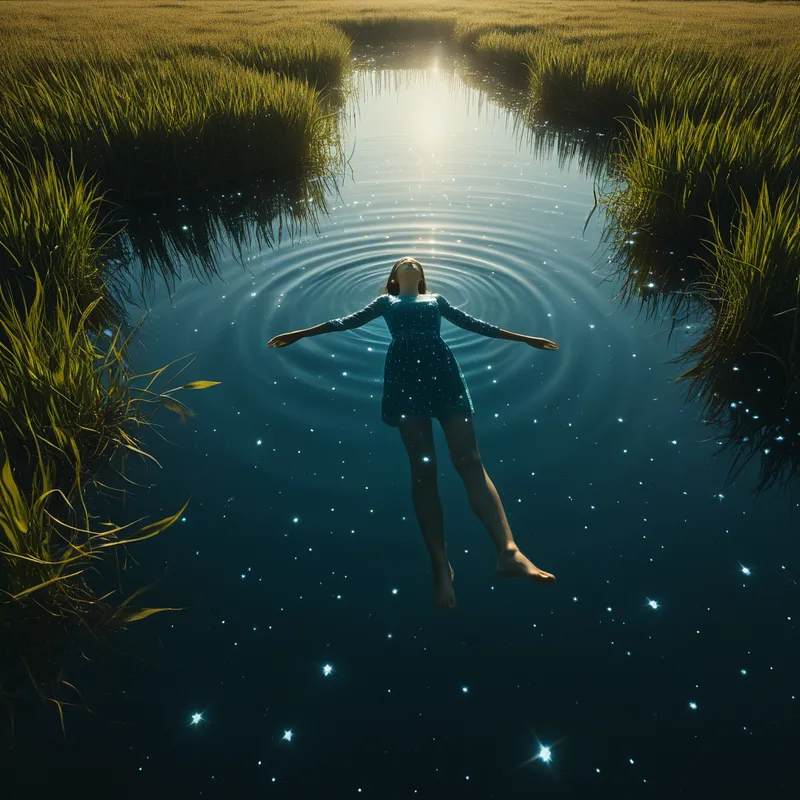
When this myth pattern stirs in the modern unconscious, it rarely manifests as a literal dream of a sleeping shepherd. Instead, it appears as dreams of profound, enviable stasis: dreaming of being in a state of suspended animation in a spaceship; of floating, weightless and thoughtless, in a warm, dark sea; of watching the world from behind unbreakable glass, safe but separate.
These dreams point to a somatic and psychological process of retreat. The psyche, overwhelmed by the demands of "waking life"—relentless action, decision-making, aging, loss, and responsibility—creates a fantasy of opt-out. It is the soul’s deep craving for a moratorium. The dreamer may be facing a life transition so daunting (a new career, parenthood, aging) that a part of them wishes to be like Endymion: to have their current self, with all its competencies and beauty, preserved forever, exempt from the next, uncertain chapter.
The somatic feeling is one of exquisite heaviness and peace—a paralysis that is chosen, not inflicted. It is the shadow side of the individuation journey, the powerful lure of the uroboric state, where one is complete because one is undeveloped.
Alchemical Translation
For the modern individual, the alchemical challenge posed by this myth is not to find a prince to awaken the sleeper, but to integrate the value of Endymion’s sleep into a waking life. The goal is psychic transmutation, not from sleep to wakefulness, but from seeing stasis and action as opposites to seeing them as a necessary rhythm.
The alchemical secret is to build a sacred cave within the waking self—a timeless, inner sanctum where the soul's essential beauty is known to be unchanging, even as the body and personality journey through time.
The first operation (nigredo) is the recognition of the Endymion complex: the depressive, enervating pull toward withdrawal, the grief over time’s passage, the desire to be loved for a static self. The albedo is the moon-bath of Selene’s light—the practice of self-reflection, dream work, and contemplative practices that honor this inner, timeless self without capitulating to full retreat.
The rubedo, the reddening, is the courageous return to the sunlit world. It is the individual carrying the certainty of that inner, eternal beauty into the arena of decay and action. One does not abandon the cave; one learns to be both shepherd and sleeper, both the mortal who ages and the beloved who is eternally cherished by their own witnessing consciousness (Selene). The triumph is a love affair with one’s own soul that does not require the freezing of time, but which makes one resilient within time. The eternal sleep becomes not a place to reside, but a wellspring to visit, a reminder that at the core of our being, beneath all our doing and becoming, we simply, beautifully are.
Associated Symbols
Explore related symbols from the CaleaDream lexicon: