Sky Lanterns Myth Meaning & Symbolism
A myth where grief transforms into light, and paper lanterns carry prayers to the heavens, symbolizing the soul's release and connection to the infinite.
The Tale of Sky Lanterns
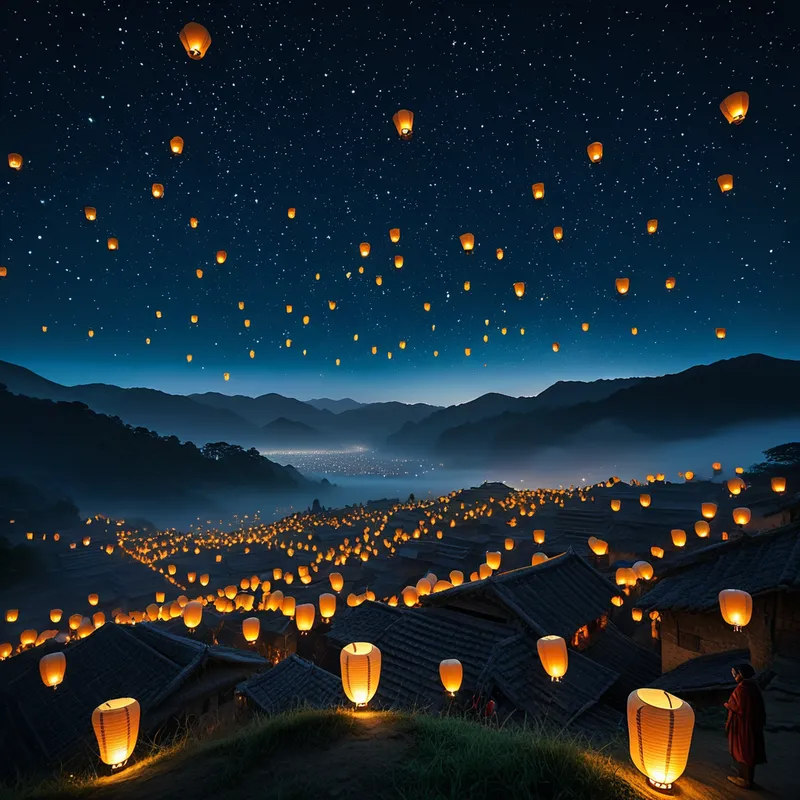
Listen, and let the smoke of memory carry you. In a time when the mountains were young and the rivers sang clearer songs, there was a village cradled in a valley so deep, the sun was a late visitor and the moon a constant guardian. The people lived in the rhythm of soil and season, but their hearts were heavy with a silent sorrow. For when a loved one passed from this world, their spirit, it was said, became lost in the vast, trackless chasm between earth and sky. They wandered as cold embers, unseen, unheard, leaving the living wrapped in a grief that had no outlet, a love with nowhere to go.
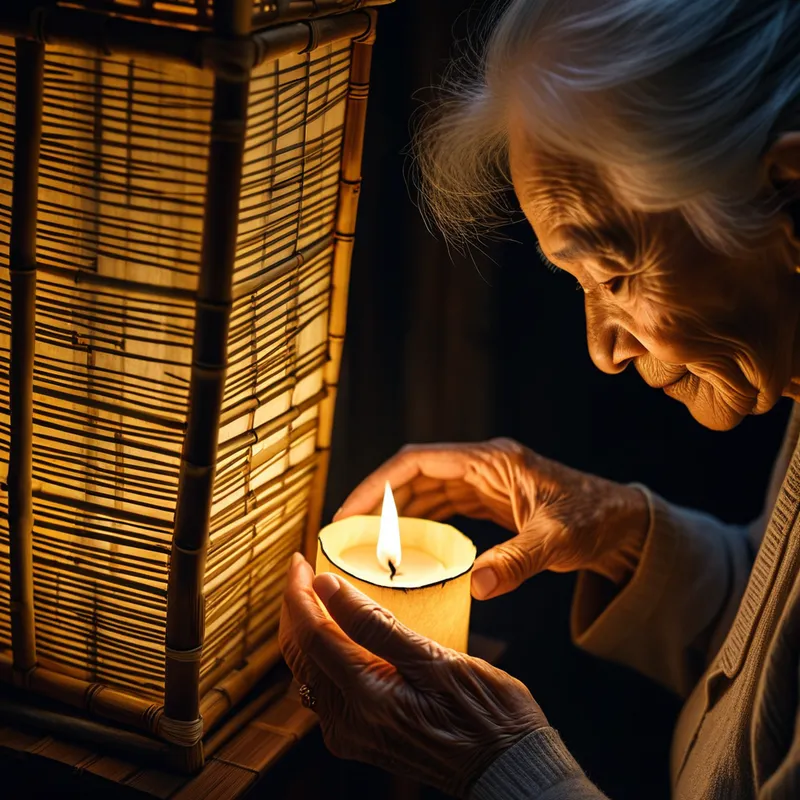
Among them was an elder named Lián. Her hair was the color of frost on stone, and her eyes held the patience of deep water. She had borne more farewells than most, watching the light leave the eyes of her kin, feeling their absence as a permanent chill in her hearth. One evening, as the first star pierced the twilight, a despair deeper than any before settled upon her. She sat by the river, the silence of the unseen world pressing down. In her hands was only a sheet of rice paper, thin as a dragonfly’s wing, and the fragile frame of a basket meant for berries.
Driven by a need that had no name, she began to fold. Not with purpose, but with the slow, aching movements of a heart trying to remember its beat. She shaped the paper into a hollow vessel. She fixed the basket as a base. From her cooking fire, she took a small square of cloth soaked in wax and oil, and placed it in the center. Her fingers trembled as she lit the wick. The flame caught, hesitant, then grew steady. Warm air began to pool inside the paper shell.
Lián did not know what she was doing. She only knew she could not hold the weight inside her chest any longer. As the warm air swelled, the paper globe tugged at her fingers. She whispered into its open mouth—a name, a memory, a fragment of a lullaby, all the love that had no earthly home. And then, she let go.
The vessel drifted from her hands, bobbing gently on the still air. It hovered for a moment, as if listening. Then, with a grace that stole her breath, it began to rise. It ascended past the rooftops, a solitary, golden heart beating against the deepening blue. It climbed past the tallest pine, a tiny sun returning to the sky. Lián watched, her own heart in her throat, until the lantern was no more than a star among stars, a point of light swallowed by the cosmos.
The next night, she was not alone. Others from the village, having seen the impossible star born from human hands, came with their own paper, their own bamboo, their own unspoken words. One by one, they lit their candles. One by one, they released their lanterns. A silent, glowing procession began, a river of light flowing upward. And as they watched, they swore they could feel a warmth return on the breeze—not a physical heat, but a feeling. A sense of answer. A silent, grateful sigh from the darkness. The lost embers had found their guide. The love had found its way.
Cultural Origins & Context
The myth of the Sky Lantern, in its countless local variations, is a foundational story of agrarian and river-valley cultures across Asia, particularly within the sinospheric sphere. It is not the property of a single empire or dynasty, but a folk innovation that emerged independently in communities intimately tied to the cycles of nature and the ancestral world. The story was traditionally told not by professional bards, but by grandparents at the hearth, by mothers preparing for seasonal festivals, and by village elders during ceremonies for the dead. Its primary societal function was threefold: to provide a ritual technology for processing grief, to reaffirm the connection between the living community and the ancestral realm, and to symbolically enact humanity’s role as a participant in the cosmic order.
The lantern release became a calendrical ritual, often aligned with the end of harvest or the turning point of winter, moments when the veil between worlds was considered thin. The act was a communal prayer in motion, a collective psychodrama where internal, invisible sorrow was given an external, luminous form and a direction—upward. It transformed passive mourning into an active ceremony of communication and release, embedding a profound psychological truth into the heart of cultural practice: what is felt must be formed, and what is formed must be released to complete its journey.
Symbolic Architecture
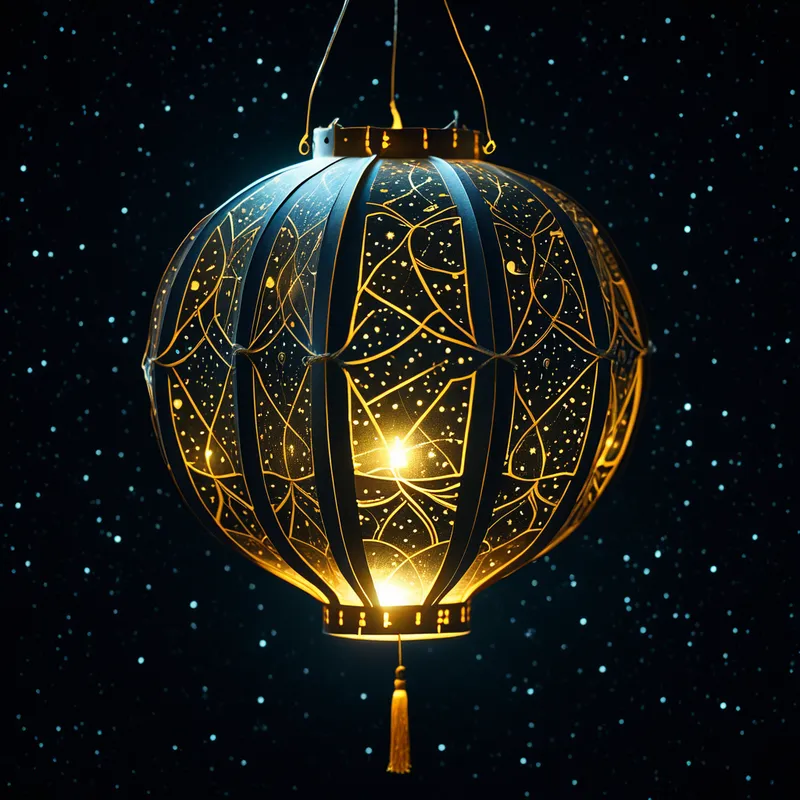
At its core, the myth presents a powerful symbolic equation: Grief is weight, but love is lift. The fragile paper lantern is the Anima, the human soul or psyche itself—seemingly insubstantial, vulnerable to the slightest tear, yet capable of containing a transformative fire. The bamboo frame represents the structure of the body and earthly life—mortal, but providing necessary form. The candle flame is the Pneuma, the immortal spirit, the essential consciousness and love that does not die with the body.
The lantern does not fight the darkness; it becomes a mobile star within it. The psyche’s task is not to defeat the night of the unconscious, but to carry its own light through it.
The act of release is the critical alchemical moment. It symbolizes the surrender of the ego’s desperate clutch on what is gone. Holding on grounds the lantern; release allows the natural law—warm air rises—to enact its miracle. This mirrors the psychological process of letting go, not as forgetting, but as entrusting a process to a larger, natural order (the Self, the unconscious, the universe). The ascent represents the soul’s journey home, the reintegration of the individual spark with the cosmic fire, and the translation of personal memory into eternal belonging.
The Dreamer’s Resonance
When this myth activates in the modern dreamer’s psyche, it signals a profound somatic and emotional process of release. To dream of crafting a lantern indicates a conscious or unconscious effort to containerize a powerful emotion—often grief, but also guilt, regret, or a cherished hope that feels trapped. The dreamer is in the stage of forming the vessel, giving shape to what has been formless and overwhelming.
Dreaming of holding a lit lantern but being unable to release it speaks to a conflict between the intellect’s understanding of the need to let go and the heart’s fearful attachment. The dream body may feel paralyzed, or the lantern may stubbornly remain earthbound. This is the somatic grip of unresolved process.
The most potent dream is the release and ascent. This often accompanies a feeling of profound relief upon waking, even if tears are present. It signifies that a deep, unconscious integration has occurred. The psyche has successfully conducted its own ritual, transferring a burden from the personal ego to the transpersonal realm of the Self. The emotion has not vanished; it has been transmuted from a heavy stone in the chest to a point of light in the internal cosmos, still visible, still part of one’s story, but now in its rightful, peaceful place.

Alchemical Translation
The myth of Sky Lanterns is a perfect map for the individuation process, specifically the stage of sublimation—the transformation of base, heavy emotion into something luminous and transcendent. The modern individual, burdened by the “unprocessed ghosts” of past trauma, lost relationships, or abandoned selves, is the village living under silent sorrow.
1. The Gathering (Confrontation with the Shadow): First, one must gather the raw materials from one’s own life—the thin paper of vulnerability, the brittle bamboo of old defenses, the wax of solidified pain. This is the difficult, honest work of introspection, acknowledging the weight one carries.
2. The Assembly (Creation of the Transcendent Function): Next, one consciously constructs a new vessel—a narrative, a creative act, a therapeutic insight, a ritual. This vessel is the Transcendent Function. It is not the old story of suffering, but a new form capable of holding that suffering differently.
3. The Ignition (Emotional Catharsis): Lighting the candle is the infusion of conscious attention and feeling into this new form. It is the courageous act of feeling the full heat of the emotion within the safe, newly-created container.
Individuation is not about becoming airless and light. It is about learning to build a lantern sturdy enough to hold your fire, and then trusting the cosmos enough to let it fly.
4. The Release (Surrender to the Self): This is the ultimate alchemical act: opening the hands. It is the surrender of the ego’s control over the outcome. It is the prayer whispered not for a specific answer, but as an act of communion. In psychological terms, it is entrusting the complex to the larger regulating wisdom of the Self, allowing it to be re-contextualized within the totality of one’s being.
The lantern’s journey into the night sky models the final stage: what was a personal burden becomes a point of light in one’s inner universe. It is no longer a weight you carry; it is a star by which you navigate. The love, the loss, the memory—they are not gone. They have simply taken their rightful place in the heavens of the soul, forever part of the constellation that is you, shining down with a gentle, guiding light.
Associated Symbols
Explore related symbols from the CaleaDream lexicon: