Skuld Myth Meaning & Symbolism
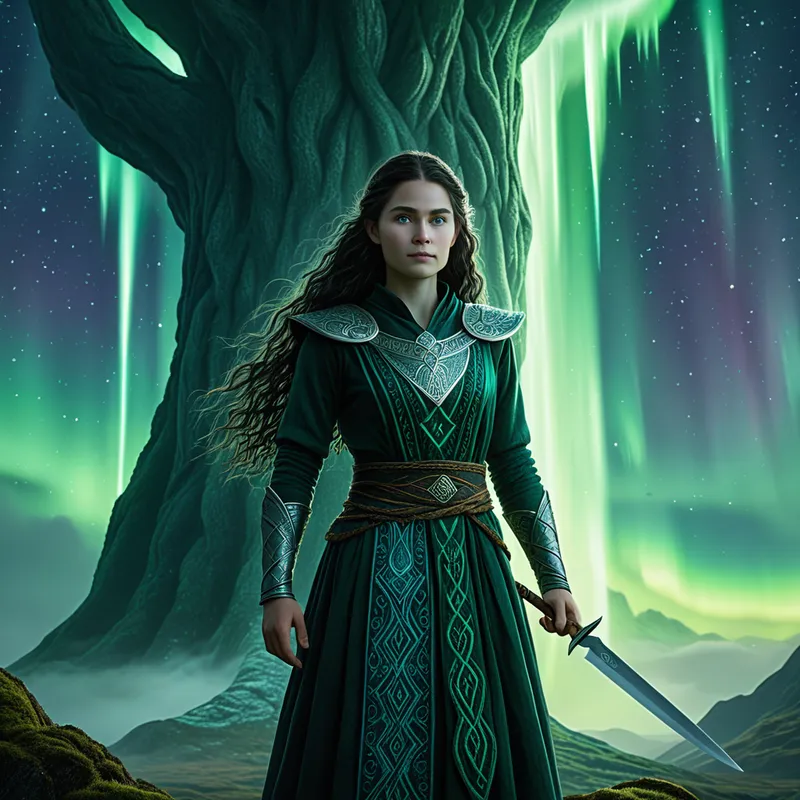
Skuld, the youngest Norn, weaves the future from necessity. She represents the inescapable yet mutable thread of what is yet to come.
The Tale of Skuld
Beneath the groaning roots of the Yggdrasil, where the air is thick with the scent of wet earth and ancient memory, the waters of Urd’s Well lie black and still. Here, time does not flow; it pools. And in this sacred gloom, three figures are forever bent to their task. You know the first two: Urd, whose face is a map of all that has been, and Verdandi, whose hands move with the urgent rhythm of the now.
But turn your eye to the third. She is Skuld. The youngest, yet her eyes hold no youth, only the profound, chilling weight of what has not yet come to pass. Her sisters draw thread from the well’s depths, thread spun from the deeds of gods and men, from the breath of giants and the whispers of the dead. Urd lays the foundation, Verdandi weaves the vibrant, living pattern of the present.
Then the thread passes to Skuld.
Her touch is different. Where her sisters weave, Skuld holds a knife. Her portion of the great tapestry is not yet fixed; it shimmers with a terrible, beautiful potential. She does not merely weave; she decides. With a motion as final as a falling star, she chooses which thread to incorporate into the unchangeable cloth of destiny, and which to sever, letting it fall, useless and forgotten, into the murky waters below. Sometimes, she cuts a thread that seems strong and bright, and a great hero in the world above feels a sudden, inexplicable chill. Sometimes, she spins a new thread from nothing but necessity, from the cold logic of “that which must be,” and a new fate is born that no one foresaw.
The gods themselves, even Odin with his stolen wisdom, fear her corner of the loom. For they can read the patterns of the past and present, but Skuld’s work is a mystery written in a language of pure consequence. Her name is spoken in a hush, not with love or reverence, but with the awe one reserves for an oncoming storm—beautiful, inevitable, and utterly beyond appeal.
Cultural Origins & Context
The myth of Skuld and her sisters, the Norns, is central to the Norse worldview, primarily preserved in the Poetic Edda, specifically in the Völuspá (The Prophecy of the Seeress) and Fáfnismál. Unlike the deterministic Fates of Greek tradition, the Norns represent a more complex interplay of time and causality. They were not just stories for entertainment but fundamental cosmological explanations.
These tales were likely told by skalds (poets) and elders around hearth-fires, serving a crucial societal function: to instill a specific kind of courage. In a culture familiar with harsh winters, fleeting summers, and violent conflict, the concept of a fixed, honorable fate (wyrd) was a comfort. Yet Skuld’s role introduced a critical, unsettling nuance. Fate was not a blind, pre-written script; it was a tapestry still being woven, influenced by past actions (Urd) and present choices (Verdandi), culminating in a future (Skuld) that was necessary but not always predictable. This created a psychological space for both resignation to one’s lot and the imperative to act with honor, as one’s present deeds became the thread Skuld would work with tomorrow.
Symbolic Architecture
Skuld is the archetypal embodiment of the Future not as a promise, but as a debt (one meaning of her name). She symbolizes the principle of consequence in its most absolute form.
The future is not a land we visit, but a debt we incur with every present moment. Skuld is the accountant of the soul, balancing the ledger of cause and effect.
Psychologically, she represents the superego at its most impersonal—not the internalized voice of parents, but the cold, logical outcome of our life’s trajectory. She is the “what will be” that is born from the “what has been” and the “what is done.” Her shearing knife is a potent symbol of negation, closure, and the cessation of possibilities. Every choice we make simultaneously creates one future and murders a thousand others. Skuld is the executioner of those ghostly, alternate selves. She is the necessary limit that gives shape to existence; without her cuts, the tapestry would be a formless, chaotic tangle.
Her position as the “youngest” Norn is deeply ironic and symbolic. In human experience, the future feels like the newest, most open frontier. Yet Skuld shows us that the future is the oldest story of all—it is the final, inescapable conclusion written by the laws of reality itself, waiting at the end of time’s arrow.
The Dreamer’s Resonance
When the energy of Skuld manifests in modern dreams, it rarely appears as a literal goddess. Instead, one dreams of standing at a crossroads where the signposts are illegible, of trying to read a book where the final chapters are blank or written in a fading ink. There is a somatic sensation of suspension, of being on the cusp. One might dream of scissors cutting a vital cord, of a door closing irrevocably behind them, or of watching a timer count down to an unknown zero.
These dreams signal a psychological process at a critical juncture. The dreamer is likely facing a major life decision, feeling the weight of past choices culminating, or sensing an inevitable change approaching (a career shift, the end of a relationship, a personal transformation). The anxiety in the dream is the anxiety of necessity—the unconscious recognition that a certain path has become unavoidable, that the “threads” of one’s life patterns now demand a specific resolution. It is the psyche preparing for the shearing knife, for the death of one potential self so that another may be woven into the fabric of actualized being.
Alchemical Translation
The individuation process, the journey toward psychic wholeness, is mirrored perfectly in the myth of the Norns, with Skuld as its crucial final phase. The work begins with Urd—confronting and integrating the Past: our personal history, traumas, and inherited patterns (the family saga). It moves into Verdandi—the conscious, diligent work in the Present: therapy, reflection, making better choices, weaving a stronger “now.”
But the alchemical gold is forged in Skuld’s realm. This is the stage of transmutation, where the leaden weight of one’s fate is consciously engaged and altered. It is the moment one stops being a victim of circumstance and becomes the co-author of necessity.
To work with Skuld psychologically is to perform the most difficult spiritual act: to willingly take up the shearing knife oneself. It means looking at the tangled threads of one’s potential futures—the comfortable path, the destructive habit, the unlived life—and making the conscious, painful cut. It is ending the relationship that has no future, leaving the job that stifles the soul, or finally speaking the buried truth. This is not an act of destruction, but of supreme creation. By cutting the thread of what cannot be, you provide Skuld with the clean, strong material from which she can weave a future that is authentically yours. You move from being a passive subject of fate to an active participant in destiny, aligning your will with the profound, impersonal necessity of your own becoming. In that alignment, the terror of the future dissolves into the solemn peace of purpose.
Associated Symbols
Explore related symbols from the CaleaDream lexicon: