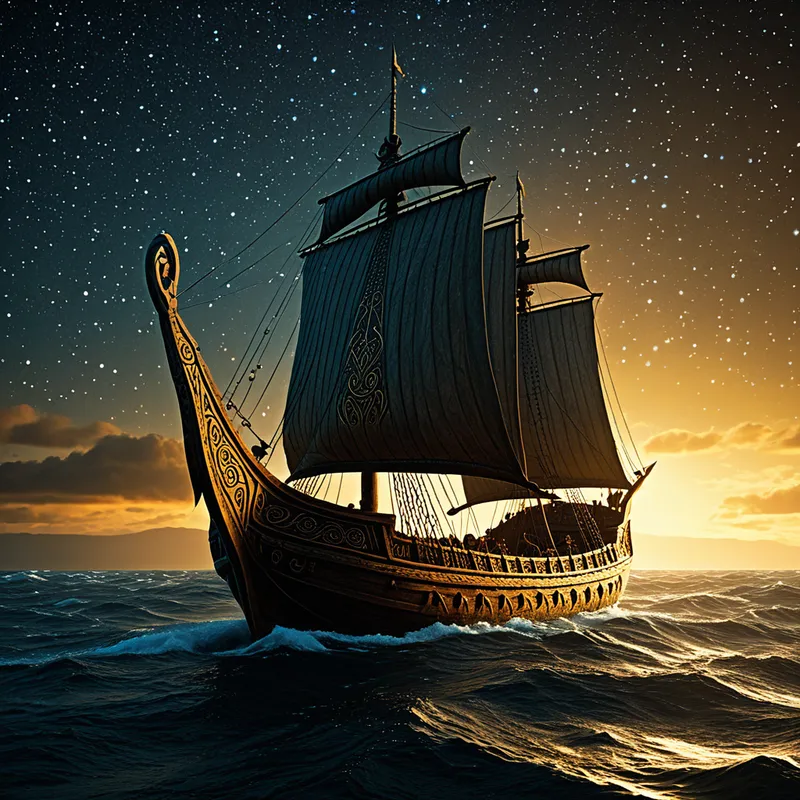
Skidbladnir Myth Meaning & Symbolism
A magical ship, crafted by dwarves, that can sail any sea, carry all the gods, yet fold small enough to fit in a pocket. A symbol of infinite potential.
The Tale of Skidbladnir
Listen, and hear the tale of a creation born not of need, but of cunning, pride, and divine mischief. The air in Asgard was thick with the scent of boasting. [The trickster](/myths/the-trickster “Myth from Various culture.”/) Loki, his silver tongue as sharp as ever, had wagered his own head. He had claimed that the sons of the dwarf Ivaldi could not craft gifts greater than those of any other smith in [the Nine Worlds](/myths/the-nine-worlds “Myth from Norse culture.”/). To settle the wager, he sought out the most formidable brothers of the forge: Brokkr and Eitri.
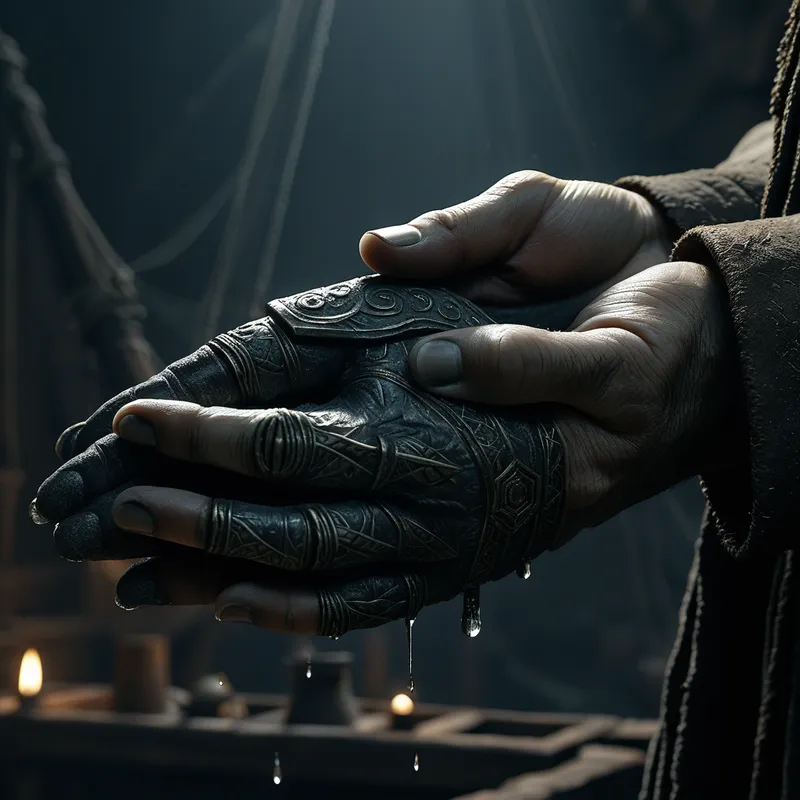
Deep within their mountain heart, where [the earth](/myths/the-earth “Myth from Hindu culture.”/)’s blood flowed as lava and the only light was the furious orange of the forge, the brothers accepted the challenge. Brokkr worked the bellows, a rhythmic, pounding heartbeat that shook the very stone. Eitri, his hands steady as the roots of [the world](/myths/the-world “Myth from Tarot culture.”/), placed precious materials into [the crucible](/myths/the-crucible “Myth from Alchemical culture.”/). First, he crafted [Gullinbursti](/myths/gullinbursti “Myth from Norse culture.”/), a boar of living gold that shone in the dark. Next, from molten gold, he drew forth Draupnir, a ring of endless replication.
For the third and final wonder, Eitri took not gold, but the finest, most supple woods and the spirit of [the wind](/myths/the-wind “Myth from Various culture.”/) itself. He whispered to the timbers, sang to the nails. Brokkr pumped the bellows with such relentless force that sweat and soot ran in rivers down his brow. To ensure their failure, Loki, transformed into a monstrous fly, stung Brokkr’s eyelid until blood blinded him. The dwarf roared in pain but never let the rhythm break, never let [the sacred fire](/myths/the-sacred-fire “Myth from Native American culture.”/) falter.
And from that crucible of agony and unwavering focus, it was born. Not a weapon, not a jewel, but a vessel. Skidbladnir. They presented it to the gods. It was a ship of such beauty that [the sea](/myths/the-sea “Myth from Greek culture.”/) itself would grow calm in envy. Its sails caught every whisper of wind, promising swift passage to any shore. It was large enough to carry all the Aesir and their steeds, with room for their glory besides. And then, with a word of command, it would fold itself—plank upon beam, mast upon sail—into a cloth so small it could be tucked into a god’s pocket, a seed of journeys yet to come. The gods were struck silent. Loki had lost his wager, saved only by a quibble about his neck. But the true prize, Skidbladnir, was given to the radiant god [Freyr](/myths/freyr “Myth from Norse culture.”/), lord of sunshine and fruitful lands, a lord whose domain was the wide, open world.
Cultural Origins & Context
The myth of Skidbladnir is preserved primarily in the Prose Edda, written by Snorri Sturluson in the 13th century. Snorri drew from older poetic traditions, where kennings and allusions to such artifacts were common. In the Viking Age, the ship was not merely transportation; it was a cultural archetype—a symbol of life’s journey, exploration, trade, raid, and ultimately, the final voyage to the afterlife. A chieftain was buried in his ship, his vessel for the unknown seas of death.
Skidbladnir, as a divine and magical amplification of this core symbol, would have functioned on multiple levels. For the skalds (poets) and their audiences, it was a testament to the wondrous nature of the mythic age, a time when dwarven craft could alter the very logic of the world. It served as a narrative device explaining the gods’ ability to traverse the cosmos. Societally, it reinforced values of supreme craftsmanship (smíð), the transformative power of skill, and the idea that the greatest creations arise from challenge, sacrifice, and sometimes, painful ordeal.
Symbolic Architecture
Skidbladnir is not just a boat. It is a perfect [symbol](/symbols/symbol “Symbol: A symbol can represent an idea, concept, or belief, serving as a powerful tool for communication and understanding.”/) of potentiality. It holds within its folded form every voyage not yet taken, every [destination](/symbols/destination “Symbol: Signifies goals, aspirations, and the journey one is on in life.”/) not yet imagined. It represents the unmanifested possibilities of the [psyche](/myths/psyche “Myth from Greek culture.”/), the latent wholeness that exists within us before we embark on the [journey](/symbols/journey “Symbol: A journey in dreams typically signifies adventure, growth, or a significant life transition.”/) of [life](/symbols/life “Symbol: The symbol of ‘Life’ represents a journey of growth, interconnectedness, and existential meaning, encompassing both the joys and challenges that define human experience.”/) or of self-[discovery](/symbols/discovery “Symbol: The act of finding something previously unknown, hidden, or lost, often representing personal growth, new opportunities, or hidden aspects of the self.”/).
The greatest vessel is not the one that conquers the sea, but the one that contains all seas within its design.
Its creation [story](/symbols/story “Symbol: The symbol of ‘Story’ represents the narrative woven through our lives, embodying experiences, lessons, and emotions that shape our identities.”/) is equally symbolic. It is born from a wager, a conflict that forces excellence. Loki’s interference—the painful sting—is necessary. True creation, the myth suggests, is never without struggle, never without the “fly” of doubt, [distraction](/symbols/distraction “Symbol: A state of diverted attention from a primary focus, often representing avoidance, fragmentation, or competing priorities in consciousness.”/), or [agony](/symbols/agony “Symbol: Intense physical or emotional suffering, often representing unresolved pain, internal conflict, or profound transformation.”/) that threatens to ruin the work. Brokkr’s endurance, his refusal to stop the [bellows](/symbols/bellows “Symbol: Bellows symbolize the act of inflating life forces or emotions, representing vitality, creativity, and transformation.”/) even while blinded, speaks to the absolute commitment required to bring a profound [idea](/symbols/idea “Symbol: An ‘Idea’ represents a spark of creativity, innovation, or realization, often emerging as a solution to a problem or a new outlook on life.”/) from the forge of the unconscious into the manifest world. The gift is given to Freyr, a god of [peace](/symbols/peace “Symbol: Peace represents a state of tranquility and harmony, both internally and externally, often reflecting a desire for resolution and serenity in one’s life.”/), plenty, and virility, indicating that this ultimate [vessel](/symbols/vessel “Symbol: A container or structure that holds, transports, or protects something essential, representing the self, emotions, or life journey.”/) of potential is meant for growth, [expansion](/symbols/expansion “Symbol: A symbol of growth, increase, or extension beyond current boundaries, often representing personal development, opportunity, or overwhelming change.”/), and harmonious journeying, not for war or destruction.
The Dreamer’s Resonance
When the image of Skidbladnir surfaces in a modern dream, it rarely appears as a literal [Viking longship](/myths/viking-longship “Myth from Norse culture.”/). Instead, one might dream of a pocket watch that unfolds into a vast city, a seed that blooms into a complex machine, or a small, intricate model that feels profoundly significant. The dreamer is often holding this object, marveling at its paradoxical nature.
This is a dream of contained potential. Psychologically, the dreamer is at a threshold. They are in possession of all the internal resources, skills, and blueprints needed for a significant life transition—a new career, a creative project, a spiritual journey—but it remains in its “folded” state. The somatic sensation is often one of quiet awe mixed with restless energy. There may be a feeling of compression, of something large being held in a small space within the chest or mind. The dream is the psyche’s way of presenting the tool for the next phase of the journey. The conflict in the dream might revolve around figuring out the “word of command” to unfold it, or fear of damaging the perfect, miniature form.
Alchemical Translation
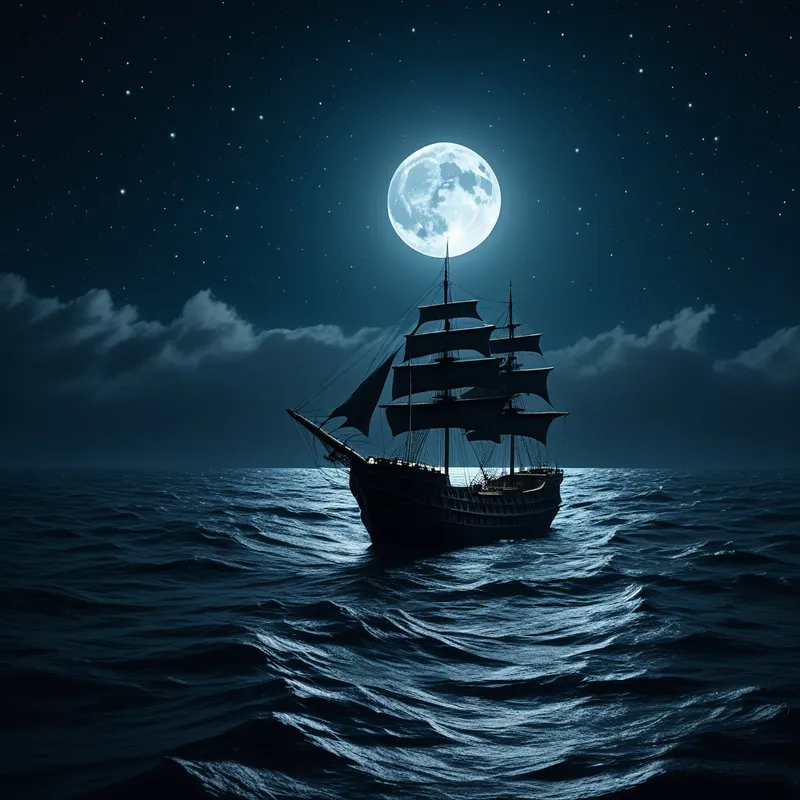
In the alchemical process of individuation—becoming one’s true, whole self—Skidbladnir models the stage of coagulatio: the bringing together of disparate elements into a new, potent, and portable form. The raw ores of our experiences, the winds of our passions, and the woods of our inherited traits are placed in the crucible of conscious work (the therapy room, the creative practice, the meditative silence).
The work of the soul is to build a vessel so perfect it can hold contradiction: the immense journey and the humble beginning, the unfolded destiny and the folded seed.
The “Loki-fly” of neurosis, old wounds, and self-sabotage will inevitably sting. This is not a sign to abandon the work, but part of the ordeal that tempers it. The enduring of this pain, the steady “pumping of the bellows” of attention and intention, is what transmutes raw material into a vessel of the soul.
The final, crucial step is the reception by Freyr. This represents the integration of this new potential into the ruling principle of one’s life—not for grandiosity, but for fertile, peaceful expansion. To own your Skidbladnir is to know that you carry within you, at all times, the capacity to navigate any inner or outer sea. You can unfold your full magnitude when the journey calls for it, and fold it back into the quiet humility of daily life. It is the ultimate symbol of psychological sovereignty and prepared grace, a ship that is always ready, waiting in the pocket of [the self](/myths/the-self “Myth from Jungian culture.”/).
Associated Symbols
Explore related symbols from the CaleaDream lexicon: