Skaði Myth Meaning & Symbolism
A jötunn goddess of winter demands vengeance for her slain father, leading to an uneasy marriage and a final, solitary return to her wild mountains.
The Tale of Skaði
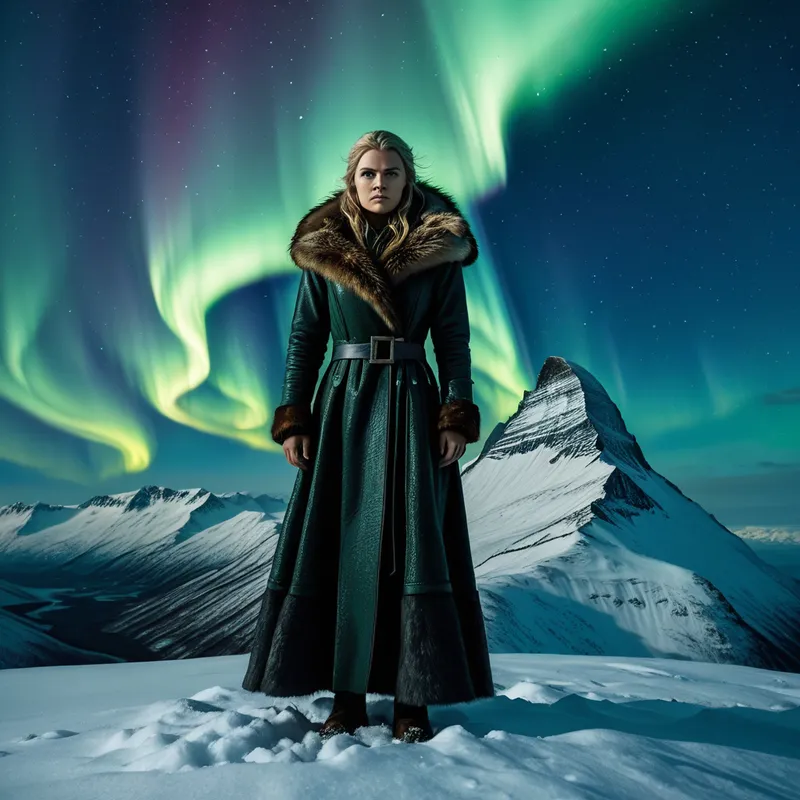
Hear now the tale of the one who walks alone. In the high, silent places where the wind carves stone and the snow never forgets, there lived a daughter of the frost. Her name was Skaði. She was of the race of jötnar, her father the mighty Þjazi. Her home was Jötunheimr, a realm of echoing cliffs and eternal winter, and there she was content, tracking the white hare across endless drifts, her breath a cloud in the still, cruel air.
But a shadow fell upon the mountains. The laughter of the Æsir gods from Asgard had turned to treachery. They had slain her father, Þjazi, for his theft of the goddess Iðunn and her life-giving fruit. The news came on a bitter wind. Skaði laid down her bow. A cold fire, deeper than any winter, ignited in her heart. It was not grief that first moved her—it was the iron demand of wergild, the blood-price. Justice.
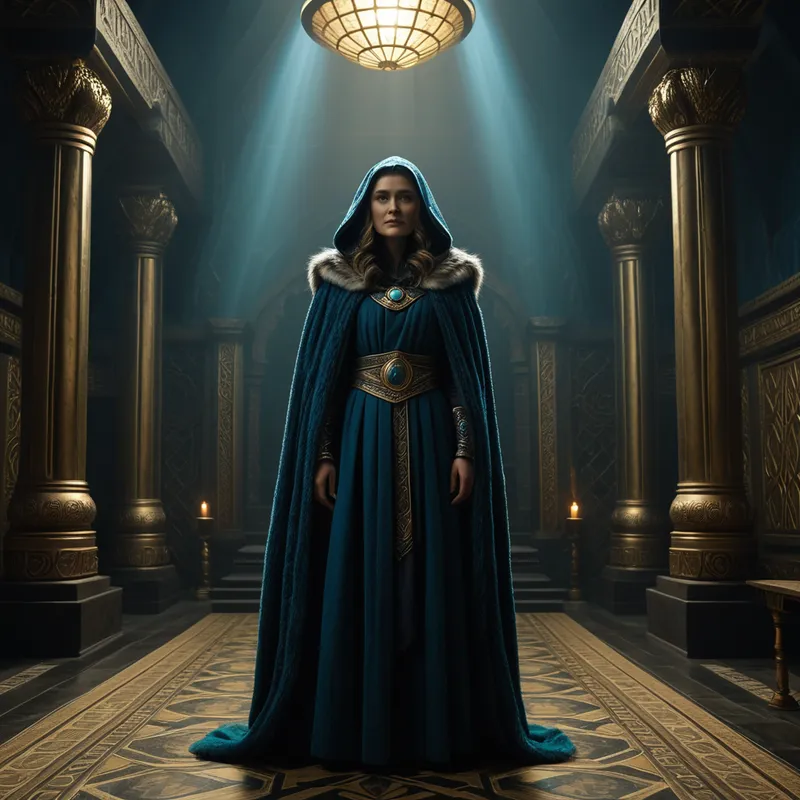
Clad in her furs, with the eyes of a hawk and the resolve of glacier ice, she strode into the golden halls of Asgard. The gods, in their shimmering robes, fell silent. Here was the wilderness itself, standing in judgement upon them. She demanded compensation. Odin, the All-Father, saw the righteousness of her claim and offered terms: she could choose a husband from among the gods, but she must choose by their feet alone, seeing nothing else.
The hall was prepared. The gods stood behind a curtain, only their feet visible. Skaði walked the line, her gaze sharp. She sought the most beautiful feet, believing they must belong to Baldr, the most radiant of the Æsir. She pointed to a pair of flawless, graceful feet. The curtain was drawn back. Laughter, nervous and then booming, filled the hall. She had chosen Njörðr, god of the gentle sea, of calm shores and summer winds.
Her second wish was granted: the gods must make her laugh, a feat she thought impossible in her grim state. The trickster Loki tied his own testicles to the beard of a goat, and the two began a grotesque, squealing tug-of-war. Against the fortress of her sorrow, a laugh broke—sharp, unexpected, a crack in the ice. The price was paid.
She went with Njörðr to his home by the sea, Nóatún. But the crying of gulls stole her sleep, and the sighing of the waves was a hollow mockery of the mountain’s silence. He, in turn, could not bear her world: the howling of wolves was hateful to him, the shriek of the eagle a torment. For nine nights she would dwell in his home, and for nine nights he in hers. But neither could endure the other’s song. “The mountains are too high,” Njörðr lamented. “The sea is too restless,” Skaði replied.
And so, the bond forged in reparation frayed in the wind. Skaði took up her skis and her bow once more. She turned her back on the halls of gods and the shores of men, and climbed. She returned to the high, lonely halls of her father, to the kingdom of frost and stone. She became the spirit of the hunting ground, the patron of the solitary skier on the mountain pass, a figure forever poised between the world of treaties and the call of the wild, untamed heart.
Cultural Origins & Context
The myth of Skaði is preserved primarily in the Prose Edda by Snorri Sturluson, drawing on older skaldic poetry. Her story is not a grand epic of creation or apocalypse, but a poignant, human-scale drama inserted into the divine conflicts. It functioned as an etiological myth, explaining the origins of her marriage to Njörðr and her association with specific landscapes. More profoundly, it served as a narrative interface between the Norse world and the implacable forces surrounding it.
Skaði embodies the utangarðr—the “out-yard,” the wild, untamed, and dangerous realm beyond the fence of the farmstead (innangarðr). The jötnar were not mere monsters; they were the personification of the chaotic, raw, and awe-inspiring natural world that the Norse people both relied upon and feared. Her journey into Asgard represents the inevitable and necessary negotiation between civilization and wilderness. The myth acknowledges that the wild has a rightful claim, a justice that must be addressed, and that integration is fraught with fundamental incompatibility. It was a story told to understand the boundaries of the human world and the powerful, sovereign spirits that ruled beyond them.
Symbolic Architecture
Skaði is the archetype of the Shadow that demands recognition. She is the frozen grief, the righteous anger, and the autonomous self that refuses to be assimilated. Her myth maps the psyche’s confrontation with a profound, life-altering loss.
The journey from vengeance to chosen solitude is the soul’s winter trek; it is not a descent into bitterness, but an ascent into a starker, more authentic self.
Her choice by feet alone is a masterful symbol of the pitfalls of projection. We choose partners, homes, and lives based on a fragment—the “beautiful feet” of an imagined ideal—only to discover the complex, often incompatible whole. Her laughter at Loki’s obscene act is crucial: it is the moment the rigid ego, frozen in grief or grievance, is punctured by the absurd, chaotic life force. It is the crack that allows thaw, however slight, to begin. Her ultimate return to the mountains signifies the acceptance that some parts of the self cannot live in the temperate, compromising climate of the persona. They require the harsh, clean air of integrity, even if it means solitude.
The Dreamer’s Resonance
To dream of Skaði is to dream of a boundary. You may find yourself in a stark, beautiful, but inhospitable landscape, feeling both powerful and profoundly alone. Or you may be in a warm, social space but feel a piercing cold emanating from within, a silent figure at the edge of the gathering.
Somatically, this can feel like a rigidity in the joints, a coldness in the extremities, or a tightness in the jaw—the body armoring itself. Psychologically, you are navigating the terrain between an old identity (the daughter, the partner, the integrated self) that has been shattered by a loss, and the nascent, colder form of what you must become. The dream is processing the wergild: what is owed to you for your loss? Is it an external compensation, or is it the internal permission to leave the shore and return to your own mountains? The dream-Skaði does not seek warmth; she seeks her rightful domain.
Alchemical Translation
The alchemical process modeled here is separatio followed not by coniunctio (union), but by a conscious, willed individuation into a state of sovereign solitude. The old compound—the daughter-father unity, the hoped-for marital union—is shattered (the killing of Þjazi, the failed marriage). The elements are separated out: the sea from the mountain, the social from the wild, the compromise from the core.
The ultimate transmutation is not gold, but granite: the psychic substance that can weather any storm because it has chosen its own landscape.
The modern individual undergoes this when a foundational relationship or identity dies. The first step is Skaði’s march to Asgard: consciously demanding that your pain be witnessed and that life offer some recompense. The choosing-by-feet is the attempt at a quick fix, a new relationship or role to cover the wound. The inevitable disillusionment—the crying of the gulls, the howling of wolves—is not failure, but crucial data. It reveals where you cannot live. The alchemical work is in the return journey, the act of skiing back uphill alone. It is the conscious decision to inhabit your grief, your anger, or your difference not as a temporary state, but as your permanent, dignified territory. You become the ruler of your own winter, the hunter in your own interior wilderness, no longer seeking a home in another’s world, but fully at home in the authentic, if colder, climate of your Self.
Associated Symbols
Explore related symbols from the CaleaDream lexicon: