
Skadi's Snowshoes Myth Meaning & Symbolism
A giantess dons snowshoes to seek vengeance for her father's death, leading to an unexpected marriage and a choice between two worlds.
The Tale of Skadi's Snowshoes
Hear now the tale of the long walk, the crunch of frost underfoot, and the heart that beat like a drum of ice. In the high halls of the Æsir, laughter had turned to ash. For they had slain Thiazi, the storm-giant, and in their triumph, they had forgotten that every giant has kin.
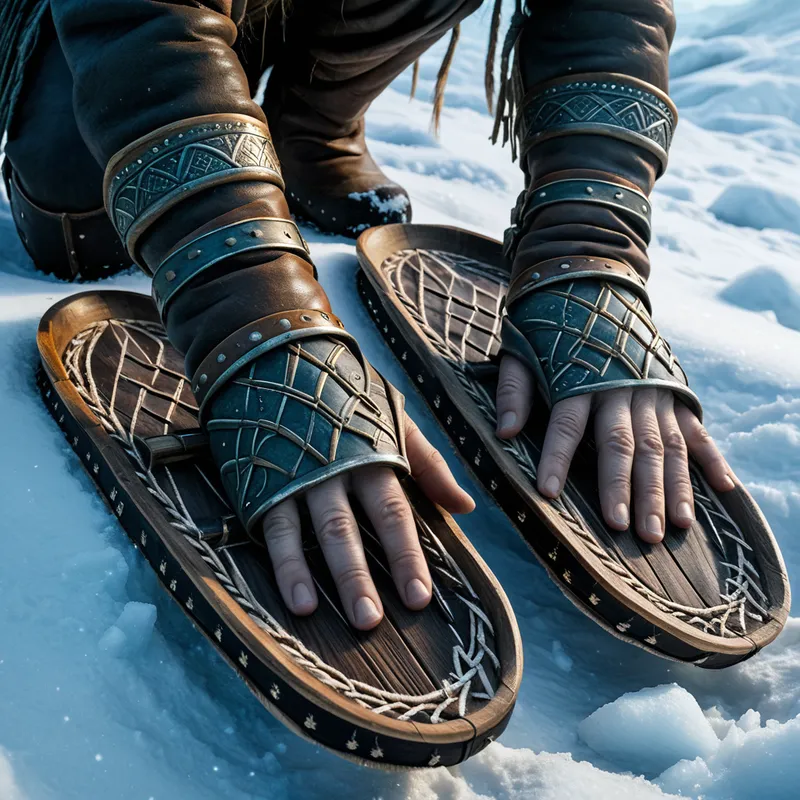
Far to the north, in Jötunheimr, where the wind sculpts stone and the cold is a living thing, his daughter heard the silence where her father’s voice should be. Her name was Skadi. She did not weep. She strapped on her father’s great war-skis, took up her shield and shining spear, and turned her face toward Asgard. She moved not as one who travels, but as one who becomes the journey itself—a figure of vengeance gliding over the frozen earth, a winter spirit descending upon the home of summer.
She arrived at the gates not with a roar, but with a terrible, cold quiet. The gods, peering from their golden walls, saw not a raiding party, but a single woman, a statue of grief armored in frost. They knew justice stood before them, and they offered a blood-price. Skadi’s terms were clear: she would choose a husband from among them, seeing only their feet. And she would be made to laugh, for her heart was frozen in sorrow.
The gods lined up behind a curtain. Skadi scanned the feet, seeking the most beautiful, thinking they must belong to Baldr, the shining one. She chose a pair of flawless, graceful feet. The curtain fell. There stood Njörðr, god of the gentle sea and summer shores. It was a union of opposites: the mountain and the wave.
Then came the test of laughter. The trickster Loki, ever resourceful, tied his own scrotum to the beard of a nanny goat. The ensuing ridiculous, bleating tug-of-war broke the ice in Skadi’s soul, and a single, sharp laugh escaped her—a sound like cracking glacier. The debt was paid.
Yet the final price was one of home. As part of the settlement, Odin took Thiazi’s eyes and cast them into the heavens, where they burn forever as stars. And Skadi, now wed, tried to live in Njörðr’s hall by the sea. She found the crying of gulls unbearable. He, in turn, could not sleep for the howling of wolves in her mountain home. So they made a pact: nine nights in the high crags, nine nights on the singing shore. But Njörðr returned from the mountains weary and worn, and Skadi from the sea, restless and cold. In the end, she fastened on her snowshoes once more and turned her steps forever toward the high places, visiting the halls of the gods only seldom, a sovereign of the lonely peaks.
Cultural Origins & Context
This myth is preserved primarily in the Prose Edda, written by Snorri Sturluson. It belongs to a cycle of stories concerning the often fraught relations between the Æsir and the Jötnar. These were not simple tales of good versus evil, but complex narratives of negotiation, intermarriage, and the necessary, dangerous exchange between order (Asgard) and wild nature (Jötunheimr).
Skadi’s story would have resonated in a culture intimately familiar with the harsh, isolating winters of Scandinavia. The snowshoe (or ski, öndurr) was not merely a tool but a symbol of survival, autonomy, and the ability to traverse otherwise impassable terrain. A woman traveling alone on such equipment to confront the gods was a powerful image of agency. The myth served multiple functions: it explained celestial phenomena (the stars), embodied the very real challenges of marriage and compromise between different clans or ways of life, and presented a model for dealing with grief—not through surrender, but through active, demanding negotiation for honor and a new place in the world.
Symbolic Architecture
At its core, Skadi’s journey is an archetypal movement from a state of frozen, reactive grief toward a hard-won, self-determined identity. Her snowshoes are the critical symbol.
The snowshoe does not conquer the snow; it creates a relationship with it. It distributes weight, finds purchase in fragility, and allows passage across a landscape that would otherwise swallow you whole.
Skadi’s initial use of them is for vengeance—a linear, direct journey toward an external target (the gods). This is the psyche’s first, necessary response to profound loss: to locate the cause and seek to balance the scales. The snowshoes here represent focused willpower cutting through the diffuse, paralyzing blanket of sorrow.
Her choice of husband by feet alone is a profound act of projection. She seeks Baldr, the beautiful, the whole, the untainted—a psychological compensation for the mangled loss of her father. Instead, she gets Njörðr, the god of the “other” element: the fluid, shifting sea opposed to her solid mountain. This is the universe presenting not what the ego wants, but what the soul needs for growth—the irreducible otherness that forces consciousness to expand.
The failed compromise of nine nights each symbolizes the impossibility of a true half-life. One cannot genuinely inhabit two fundamentally different psychic territories. The final return to the mountains is not a failure, but an integration. She leaves the marriage but keeps her status as a goddess. Her snowshoes are no longer tools of vengeance, but of sovereignty. They carry her back to her essential nature, not as a daughter in mourning, but as the dís of the winter wilderness itself.

The Dreamer's Resonance
When this myth stirs in the modern dreamer, it often manifests as dreams of traversing vast, snowy, or otherwise inhospitable landscapes. The dreamer may feel cold, isolated, but purposefully moving. The snowshoes themselves might appear as oversized, clumsy, or miraculously efficient.
Psychologically, this signals a process of navigating a period of emotional "winter"—a time of grief, depression, alienation, or a cold, hard truth that has entered one’s life. The somatic feeling is one of weight, of each step requiring conscious effort, yet also of a strange, grim competency. The dreamer is in the phase of "Skadi’s trek to Asgard": they have identified a source of their pain (a betrayal, a loss, an injustice) and are mustering the energy to confront it, to demand reparation. The dream affirms the necessity of this journey, even as it feels lonely and arduous.
Alternatively, dreaming of being in the wrong environment—longing for mountains while by the sea, or vice versa—speaks to the compromise phase. It indicates a lived situation that feels fundamentally alien to the soul’s terrain, creating a deep, restless discomfort. The psyche is signaling that the current "habitation" is unsustainable and a choice for authentic ground must be made.

Alchemical Translation
The alchemical process modeled here is the separatio followed by a conscious coniunctio that ultimately fails in its initial form, leading to a higher synthesis. The raw material (the prima materia) is Skadi’s frozen grief and rage. The first operation is her journey—the application of will (the snowshoes) to separate herself from the morass of passive suffering and define a boundary against the world that harmed her.
The marriage to Njörðr is the attempted coniunctio, the union of opposites: mountain/sea, winter/summer, feminine vengeance/masculine gentility. In personal individuation, this represents the ego’s attempt to integrate an opposite or shadow aspect into daily life through compromise and agreement.
The true alchemy is not in the compromise, but in realizing what the compromise reveals: the immutable core of one’s own nature.
The failure of the nine-nights pact is the crucial moment of rubedo, the reddening. It is the painful, honest recognition that some syntheses are not meant to last. Some opposites can engage, exchange, and honor each other, but cannot cohabitate without destroying both. The final return to the mountains is the creation of the lapis philosophorum—the philosopher’s stone. For Skadi, it is her fully realized, autonomous identity. She has taken what she needed from the encounter (honor, status, the catharsis of laughter) and returned to her essence, now wiser and sovereign.
For us, the myth instructs that after a great loss or injustice, we must make the long, cold journey to confront what wounded us (externally or internally). We may enter into compromises or unions in an attempt to heal. But the ultimate goal is not to live forever on another’s shore. It is to reclaim, with the hard-won tools of our experience, the inner landscape that is truly our own, and rule it with the fierce, lonely grace of winter.
Associated Symbols
Explore related symbols from the CaleaDream lexicon: