Sivka-Burka Myth Meaning & Symbolism
A tale of a seemingly foolish youngest son who, with the aid of a magical horse, sees the truth of his destiny and wins a kingdom.
The Tale of Sivka-Burka
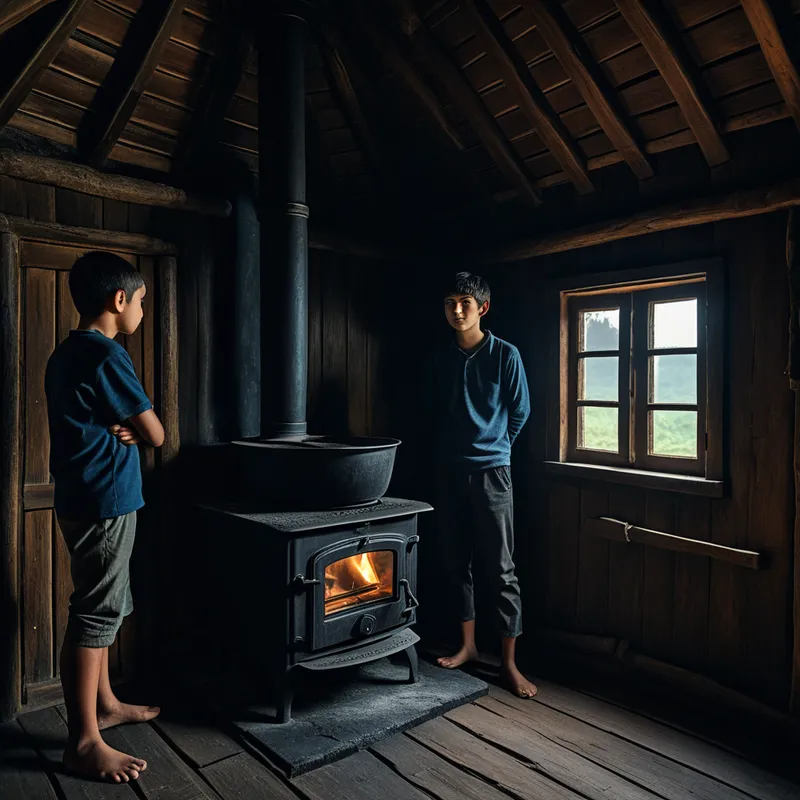
Listen, and let the old timber of the tale creak with the weight of its truth. In a land of deep forests and wide steppes, where the Domovoy whispers in the hearth-smoke, there lived an old man and his three sons. The elder two were strong, sharp-eyed, and favored. The youngest, Ivanushka-Durachok, was kept in the corner by the stove, covered in soot and dismissed by all.
One night, a great marvel appeared in their father’s field: a wondrous apple tree sprang from the earth, its branches heavy with golden fruit. But with it came a terrible thief—each night, a shadow would come and strip the tree bare. The father commanded his sons to stand guard. The eldest went first, but sleep, thick as wool, overcame him, and the apples were gone by dawn. The second son followed, with the same fate.
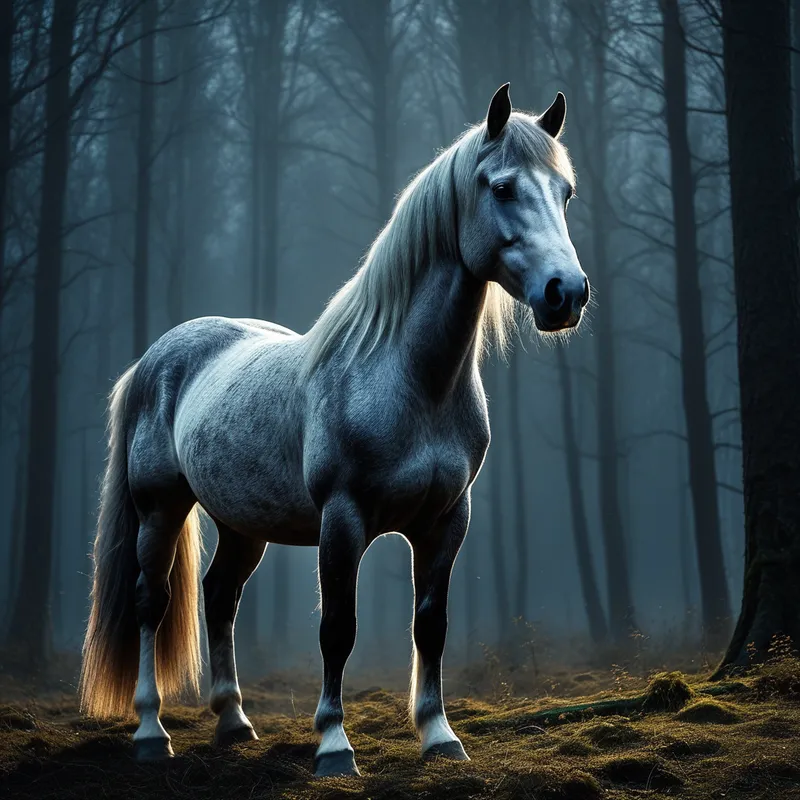
Then it was Ivan’s turn. His brothers scoffed, his father sighed, but the soot-covered son took his place beneath the silver-leafed tree. To stay awake, he plunged a knife into his own leg, letting the sharp pain keep the veil of sleep at bay. At the stroke of midnight, the air grew cold, and the earth trembled. Not a man, but a horse of impossible majesty galloped from the forest—Sivka-Burka, the prophetic steed of [Perun](/myths/perun “Myth from Slavic culture.”/) himself. Its coat shimmered between ash and storm-cloud, its eyes held the light of distant stars, and its hooves struck sparks from the stones.
Ivan did not cower. He leapt, seizing the horse’s mane. The beast roared, “Who dares? For a century, no hand has touched me!” But Ivan held fast. Sivka-Burka, recognizing the mettle in this soot-stained soul, yielded. A pact was forged. Ivan would feed and care for him, and in return, the horse would serve him at his greatest need. “When you call,” said the horse, “crawl into my right ear, and emerge from my left.”
Time passed, and news came of a tsar whose daughter, the beautiful Tsarevna, sat in a high tower. She would marry only the man who could leap his horse to her very window and take a kiss from her lips. All the princes and knights of the land assembled. Ivan’s brothers, in fine armor, rode off to try their luck. Ivan, from his stove-corner, asked to go. They laughed, giving him a broken-down nag. He went to the field, called his true name into the wind: “Sivka-Burka, prophetic kaurka! Stand before me like leaf before grass!”
The earth split. With a sound like thunder, the magical horse appeared, fire snorting from its nostrils. Ivan crawled into its right ear and emerged from the left transformed—a youth of dazzling beauty, clad in armor that shone like the sun, a hero from the oldest songs. He mounted, and with a leap that spanned rivers and forests, he reached the tsarevna’s window, took the fateful kiss, and vanished as swiftly as he came, leaving only a memory of glory and a single lost glove. Twice more the feat was required, and twice more Ivan, transformed by the horse, succeeded, finally winning the tsarevna’s hand and his rightful kingdom, while his brothers saw only a mysterious, glorious stranger—never recognizing the fool from their own hearth.
Cultural Origins & Context
The tale of Sivka-Burka is a classic skazka, belonging to the vast oral tradition of the Eastern Slavs. These stories were not mere children’s entertainment but a vital vessel of cultural wisdom, told during the long winter nights at gatherings called posidelki. The storyteller, often an elder, was a keeper of this symbolic language.
The myth served multiple societal functions. On one level, it was a wish-fulfillment fantasy for the disenfranchised—the youngest son, the overlooked, the “fool” who possesses an inner royalty unrecognized by the worldly order. It reinforced the idea that true worth is not in boastful strength but in endurance, cunning, and a connection to the numinous. The horse itself is a profound archetype in Slavic Rodnovery and later folklore, a symbol of fertility, destiny, and a link to the chthonic and celestial realms. Sivka-Burka, specifically, is a remnant of the sacred solar horse, a psychopomp creature that belongs to the order of the gods but allies itself with a human who proves worthy through a trial of pain and vigilance.
Symbolic Architecture
At its core, this is a myth of latent potential catalyzed by a [relationship](/symbols/relationship “Symbol: A representation of connections we have with others in our lives, often reflecting our emotional state.”/) with the instinctual, prophetic Self. Ivanushka-Durachok is not merely a simpleton; he is the unindividuated psyche, covered in the “soot” of neglect, familial projections, and his own unrealized [nature](/symbols/nature “Symbol: Nature symbolizes growth, connectivity, and the primal forces of existence.”/). His [station](/symbols/station “Symbol: Signifies a temporary stop, transition point, or a place of waiting in life’s journey.”/) by the stove is significant—the stove (pech) is the [soul](/symbols/soul “Symbol: The soul represents the essence of a person, encompassing their spirit, identity, and connection to the universe.”/)-center of the Slavic home, the place of transformation (cooking, baking), yet he is relegated to its periphery. His initial act of piercing his own leg is a critical, initiatory act of self-sacrifice. It is the conscious infliction of pain to achieve a higher state of [awareness](/symbols/awareness “Symbol: Conscious perception of self, surroundings, or internal states. Often signifies awakening, insight, or heightened sensitivity.”/), a brutal but effective method of waking up.
The magical helper does not appear to the one who sleeps through life, but to the one who chooses the conscious wound over unconscious slumber.
Sivka-Burka is the incarnate power of the deep unconscious—instinct, [intuition](/symbols/intuition “Symbol: The immediate, non-rational understanding of truth or insight, often described as a ‘gut feeling’ or inner knowing that bypasses conscious reasoning.”/), and prophetic [knowledge](/symbols/knowledge “Symbol: Knowledge symbolizes learning, understanding, and wisdom, embodying the acquisition of information and enlightenment.”/). The act of crawling through the horse’s ear is a sublime [image](/symbols/image “Symbol: An image represents perception, memories, and the visual narratives we create in our minds.”/) of psychic [integration](/symbols/integration “Symbol: The process of unifying disparate parts of the self or experience into a cohesive whole, often representing psychological wholeness or resolution of internal conflict.”/). One enters the [body](/symbols/body “Symbol: The body in dreams often symbolizes the dreamer’s self-identity, personal health, and the relationship they have with their physical existence.”/) of the instinctual self (the ear as an orifice of [perception](/symbols/perception “Symbol: The process of becoming aware of something through the senses. In dreams, it often represents how one interprets reality or internal states.”/)) and is reborn through it, transformed. The horse does not carry the [hero](/symbols/hero “Symbol: A hero embodies strength, courage, and the ability to overcome significant challenges.”/); it transmutes him. Ivan does not ride on Sivka-Burka; he rides as the union of conscious will and archetypal power. The three leaps to the tsarevna’s [window](/symbols/window “Symbol: Windows in dreams symbolize opportunities for insight, clarity, and a desire to connect with the outside world or one’s inner self.”/) represent the stages of the individuation process: confronting the [anima](/symbols/anima “Symbol: The feminine archetype within the male unconscious, representing soul, creativity, and connection to the inner world.”/) (the inner feminine, the soul-[image](/symbols/image “Symbol: An image represents perception, memories, and the visual narratives we create in our minds.”/) represented by the tsarevna), integrating it, and ultimately achieving the “sacred [marriage](/symbols/marriage “Symbol: Marriage symbolizes commitment, partnership, and the merging of two identities, often reflecting one’s feelings about relationships and social obligations.”/)” that signifies [psychic wholeness](/symbols/psychic-wholeness “Symbol: A state of complete integration between conscious and unconscious aspects of the psyche, representing spiritual unity and self-realization.”/) and sovereignty.
The Dreamer’s Resonance
When this myth stirs in the modern dreamer, it often signals a profound call from the Self. To dream of a neglected, soot-covered figure in the corner of a familiar house is to dream of a disowned part of one’s own potential, languishing in the shadow. Dreams of a powerful, untamed horse—especially one that speaks or demands a pact—point directly to the awakening of immense instinctual energy that feels both terrifying and numinous.
The somatic experience is key. There may be a feeling of constriction (the stove corner), then a sharp, awakening pain (the knife), followed by an overwhelming surge of power and vitality (the call of the horse, the transformation). The dreamer might experience the sensation of flight, of impossible leaps, symbolizing a sudden transcendence of previously insurmountable life obstacles. This is not escapism, but the psyche’s revelation that a latent, transformative power is now accessible, if one has the courage to make the pact and endure the passage through the “ear”—the often disorienting process of listening deeply to and integrating one’s own instinctual wisdom.
Alchemical Translation
The alchemy of Sivka-Burka is a map for turning the leaden, overlooked self into the golden, sovereign self. The initial state is nigredo: the blackening, the soot, the state of being hidden and devalued. The father’s field, the site of the miraculous apple tree, is the fertile but threatened ground of the personal unconscious, where precious contents (the golden apples of value, desire, life-force) are being stolen by an autonomous complex (the nightly thief).
The act of standing guard with self-inflicted pain is the mortificatio—a necessary, conscious suffering that breaks the identification with the “fool” persona. This death-to-the-old-self creates the vacuum that summons the transformative agent: Sivka-Burka, the spirit of the deep unconscious. The pact is the beginning of coniunctio, the sacred marriage between ego-consciousness and the Self.
The ultimate transformation is not done to the hero by the magic, but through the hero’s symbiotic journey with it.
Crawling through the ear is the albedo, the whitening—a purification and rebirth into a new form. Each leap to the tsarevna is a stage of rubedo, the reddening, where the integrated energy is tested and applied in the world, culminating in the final achievement: the recognition (the lost glove as proof) and the marriage. The fool is not replaced by the hero; the fool is the hero, once he has completed the circuit between his humble humanity and the archetypal power that was his birthright all along. The kingdom he wins is not external land, but the inner realm of a psyche that has claimed its full, destined authority.
Associated Symbols
Explore related symbols from the CaleaDream lexicon:
- Horse — The embodied spirit of instinct, prophetic power, and the untamed Self that forms a symbiotic pact with the conscious ego for the purpose of transformation.
- Journey — The archetypal passage from a state of devalued latency to realized sovereignty, guided by a numinous helper and marked by impossible leaps.
- Transformation — The core process of the myth, where a soot-covered fool is alchemically reborn as a king through a ritual integration with an animal spirit.
- Destiny — The hidden, royal potential within the overlooked individual, which must be actively claimed through ordeal and alliance with deeper powers.
- Shadow — The soot-covered Ivan represents the personal shadow, the disowned and devalued parts of the self that hold the key to true power.
- Key — The magical horse itself functions as the key that unlocks the hero’s latent destiny and the tsarevna’s tower, representing access to the soul.
- Fire — Represented in the hearth by the stove and the sparks from the horse’s hooves, it is the transformative element that purifies and empowers.
- Mask — The transformed identity Ivan wears when he emerges from the horse—a glorious facade that is nonetheless a true expression of his inner reality.
- Tower — The inaccessible height of the anima or the integrated Self, which can only be reached through the supernatural leap facilitated by the unconscious.
- Hero — The archetype embodied through the process, not through innate strength, but through endurance, cunning, and the forging of a sacred pact.