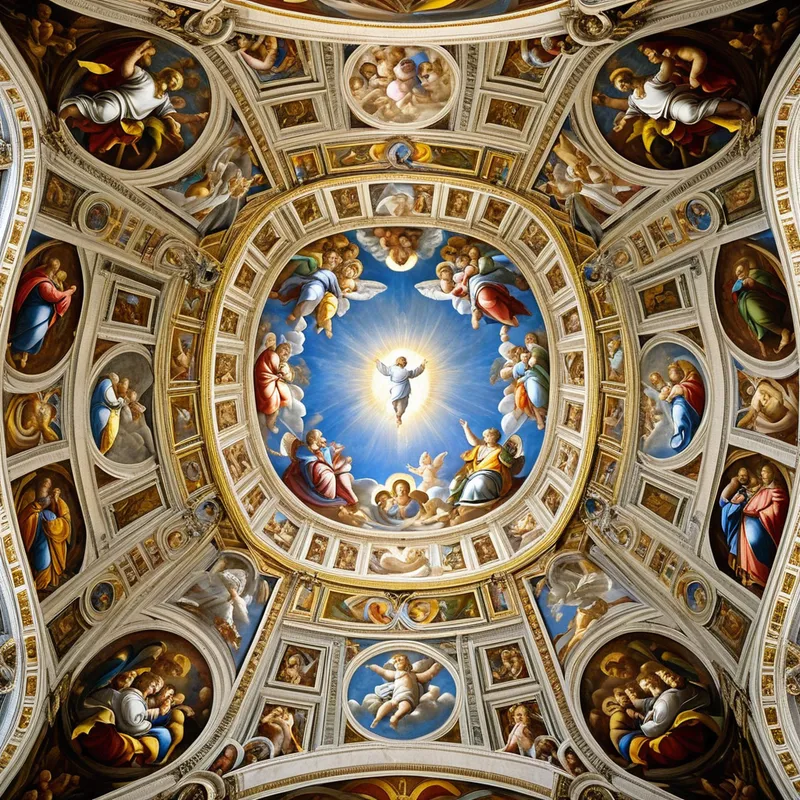
Sistine Chapel Ceiling Myth Meaning & Symbolism
A visual epic painted on stone, narrating the divine genesis of the world, the tragic fall of humanity, and the promise of ultimate reconciliation.
The Tale of Sistine Chapel Ceiling
In the beginning, there was a void, a curved and waiting sky of stone. Then, a presence moved upon the face of the deep. Not with sound, but with intent. From a whirlwind of drapery and divine energy, a mighty hand extended. It did not grasp, but offered. Its fingertip, charged with the spark of all existence, reached toward a form of sublime clay—Adam. He lay upon the new earth, his body a masterpiece of potential, his gaze languid yet yearning. In that sliver of space between Creator and created, the universe held its breath. Life, like a silent lightning bolt, leapt across the gap.
Thus the great drama was set in motion upon this vaulted firmament. We witnessed the separation of light from darkness, the sun and moon placed as sentinels in [the sky](/myths/the-sky “Myth from Persian culture.”/). We saw the waters part, and the dry land appear. We beheld the creation of Eve, drawn from the side of the sleeping Adam, not as an afterthought, but as a completion, her form emerging with grace and destiny already in her eyes.
But then, [the shadow](/myths/the-shadow “Myth from Jungian culture.”/) fell. In a garden of impossible lushness, a serpent, cunning and coiled, whispered. The fruit was taken, the knowledge tasted—and with it came the terrible, shuddering awareness of nakedness, of separation. The scene turns to anguish. A flaming angel, sword held high, drives the first man and woman from the gates of paradise. Their bodies, once perfect vessels of divine light, are now twisted in grief, their faces masks of a loss so profound it echoes through the ages. Paradise is a bright disk behind them, forever receding.
Yet the story does not end in exile. Prophets and sibyls, their muscles straining with the weight of foresight, flank the central narrative. They are the bridges, the ones who see the thread of hope woven through the tapestry of human failure. The drama culminates not with a king or a warrior, but with a final, terrifying vision of the end of all things. Christ, no longer the gentle teacher, appears as the cosmic judge in the Last Judgment. He raises a hand not of creation, but of ultimate reckoning, surrounded by a storm of resurrected bodies, [saints](/myths/saints “Myth from Christian culture.”/) ascending in ecstasy, and the damned plunging into an eternal abyss. It is a resolution of absolute finality, where every secret is laid bare, and the circle of divine intention—from creation to judgment—is brutally, magnificently closed.
Cultural Origins & Context
This myth was not sung by bards but painted by a single, titanic will: Michelangelo Buonarroti. Commissioned by Pope Julius II in the early 16th century, the ceiling of the Sistine Chapel became the canvas for a theological and political statement of unparalleled scale. The culture was that of High Renaissance Rome, a fusion of revived classical humanism and militant papal authority. The myth was “passed down” not orally, but visually, to an audience of cardinals, princes, and theologians who gathered in that sacred space. Its societal function was multifaceted: to awe, to instruct, to assert the authority of the Church as the sole interpreter of this cosmic history, and to visually reconcile the classical wisdom of the sibyls with the revealed truth of the biblical prophets. It was dogma rendered as sublime epic, designed to overwhelm the senses and confirm the faith.
Symbolic Architecture
The [ceiling](/symbols/ceiling “Symbol: The ceiling in dreams often symbolizes limitations, aspirations, and the boundaries of one’s potential or consciousness.”/) is not a mere illustration; it is a symbolic map of the [human](/symbols/human “Symbol: The symbol of a human represents individuality, complexity of emotions, and social relationships.”/) [soul](/symbols/soul “Symbol: The soul represents the essence of a person, encompassing their spirit, identity, and connection to the universe.”/)‘s [relationship](/symbols/relationship “Symbol: A representation of connections we have with others in our lives, often reflecting our emotional state.”/) with the divine. The central panels chart the archetypal [journey](/symbols/journey “Symbol: A journey in dreams typically signifies adventure, growth, or a significant life transition.”/) from unconscious unity (Creation), through the necessary catastrophe of self-[awareness](/symbols/awareness “Symbol: Conscious perception of self, surroundings, or internal states. Often signifies awakening, insight, or heightened sensitivity.”/) and [separation](/symbols/separation “Symbol: A spiritual or mythic division between realms, states of being, or consciousness, often marking a transition or loss of connection.”/) ([the Fall](/myths/the-fall “Myth from Biblical culture.”/)), toward a potential reconciliation that demands terrifying accountability (the Last Judgment).
The finger of God does not touch Adam; it invites. The gap is the space of human freedom, the terrifying and glorious void where choice—and therefore fate—is born.
Adam represents the nascent ego, the spark of individual [consciousness](/symbols/consciousness “Symbol: Consciousness represents the state of awareness and perception, encompassing thoughts, feelings, and experiences.”/) emerging from the divine ground of being. His reclining [posture](/symbols/posture “Symbol: Posture in dreams represents one’s stance in life, social presentation, and inner confidence or submission. It reflects how one carries themselves through challenges and relationships.”/) speaks of latent power, not yet activated by will. Eve symbolizes the [emergence](/symbols/emergence “Symbol: A process of coming into being, rising from obscurity, or breaking through a barrier, often representing birth, transformation, or revelation.”/) of the relational and intuitive [aspect](/symbols/aspect “Symbol: A distinct feature, quality, or perspective of something, often representing a partial view of a larger whole.”/) of the [psyche](/myths/psyche “Myth from Greek culture.”/), the “[anima](/symbols/anima “Symbol: The feminine archetype within the male unconscious, representing soul, creativity, and connection to the inner world.”/)” that connects [the ego](/myths/the-ego “Myth from Jungian culture.”/) to deeper layers of [life](/symbols/life “Symbol: The symbol of ‘Life’ represents a journey of growth, interconnectedness, and existential meaning, encompassing both the joys and challenges that define human experience.”/) and, ultimately, to temptation and [knowledge](/symbols/knowledge “Symbol: Knowledge symbolizes learning, understanding, and wisdom, embodying the acquisition of information and enlightenment.”/). The [Serpent](/symbols/serpent “Symbol: A powerful symbol of transformation, wisdom, and primal energy, often representing hidden knowledge, healing, or temptation.”/) is the shadowy catalyst, the [trickster](/symbols/trickster “Symbol: A boundary-crossing archetype representing chaos, transformation, and the subversion of norms through cunning and humor.”/) that forces [consciousness](/symbols/consciousness “Symbol: Consciousness represents the state of awareness and perception, encompassing thoughts, feelings, and experiences.”/) out of its innocent containment. [The prophets](/myths/the-prophets “Myth from Biblical culture.”/) and sibyls are personifications of the [inner voice](/symbols/inner-voice “Symbol: A spiritual or subconscious guide representing intuition, conscience, or higher self, often seen as a connection to divine wisdom or ancestral knowledge.”/) of conscience, [intuition](/symbols/intuition “Symbol: The immediate, non-rational understanding of truth or insight, often described as a ‘gut feeling’ or inner knowing that bypasses conscious reasoning.”/), and foresight—the psychic functions that attempt to guide the conscious mind toward wholeness, often through struggle.

The Dreamer’s Resonance
To dream of this mythic space is to dream of one’s own psychic architecture. Dreaming of the outstretched hands, almost touching, may signal a profound moment of potential—a new idea, relationship, or aspect of [the self](/myths/the-self “Myth from Jungian culture.”/) yearning to be born. The somatic feeling is one of electric anticipation mixed with anxiety.
Dreaming of the Expulsion scene often accompanies a psychological “fall”—the shattering of an illusion, the painful acquisition of a truth about oneself that one wished to ignore. The body in the dream may feel heavy, ashamed, or cold. Conversely, dreaming of the swirling, chaotic Last Judgment can manifest during periods of intense self-reckoning or moral crisis, where past actions and choices rise up for final review. It is the psyche’s own terrifying tribunal.
Alchemical Translation
The Sistine narrative is a perfect model for the alchemical process of individuation. It begins with the [prima materia](/myths/prima-materia “Myth from Alchemical culture.”/), the unformed self ([the void](/myths/the-void “Myth from Buddhist culture.”/), the clay of Adam). The [separatio](/myths/separatio “Myth from Alchemical culture.”/) is violently achieved in the Fall—the ego is cleaved from its unconscious, paradisiacal unity. This is a necessary, if agonizing, stage.
The long middle sequence—the prophets, sibyls, and ancestral stories—represents the mortificatio and illuminatio of the work: the confrontation with one’s inner guides, the suffering of insight, and the slow accumulation of wisdom.
The Judgment is not a punishment imposed from without, but the ultimate coniunctio: the conscious ego facing, and integrating, the totality of its own being—light and shadow, saint and sinner.
The final panel, the Last Judgment, symbolizes the final stage of psychic transmutation. Here, the Christ-figure is not an external judge but the archetype of the Self, the central, unifying principle of the whole psyche. The “judgment” is the moment when the ego surrenders its illusion of total control and acknowledges the sovereignty of this greater Self. [The resurrection](/myths/the-resurrection “Myth from Christian culture.”/) of the bodies is the integration of all once-repressed or fragmented parts of the personality into a new, conscious wholeness. The myth teaches that the journey from creation to apocalypse is not a historical line, but an eternal cycle within the soul, where we are forever being created, forever falling into awareness, and forever being called to our own final, truthful reckoning and renewal.
Associated Symbols
Explore related symbols from the CaleaDream lexicon: