Sinterklaas/Santa Claus Myth Meaning & Symbolism
A mythic figure of winter, traversing the liminal dark to judge and gift, embodying the collective psyche's negotiation of morality, abundance, and the unconscious.
The Tale of Sinterklaas/Santa Claus
Listen. The year is dying. The sun flees the sky, and the world is swallowed by the long, blue dark. In this season of sleeping earth and sharp stars, the boundary between worlds grows thin as frost on a windowpane. It is then He comes.
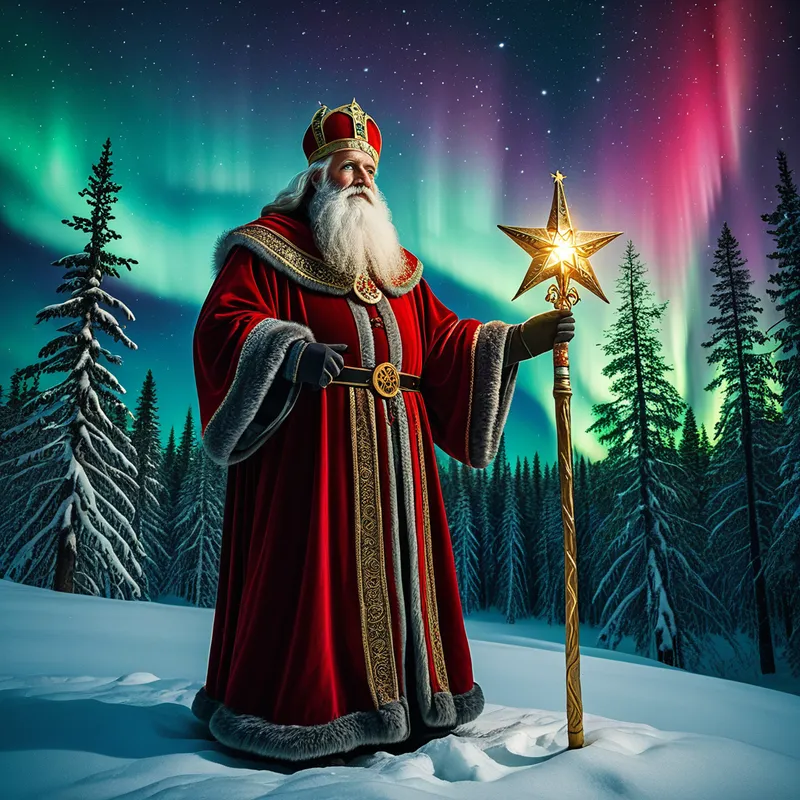
He does not arrive with fanfare, but with the whisper of wind through bare branches. From the cold North, across the white waste, He rides. His steed is not of this earth—a great, pale horse that gallops upon the rooftops, its hooves striking sparks from the frozen tiles, its breath a plume of winter mist. Upon its back sits the Figure, a colossus wrapped in the deep crimson of old blood and the white fur of the Arctic fox. In one hand, a staff of gnarled wood, crowned with a gleaming sun-cross. In the other, a heavy book, bound in worn leather, wherein every deed, whispered or shouted, is inscribed.
He is the Nikolaos of Myra, the saint who saved sailors from the storm, but also the older, sterner spirit who walks the winter. With Him come His helpers—not cheerful elves, but dark, nimble shapes, born of shadow and peat smoke. Some call them Krampus or Zwarte Piet; they are the raw, untamed forces of nature that do His bidding.
On the eve of His feast, the world holds its breath. Children, washed and scrubbed, leave their shoes by the hearth, filled with straw and carrots for the celestial horse. They sing songs into the gathering gloom, their voices thin and hopeful. Then, silence falls. The fire crackles low. Up on the roof, there is a scrape, a muffled step. Down the soot-black chimney, a form descends—not the jolly man of later tales, but a swift, assessing presence.
He consults the great book. The helpers rustle in the corners. For the good, there is reward: a speculaas shaped like a saint, a handful of silver coins, a toy carved from wood. For the wicked, the forgetful, the cruel of tongue? A bundle of birch rods left in the shoe. Or worse—the helper might take them, whisking them away in his sack to a distant, pedagogical land. It is a night of cosmic accounting, a moral harvest in the dead of winter.
Before dawn breaks, He is gone. Only the gifts, or the rods, remain as proof. The horse’s spectral gallop fades into the wind, and the long night begins, at last, to loosen its grip.
Cultural Origins & Context
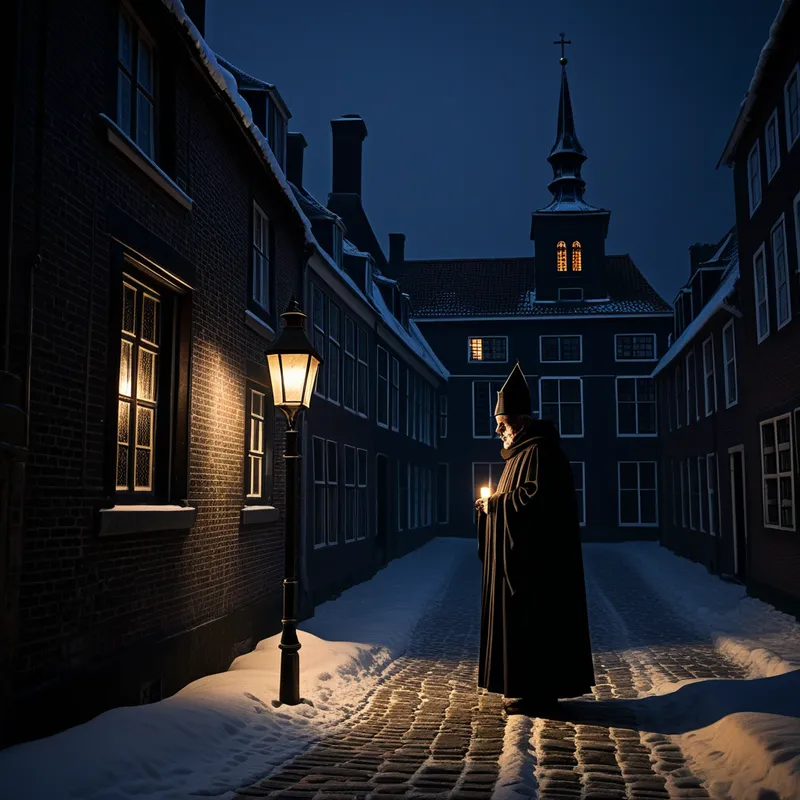
This myth is not a single story but a palimpsest, written and rewritten upon the vellum of European winter. Its deepest layer is pre-Christian, rooted in the Germanic and Norse world. Here, the god Odin, the Allfather, rode the winter skies on his eight-legged horse Sleipnir, during the wild hunt of Yule. Children would leave boots filled with straw for Sleipnir, hoping for gifts in return. Odin was a god of poetry and magic, but also of the hanged and the battlefield—a judge and a bestower of fate.
This archetype was later Christianized and softened into the figure of Saint Nicholas, a 4th-century Greek bishop known for secret gift-giving. In the Netherlands, this merged with local folk traditions to become Sinterklaas. The myth was passed down not in sacred texts, but in hearth-side stories, seasonal songs, and community rituals performed on December 5th (the eve of his feast day). Its societal function was profound: it externalized the community’s moral framework, using the awe of the supernatural to reinforce codes of behavior in children. It also served a vital psychological function for an agricultural society facing the deprivation and existential threat of winter—it ritualized hope and the promise of abundance in the barren time.
Symbolic Architecture
At its core, this is a myth of the individuation of the collective. The Figure is the embodiment of the Self, the central archetype of order and totality. He descends from the “North”—the symbolic realm of the unconscious, the cold, unknown depths of the psyche—into the “village” of the conscious ego.
The gift-giver is first and foremost the judge. The abundance he bestows is not entitlement, but the psychic reward for engaging with one’s own moral substance.
The chimney is the critical symbol. It is the axis mundi of the domestic sphere, the narrow, liminal passage connecting the heavens (rooftop/consciousness) with the underworld (hearth/unconscious). His descent is a ritualized invasion of the unconscious into the ordered home of the ego. The gifts and rods represent the two faces of the Self: the nurturing, rewarding parent and the disciplining, shadow-carrying parent. The helpers—the controversial, dark-faced companions—are the personified shadow. They do the dirty, frightening work of confronting naughtiness, carrying the sack of potential “abduction” (assimilation by the unconscious), allowing the central Figure to remain an august, if stern, authority.
The Dreamer’s Resonance
When this mythic pattern surfaces in modern dreams, it often signals a profound encounter with the inner moral arbiter and the economy of the psyche. Dreaming of a looming, silent Santa Claus figure can indicate the dreamer is undergoing a subconscious “life review,” where deeds and intentions are being weighed by the Self. A dream of being watched by this figure from a fireplace speaks to the feeling of the unconscious observing and judging the conscious personality.
The somatic experience can be one of anxious anticipation—the child-like hope for reward mixed with the dread of punishment. To dream of receiving a gift from him is to experience a moment of psychic validation, a sense that one’s efforts are recognized by a deeper, transpersonal authority. Conversely, to dream of receiving rods, or of the dark helpers, is to confront the shadow’s critique, a call to integrate neglected or denied aspects of one’s behavior. The dream is an internalized Sinterklaasavond, where the psyche itself performs the annual audit.
Alchemical Translation
The myth models the alchemical opus, the great work of psychic transformation. The initial state is the “lead” of winter—the nigredo, the dark night of the soul, where the conscious ego feels barren and the unconscious looms large. The Figure’s journey is the circumambulatio; he moves around the perimeter of the world (the rooftops), symbolizing the need to approach the center (the Self) from all angles, acknowledging every aspect of the psyche.
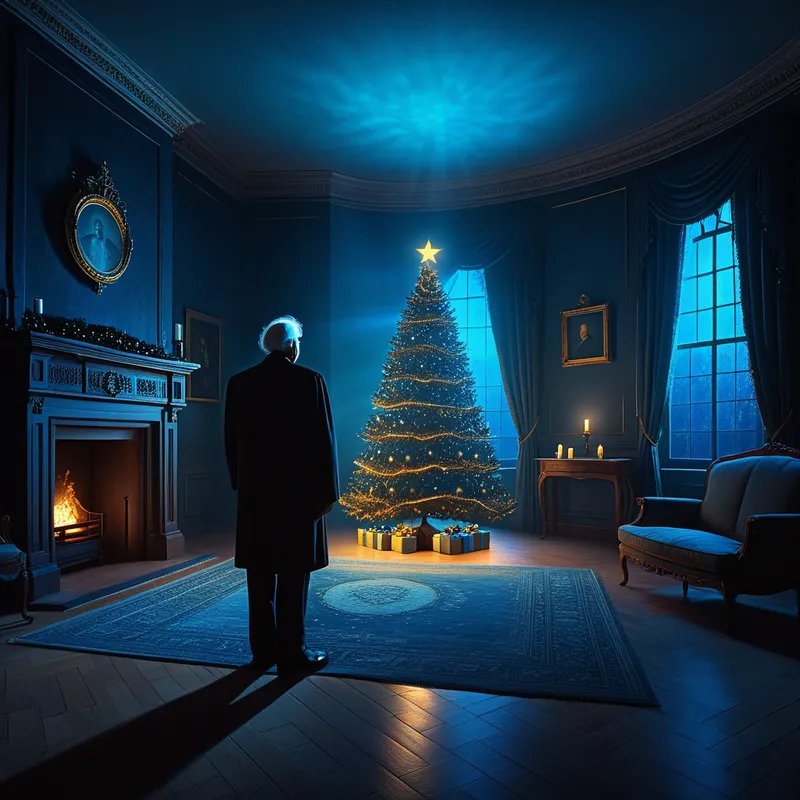
The descent into the soot-black chimney is the descent into the prima materia, the chaotic base matter of the soul. The judgment in the dark living room is the separatio, dividing the pure from the impure within oneself.
The gifts represent the albedo, the whitening—the moments of clarity, insight, and reward that come from honest self-appraisal. The rods or the threat of the sack represent the necessary mortificatio, the humbling or “killing” of inflated or ignorant aspects of the ego. The ultimate goal is not merely to receive presents, but to internalize the Judge and the Gift-Giver. One must become, for oneself, the source of both honest accountability and generous self-compassion. The myth teaches that true abundance—the philosopher’s gold of psychological wholeness—is only granted after a fearless inventory taken in the deepest dark of the year, and of the self.
Associated Symbols
Explore related symbols from the CaleaDream lexicon: