Simurgh's Nest Myth Meaning & Symbolism
A cosmic bird guards a mountain-top nest, its feather a guide for a hero's ascent, culminating in a revelation that transforms both seeker and guardian.
The Tale of Simurgh’s Nest
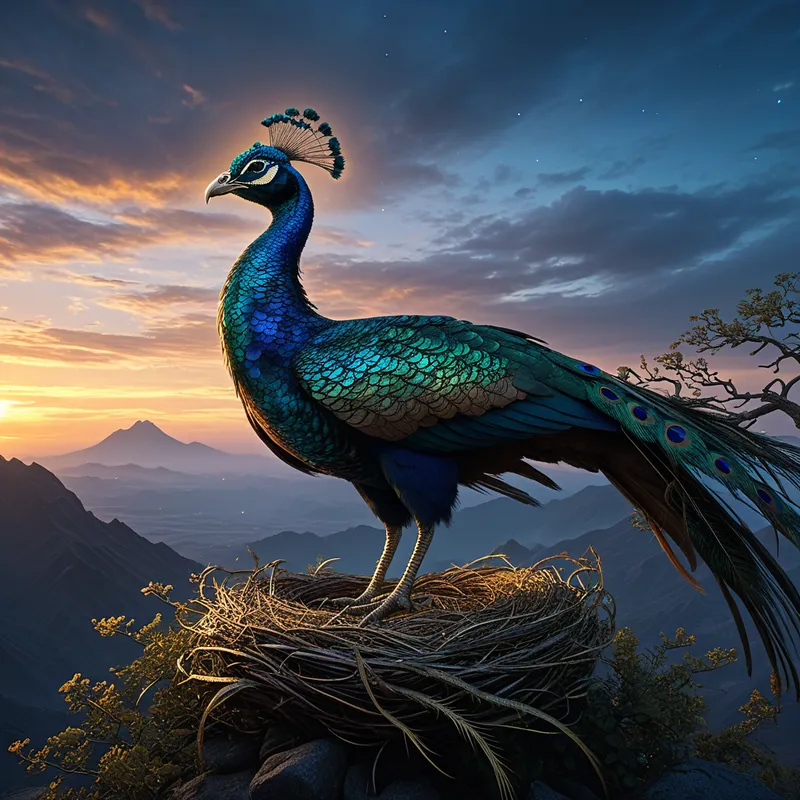
Listen, and let your spirit travel to the edge of the known world, to where the earth curves into the realm of pure myth. There stands Mount Qaf, a ring of emerald peaks so high they scratch the crystal sphere of the heavens. Its cliffs are unscalable, its valleys unknowable. And at its summit, cradled in a nexus of winds older than time, rests the Nest.
This is no nest of twigs and straw. It is woven from the branches of the Tree of All Seeds, threaded with strands of moonlight and solidified dawn. It is the throne and the cradle of the Simurgh.
Now, the Simurgh is not merely a bird. She is a continent of feathers, each one a tablet of wisdom. Her wings, when she stirs, cast shadows that become valleys on the earth below. Her eyes hold the patience of millennia. She is the guardian of the threshold, the keeper of the cosmic balance, and in her Nest, she broods over the egg of potential—the secret of origins and ends.
Our tale turns to the world of men, to the kingdom of Zabulistan. Here, a child named Zal is born, his hair as white as the snows of Qaf. Seen as an ill omen, he is abandoned at the mountain’s foot. His cries, pitiful and pure, do not go unheard. They rise, carried by a compassionate wind, to the summit.
The Simurgh hears. With a grace that belies her immensity, she descends, her presence a soft thunder. She gathers the albino infant in her talons, gentle as a mother’s hand, and carries him to her high Nest. There, in that cradle of myth, she raises him. He drinks dew from celestial flowers and learns the languages of stars and stones. The Simurgh rears him not as a pet, but as a soul.
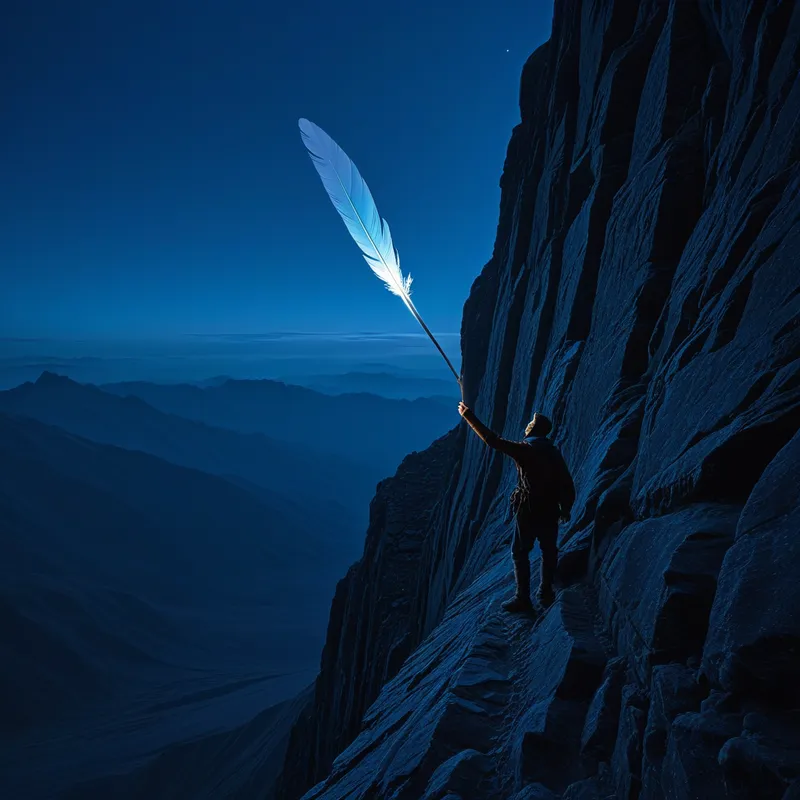
But the destiny of a human prince is woven on a different loom. When Zal is grown, wise and strong, the Simurgh knows he must return. With a sorrow that rustles like a forest, she plucks a single feather from her breast. “Take this,” her voice echoes in his mind, not in sound, but in knowing. “When you are lost in the deserts of the world, when despair is a mountain before you, burn this feather. I will come.”
Zal descends, the feather his only inheritance. He becomes a great king, a hero of the Shahnameh. Yet, his greatest trial comes later. When his beloved wife, Rudabeh, lies in mortal agony during childbirth, all human skill fails. Remembering, Zal builds a fire of sandalwood and aloes. With a prayer that is also a farewell, he casts the sacred feather into the flames.
It does not burn. It dissolves into a column of fragrant smoke that pierces the sky. From the direction of Mount Qaf, a darkness grows—not of night, but of vast, approaching wings. The Simurgh arrives, dimming the sun. She does not speak to the astonished court. Over Rudabeh, she performs a mysterious rite, passing her shadow over the laboring queen. Then, she gives Zal a secret: a celestial herb, and the knowledge of the Cesarean section. Life is saved. The hero Rostam is born.
Her task complete, the Simurgh turns to Zal one last time. Her ancient eyes hold an ocean of silence. “The bond is not severed,” she seems to say, “it is transformed. You carry the Nest within you now.” And with a beat of her wings that stirs the soul of every witness, she ascends, returning to her eternal vigil atop Qaf, leaving behind a world forever touched by the mythic.
Cultural Origins & Context
The story of the Simurgh and her Nest is a central jewel in the crown of Persian epic poetry, most famously recorded in the 10th-century masterpiece, the Shahnameh (Book of Kings) by the poet Ferdowsi. However, its roots dig far deeper, into the pre-Zoroastrian soil of Greater Iran. The Simurgh likely evolved from the Saēna bird of the Avestan texts, a great falcon or eagle associated with healing and rain.
Ferdowsi did not invent the myth; he wove existing oral traditions into his national epic, giving it a narrative home and psychological depth. The story was told by naqqāls (storytellers) in coffee houses and courts, serving not just as entertainment but as a vessel of cultural identity, ethical instruction, and cosmic philosophy during times of foreign domination. It functioned as a reminder of a majestic, ordered cosmology centered on wisdom (kherad) and benevolent, supra-human guardianship. The Nest was not a geographical place but a spiritual destination, a symbol of Persia’s own perceived role as a cradle of civilization and wisdom amidst the chaos of the world.
Symbolic Architecture
The myth is a perfect symbolic organism. Every element is a mirror reflecting a facet of the soul’s journey.
Mount Qaf is the axis mundi, the world pillar, representing the ultimate challenge, the boundary between the conscious ego and the vast, unconscious Self. The climb is the path of individuation.
The Simurgh Herself is the ultimate symbol of the Self. She is the unified, transcendent totality that the ego must eventually relate to. She is not a god to be worshipped from afar, but a psychopomp—a guide who intervenes, nurtures, and bestows tools (the feather) for the journey.
The Nest is not where the soul is kept; it is where the soul is recognized.
The Nest is the temenos, the sacred precinct, the vessel of transformation. It is the protected psychic space where the abandoned, alienated part of the self (Zal, the white-haired outcast) is integrated and nurtured by the greater Self. It represents the goal of the therapeutic or spiritual process: a state of wholeness and grounded wisdom.
The Feather is the symbol of the living connection to the Self. It is a talisman of remembrance and a means of summoning transformative aid from the depths of the psyche. Its burning is an act of supreme humility and invocation, a conscious surrender to a power greater than the ego.
The Dreamer’s Resonance
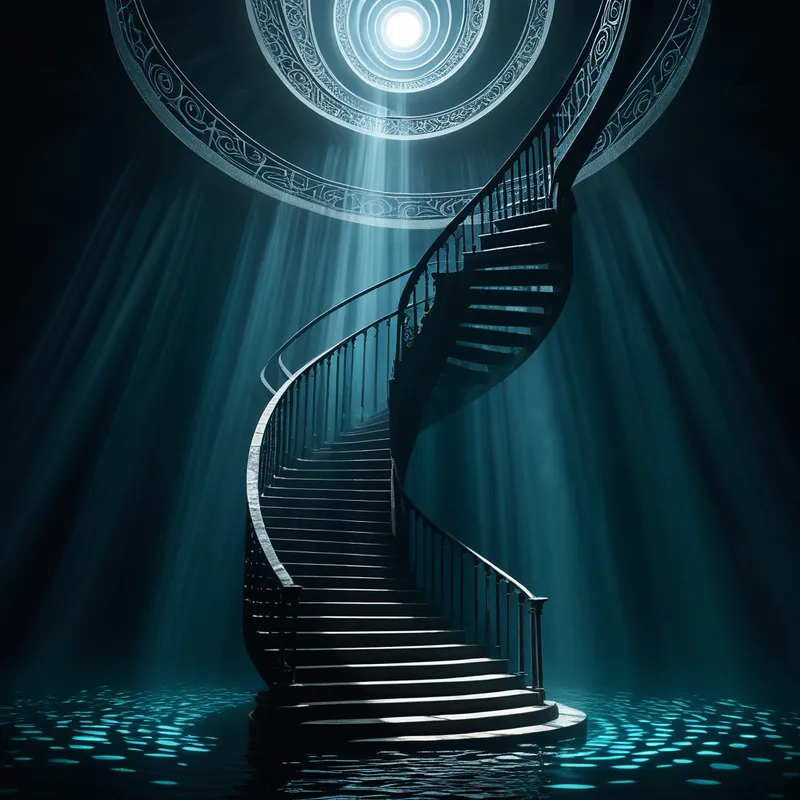
When this myth stirs in the modern unconscious, it manifests in dreams of profound ascent and avian guardians. To dream of climbing an impossible mountain, especially with a sense of sacred duty, echoes Zal’s journey. The mountain may appear as a literal cliff, a towering corporate ladder, or an endless staircase—the somatic feeling is one of arduous effort coupled with a pull from above.
Dreams of a giant, benevolent bird—often not seen directly but felt as a vast shadow or a rustle of immense wings—signal the active presence of the Self-archetype. It is a protective, overseeing intelligence. The dreamer may find a single, luminous feather. This is a critical dream symbol: it represents a gift from the deep psyche, a piece of innate wisdom or a nascent talent that must be acknowledged and “carried” into waking life.
Conversely, dreams of being abandoned at a mountain’s base reflect the “Zal wound”—the feeling of being an outsider, alienated due to some inherent trait (one’s sensitivity, creativity, or difference). The psychological process here is one of moving from abandonment to adoption by one’s own deeper nature, learning to parent the exiled parts of oneself within the inner Nest.
Alchemical Translation
The myth of Simurgh’s Nest is a precise alchemical recipe for psychic transmutation. The prima materia is the abandoned child, the raw, rejected aspect of the personality (the nigredo). The Simurgh’s act of retrieval is the first conjunction, the raising of this material into the vessel of transformation (the Nest).
Zal’s upbringing in the Nest is the albedo—the whitening. He is purified, educated by the non-human (the unconscious), and made wise. His return to the human world is the necessary separatio; the integrated wisdom must be tested in the realm of action and relationship.
The crisis of childbirth is the rubedo, the final and fiery test. Here, the ego (Zal) faces its ultimate limitation—the potential death of love and future (Rudabeh and Rostam). He must consciously sacrifice his most precious connection to the Self (burn the feather) to save the very world he was sent to inhabit. This is the supreme paradox of individuation.
One must be willing to relinquish the symbol to invoke the reality it represents.
The Simurgh’s final intervention and subsequent departure mark the completion. The help comes not as a permanent crutch, but as a final act of empowerment that leaves the individual sovereign. The Nest is internalized. The Self is no longer a distant bird on a mythical mountain, but an operative principle within the human heart. The hero (and by extension, the individual on the path) is left not dependent, but capable. He has been to the Nest, and thus, he carries its unshakable order within him, ready to face the chaotic births and deaths of a human life with the grace of one who has seen the view from Mount Qaf.
Associated Symbols
Explore related symbols from the CaleaDream lexicon: