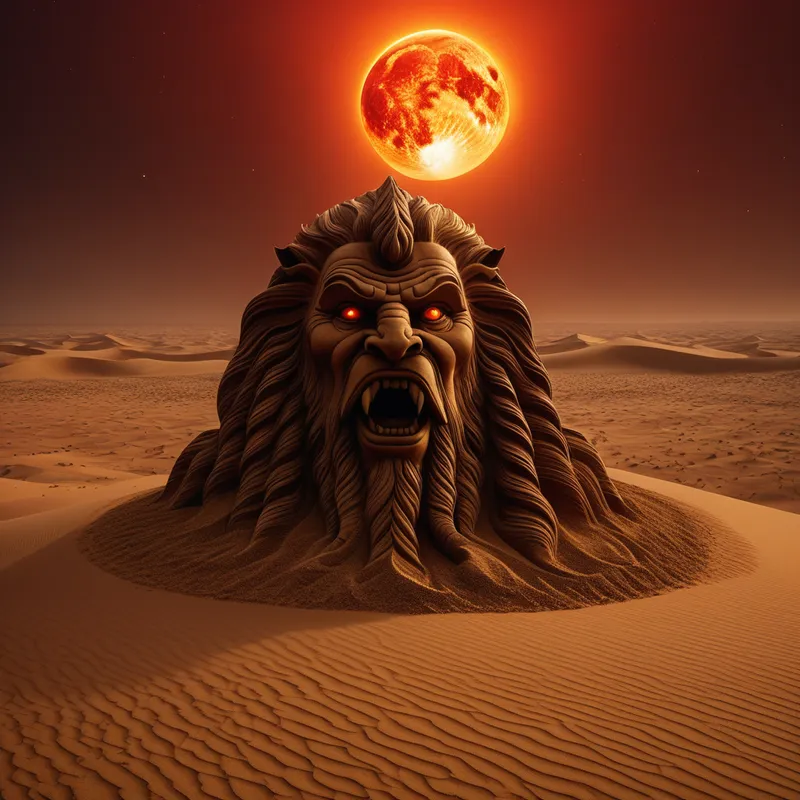
Simoom Myth Meaning & Symbolism
A myth of the scorching desert wind, Simoom, embodying divine wrath, the unbearable truth, and the alchemical fire that purifies the soul.
The Tale of Simoom
Listen, and feel the air grow still. The sun, a merciless brass coin, hangs in a sky bleached of all mercy. This is the moment before the breath of Simoom is drawn. In the old times, they say it was not merely a wind, but the sigh of a betrayed god, or the last, furious exhalation of a desert that remembers when it was an ocean.
It begins with a silence so profound it rings in the ears. The scorpion ceases its scuttle, the viper coils deep. Then, a distant moan, as if the dunes themselves are grieving. The horizon shimmers, not with water, but with a wavering, amber haze. This is the veil of Simoom drawing near. It carries not the scent of rain, but of baked stone, of iron left too long in the sun, of a tomb opened after millennia.
The tales whisper of its origin in a time when humankind grew arrogant, when they believed their wells were bottomless and their tents could defy the sky. They forgot the covenant of the desert: humility or oblivion. In their pride, they poisoned an oasis sacred to the spirits of the land. And from the heart of that poisoned spring, from the collective wrath of the unseen ones, Simoom was born. It was not sent; it erupted.
It is described as a living wall—not of air, but of finely-ground earth and searing heat, moving with a deliberate, hungry speed. It does not howl; it roars with a low, furnace-like thunder. To be caught in it is to be scoured. The sand finds every seam, every eyelash, every breath. The heat is not of the sun, but from within the very particles of the storm, a dry fire that seeks to evaporate the soul itself. Men and beasts are found afterward, not slain, but desiccated, reduced to statues of dust and despair, their final postures frozen in a futile search for shelter that does not exist.
But the oldest stories, those told in whispers when the stars are sharp as daggers, say Simoom has a purpose beyond punishment. It is the great eraser, the resetter of balances. Where it passes, it burns away the false, the corrupt, the overgrown. It clears the slate of the land with terrifying finality. And in the absolute void it leaves behind—a silence even deeper than before its coming—there lies a terrible, pristine potential. The myth ends not with a hero’s triumph, but with the desert holding its breath, waiting to see what, if anything, will be brave enough, or pure enough, to grow in the cleansed and scorched earth.
Cultural Origins & Context
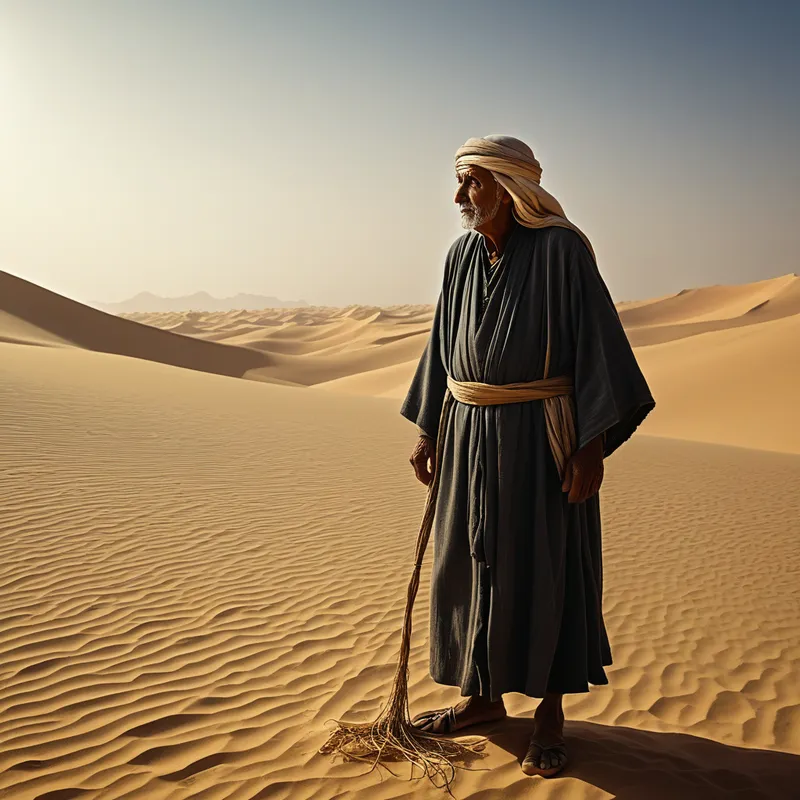
The myth of Simoom is not the stuff of royal courts or temple scrolls, but of the Bedouin and the traders who traversed the empty quarters. It is an oral cartography of danger, a story etched into collective memory by experience. Passed down in tents under vast night skies, its primary function was starkly practical: to encode a lethal meteorological phenomenon into a narrative of moral and spiritual consequence.
By personifying the wind as a conscious, wrathful force, the story enforced a crucial cultural code. It taught respect for the absolute power of the natural world, a humility essential for survival. The desert was not a passive landscape but an active, sentient entity with which one had to negotiate. Simoom was its most extreme voice. Storytellers, often elders who had seen its aftermath, used the tale to explain sudden, mass deaths on caravan routes and to instill the vital behaviors of reading the sky’s subtle warnings and knowing when to seek the scant, true shelter.
Furthermore, it served a profound psychological function for people living perpetually on the edge of existential threat. Giving a name and a story to a random, annihilating force is a way to reclaim a sliver of cognitive control. If Simoom was a punishment, then its arrival was not mere chance; it was a consequence. This framework, while severe, offered a universe that was ultimately intelligible, where catastrophe had a cause, often rooted in human transgression against natural or divine law.
Symbolic Architecture
Psychologically, Simoom represents the unbearable truth, the psychic content that is too hot, too abrasive, and too total to be integrated through gentle means. It is not a simple shadow figure, but the environmental shadow—the entire climate of the unconscious rising up to annihilate a consciousness that has become too rigid, too arrogant, or too false.
The wind that scours the desert clean is the same force that burns away the ego’s comforting illusions. There is no growth without the terrifying passage of that fire.
The desert setting is the psyche in a state of arid stagnation, where life (feeling, adaptation) has been suppressed by a dominant, one-sided attitude (the “pride” of the myth). The poisoned oasis symbolizes a corrupted source of life—perhaps a damaged instinct, a polluted emotion, or a spirituality turned dogmatic. Simoom, then, is the inevitable, violent reaction of the Self against this corruption. It is nature’s (and the psyche’s) non-negotiable reset button.
Its mode of action is symbolic alchemy: calcinatio, the burning down to a dry, white ash. This is not a nurturing fire, but a reducing, purifying one. It aims not to destroy the soul, but to destroy everything that is not the soul—the pretensions, the false identities, the toxic complexes. The horrific “statues of dust” left in its wake are images of a psyche that has identified wholly with its persona and could not withstand the encounter with the raw, archetypal force of truth.

The Dreamer’s Resonance
When the pattern of Simoom manifests in modern dreams, it rarely appears as a literal desert storm. Its signature is felt in the somatic and emotional atmosphere. The dreamer may experience:
- Dreams of Overwhelming, Dry Heat: Feeling trapped in an oven-like room, or a landscape where the air itself burns to breathe.
- Dreams of Abrasive Winds or Sands: Being pelted by particles that sting and scour, or trying to move through a relentless, buffeting force that erodes one’s sense of self.
- Dreams of Absolute Desiccation: Witnessing plants, people, or familiar objects wither instantly to dust, or feeling one’s own body cracking and drying out.
Psychologically, this signals a process of intense, involuntary purification. The ego is undergoing a “scorching.” This often occurs when a long-held self-image, belief system, or life structure has become unsustainable and is being forcibly dismantled by the unconscious. The dreamer is in the storm. The process is one of endurance, not understanding. The somatic feeling is key: it is the body-mind experiencing the “heat” of repressed truth and the “abrasion” of outworn patterns being stripped away. It is a profoundly uncomfortable, often frightening, initiation into a more authentic state of being.
Alchemical Translation
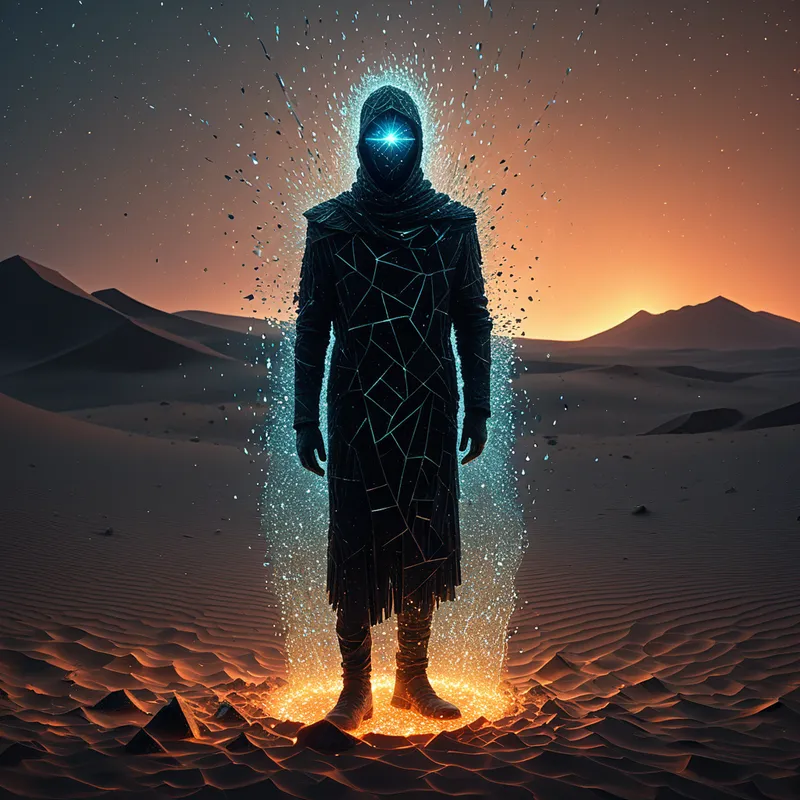
The individuation journey modeled by Simoom is the most severe and direct: the path of the phoenix through calcination. For the modern individual, the myth maps the process not of gradual growth, but of catastrophic, necessary breakdown.
The first stage is the Poisoned Oasis—the comfortable, yet corrupt, status quo. This could be a career that pays well but kills the spirit, a relationship built on silent lies, or an identity founded on others’ expectations. It sustains life, but poorly, and at great cost to the soul.
The rising silence and the moaning wind represent the Gathering Truth—the dawning, unbearable awareness that this cannot continue. The ego senses the approach of a psychic reality it has long denied.
The storm does not ask for permission to cleanse. It announces itself with the silence of a verdict already passed.
Then comes the Encounter with Simoom itself—the crisis. This is the loss of the job, the collapse of the relationship, the depressive episode, the sudden illness. It feels annihilating. The ego’s task here is not to fight, but to submit to the scouring. The goal is survival, not victory. One must find the inner “rock” to cling to—the bare, essential core of the Self that remains when all else is stripped.
The final, crucial stage is the Scorched Earth. This is the aftermath, often mistaken for mere devastation. It is a state of psychic numbness, emptiness, and profound exhaustion. Yet, this is the alchemical albedo, the whitened state. The old complexity is gone. Here, in the terrible clarity of the void, the individual has a choice: to lament the loss, or to recognize the pristine potential of the cleared ground. From this absolute zero, the most authentic life, built on the bedrock of a truth earned through fire, can slowly, cautiously, begin to grow. The myth of Simoom teaches that some renewals are only possible after a total, mercifully ruthless, end.
Associated Symbols
Explore related symbols from the CaleaDream lexicon: