Silk robes of the immortals Myth Meaning & Symbolism
A celestial artisan weaves robes of fate for the Jade Emperor, a myth of divine craft, cosmic order, and the luminous garment of the perfected self.
The Tale of Silk robes of the immortals
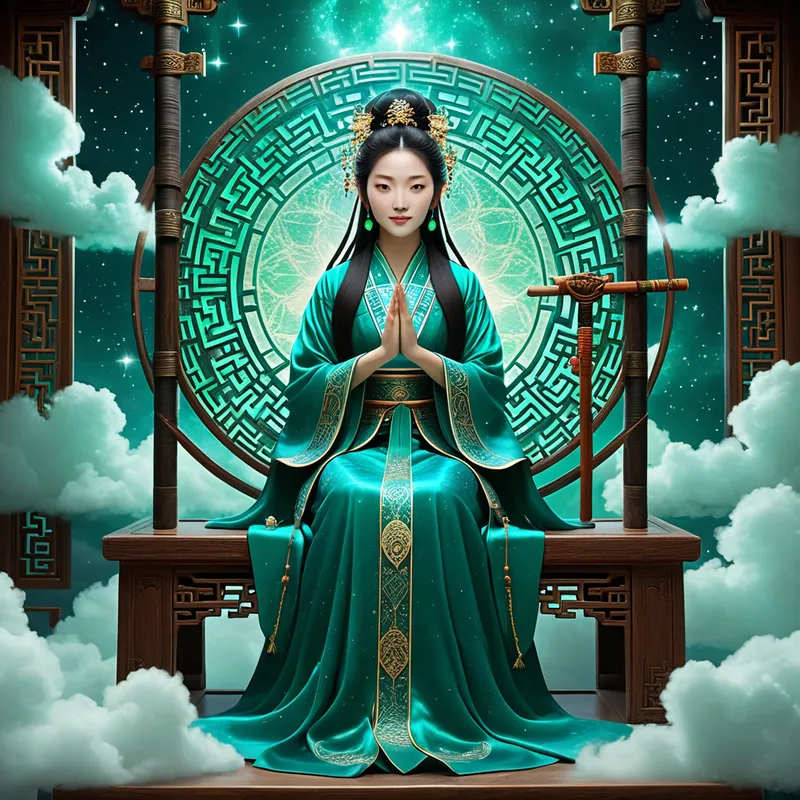
Listen, and let your spirit ascend to the Ninth Heaven. Here, where time is measured in the breath of dragons and the turning of star-chariots, there exists a silence so profound it is the loom upon which creation is woven. In a pavilion suspended between the Taiyang and the Taiyin, where clouds are not vapor but the raw silk of the cosmos, sits the Weaving Maiden.
She is not merely a maiden, but a sovereign of subtlety. Her fingers are not flesh and bone, but the concentrated will of Li. Her eyes hold the patient depth of still, star-reflecting pools. Before her stretches not a simple frame, but the Tian Ji, the Heavenly Loom. Its beams are polished jade, humming with a quiet celestial frequency. The warp threads are strands of destiny, pulled taut from the spindle of the Purple Forbidden Enclosure.
Her task, decreed by the Jade Emperor himself, is one of impossible perfection: to weave the Robes of the Immortals. These are not garments for warmth or modesty. They are the visible manifestation of a being’s harmony with the <abbr title=“The “Way,” the fundamental principle underlying the natural order”>Dao. Each robe must contain the pattern of a perfected life—the balance of Yin and Yang, the flow of the Five Phases, the orderly dance of constellations.
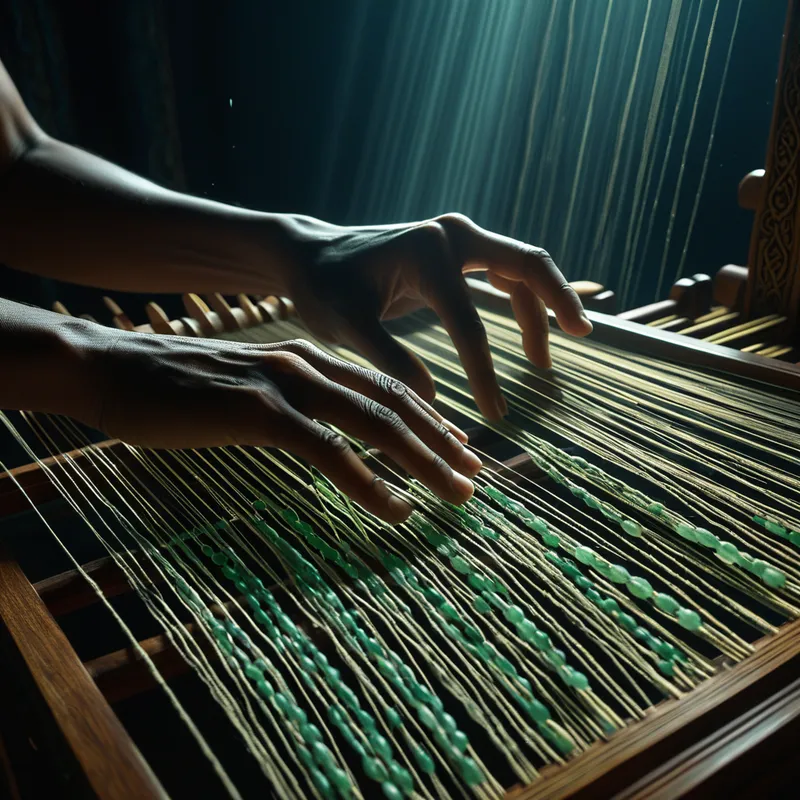
The conflict is not one of monsters or battles, but of sublime pressure. A single thread out of alignment, a hue of compassion too pale, a strand of integrity too coarse, and the robe would be a lie. It would clothe not an immortal, but a pretender to the celestial courts. The rising action is the agonizing slowness of true creation. She plucks the rosy hue of dawn’s first light for benevolence. She spins the unyielding strength of mountain roots for virtue. She intertwines the fluid grace of a calligrapher’s ink stroke for wisdom. The shuttle, carved from a moonbeam, flies back and forth, its sound the whisper of planets in their orbits.
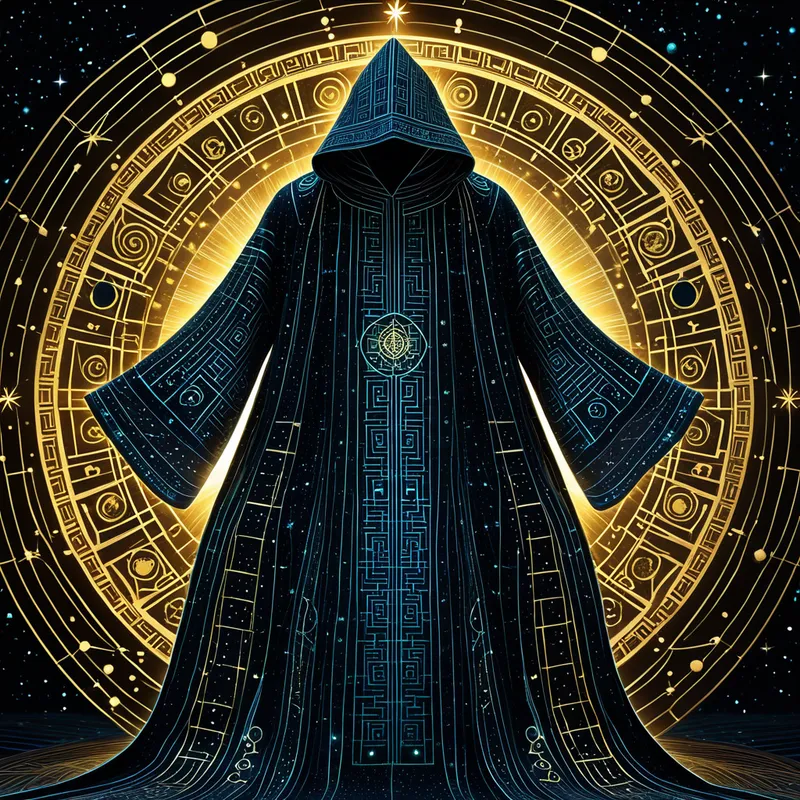
The resolution arrives not with a fanfare, but with a settling. The final thread, a filament of pure starlight representing the spark of individual consciousness within universal order, is woven in. The completed robe lies upon the loom. It has no weight, yet it contains the gravity of a moral universe. It shimmers with a soft, internal luminescence, its patterns alive and slowly shifting like clouds in a tranquil sky. To don it is not to wear clothing, but to be wrapped in one’s own achieved destiny, a second skin of luminous order. The Weaving Maiden does not smile, for her work is endless, but in her eyes, the stars seem to burn a little brighter, reflected in the perfect creation born of her boundless patience and sacred craft.
Cultural Origins & Context
The motif of the celestial robe or garment is woven deeply into the fabric of Chinese spiritual and literary tradition, appearing in Daoist texts, folktales, and poetry. While no single, canonical “Silk Robes of the Immortals” myth exists as a standalone epic, the concept is a pervasive archetype. It finds one of its most famous expressions in the related story of the Zhinü and the Niulang, where a fairy’s feathered or silken robe is stolen, grounding her in the mortal world.
This mythic idea served multiple societal functions. For the imperial court, it reinforced the concept of the Mandate of Heaven; the emperor’s dragon robes were earthly echoes of these celestial garments, symbolizing his role as the nexus between heaven and earth. In Daoism, the robe became a potent symbol of the adept’s progress. Through alchemical practices, meditation, and ethical living, one was said to “weave” a “body of light” or a “rainbow body”—an immortal, luminous form that was the ultimate spiritual attire. The myth was passed down not just as a story, but as an implicit model of refinement, order, and the transformation of base existence into something transcendent through disciplined, sacred effort.
Symbolic Architecture
At its core, the myth is a profound allegory for the creation of the integrated Self. The Weaving Maiden represents the conscious, ordering principle of the psyche—the ego in its highest, most devoted function. She is not the source of the threads (which come from the cosmos, the unconscious, and fate), but the artist who integrates them into a meaningful whole.
The Heavenly Loom is the structured framework of reality itself—the laws of nature, society, and morality within which individual life must be fashioned. The silk threads are the raw materials of a life: innate temperament (xing), acquired experiences, virtues cultivated, and flaws endured. The immortal for whom the robe is destined is the potential, perfected Self, the Self archetype awaiting its realization.
The robe is not given; it is earned through the meticulous, lifetime labor of weaving disparate threads of experience into a garment of coherent meaning.
The act of weaving symbolizes the psychological process of individuation: the conscious effort to bring order to the chaos of impulses, complexes, and archetypal forces. A tangled thread represents a neurosis; a broken thread, a trauma; a brilliantly colored thread, a moment of insight or love. The completed, luminous robe symbolizes the ultimate goal: a personality so harmoniously integrated that it becomes a transparent vessel for the transcendent, a “body of light” that is both uniquely individual and in perfect accord with the cosmic pattern.
The Dreamer’s Resonance
When this mythic pattern surfaces in modern dreams, it often signals a profound phase of self-creation or re-creation. To dream of weaving, especially of a garment or tapestry, points to an active, often somatically felt, process of integrating life’s fragments. The dreamer may feel they are “making something of themselves” after a period of dissolution or chaos.
Conversely, dreaming of a torn, unfinished, or impossibly tangled robe or loom speaks to a crisis of identity. It is the psyche’s depiction of feeling unraveled, of being unable to find a coherent narrative for one’s life. The somatic sensation may be one of literal constriction (if the dreamed garment is too tight) or exposure (if it is threadbare). Dreaming of receiving a finished, magnificent robe from a wise figure can symbolize the emergence of a new, more authentic sense of self, gifted from the depths of the unconscious. It is a dream of legitimacy and wholeness, where the dreamer feels clothed in their own truth.
Alchemical Translation
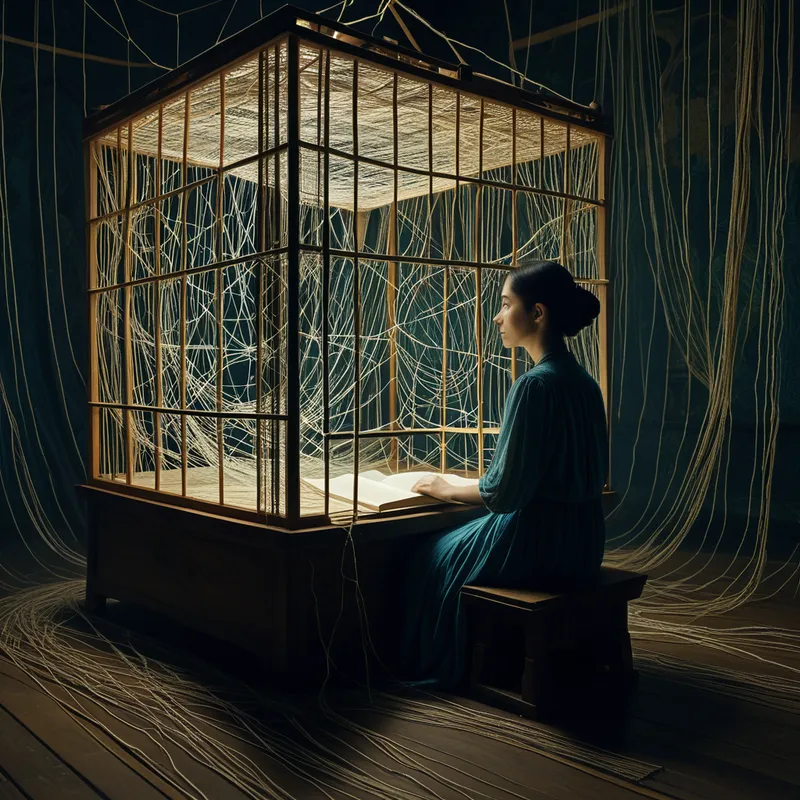
The myth provides a precise model for psychic transmutation. The “base metal” of our unexamined life—a jumble of inherited patterns, unconscious reactions, and fragmented desires—is the raw silk. The alchemical vas or vessel is the Heavenly Loom of disciplined attention. The Weaving Maiden is the observing, persevering consciousness that commits to the work.
The first stage (nigredo) is confronting the tangled skein: acknowledging one’s shadows, contradictions, and broken threads. The second (albedo) is the careful sorting and cleaning: understanding origins, refining emotions, clarifying values. The third (citrinitas) is the beginning of the true weave: actively connecting insights, building new habits, forging conscious relationships between different parts of the self.
The final golden robe (rubedo) is not a state of flawless static being, but a dynamic, living pattern where light and shadow, strength and vulnerability, individual will and universal flow are woven into a resilient, luminous whole.
For the modern individual, the “Silk Robes of the Immortals” is not a promise of literal ascension to heaven. It is a map for achieving a psychological state of immortality—not as endless duration, but as a quality of being. It is the creation of a self so authentic, so harmoniously ordered from within, that it becomes a stable, radiant center amidst the transience of the world. We are all, in our own earthly pavilions, weavers at the loom. The myth asks us: What threads are you choosing? And what manner of garment, ragged or radiant, are you weaving with the shuttle of your days?
Associated Symbols
Explore related symbols from the CaleaDream lexicon: