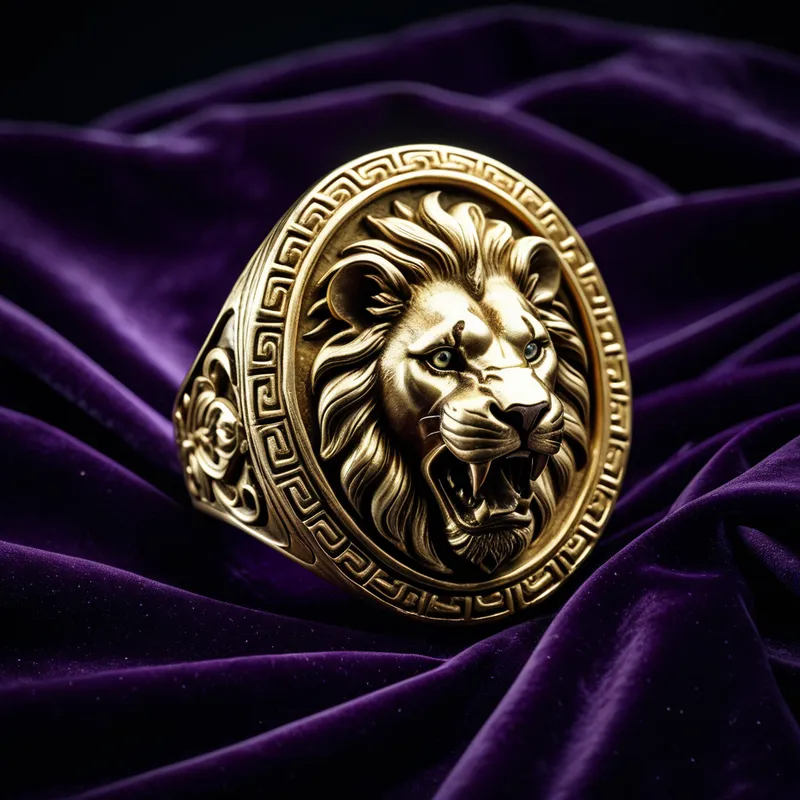
Signet Ring of the King Myth Meaning & Symbolism
A tale of a royal ring, lost and restored, symbolizing the divine authority entrusted to and reclaimed within the human soul.
The Tale of the Signet Ring of the King
Hear now a tale not of swords and shields, but of wax and gold, of a whisper that toppled a kingdom. In the days when the sun beat hot upon the palace at Shushan, there ruled a king, Ahasuerus, whose word was law and whose nod could raise a man to the heavens or cast him into the pit. His power was absolute, a river of command flowing from the throne. Yet, even a king’s will needs a hand to shape it, and a voice to proclaim it.
That hand was the signet ring. It was not mere jewelry, but the very engine of empire. Forged of the heaviest gold, its face bore the king’s own seal—a lion rampant, perhaps, or a chariot of the sun. To press this ring into soft clay or warm wax was to make the king present. The mark it left was his voice made solid, his will made immutable. It could command armies, seal treaties, or sign a death warrant. The ring was the king, and the king was the ring.
But power, like a shadow, draws those who would wield it in secret. Enter Haman, whose heart was a nest of vipers and whose pride was a mountain that scraped the sky. He coveted the authority that flowed from the throne, not to serve, but to devour. With honeyed lies and poisoned counsel, he wove a net of deceit so fine it was invisible. He spoke of a people scattered, a people different, a people who did not bow. And the king, in a moment of unthinking trust, listened. In a gesture of catastrophic delegation, the king slid the heavy ring from his own finger. The cold gold passed from sovereign to servant. “The silver is given to you,” the king said to Haman, regarding the people he condemned, “do with them as seems good to you.”
The ring was now in the hand of hatred. With a triumphant, cruel smile, Haman pressed the royal seal onto scrolls of doom. Messengers raced to every province, bearing the king’s own mark, ordering destruction. The empire held its breath. The seal was set; the law of the Medes and Persians could not be revoked.
Yet in the shadows of the harem and the halls of memory, another story stirred. Esther, the hidden queen, her heart a drum of terror, knew the ring’s mark meant the end of her people. She faced a choice: to remain silent in safety, or to speak and risk the ring’s wrath—the wrath she now knew was Haman’s. She chose to speak. In a night of feasting and dread, the truth was unveiled. Haman’s conspiracy lay bare before the throne he sought to manipulate.
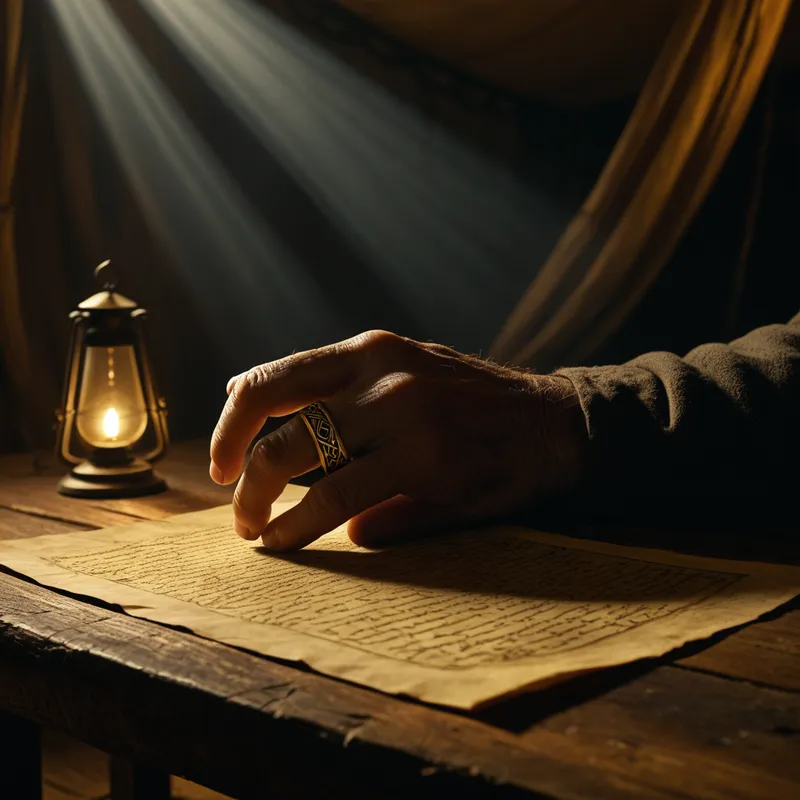
And then, the moment of cosmic reversal. The king’s fury burned. Haman fell from the heights he built for himself. And the ring—the terrible, potent ring—was taken back. It was pried from the dead man’s grasp or lifted from his silent chamber. The king held it again, this symbol of his own misused authority. He turned to Mordecai, the faithful scribe, the man who had once saved his life. “You have my ring,” the king declared. The weight of the kingdom changed hands once more, this time from hatred to righteousness. Mordecai pressed that same seal onto new scrolls, granting the condemned people the right to defend themselves. The seal that doomed now delivered. The ring had come home.
Cultural Origins & Context
This narrative is embedded in the Book of Esther, a unique text within the Biblical canon for its lack of explicit mention of God. It is a diaspora story, set in the Persian court, reflecting the lived reality of a minority community navigating the absolute, often capricious, power of a foreign empire. The story was likely told and preserved to explain the origins of the Purim festival. Its societal function was profound: it was a myth of survival. It taught that divine providence could work through hidden channels—through beauty, courage, wisdom, and timely action—even when the machinery of state power was arrayed against you. The signet ring was the ultimate symbol of that state power, a tangible reminder that in this world, law and decree held terrifying sway. The story’s power lies in the subversion of that very symbol, showing that authority, even the king’s, could be reclaimed and redirected for salvation.
Symbolic Architecture
The signet ring is the myth’s central symbol, an object dense with meaning. It is far more than a tool; it is a metaphysical concept made manifest.
The ring is the point where the infinite will of the sovereign meets the finite material of the world, leaving an indelible impression.
First, it symbolizes delegated authority. The king cannot be everywhere, so he extends his agency through the ring. Psychologically, this represents the parts of our own sovereign Self—our will, our voice, our creative power—that we delegate, often unconsciously. We hand our “ring” to inner figures: to the critical parent (our inner Haman), to the people-pleaser, to the fearful child. These sub-personalities then issue “decrees” in our name, shaping our lives with limitations and self-condemnation.
Second, it represents irrevocable identity. The seal cannot be undone. This speaks to the Jungian concept of the Self—the total, integrated personality that is our ultimate, authentic identity. Our true name, our divine stamp, is irrevocable. It may be buried, misused, or forgotten, but it cannot be annulled. The struggle is to reclaim the seal from the usurpers and affirm our true decree.
Finally, it embodies the power of the word made manifest. The seal transforms thought (the king’s decree) into reality (a law). In the psyche, this mirrors how our core beliefs and self-concepts, once “sealed” in our unconscious, create the reality of our lived experience. To change our life, we must first reclaim the seal and change the decree.

The Dreamer's Resonance
When the symbol of the king’s signet ring surfaces in modern dreams, it signals a critical moment in the dreamer’s relationship with their own authority and authenticity. The dream may present the ring as lost, stolen, found, or being used by someone else.
To dream of losing the ring often correlates with a somatic feeling of powerlessness, a “knot in the stomach” or a hollow chest. Psychologically, it indicates a period where the dreamer feels their life is being dictated by external forces or internalized critics—they have handed their agency away. To dream of finding or receiving the ring may come with a somatic sense of weight, solidity, or warmth in the hands. This marks the beginning of reclaiming projecti on, taking back the power one has lodged in a job, a relationship, or a self-image. A dream where another person uses the ring destructively is a stark portrayal of the “inner usurper”—perhaps a pattern of self-sabotage or a harsh inner judge that has been authorized to run one’s life. The dreamwork involves identifying who, in one’s waking life, that dream figure represents, and more importantly, what disowned part of oneself it symbolizes.
Alchemical Translation
The myth’s arc is a perfect map for the alchemical process of individuation, the psychic transmutation of leaden unconsciousness into golden Self-awareness.
The initial state is nigredo, the blackening. The king (the conscious ego) is disassociated, feasting and ruling in a state of naive inflation. He casually delegates his core power (the ring) to the shadow (Haman). This is the universal human condition: we are born whole, but we split off our power, our anger, our creativity, and hand it to complexes that then rule us from within.
The crisis is the mortificatio, the death. The sealed decree brings the shadow’s destructive plan into reality, threatening total annihilation (of the people, symbolizing the vital, authentic parts of the psyche). This painful confrontation is necessary. It forces the hidden Self (Esther) to emerge from seclusion and risk everything by speaking truth to power.
The reclaiming of the ring is the albedo, the whitening—not a battle, but a separation. The shadow is seen for what it is and falls by its own mechanism. The ring is simply taken back.
Finally, the rubedo, the reddening, is the glorious restoration. The same ring, the same seal, is now in the hand of the integrated servant (Mordecai). The decree is reversed. What was meant for destruction now becomes the basis for defense, celebration, and life. The psyche’s authority is no longer used against itself, but to protect and empower its own totality. The festival of Purim, with its masks and revelry, symbolizes the joy of this liberation—the Self, once hidden and threatened, now openly celebrated. The ring is finally worn by the rightful ruler within.
Associated Symbols
Explore related symbols from the CaleaDream lexicon: