Showbread Myth Meaning & Symbolism
The sacred bread placed perpetually before God, a tangible covenant of divine presence and sustenance, consumed only by the priests in holiness.
The Tale of Showbread
In the heart of the desert, where the sun bleaches bone and the wind whispers secrets of sand, there stood a tent unlike any other. It was the Mishkan, the Dwelling Place, and within its outermost court, the smell of sacrifice hung heavy in the air. But beyond the bronze altar, behind a woven screen of blue, purple, and scarlet, lay the Holy Place. Here, the air was still, thick with the scent of frankincense and the silence of awe.
Golden light, not from the sun but from a seven-branched lampstand of pure gold, washed over three sacred objects. There was the altar of incense, its smoke a perpetual prayer. There was the Menorah, its flames dancing like captured stars. And there, against the northern wall, stood a table. Not a table for feasting, but a table of pure gold, a table of Lechem HaPanim.
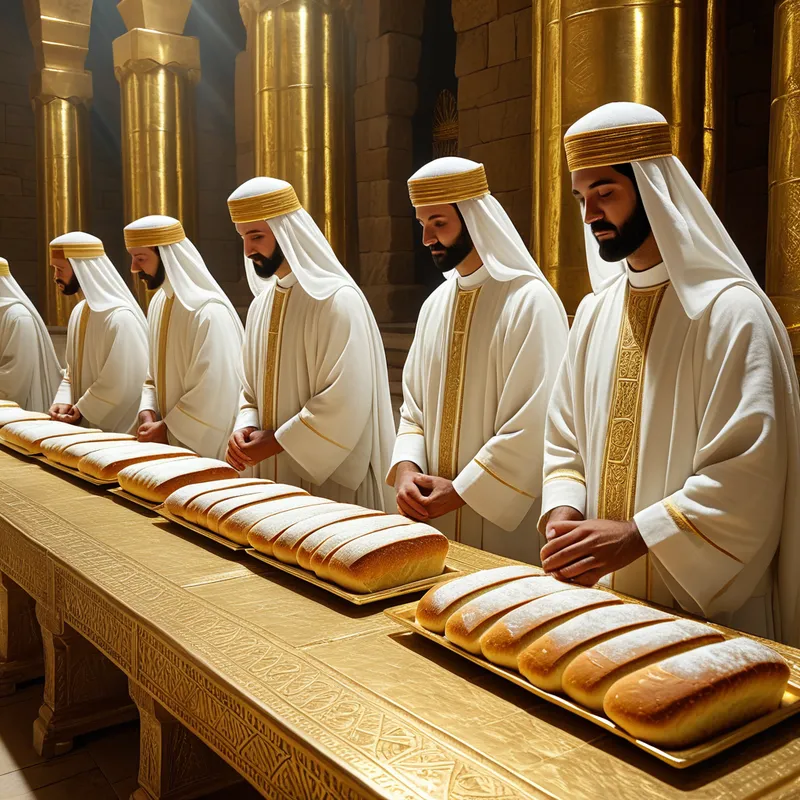
Each Shabbat, as the sun began its descent, a solemn ritual unfolded. The priests, their bodies washed, clothed in simple linen, entered the sacred gloom. With utmost care, they would remove twelve loaves, baked from the finest flour, now a week old. The loaves were arranged in two rows, six upon six, upon the bare gold of the table. Beside each row, a vessel of pure frankincense was placed, like a sentinel of sweet scent.
These were not mere offerings to be consumed by fire. They were a presentation, a showing. “The Bread of the Presence,” it was called, for it was set Lifnei the Parokhet, the veil beyond which the Unnameable Presence dwelt. For six days, the bread lay there, a silent, tangible testament. It was a covenant of sustenance, a promise written in grain and fire: “I AM your provision. I AM here.”
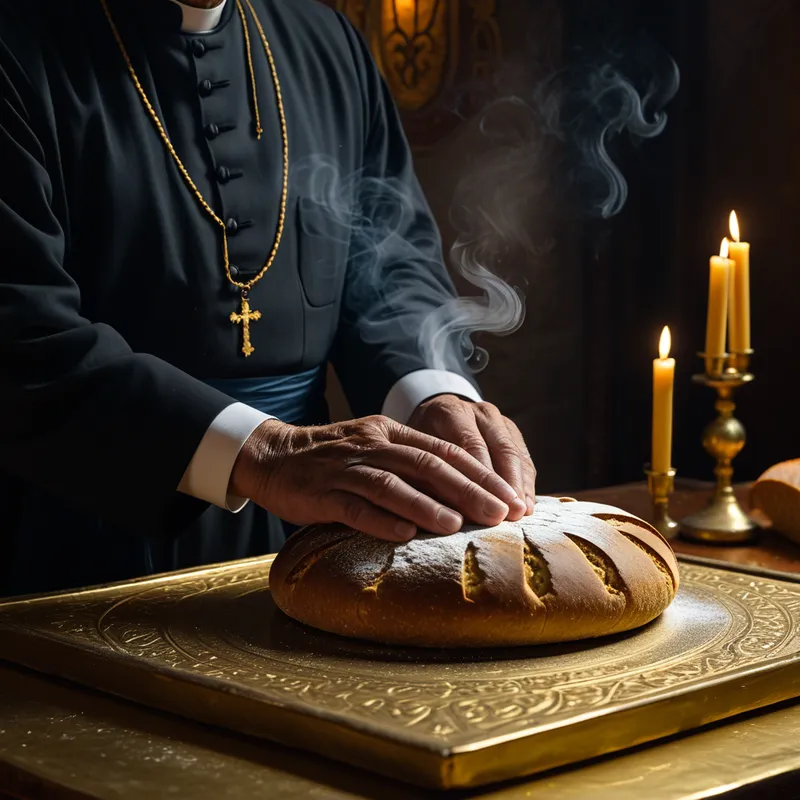
Then, on the Shabbat, the old bread was removed. But it was not discarded into the common dust. It became most holy. The priests, the sons of Aaron, would eat it within the sacred precincts. This was their portion, their sustenance for the holy service. In consuming the bread that had rested in the Divine Presence, they ingested the covenant itself. They became living vessels of the promise, their very bodies nourished by the symbol of God’s abiding care. The frankincense, meanwhile, was offered on the altar of incense, its smoke a final, fragrant ascent, completing the cycle of presentation and reception. And so, week after week, in the desert and later in the stone temple in Jerusalem, the bread was always there. Perpetual. A silent, edible prayer between heaven and earth.
Cultural Origins & Context
The mythos of the Showbread is rooted not in a narrative of gods and heroes, but in the intricate ritual law of the Torah. Its primary source is the priestly tradition, detailed in Exodus 25:30 and Leviticus 24:5-9. This was not a story told around a campfire, but a procedure meticulously recorded and transmitted by the Kohanim, the priestly caste. Its societal function was multifaceted. On a concrete level, it provided the priests’ food, tying their physical sustenance directly to their sacred office. More profoundly, it served as a constant, physical symbol of the Brit, the covenant. In an ancient Near Eastern context, to share a meal was to establish peace and fellowship. The Showbread, perpetually “before the face” of God and then consumed by His priests, enacted a continuous state of covenantal communion. It translated the abstract promise of divine care—“give us this day our daily bread”—into a tangible, ritual reality, reinforcing the cosmic and social order centered on the sanctuary.
Symbolic Architecture
The Showbread is a masterpiece of symbolic condensation. The twelve loaves represent the twelve tribes of Israel, the whole community perpetually held in the divine gaze. The bread itself, the staff of life, symbolizes God as the ultimate source of all sustenance—physical, spiritual, and communal.
The sacred is not only to be worshipped from afar; it is to be internalized, to become the very substance of one’s being.
The weekly cycle is crucial. The bread is presented fresh, rests for a week, and is then replaced. This speaks to the rhythm of time itself being sanctified, and to the concept that divine provision is constant but requires renewal and human participation (the baking, the placing). The frankincense represents prayer, suggesting that material sustenance must be coupled with spiritual aspiration to become truly holy. Most alchemical is the transformation of the bread’s status: from a “most holy” offering presented to God, it becomes “most holy” food for the priests. The divine presence does not consume it; it consecrates it, and that consecration is then transferred to those who serve at the threshold.
The Dreamer’s Resonance
To dream of showbread is to dream of sacred sustenance. The dreamer may find themselves in a liminal, temple-like space, observing or perhaps nervously handling a loaf that feels charged with significance. This often emerges when the psyche is grappling with questions of true nourishment. Are they feeding on that which is holy and sustaining, or on psychic “junk food”—empty accolades, toxic patterns, or superficial connections? The dream may point to a hunger for meaning, for a connection to something that feels perpetually present and reliable (the gold table). Alternatively, if the dreamer is illicitly eating the bread or finds it moldy, it may reflect anxiety about taking what is not rightly theirs (imposter syndrome) or a feeling that their spiritual or creative resources have become stale and need sacred renewal.
Alchemical Translation
The myth of the Showbread models the individuation process as the alchemy of internalizing the sacred. The “Holy Place” is the sanctified inner space of the psyche, the ego having passed beyond the “outer court” of persona and social demands. Here, the gold table is the conscious mind, prepared and ordered to receive the contents of the Self.
The work is to take the raw flour of daily experience, knead it with intention, bake it in the fire of attention, and place it before the inner divine presence.
The twelve loaves are the totality of our psychic components—complexes, talents, wounds—all presented for acknowledgment. We do not “eat” this totality raw; we let it rest in the presence of a higher, integrating principle (the Self). The “frankincense” is the attitude of reverence and reflection we bring to this process. The alchemical transmutation occurs in the weekly cycle: the old, now-consecrated “bread”—a pattern of understanding, a integrated complex—is finally internalized (“eaten”) to nourish the conscious personality in its ongoing service to the whole Self. The process is perpetual. There is no final loaf. Individuation, like the showbread ritual, is a rhythm of presentation, consecration, and nourishing ingestion, ensuring the ego is continually sustained by its dialogue with the depths.
Associated Symbols
Explore related symbols from the CaleaDream lexicon: