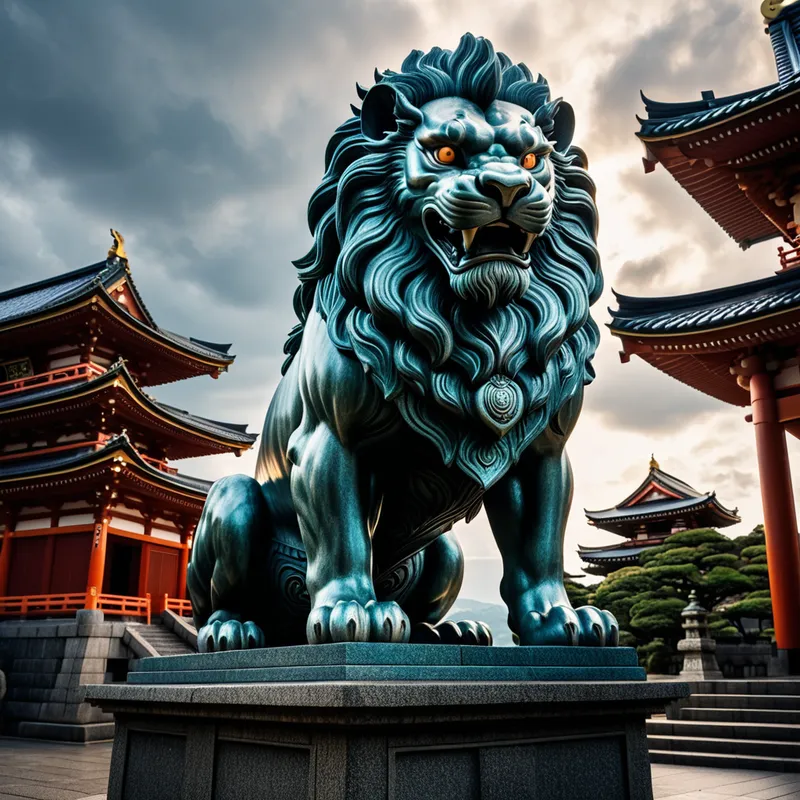
Shishi Myth Meaning & Symbolism
A mythic guardian, born of celestial fire, descends to tame earthly chaos, becoming the eternal protector at the threshold between worlds.
The Tale of Shishi
Listen, and hear the tale that is carved in stone and whispered by [the wind](/myths/the-wind “Myth from Various culture.”/) at the gate.
In the age when [the world](/myths/the-world “Myth from Tarot culture.”/) was still soft, when mountains breathed and rivers sang with voices of their own, a great disorder stirred. Not a war of men, but a deeper, wilder chaos. Malevolent spirits, the mononoke, slithered from shadowed places. They brought plague to the rice, madness to the dreams of the wise, and a creeping dread that stilled the laughter in the villages. The people’s prayers rose like smoke, a desperate plea woven into the incense that climbed towards the silent, star-dusted vault of heaven.
The celestial realms heard. And from the forge of the stars, from the breath of the kami, an answer was shaped. It was not born but kindled. A spark of pure, celestial will fell through the night, not as a meteor of destruction, but as a living ember. It landed not with a crash, but with a low, resonant hum that vibrated in the bones of [the earth](/myths/the-earth “Myth from Hindu culture.”/).
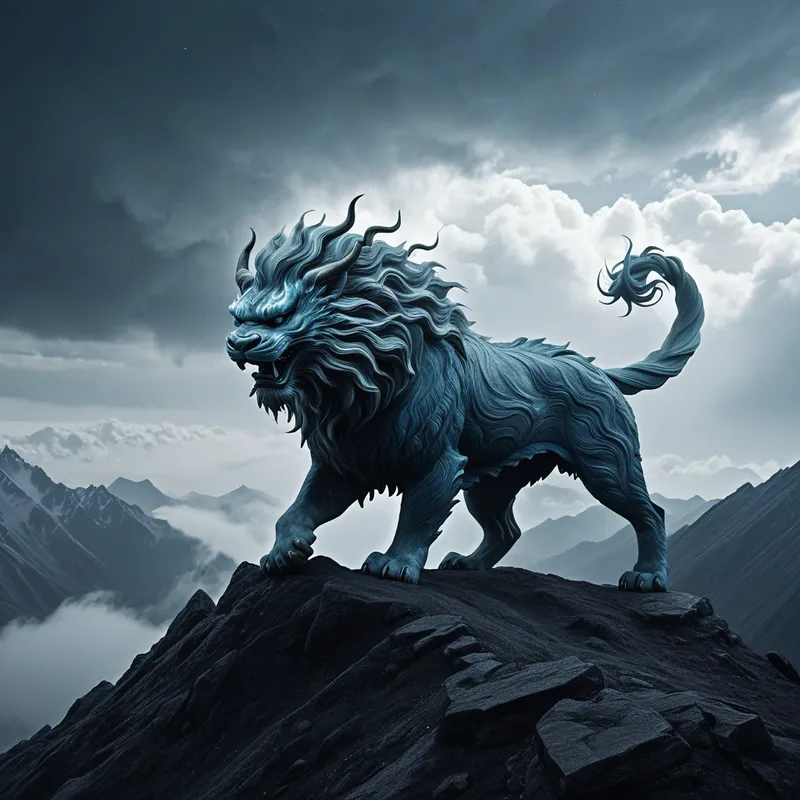
From that ember, form coalesced. It was a creature of magnificent paradox. It had the powerful, muscled body of the king of beasts, a lion of such grandeur it seemed carved from storm cloud and granite. Yet its head held the keen, intelligent grace of a loyal hound, with eyes that held the patience of centuries and the fire of immediate judgment. Its mane was not mere hair, but a rolling cascade of mystical flame and mist, shimmering with colors unseen on earth. This was the Shishi, the Lion-Dog.
It did not roar a challenge to [the sky](/myths/the-sky “Myth from Persian culture.”/). Instead, it placed one great paw upon the troubled land. Where it stepped, the chaotic energy stilled. It began to walk, a slow, deliberate patrol along the invisible borders between the human world and the world of unruly spirits. When it encountered a mononoke, the Shishi did not merely attack. It opened its jaws, and with a sound like a mountain sighing, it inhaled the malady, the chaos, the spiritual poison. The corruption was drawn into its celestial furnace of a being and utterly consumed, transmuted into harmless smoke that drifted from its nostrils.
Its journey was a weaving of order. It traced the boundaries of villages, the approaches to sacred mountains, the thresholds of soon-to-be-built temples. Finally, it came to a place of powerful convergence, a gateway between worlds. There, it settled. Its form softened, hardened, merged with the very stone of the land. It became twin sentinels—one with mouth open to swallow evil, the other with mouth closed to guard the good within. They became the eternal [komainu](/myths/komainu “Myth from Japanese culture.”/), the keepers of [the threshold](/myths/the-threshold “Myth from Folklore culture.”/). The chaos receded, not destroyed, but held at bay by a perpetual, vigilant presence. And so, the people learned: at the gate, between the known and the unknown, stands the guardian.
Cultural Origins & Context
The Shishi, and its paired form the komainu, entered the Japanese spiritual and artistic lexicon via the [Silk Road](/myths/silk-road “Myth from Chinese culture.”/), traveling from India through China and Korea. Originally a Buddhist symbol of protection for sacred law, it was seamlessly adopted into the native Shinto tradition, where guardianship of sacred space (shinboku) was already a profound concept. By the Nara period (710-794 CE), they were firmly established as fixtures at the entrances to temples, shrines, and eventually imperial and aristocratic residences.
Their stories were not codified in a single, canonical text but were woven into the oral teachings of Buddhist monks and Shinto priests, used to explain the powerful, silent figures that flanked the gates. Craftsmen—sculptors in wood and stone—were also myth-bearers, their chisels giving enduring form to the collective understanding of this protective force. Societally, the Shishi myth functioned as a narrative of spiritual security. It physically and psychologically marked the transition from the profane, everyday world (ke) to the sacred, purified space (hare), assuring the community that the realm within was guarded from spiritual pollution (kegare) and chaos.
Symbolic Architecture
The Shishi is a masterful [symbol](/symbols/symbol “Symbol: A symbol can represent an idea, concept, or belief, serving as a powerful tool for communication and understanding.”/) of controlled power. It is not a mindless [beast](/symbols/beast “Symbol: The beast often represents primal instincts, fears, and the shadow self in dreams. It symbolizes the untamed aspects of one’s personality that may need acknowledgment or integration.”/), but a conscious, intelligent force—the embodiment of the will to create and maintain order. Its composite [nature](/symbols/nature “Symbol: Nature symbolizes growth, connectivity, and the primal forces of existence.”/) is its first great teaching: it combines the raw, untamed power of the [lion](/symbols/lion “Symbol: The lion symbolizes strength, courage, and authority, often representing one’s inner power or identity.”/) (instinct, [strength](/symbols/strength “Symbol: ‘Strength’ symbolizes resilience, courage, and the ability to overcome challenges.”/), ferocity) with the loyalty, discernment, and domesticated service of the dog ([consciousness](/symbols/consciousness “Symbol: Consciousness represents the state of awareness and perception, encompassing thoughts, feelings, and experiences.”/), duty, [relationship](/symbols/relationship “Symbol: A representation of connections we have with others in our lives, often reflecting our emotional state.”/)). This represents the necessary [integration](/symbols/integration “Symbol: The process of unifying disparate parts of the self or experience into a cohesive whole, often representing psychological wholeness or resolution of internal conflict.”/) of our own [primal instincts](/symbols/primal-instincts “Symbol: Primal Instincts represent the basic drives and survival mechanisms inherent in every individual, harkening back to our animalistic nature.”/) into the service of a conscious [purpose](/symbols/purpose “Symbol: Purpose signifies direction, meaning, and intention in life, often reflecting personal ambitions and core values.”/).
The guardian does not eradicate the wild; it harnesses the wild to protect the sacred.
The act of inhaling evil is profoundly alchemical. The Shishi does not reject or fight the negative in a dualistic battle; it incorporates and transmutes it. This symbolizes the psychological process of integrating the [shadow](/symbols/shadow “Symbol: The ‘shadow’ embodies the unconscious, repressed aspects of the self and often represents fears or hidden emotions.”/)—taking the disowned, chaotic, or “evil” aspects of [the self](/myths/the-self “Myth from Jungian culture.”/) and, through the conscious container of the [psyche](/myths/psyche “Myth from Greek culture.”/), transforming their [energy](/symbols/energy “Symbol: Energy symbolizes vitality, motivation, and the drive that fuels actions and ambitions.”/) into something usable. The open-mouthed (A) and closed-mouthed (Un) pair represent the cosmic cycle of all things: beginning and end, inhalation and exhalation, the manifest and the potential, eternally in balance at the point of transition.
The Dreamer’s Resonance
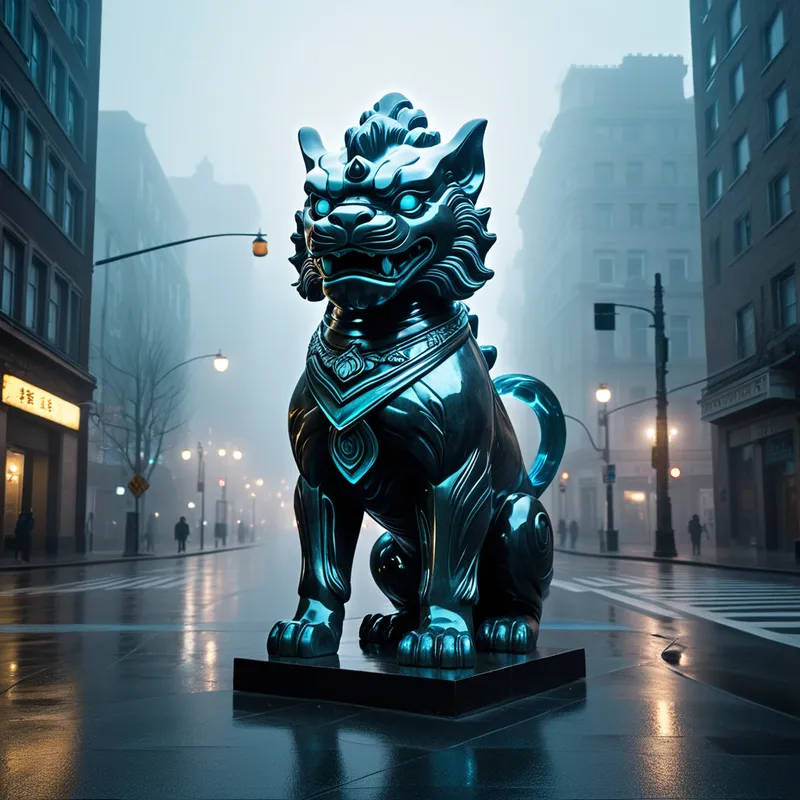
When the Shishi pads into the modern dreamscape, it often appears at a psychological threshold. Dreaming of a Shishi statue, especially one that feels alive or is situated at a doorway, bridge, or gate in the dream, signals that the dreamer’s psyche is actively engaged in a process of boundary-setting and self-protection.
The somatic feeling can be one of profound relief—a solid, immovable presence where there was once anxiety or vulnerability. Alternatively, if the dream Shishi is aggressive or blocks the dreamer’s path, it may reflect the psyche’s own overzealous defenses, perhaps an inner critic or a rigid [persona](/myths/persona “Myth from Greek culture.”/) that is protecting the self from necessary growth or experience. To dream of a Shishi in motion, patrolling, indicates an active, conscious engagement with ordering one’s internal world, confronting and “inhaling” chaotic emotions or intrusive thoughts to neutralize their power.
Alchemical Translation
The myth of the Shishi provides a potent model for the individuation process, specifically the stage of building a competent and resilient ego—the “guardian of the psyche.” The initial “descent of the celestial ember” mirrors the moment a conscious intention is born from the Self to address an inner state of chaos—be it addiction, emotional turmoil, or a life lacking direction.
The subsequent “patrol” is the hard, daily work of consciousness: mindfulness, therapy, discipline, the practice of observing one’s own chaotic impulses without being ruled by them. The alchemical act is not to pretend [the shadow](/myths/the-shadow “Myth from Jungian culture.”/) (the mononoke) does not exist, nor to expel it in a futile war of repression.
Individuation is not the construction of a flawless fortress, but the development of a vigilant, transmuting presence at the gates of the self.
We are to become our own Shishi. We learn to “inhale” our own anger, fear, or envy, not to be poisoned by it, but to hold it in the conscious container of our awareness—the “celestial furnace”—where its raw energy can be broken down and reconstituted as insight, creative fuel, or compassionate strength. The final “settling at the gate” as paired komainu represents the achievement of a stable, balanced psyche. The self is not a static, isolated entity, but a dynamic threshold. One aspect engages with the outer world (inhaling, processing), while the other guards the inner sanctum of values, spirit, and true identity. In this state, we are both protected and permeable, strong yet capable of transformation, eternally vigilant at the border where the self meets the world.
Associated Symbols
Explore related symbols from the CaleaDream lexicon: