
Shiprock Myth Meaning & Symbolism
A great bird-ship of stone, born from a people's desperate flight and a hero's final sacrifice, forever anchored in the red desert.
The Tale of Shiprock
Listen. [The wind](/myths/the-wind “Myth from Various culture.”/) does not just blow across the high desert; it remembers. It sings of a time when [the world](/myths/the-world “Myth from Tarot culture.”/) was soft, and the People were in flight. They were pursued, harried from their homes by other nations, driven into a land of red rock and little [water](/myths/water “Myth from Chinese culture.”/), a place of desolation and fear. Their hearts were heavy, their feet were sore, and [the horizon](/myths/the-horizon “Myth from Various culture.”/) offered no refuge.
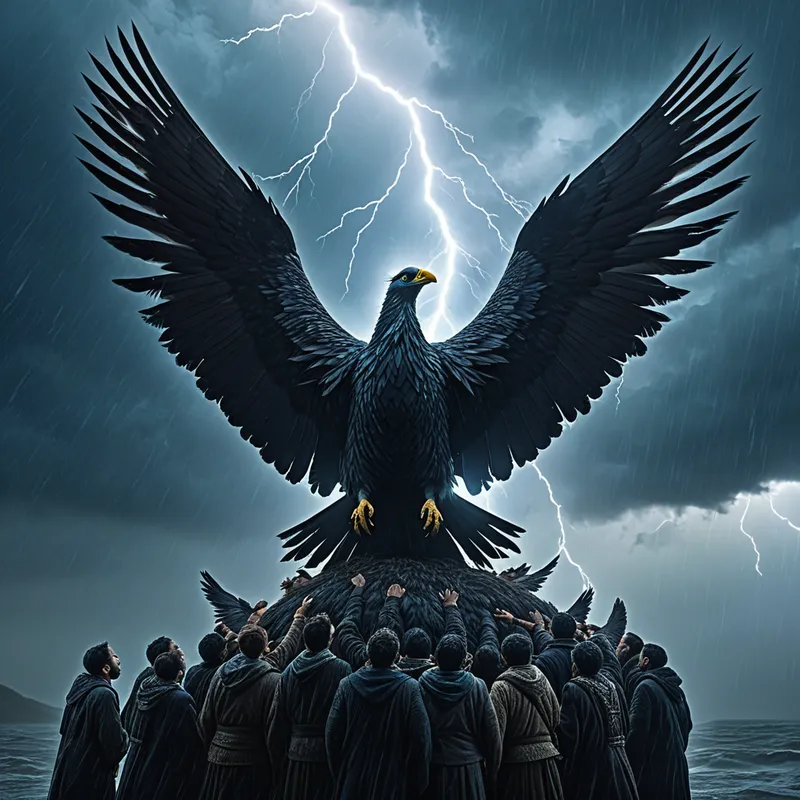
In their greatest moment of need, they called upon the holy ones. And [the earth](/myths/the-earth “Myth from Hindu culture.”/) heard them. Or perhaps [the sky](/myths/the-sky “Myth from Persian culture.”/) did. For from the sacred directions, a great power descended. It was not a beast of the land, nor a spirit of the water. It was Tse Bitʼaʼí, the Rock with Wings. It landed among them, a creature vast as a hill, its back broad and feathered not with soft down, but with the promise of salvation. It was a living ship, born of the union between the winged ones and the [stone people](/myths/stone-people “Myth from Native American culture.”/).
The People climbed upon its back, clutching its stony feathers. With a sound like thunder cracking the bedrock, the great bird-ship lifted. It did not fly as an eagle flies, but carried them across the terrible expanse, over canyons that gaped like hungry mouths, past mountains that reached to claw them down. They flew for a day and a night, the wind of their passage drying their tears. The bird-ship was their entire world—their deck, their shelter, their only hope against the swallowing desert below.
They flew until they saw it: a place of relative safety, a broad plain where they might make a stand, where they could see enemies coming from far away. And here, the great being spoke to them, not with words, but with a deep, resonant intention that vibrated in their bones. Its journey was complete. Its purpose, fulfilled.
And so, as the People stepped onto the solid, welcoming earth, giving thanks with every breath, the great bird-ship settled. Its wings, once vibrant with the power of flight, slowly stiffened. Its feathers fused, transforming into sharp, angular plates of stone. Its living warmth seeped into the ground, and the cool patience of the mountain entered its heart. Before their eyes, their savior petrified, becoming an immense, jagged sentinel—a fortress of rock that would never fly again, but would forever stand as a boundary and a beacon. It had carried them to safety, and in return, it became their eternal guardian, its silhouette against the sky a perpetual reminder of the voyage that brought them home.
Cultural Origins & Context
This is the story of Tse Bitʼaʼí, a central sacred narrative of the Diné, the Navajo people. The myth is intrinsically tied to the physical monolith of Shiprock, a volcanic plug rising nearly 1,600 feet from [the desert](/myths/the-desert “Myth from Biblical culture.”/) plain in present-day New Mexico. For the Diné, this is not a mere geological formation; it is a crystallized event, a chapter of their epic migration stories permanently written in stone.
The tale was and is passed down orally, often by Hataałii (medicine people) within the context of ceremonial knowledge and teachings. Its function is multifaceted: it is a sacred history explaining the origin of a major landmark, a moral lesson about sacrifice and providence, and a territorial marker defining the Navajo homeland. The story sanctifies the landscape, turning geography into theology. It teaches that the world is alive with intelligent, responsive forces that interact with human destiny, but always on terms that ultimately bind the people to that place, forever. Climbing Shiprock is strictly forbidden, as it is considered the petrified body of a holy being.
Symbolic Architecture
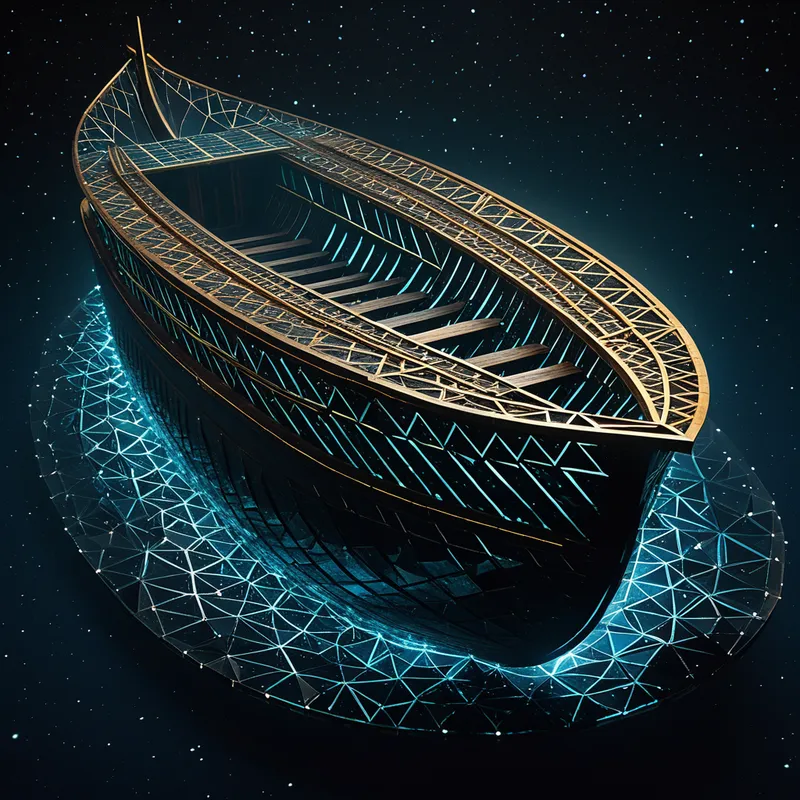
At its core, the myth of Shiprock is a profound [allegory](/symbols/allegory “Symbol: A narrative device where characters, events, or settings represent abstract ideas or moral qualities, conveying deeper meanings through symbolic storytelling.”/) of transition and the cost of sanctuary. The great [bird](/symbols/bird “Symbol: Birds symbolize freedom, perspective, and the connection between the earthly and spiritual realms, often representing the soul’s aspirations or personal growth.”/)-ship represents the archetypal [vessel](/symbols/vessel “Symbol: A container or structure that holds, transports, or protects something essential, representing the self, emotions, or life journey.”/)—a [motif](/symbols/motif “Symbol: A recurring thematic element, pattern, or design in artistic or musical works, representing underlying ideas or emotional currents.”/) found worldwide symbolizing the container that carries [consciousness](/symbols/consciousness “Symbol: Consciousness represents the state of awareness and perception, encompassing thoughts, feelings, and experiences.”/) (the people) through a [crisis](/symbols/crisis “Symbol: A crisis symbolizes turmoil, urgent challenges, and the need for immediate resolution or change.”/) (the hostile desert) from one state of being to another.
The vessel that saves you does not remain a vessel; it becomes the foundation of your new world. Salvation is not a delivery, but a transmutation.
The People are in a state of [the nigredo](/myths/the-nigredo “Myth from Alchemical culture.”/)—the chaotic, desperate [flight](/symbols/flight “Symbol: Flight symbolizes freedom, escape, and the pursuit of one’s aspirations, reflecting a desire to transcend limitations.”/). The bird-ship is the mediating principle, a miraculous intervention that is neither fully of the old land nor the new. Its ultimate transformation into [stone](/symbols/stone “Symbol: In dreams, a stone often symbolizes strength, stability, and permanence, but it may also represent emotional burdens or obstacles that need to be acknowledged and processed.”/) is the critical [symbol](/symbols/symbol “Symbol: A symbol can represent an idea, concept, or belief, serving as a powerful tool for communication and understanding.”/). The dynamic, mobile, saving power does not depart; it sacrifices its own [nature](/symbols/nature “Symbol: Nature symbolizes growth, connectivity, and the primal forces of existence.”/) and anchors itself. The flight (aspiration, escape) becomes the [mountain](/symbols/mountain “Symbol: Mountains often symbolize challenges, aspirations, and the journey toward self-discovery and enlightenment.”/) ([stability](/symbols/stability “Symbol: A state of firmness, balance, and resistance to change, often represented by solid objects, foundations, or steady tools.”/), [identity](/symbols/identity “Symbol: Identity represents the sense of self, encompassing personal beliefs, cultural background, and social roles.”/), [memory](/symbols/memory “Symbol: Memory symbolizes the past, lessons learned, and the narratives we construct about our identities.”/)). The myth beautifully inverts the expected: the [savior](/symbols/savior “Symbol: A figure representing rescue, redemption, or deliverance from crisis, often embodying hope and external intervention in times of need.”/) does not leave after the [rescue](/symbols/rescue “Symbol: The symbol of rescue embodies themes of salvation, support, and liberation from distressing circumstances.”/); it becomes the permanent, immutable feature of the rescued people’s [reality](/symbols/reality “Symbol: Reality signifies the state of existence and perception, often reflecting one’s understanding of truth and life experiences.”/), a constant reminder that their existence is founded upon a sacred sacrifice.
The Dreamer’s Resonance
When this myth stirs in the modern [psyche](/myths/psyche “Myth from Greek culture.”/), it often manifests in dreams of monumental, immovable structures that once possessed agency. To dream of a great ship beached and turning to stone, a colossal bird frozen mid-flight, or a fortress that you somehow know carried you there, is to touch the Shiprock archetype.
Somatically, this can feel like a profound grounding after a long period of instability—a deep, weary relief mixed with the eerie stillness of a concluded journey. Psychologically, the dreamer is processing a major life transition that has now solidified into a new, permanent reality. The frantic energy of the “flight” (a career change, a relational ending, a recovery) has ceased, and the new landscape of the psyche has been established. There may be a tinge of melancholy for the lost mobility of the saving force (a supportive friend who moved away, a therapist who concluded treatment, an inner resilience that has now become a rigid belief), but overwhelmingly, the resonance is one of achieved sanctuary. The struggle is over; you have arrived. The task now is to learn to live in the lee of the mountain that was your ship.

Alchemical Translation
For the individual on the path of individuation, the Shiprock myth models the final stage of a profound psychic transmutation. The process begins with the [nigredo](/myths/nigredo “Myth from Alchemical culture.”/): a crisis that forces [the ego](/myths/the-ego “Myth from Jungian culture.”/) into flight, away from entrenched but untenable positions. The bird-ship represents the emergent symbol from the unconscious—a brilliant, synthesizing image or insight (the unifying symbol) that appears to carry us through the chaos.
The alchemical miracle, however, is not the flight itself, but the petrification.
The true work is not in being rescued by insight, but in allowing that insight to become the bedrock of your character.
This is the albedo and [rubedo](/myths/rubedo “Myth from Alchemical culture.”/) combined. The luminous, saving idea (the bird) must lose its separateness and be sacrificed to the earth of daily life. It must become structure, habit, unwavering principle—the “stone” of one’s renewed being. The dynamic rescue fantasy solidifies into enduring ethical stance. The therapist’s words become your own inner voice. The spiritual epiphany becomes a daily practice. The love that saved you becomes the foundation of your home.
The myth warns that to cling to the bird, to wish for perpetual rescue flight, is to reject the gift. The completion of the journey is the death of [the vessel](/myths/the-vessel “Myth from Alchemical culture.”/) and its rebirth as the mountain. The modern individual’s [triumph](/myths/triumph “Myth from Roman culture.”/) is to look upon the solidified, seemingly inert forms in their life—their values, their commitments, their healed wounds—and see within them the fossilized wings of their own deliverance.
Associated Symbols
Explore related symbols from the CaleaDream lexicon: