Shamash the Sun God Myth Meaning & Symbolism
The myth of Shamash, the all-seeing Babylonian Sun God, whose daily journey across the sky dispels darkness and illuminates the path to justice and truth.
The Tale of Shamash the Sun God
Hark, and listen to the journey that brings the world to life.
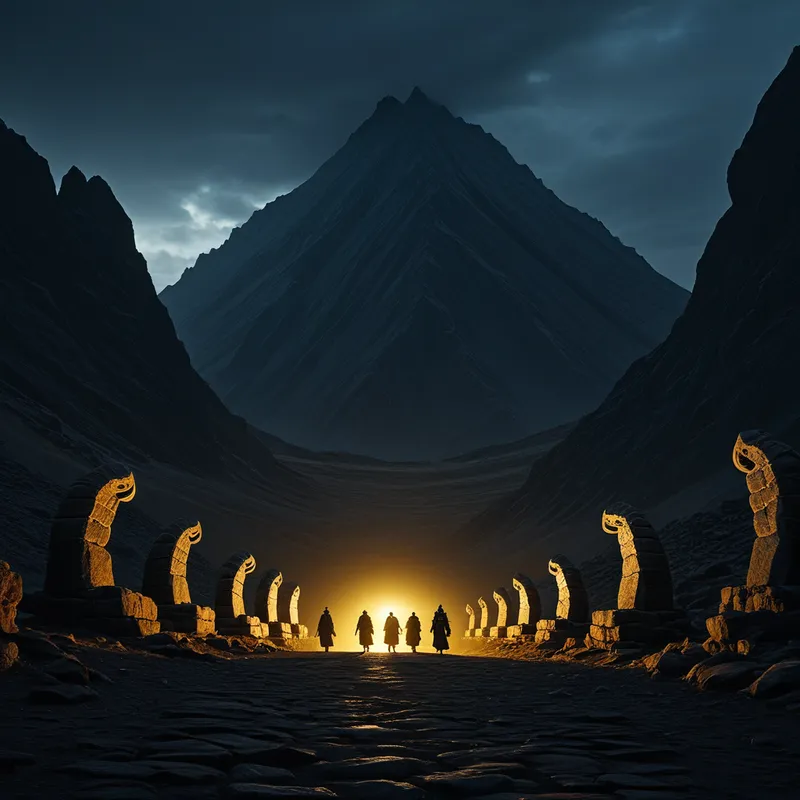
Before the first breath of dawn, the world lies still, wrapped in the velvet cloak of Ningal. In the deep east, where the earth meets the sky in a jagged line of impossible mountains, there is a gate. This is Mashu, and its guardians are not of stone or metal, but of flesh and terror: the Scorpion-men, whose gaze is death and whose tails hold the sleep of eternity. They wait in the profound silence, knowing what must come.
Then, a tremor. Not in the earth, but in the fabric of the dark itself. A soundless hum builds, a pressure behind the great gates. The Scorpion-men bow their fearsome heads, not in fear, but in awe. The gates of Mashu do not swing open—they dissolve in a torrent of liquid gold.
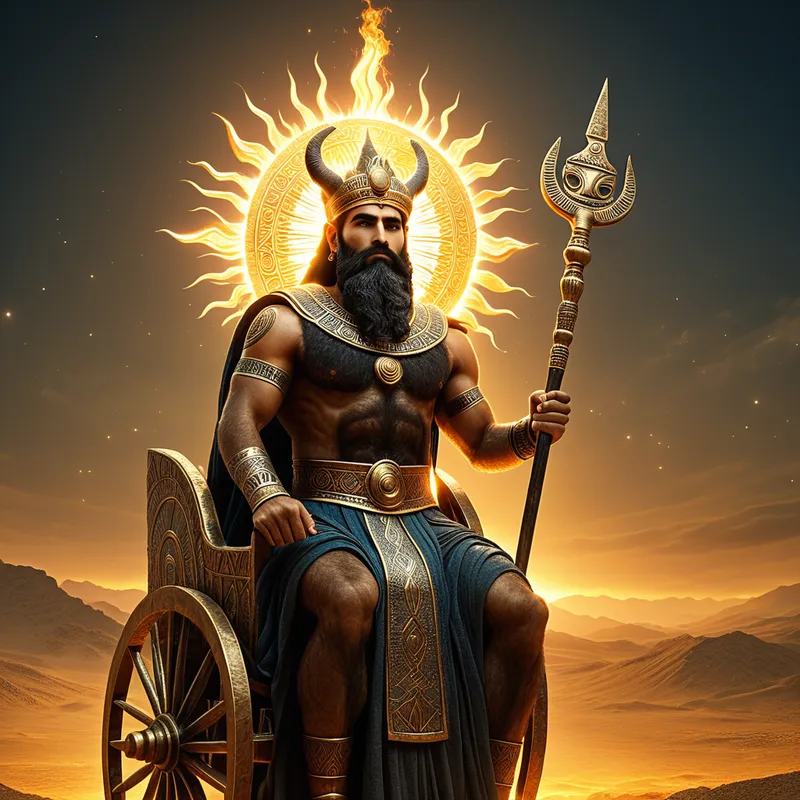
He emerges. Shamash. Not walking, but borne aloft in a chariot that is not wood and bronze, but pure, harnessed fire. The steeds that pull it are the winds of the east, their manes streaming comet-tails of incandescence. His face is the face of law itself: severe, radiant, impossible to look upon directly. In one hand, he carries the saw-toothed sword that cleaves deception; in the other, the rod and ring, the eternal measures of truth and fairness.
His ascent is a battle. The clinging tendrils of night, the labmu of the deep, grasp at his wheels. The mountain peaks themselves seem to strain to hold him back, to keep the comfort of the unknown dark. But Shamash does not fight with fury; he advances with the terrible, inevitable weight of a verdict. Light pours from him, not as a gentle glow, but as a conquering flood. It scours the shadows from the valleys, chases the creatures of gloom into their hidden holes, and strikes the dewdrops on the grass, setting each one ablaze like a tiny, perfect mirror of his glory.
He climbs the vault of Anu, and at his zenith, he is the great arbiter. From this height, he sees all. The secret deal struck in a shadowed alley, the hidden kindness, the buried truth, the unspoken oath—nothing is obscured. His light is the great revealer, the bringer of facts into the open air where they must be weighed.
His work is not done with seeing. He descends, now toward the west, his light growing longer, richer, tinged with the copper of impending rest. He passes over the great river, the Burannu, turning it into a ribbon of molten metal. He blesses the righteous and his gaze falls heavily upon the wicked, a palpable heat of judgment. As he approaches the western mountains, his journey seems to slow. The light softens, bleeding into oranges and purples. He does not die; he enters the Netherworld, becoming its judge for the night, illuminating even that land of dust with his unwavering justice, before beginning the cycle anew at the gates of Mashu.
Cultural Origins & Context
This myth was not merely a story to explain the sunrise; it was the operating system for a civilization built on law and agriculture. The figure of Shamash was central to the Old Babylonian period (c. 1894–1595 BCE) and beyond, with his primary cult center at Sippar, the “city of the sun.” His myth was inscribed on clay tablets in cuneiform, recited by priests (kalu), and embedded in daily rituals.
The societal function was multifaceted. For the king, Shamash was the divine model of kingship—the ultimate source of the me (divine decrees) that legitimized royal authority and the law codes, such as the famous Code of Hammurabi, which was depicted as being received from the seated god. For the common person, Shamash was the witness. Oaths were sworn in his name, contracts were sealed under his eye, and appeals for justice in legal disputes were made directly to him. His daily journey mirrored the ideal of a life and a society moving from the darkness of chaos and falsehood into the illuminated order of truth and righteous judgment.
Symbolic Architecture
Shamash is the archetypal principle of [consciousness](/symbols/consciousness “Symbol: Consciousness represents the state of awareness and perception, encompassing thoughts, feelings, and experiences.”/) itself. He is not the creative fire of inspiration nor the nurturing light of growth, but the clear, discerning, and often merciless light of [awareness](/symbols/awareness “Symbol: Conscious perception of self, surroundings, or internal states. Often signifies awakening, insight, or heightened sensitivity.”/). His [journey](/symbols/journey “Symbol: A journey in dreams typically signifies adventure, growth, or a significant life transition.”/) from the eastern gate (Mashu) to the western gate (the Netherworld) maps the full arc of a conscious [life](/symbols/life “Symbol: The symbol of ‘Life’ represents a journey of growth, interconnectedness, and existential meaning, encompassing both the joys and challenges that define human experience.”/): the heroic [emergence](/symbols/emergence “Symbol: A process of coming into being, rising from obscurity, or breaking through a barrier, often representing birth, transformation, or revelation.”/) of ego from the unconscious (the [mountain](/symbols/mountain “Symbol: Mountains often symbolize challenges, aspirations, and the journey toward self-discovery and enlightenment.”/)/[underworld](/symbols/underworld “Symbol: A symbolic journey into the unconscious, representing exploration of hidden aspects of self, transformation, or confronting repressed material.”/)), the [zenith](/symbols/zenith “Symbol: The highest point in the sky or life’s peak moment, representing spiritual culmination, achievement, and divine connection.”/) of rational [clarity](/symbols/clarity “Symbol: A state of mental transparency and sharp focus, often representing resolution of confusion or attainment of insight.”/) at [midday](/symbols/midday “Symbol: The peak of the sun’s daily journey, representing clarity, exposure, and the height of activity or consciousness.”/), and the necessary return and [integration](/symbols/integration “Symbol: The process of unifying disparate parts of the self or experience into a cohesive whole, often representing psychological wholeness or resolution of internal conflict.”/) with the shadowy [depths](/symbols/depths “Symbol: Represents the subconscious, hidden emotions, or foundational aspects of the self, often linked to primal fears or profound truths.”/) of the psyche at [night](/symbols/night “Symbol: Night often symbolizes the unconscious, mystery, and the unknown, representing the realm of dreams and intuition.”/).
The sun god does not create the world; he renders it knowable. His light is the faculty of discrimination, separating truth from falsehood, right action from wrong, the seen from the unseen.
The [Scorpion](/symbols/scorpion “Symbol: A venomous arachnid symbolizing danger, hidden threats, and potent transformation. Often represents repressed anger or deep-seated fears.”/)-men symbolize the terrifying thresholds of consciousness. To bring something into the light of awareness, one must first pass the guardians of the deep—the [resistance](/symbols/resistance “Symbol: An object or tool representing opposition, struggle, or the act of pushing back against external forces or internal changes.”/), the fear, the potentially paralyzing [truth](/symbols/truth “Symbol: Truth represents authenticity, honesty, and the quest for knowledge beyond mere appearances.”/) that has been repressed. They are the psyche’s own [defense](/symbols/defense “Symbol: A protective mechanism or barrier against perceived threats, representing boundaries, security, and resistance to external or internal challenges.”/) mechanisms, which must be acknowledged and passed for genuine [illumination](/symbols/illumination “Symbol: A sudden clarity or revelation, often representing spiritual awakening, intellectual breakthrough, or the dispelling of ignorance.”/) to occur. The rod and ring are the symbols of measured judgment, representing the need for consciousness to not merely see, but to evaluate and bring things into right [relationship](/symbols/relationship “Symbol: A representation of connections we have with others in our lives, often reflecting our emotional state.”/).
The Dreamer’s Resonance
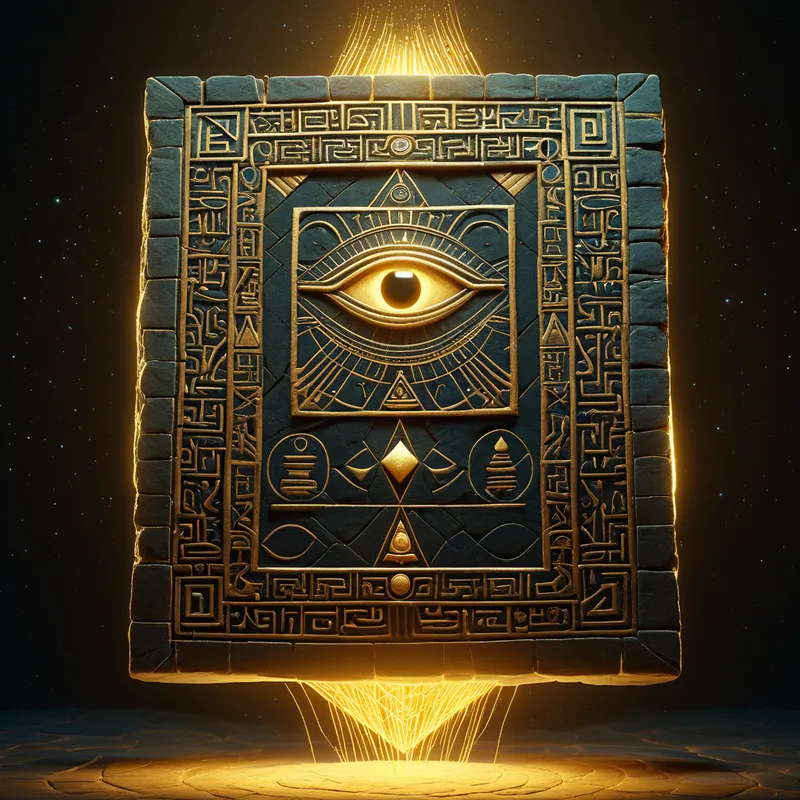
When the pattern of Shamash arises in modern dreams, it often signals a profound psychological process of illumination and judgment. This is not about external legalities, but an internal, somatic reckoning.
One might dream of a blinding light revealing a hidden room in a familiar house, exposing forgotten or shameful objects. Or dream of standing on a high peak under a searing sun, feeling utterly exposed, with nowhere to hide one’s faults. The body may respond with heat, sweating, or a feeling of being “pinned” or scrutinized. These dreams point to a moment where the psyche’s own integrative function—the inner Shamash—is activating. It is forcing into consciousness that which has been kept in the dark: a self-deception, a buried guilt, an ignored truth about one’s life direction, or a demand for inner justice where one has been unfair to oneself or others. The process can feel violent and uncomfortable, as true seeing often is.
Alchemical Translation
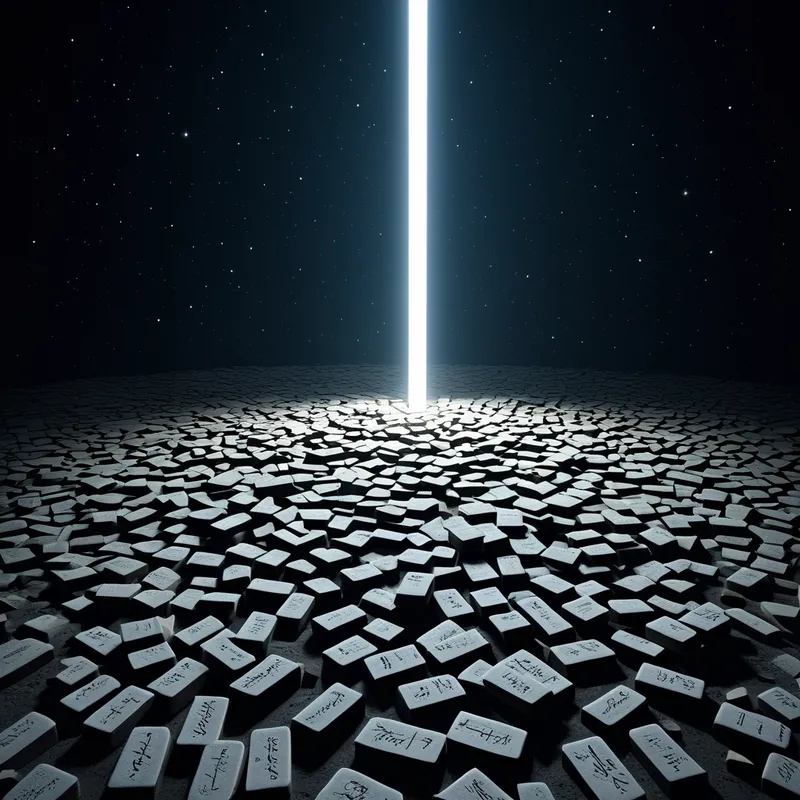
The alchemical work modeled by Shamash is the opus of separatio and solutio—separation and dissolution under the radiant light of the sol (sun). The modern individual’s journey of individuation requires this solar function. We must become our own Shamash, undertaking the daily discipline of the ascent.
First, we must confront our personal Scorpion-men—the fears and complexes that guard the gates to deeper self-knowledge. Passing them, we emerge into a more conscious stance (the ascent). At the zenith, we practice self-reflection—shining the light of honest awareness on our motives, actions, and shadow aspects without flinching. This is the judgment seat, where we weigh our own soul with the rod and ring of integrity.
The ultimate goal is not to live in perpetual, scorching noon, but to integrate the cycle. The descent into the Netherworld is crucial. It represents the conscious engagement with the unconscious, bringing the light of understanding into our own depths, dreams, and repressed material, thereby judging and integrating them, not leaving them in chaotic darkness.
The triumph is a psyche in order, where the inner ruler—the conscious ego—governs not through tyranny, but through the enlightened, just, and unwavering application of self-truth. One becomes a vessel for the me of one’s own existence, a living code of personal law aligned with a greater cosmic order.
Associated Symbols
Explore related symbols from the CaleaDream lexicon:
- Sun — The central symbol of Shamash himself, representing conscious awareness, divine truth, illuminating judgment, and the cyclical nature of revelation and introspection.
- Light — The active principle of Shamash’s power, symbolizing revelation, clarity, the dispelling of ignorance, and the unavoidable exposure of what is hidden.
- Justice — The core domain of Shamash, representing the cosmic and psychological principle of balance, right measure, truth, and moral order emerging from clear sight.
- Mountain — Represents the threshold (Mashu) between the conscious and unconscious, the formidable challenge that must be crossed for illumination to begin.
- Gate — The point of emergence and return, symbolizing critical transitions, passages into new states of awareness, and the guardianship of psychic boundaries.
- Journey — The eternal daily path of the sun, mapping the necessary cycle of psychological emergence, zenith, and reintegration for holistic growth.
- Order — The result of Shamash’s reign, symbolizing the structure, law, and cosmic harmony established and maintained by conscious discernment.
- Shadow — That which is chased and revealed by Shamash’s light, representing the repressed, unseen, or denied aspects of the self that demand integration.
- Truth — The ultimate product of Shamash’s gaze, representing objective reality, fidelity to fact, and the foundational principle upon which justice is built.
- God — The archetypal form of Shamash, representing the transcendent principle of sovereign consciousness, ultimate authority, and the numinous power of law.
- Vision — The capacity granted by Shamash’s light, representing insight, foresight, and the ability to see things as they truly are, beyond illusion.
- Circle — The perfect shape of the sun’s disk and its daily path, symbolizing wholeness, completion, eternal return, and the cyclical nature of psychological processes.