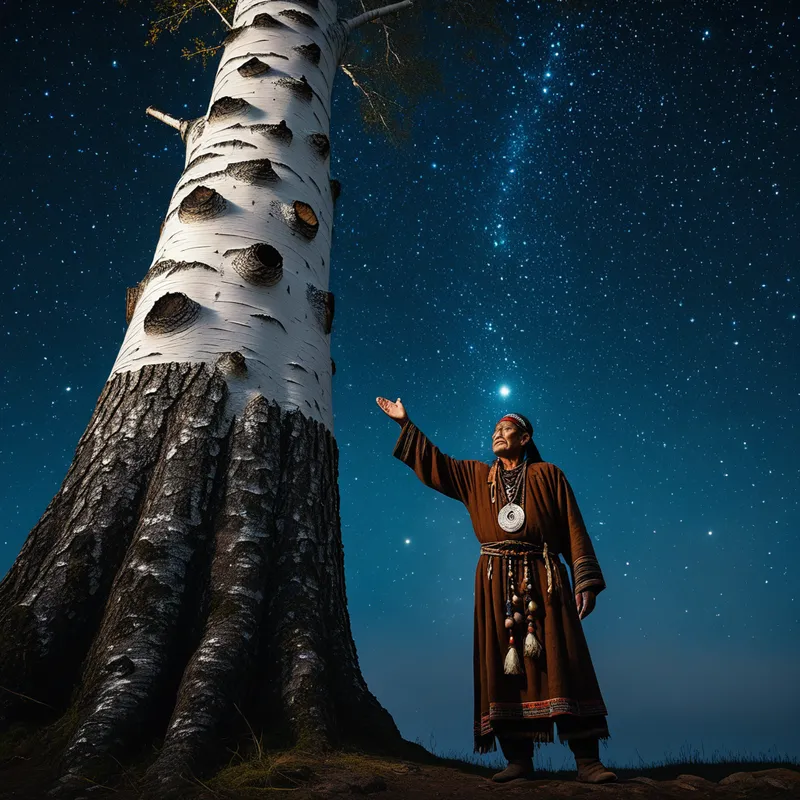
Shamanic Journey Myth Meaning & Symbolism
A mythic narrative of a chosen one's perilous descent into the spirit world, their ritual dismemberment, and rebirth as a conduit between realms.
The Tale of Shamanic Journey
Listen. In the time when the world was thin, and the breath of the spirits frosted the larch trees, a sickness fell upon the people. It was a sickness of the soul, a great forgetting that separated them from the animals they hunted and the rivers that gave them life. The world grew silent. The drums were still.
In this silence, a child was born under a strange star. He was different—sensitive, prone to fits, seeing shapes in the smoke where others saw only ash. The people whispered. When he came of age, a great lethargy seized him. He fell into a sleep so deep they thought him dead. But his spirit was not sleeping. It was called.
A mighty tuŋgur, a great horned eagle-spirit, descended from the Upper World. Its shadow covered the sun. With talons of lightning, it snatched the young man’s soul from his limp body and carried him upward, through the cold, thin air, to the crown of the World Tree. There, amidst branches of crystal and nests of cloud, the spirits of sky and storm scrutinized him. They found him wanting. “He is too heavy with earth,” they thundered, and cast him down.
He fell not to the familiar forest, but through it, down into the roots of the World Tree, into the Underworld. Here, the light was the color of deep water. Grotesque and helpful spirits swarmed him—the fish-headed people, the guardians of decay. They led him to a boggy clearing where the Khans of the Underworld sat on thrones of black stone.
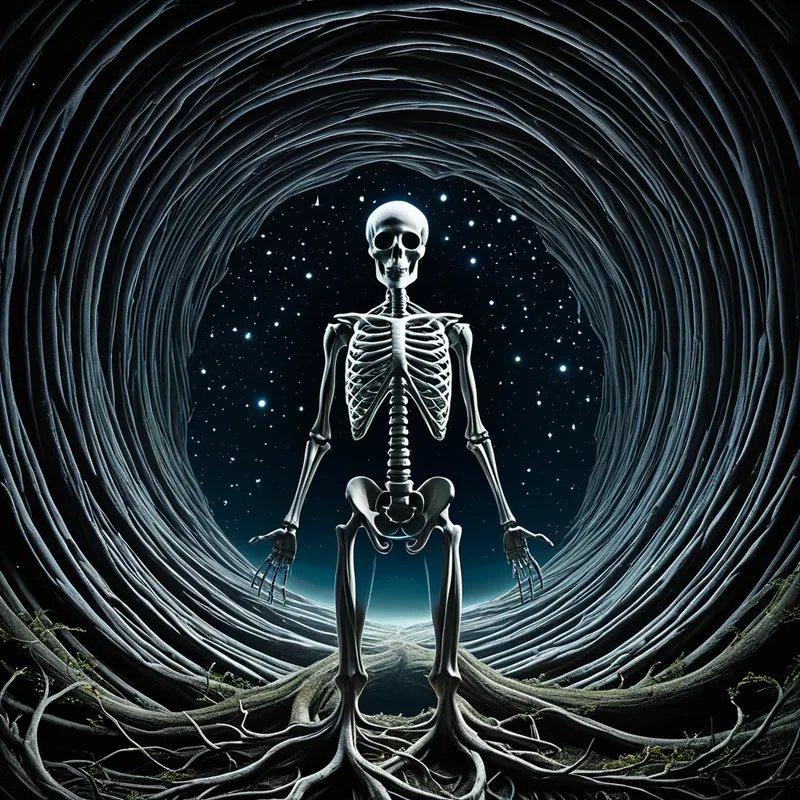
Without ceremony, they took him apart. This was the Great Dismemberment. Knives of flint and obsidian, wielded by invisible hands, separated his joints. His bones were scraped clean, washed in the icy water of the subterranean river. His eyes were replaced with pools of quartz. His organs were examined, the sickness burned away with spiritual fire, and new ones, forged from iron and gifted by animal spirits, were placed within his hollowed frame. His skull was opened, and the old mind was emptied like a cup of stale water. For three days and three nights, he was a scattered puzzle upon the moss.
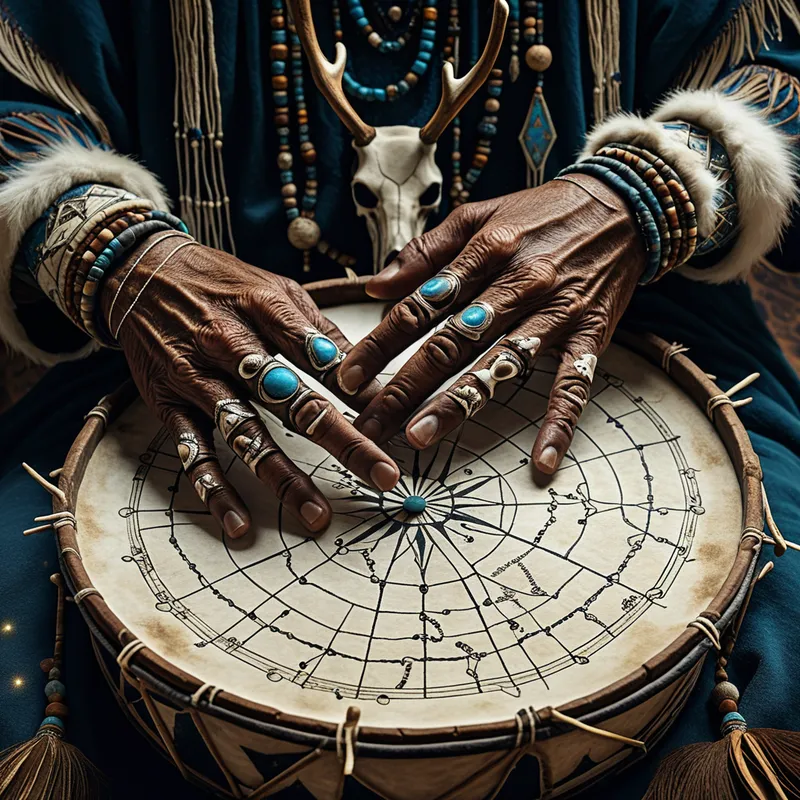
Then, the humming began. It was the sound of the drum, a heartbeat from the world above. Guided by this call, the spirits reassembled him. But he was no longer just a man. His ribs were fused with iron rings. His vertebrae were strung with the vertebrae of a bear. In his chest cavity, they placed a crystal that held the light of the Upper World and the memory of the Lower. He was sewn back together with sinews of power.
He awoke in his tent, gasping. But the world was not as it was. He could hear the thoughts of the reindeer herd on the wind. He could see the illness in a person as a dark smoke. He could journey, at will, by the beat of the drum he now knew how to make, riding its sound up the World Tree or down into the roots. He was broken, and in the breaking, was made whole. He was no longer just of the people. He was the bridge. He was the shaman.
Cultural Origins & Context
This foundational narrative is not a single story from one tribe, but a core mythic pattern woven through the many Indigenous cultures of Siberia—from the Evenki and Khakas to the Nanai. It was not merely entertainment; it was a sacred etiology, explaining the origin of the shaman’s terrifying power and their ambiguous role in society. The tale was passed down orally, often by shamans themselves or elders during long winter nights, serving as both a map for future initiates and a societal contract for the community.
The shaman was the ultimate specialist in crisis, called upon for healing, divination, and soul-retrieval when the normal order failed. This myth legitimized their often-antisocial behavior (the “shamanic sickness”) and their profound, hard-won knowledge. It established that their authority came not from human hierarchy, but from a direct, brutal encounter with the spirit world itself. The story functioned as a living doctrine, reminding all that the cosmos is layered, interactive, and that maintaining balance requires a guide who has walked the edges of annihilation.
Symbolic Architecture
The myth’s power lies in its stark, universal symbolism of death and rebirth. The journey is not a conquest, but a surrender to a process of utter deconstruction.
The path to wholeness first passes through the valley of fragmentation. One must be unmade to be remade correctly.
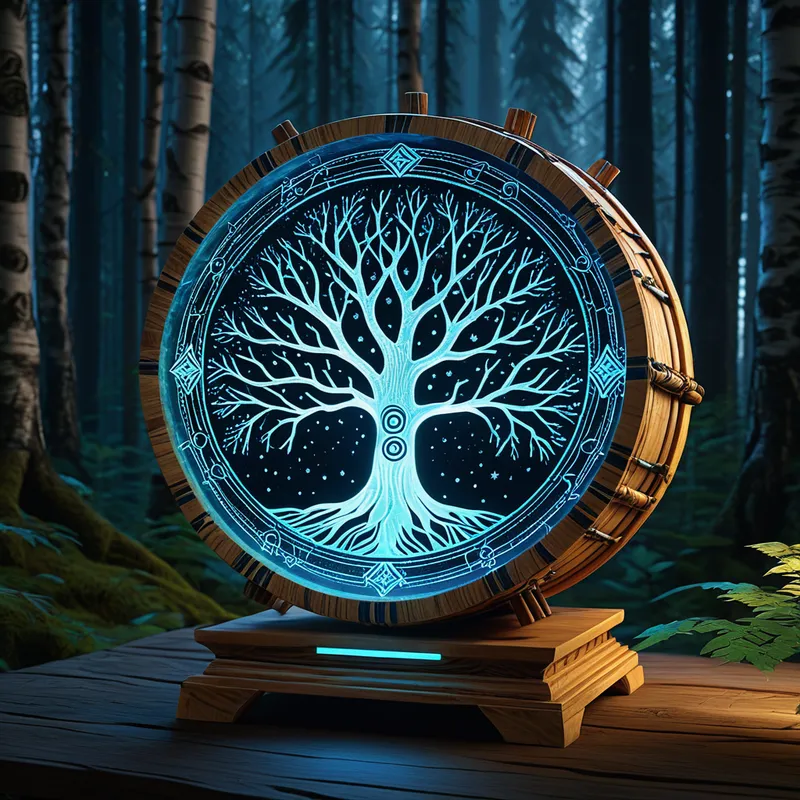
The World Tree is the central axis of reality, the psychic spine connecting the conscious (Upper World), the personal unconscious (Middle World), and the collective unconscious (Underworld). The shaman’s ascent and descent represent the necessity of exploring all levels of experience. The initial rejection by the Upper World spirits signifies that spiritual bypass—seeking only the “light” without integrating the “shadow”—is futile.
The core of the transformation is the Dismemberment. This is not punishment, but a radical initiation. It represents the complete dissolution of the old, egoic personality—its attachments, identities, and pathologies. The scraping of the bones is the stripping down to the essential, core Self. The replacement of organs with iron and crystal symbolizes the infusion of the psyche with transcendent, durable qualities—resolve (iron) and clarity (crystal). The shaman is reassembled as a conscious artifact, a living symbol of integration.
The Dreamer’s Resonance
When this mythic pattern stirs in the modern dreamer, it signals a profound psychic initiation underway. Dreams of catastrophic bodily destruction—teeth falling out, bones breaking, being taken apart—often evoke terror. Yet, in the shamanic framework, these are not portents of literal doom, but somatic metaphors for a necessary psychic deconstruction.
The dreamer may feel a profound “shamanic sickness” in waking life: a depression, a burnout, a sense of being alienated from their own life, a calling towards something undefined that disrupts their normal functioning. This is the spirit’s summons. Dreams of descending into caves, basements, or murky waters mirror the journey to the Underworld, where shadow material and ancestral patterns demand attention. Dreams of flight or climbing immense structures echo the ascent, the search for higher perspective or meaning.
The process is somatic because the psyche uses the body as its canvas. The feeling of being “pulled apart” by life’s demands or internal conflicts is the literal experience of the myth. The dreamwork is the soul’s attempt to navigate this involuntary initiation towards a more authentic, empowered configuration of the Self.
Alchemical Translation
For the modern individual pursuing individuation—the Jungian process of becoming psychologically whole—the shamanic journey is the ultimate allegory. Our culture lacks formal rites of passage, so the psyche creates its own through life crises: the end of a relationship, the loss of a career, a spiritual emergency, a deep depression. These are our calls to journey.
The alchemical vessel is not the comfortable life, but the crucible of crisis. Within it, the lead of the old self is subjected to the heat of suffering, until it transmutes into the gold of conscious awareness.
The first step is the Call, which often feels like a sickness of soul, a divine discontent. We must, like the shaman, heed it, even if it means entering a period of confusion and withdrawal (the Fall). The Dismemberment is experienced as the painful but necessary breakdown of outdated self-concepts, compulsive behaviors, and inherited narratives. It is the “dark night of the soul.” This is not something to be avoided, but endured with the knowledge that it is purposive.
The Reassembly is the conscious work of integration. We take the insights from our “underworld” (shadow work, facing trauma) and our “upper world” (expanded perspectives, spiritual insights) and forge a new personality structure. We install “iron” boundaries and resilience, and “crystal” clarity of purpose. We become our own bridge—integrating body and spirit, conscious and unconscious, personal and archetypal. We may not become community shamans, but we become the conscious stewards of our own inner cosmos, capable of navigating its depths and heights, and of bringing back “healing” in the form of greater authenticity, creativity, and connection to the living world. The drum we learn to beat is the rhythm of our own attentive, courageous heart.
Associated Symbols
Explore related symbols from the CaleaDream lexicon: