Seventh Plague of Egypt Myth Meaning & Symbolism
A cataclysmic storm of fire and hail descends upon Egypt, a divine judgment that shatters the land but leaves the human heart of Pharaoh unmoved.
The Tale of Seventh Plague of Egypt
Hear now of the day the sky broke open. The air, once the breath of Ra, grew thick and heavy, a woolen blanket smothering the Two Lands. In the court of Pharaoh, a silence louder than war drums had settled since the river ran red and the frogs came. The word of YHWH, spoken through the stammering prophet Moses and his brother Aaron, hung in the air like a promise of ruin: Let my people go.
But the heart of Pharaoh was a stone sunk deep in the riverbed of his own pride. The god-kings of Egypt did not bend. They were the axis of the world, sons of Horus. To yield was to unravel creation itself.
Then came the morning without dawn. A greenish bruise bloomed in the west, swallowing the stars. Moses stood before the granite face of power, his staff not a scepter but a witness. He stretched his hands toward heaven, and heaven answered.
It began as a whisper, a sigh from the furnace of the firmament. Then a rumble, deep as the earth’s bones grinding. The first hailstone struck the white plaster of a courtyard like a fist of god. It did not melt. It was ice, but ice forged in a celestial fire, its core a captured ember that hissed and spat upon the earth. Then another fell. And another.
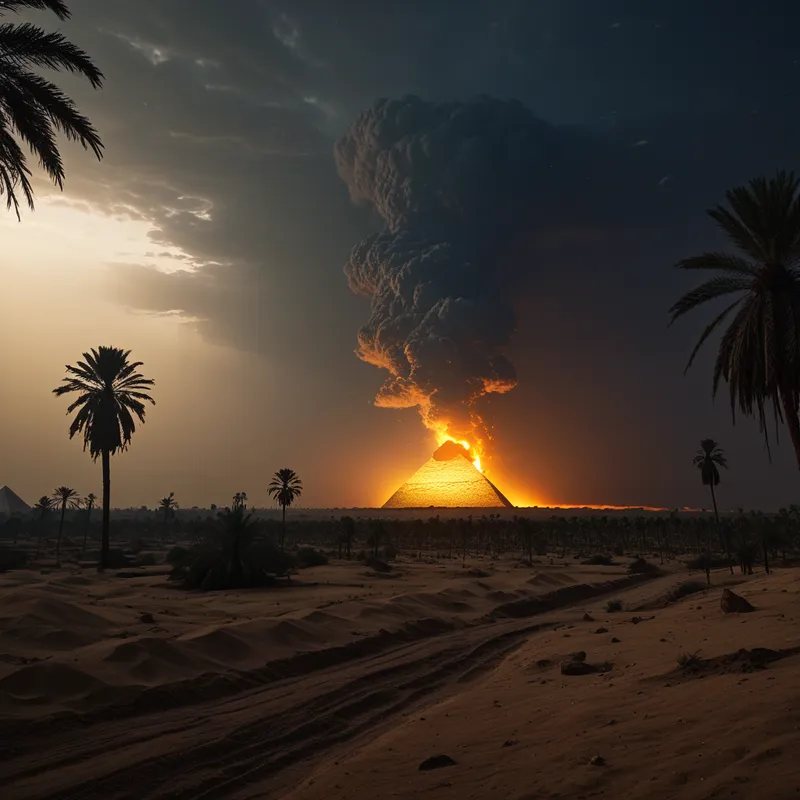
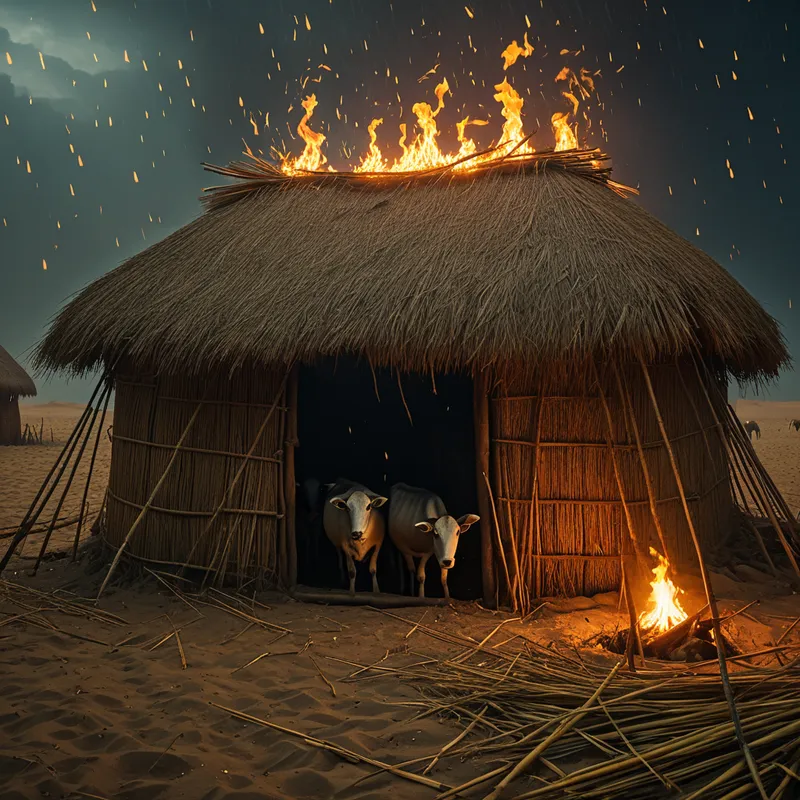
The sky unraveled into a screaming tapestry of ice and flame. Stones of frozen rain, some as large as a man’s head, wrapped in licking tongues of fire, plummeted in a deafening roar. They shattered the flax, just risen from the fields, into pulp. They smashed the barley, heavy with promise, into the mud. They found the fig and the vine and the pomegranate and left only splintered skeletons. They struck the cattle in the field, the ox and the donkey, and their bellows were cut short by the terrible, wet crunch of divine artillery.
In the fields, those who had not heeded the warning—for the servants of Pharaoh who feared the word of YHWH had brought their beasts and slaves inside—were caught in the open. The sound was not of rain, but of the world breaking. The air smelled of ozone, scorched earth, and a strange, metallic cold. Lightning walked the ground in blue-white veins, and thunder was not a sound but a physical pressure, a hammer on the anvil of the land.
And in the land of Goshen, where the children of Israel dwelled, there was no hail. The storm raged at the border like a beast on a chain. There, the sun still hinted behind the smoke. Here, only the quiet terror of watching a world end next door.
Pharaoh, from within his palace of stone, heard the cataclysm. He sent for the brothers. His face, when they stood before him, was the color of ash. “I have sinned this time,” he said, the words torn from him. “YHWH is in the right, and I and my people are in the wrong. Plead with YHWH to end this thunder and hail. I will let you go; you will stay no longer.”
Moses went out from the city and spread his hands. And as suddenly as it began, the fury ceased. The rain stopped. The hail no longer fell. The fire retreated into the clouds. The silence that followed was more terrifying than the noise.
And Pharaoh, feeling the sun again on his skin, seeing the broken world but his own throne intact, felt his heart congeal once more. The stone, momentarily cracked, fused itself with a new, harder resolve. He looked upon the ruin, and he did not let them go. The sky was silent, but the rebellion in the human heart roared on.
Cultural Origins & Context
This narrative is embedded within the Book of Exodus, a foundational text of the Israelite nation formed during the Babylonian Exile (6th century BCE) but drawing on oral traditions centuries older. It was not a tale told for mere historical record, but a sacred story of identity and theology, recited during Passover and other communal rituals. Its tellers were priests and scribes, crafting a national epic that defined their people as those chosen and liberated by a sovereign God.
The societal function was multifaceted. For a people often under the heel of empires, it was a narrative of empowerment and justification, explaining their unique covenant with YHWH. The plagues, specifically, served a profound theological purpose: they were not random punishments but targeted de-creations, systematic dismantlings of the Egyptian cosmic order. Each plague confronted a specific aspect of the Egyptian pantheon and Pharaoh’s own divine kingship. The Seventh Plague took aim at the sky gods—Nut, Set, and the fertility they governed—demonstrating YHWH’s absolute dominion over the very forces Egypt worshipped. It was a story that forged resilience, teaching that liberation is often preceded by cataclysm, and that the hardest chains to break are not of iron, but of ideology and pride.
Symbolic Architecture
The Seventh Plague is a myth of radical duality and divine paradox. It presents a storm that is both ice and fire, destruction and revelation, a message of unparalleled clarity that falls on willfully deaf ears.
The hail wrapped in fire is the ultimate symbol of the coniunctio oppositorum—the union of opposites—turned destructive. It is the unbearable truth that shatters the comfortable, half-grown world.
The fire represents the purifying, penetrating judgment of the divine will, the searing truth that cannot be ignored. The hail, cold and crushing, symbolizes the hardened, frozen resistance of the ego, the petrified structures of a life built on false foundations. Together, they are the catastrophic collision between an emerging consciousness (the demand for freedom) and an entrenched, rigid identity (Pharaoh’s Egypt). The land of Goshen, spared, represents the nascent Self, the protected inner space where a new way of being is being nurtured, even as the old personality structures (Egypt) are violently dismantled.
The core psychological figure is Pharaoh’s hardened heart. This is not merely stubbornness; it is a profound archetypal resistance. Each time the heart is offered a chance to soften through suffering, it chooses, paradoxically, to harden further. This represents the ego’s terrifying commitment to its own known world, even a world of misery, over the terrifying uncertainty of change and surrender. The plague devastates the external landscape—the “crops” of his pride and power—but leaves the inner citadel of the heart untouched and more fortified than ever. It is a stark portrait of the psyche’s capacity for self-imprisonment.

The Dreamer’s Resonance
When this myth stirs in the modern dreamer, it often manifests as dreams of apocalyptic weather—freak storms, fire raining from the sky, or being caught in a cataclysm of opposing elements. Somaticly, one may awaken with a feeling of constriction in the chest, a literal “hardening,” or a sense of being pummeled.
Psychologically, this dream pattern signals a critical impasse in the individual’s process of growth. The “Pharaoh” within—the ruling complex of the psyche, perhaps a rigid career identity, a toxic relationship pattern, or a long-held dogma—is being confronted by an insistent, life-giving demand for freedom (the “Moses” archetype). The fiery hail represents the overwhelming, contradictory forces now unleashed by the unconscious: searing insights that also feel crushing, passionate urges that are frozen in fear. The dreamer is in the field, exposed. The warning to “bring things inside” was the ignored intuition, the dismissed therapy session, the unread book that could have offered shelter.
The process is one of necessary devastation. The dream says the half-measures, the “flax and barley” of superficial growth, are being shattered so that something rooted deeper may eventually grow. The terror is real, for the dream-ego is witnessing the violent end of a world it helped build. The crucial question the dream poses is: Will you, like Pharaoh, behold the ruin and still refuse to let go, hardening your heart anew with excuses and rationalizations? Or will you begin the fearful journey toward your own Goshen?

Alchemical Translation
The alchemical journey mirrored here is the nigredo—the blackening, the utter dissolution of the old matter. It is the stage of mortification and despair, essential for any true transmutation.
The plague is the massa confusa of the soul thrown into the athanor of crisis. The fire and hail are the opposing mercurial forces that must reduce the ego’s pretensions to ash and powder before the work of reconstruction can begin.
For the modern individual, the “Egypt” is the totalitarian rule of the persona and the conscious ego, a land of slavery that promises security. The demand to “let my people go” is the Self’s insistent call toward individuation. The series of plagues are the successive life-crises, failures, and depressions that gradually dismantle this false kingdom. The Seventh is often the pivotal, most devastating crisis—the failed marriage, the collapsed career, the spiritual bankruptcy—where the opposites rage openly.
The alchemical secret lies in the spared land of Goshen. Even in the midst of the psyche’s apocalypse, there is a space held for the future Self. This is the part of us that can witness the storm without being fully identified with the Pharaoh’s doomed court. The work is to consciously inhabit that Goshen—through journaling, art, therapy, or sincere reflection—to “bring your beasts inside,” that is, to protect your nascent instincts and vulnerable feelings from the destructive narrative of the hardened heart.
The ultimate transmutation is not the defeat of Pharaoh, but the liberation of the Israelite within—the nascent, authentic spirit. The hardened heart is not to be defeated by force, but outlived. One must pass through the storm of fire and ice, allow the old identifications to be shattered, and endure the terrifying silence that follows Pharaoh’s temporary relents. Only then can one walk out of the ruined landscape, through a sea parted not by magic, but by the unwavering commitment to a freedom finally chosen over a familiar prison. The Seventh Plague is the terrible, beautiful, and necessary destruction that makes exodus possible.
Associated Symbols
Explore related symbols from the CaleaDream lexicon: